“He Wrote Her Every Day” reviewed by World War II Vet and author Allan Wilford Howerton

As a WW II combat veteran of the 84th Infantry Division (Railsplitters), serving in the same unit as the subject of this book, I [Allan Wilford Howerton] was honored to be asked to read and react to the manuscript of He Wrote Her Everyday prior to its publication.


Note from Blog host: the 84th Infantry Division landed on Omaha Beach, November 1 – 4, 1944, and fought in the Battle of the Bulge in December 1944 – January 1945.

Ms Lindenberg, in getting the story together, has made a grand contribution to the literature of World War II. In addition to a war story, it is a wonderful book about love, longing, and faithfulness under unimaginable hardship and uncertainty.

Anyone with an interest in World War II will like He Wrote Her Everyday. It tells, among many other things, a true story about the plight of replacements rushed to the front lines to augment units suffering heavy casualties in the Siegfried Line and the Battle of the Bulge.

I was there, an infantryman in the same division, but thankfully not a replacement. They were assigned, often in the middle of a battle, knowing no one and without buddies to rely on. Many became casualties but those who survived adjusted pretty rapidly and went on, like the subject of this book, to make major contributions during the drive across Nazi Germany to end the war.

Writing about war experience is difficult for those who experienced it first-hand.  It is nearly impossible for someone who wasn’t there to give a believable picture of how things really were.   Use of the letters written during the war gives this book a strong sense of the soldier’s walk through the snow.
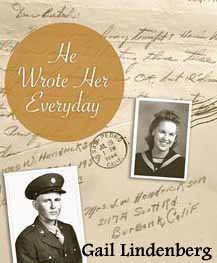
Cover for He Wrote Her Everday by Gail Lindenberg

HIGHLY RECOMMENDED. Allan Wilford Howerton, World War II veteran and the author of Dear Captain…

Continued on October 22, 2013 in a Question and Answer about the writing of “He Wrote Her Every Day” with author Gail Lindenberg

_______________________

Lloyd Lofthouse, this blog’s host, is a former U.S. Marine and Vietnam Veteran.

His latest novel is the award winning suspense-thriller Running with the Enemy. Blamed for a crime he did not commit while serving in Vietnam, his country considers him a traitor. Ethan Card is a loyal U.S. Marine desperate to prove his innocence or he will never go home again.

And the woman he loves and wants to save was fighting for the other side.

To follow this Blog via E-mail see upper left-hand column and click on “FOLLOW!”

A surprise family reunion—Navy father returns home

Recently, I logged on to discover another story about a father serving in the United States Navy returning home after a six-month overseas deployment.

I’m a sucker for this genre of YouTube homecoming videos, because as I watch them I relieve that moment forty-seven years ago in December of 1966 when I returned home without warning at three in the morning after a combat tour in Vietnam. I wrote about my return in Coming Home. There was no YouTube back then.

It’s powerful moment to watch a family reunion when a military father or mother returns home from a dangerous war zone.  

However, this time I questioned why this homecoming should gain national attention in the media. What was unique about it?

Rachel Martin writing for Indiana News Center.com said, “First Class Petty Officer Scott McComas has been serving overseas on the island of Diego Garcia for the Navy Reserves. McComas says he’s been gone for a year, four times before.”

I was curious where he served the other four times. Maybe one or more of those deployments was in a more dangerous place than Diego Garcia.

The island of Diego Garcia is really remote and isolated.  It’s 1,970 nautical miles east of Africa, 967 nautical miles south-southwest of the southern tip of India and 2,550 nautical miles west-northwest of the West coast of Australia.

Princeton University Press says, “The American military base on the island of Diego Garcia is one of the most strategically important and secretive U.S. military installations outside the United States. Located near the remote center of the Indian Ocean and accessible only by military transport, the base was a little-known launch pad for the wars in Iraq and Afghanistan and may house a top-secret CIA prison where terror suspects are interrogated and tortured.”

In addition, the UK forcibly evicted/removed the 2,000 people who lived on Diego Garcia before the U.S. military moved in. Source: Global Post.com

For years I imagined the island of Diego Garcia was a desolate, freezing rock surrounded by nothing but a brutal, stormy ocean. Then I searched YouTube and discovered I was wrong—really wrong.

Diego Garcia is a tropical paradise with warm to hot temperature year around and if you watch the embedded video above you will discover breathtaking beaches and crystal clear water.

What about all the American troops who are serving in dangerous or risky overseas deployments? There are still 69,000 American troops fighting in Afghanistan; 15,000 are in Kuwait; 28,500 in South Korea not far from the threat of the lunatics in North Korea; 3,628 in Kyrgyzstan; 2,714 in Bahrain, and 806 in Qatar.  Source: U.S. Deployments Overseas

In fact, the vast majority of Navy deployments are at sea on Naval ships and submarines inside metal hulls. Some of those deployments are in dangerous waters like the Persian Gulf, the Gulf of Aden or the Red Sea.

Then again, maybe it was the uniqueness of that Indiana corn-maze that made this homecoming a worthy news item, and it really had nothing to do with a Navy father coming home from a tropical paradise. And it’s cute to watch a young daughter throw herself in her daddy’s arms because he’s been away from home for six months.

_______________________

Lloyd Lofthouse is a former U.S. Marine and Vietnam Veteran.

His latest novel is the award winning suspense-thriller Running with the Enemy. Blamed for a crime he did not commit while serving in Vietnam, his country considers him a traitor. Ethan Card is a loyal U.S. Marine desperate to prove his innocence or he will never go home again.

And the woman he loves and wants to save was fighting for the other side.

To follow this Blog via E-mail see upper left-hand column and click on “FOLLOW!”

Ignorance of PTSD might be dangerous: Part 2 of 2

It’s been forty-seven years since I served in Vietnam, and over those years, the few times I’ve been in threatening situations, my thoughts are not of running away or breaking down in tears of fear. Instead, I’m thinking of the fastest way I can kill the person I perceive as a threat. If I’m close enough, I’ll be looking at his throat thinking about digging my teeth in and tearing out his jugular.

In the film “Patton”—played by George C. Scott—there is a scene where the general explodes in anger at troops who were in military hospitals suffering from severe PTSD—known as battle fatigue or shell shock back then.  The violence they had experienced had traumatized them severely. But General Patton thought anyone who suffered from PTSD was a coward and a fake.

I think that Russell Ireland, who owns the Big I’s Restaurant in Oxford, Massachusetts, is evidently an uneducated throw back to that World War II era, who does not think a war veteran suffering from PTSD deserves the same respect as a vet who lost body parts and probably also suffers from PTSD.

To Ireland’s way of thinking—just like General Patton—if the injury isn’t physical, it doesn’t count. For example, missing body parts.

I never know when my PTSD is going to flare or what may trigger it. When I’m awake, I’m always vigilant of my surroundings watching for threats.

 At night and early morning hours I often wake up and see enemy combatants in the darkness—they seem real but I’ve experienced this so many times over the decades that I often stare at them and maybe use a flashlight I keep by my bed to make sure it isn’t real before I can go back to sleep.  And by my side is a .45 caliber Glock automatic with a loaded magazine.  In the closet is a pump shotgun. In the gun safe are more weapons and boxes of ammo.

I did not buy these weapons to go hunting. I bought these weapons so I could sleep at night knowing I was prepared for the unexpected that my PTSD keeps reminding me is out there. Watching the daily news also doesn’t help so I avoid it most of the time. Before Vietnam, I read newspapers. After Vietnam, I stopped reading them. Newspapers are filled with reminders of crimes and violence in the United States that may trigger PTSD symptoms.

PTSD wasn’t recognized until the 1980s and then vets started to receive help from the VA.  I have carried the dark shadow of my PTSD with me since 1966 and didn’t get any help from the VA until after 2005 when I discovered that I was eligible.

And ignorant idiots like Russell Ireland don’t have any idea about the time bomb they may be triggering when they confront a vet with combat induced PTSD. He may have been fortunate that James Glaser had his trained service dog by his side.

By the way, it’s been forty-seven years since I served in Vietnam and I haven’t killed or physical attacked anyone yet. As for Dr. Phil, I’ve never been impressed by his show. It’s more of a shock and awe thing promoted by Oprah [she’s the billionaire who owns the show] while Dr. Phil acts the guru to an ignorant mob of fools—Dr. Phil’s net worth is estimated to be $200 million or more earned from his show.

Return or start with Ignorance of PTSD might be dangerous: Part 1

_______________________

Lloyd Lofthouse is a former U.S. Marine and Vietnam Veteran.

His latest novel is the award winning suspense-thriller Running with the Enemy. Blamed for a crime he did not commit while serving in Vietnam, his country considers him a traitor. Ethan Card is a loyal U.S. Marine desperate to prove his innocence or he will never go home again.

And the woman he loves and wants to save was fighting for the other side.

To follow this Blog via E-mail see upper left-hand column and click on “FOLLOW!”

Ignorance of PTSD might be dangerous: Part 1 of 2

Charlene Sakoda writing for Odd News reported that James Glaser, a retired Air Force veteran, who served in Iraq, was forced to leave a restaurant with his service dog trained to help him keep his PTSD under control.

Glaser called the police and the officer who responded to the call failed to convince the owner of the restaurant that the dog was legitimate. Russell Ireland, the owner of the restaurant, said, “Get that fake service dog out of my restaurant.”

When the police officer said the papers the vet carried on him proved the dog was not fake, Ireland said, “I don’t give a [expletive]”.

Ireland was an ignorant and biased fool. It seems that even Dr. Phil is one of those ignorant fools [watch the following video to see what I mean].

CNN reported that violence is a growing problem among vets with PTSD. “Study after study has highlighted the struggles faced by troops returning home, including substance abuse, relationship problems, aggression or depression…”

And a PTSD service dog is trained to deal with and disarm a PTSD reaction to a situation.

My combat induced PTSD was rated at 30% by the VA, and that was decided after a number of sessions with a VA counselor and Q&A sessions with other VA counselors and shrinks. And I’ve met a vet with a 100% PTSD disability who suffered much worse in Vietnam. Just the sound of a helicopter flying overhead caused him to suffer an awake flashback in daylight [click on A Prisoner of War for Life to discover more].

Suffering from a PTSD flashback does not mean vets turn into a mass of quivering cowardly jello. In fact, the opposite may happen. I’ll explain in Part 2.

Continued on September 24, 2013 in Ignorance of PTSD might be dangerous: Part 2

_______________________

Lloyd Lofthouse is a former U.S. Marine and Vietnam Veteran.

His latest novel is the award winning suspense-thriller Running with the Enemy. Blamed for a crime he did not commit while serving in Vietnam, his country considers him a traitor. Ethan Card is a loyal U.S. Marine desperate to prove his innocence or he will never go home again.

And the woman he loves and wants to save was fighting for the other side.

To follow this Blog via E-mail see upper left-hand column and click on “FOLLOW!”

Sun Tzu’s “The Art of War”: part 10 of 10

On the third day of Gettysburg during Picket’s charge up another hill, only 5,000 survived of 12,000 troops.  Sun Tzu would have been horrified.

Sun Tzu says, “When troops flee, are insubordinate, collapse or are routed in battle, it is the fault of the general.”

Sun Tzu sees a commanding general as someone intelligent and cunning and never rash or arrogant, which is the opposite of the commander of the Chu army more than two thousand years ago.

Sun Tzu won the war against Chu, which had an army ten times larger than his. He did this through preparation, deception and indirect attacks.

After winning the war against Chu, Sun Tzu retires and writes The Art of War.

The first line of Sun Tzu’s rules of war says, “War is a matter of vital importance to the State. It is a matter of life and death, survival or ruin.

Return to Sun Tzu’s “The Art of War”: Part 9 or start with Part 1

View as Single Page

_______________________

Lloyd Lofthouse is a former U.S. Marine and Vietnam Veteran.

His latest novel is the award winning suspense-thriller Running with the Enemy. Blamed for a crime he did not commit while serving in Vietnam, his country considers him a traitor. Ethan Card is a loyal U.S. Marine desperate to prove his innocence or he will never go home again.

And the woman he loves and wants to save was fighting for the other side.

To follow this Blog via E-mail see upper left-hand column and click on “FOLLOW!”

Sun Tzu’s “The Art of War”: part 9 of 10

Sun Tzu says if the orders are unclear, it is the fault of the commanding general.

General Lee told one of his generals to “Attack when you think it is practical.”  That general decides it isn’t practical and does nothing.

At the Battle Gettysburg, Lee did not give clear orders.

Robert E. Lee made a tactical mistake when he did not follow Sun Tzu’s rule to “Move only when you see an advantage and there is something to gain. Only fight if a position is critical.”

Sun Tzu says, “When the enemy occupies high ground, do not confront him.  If he attacks downhill. do not oppose him.”  Robert E. Lee didn’t listen and decides to attack the Union positions on the high ground.

General Longstreet disagrees.  He does not want to attack the high ground.  Instead, he wants to go around the Union Army toward the North’s capital, Washington D.C.

Sun Tzu says, “There are some armies that should not be fought and some ground that should not be contested.”

After two days of horrible losses, Robert E. Lee orders what’s left of his army to attack uphill a third time.  General Longstreet urges Lee not to do this. Lee ignores him.

Continued on September 18, 2013 in Sun Tzu’s “The Art of War”: Part 10 or return to Part 8

View as Single Page

_______________________

Lloyd Lofthouse is a former U.S. Marine and Vietnam Veteran.

His latest novel is the award winning suspense-thriller Running with the Enemy. Blamed for a crime he did not commit while serving in Vietnam, his country considers him a traitor. Ethan Card is a loyal U.S. Marine desperate to prove his innocence or he will never go home again.

And the woman he loves and wants to save was fighting for the other side.

To follow this Blog via E-mail see upper left-hand column and click on “FOLLOW!”

Sun Tzu’s “The Art of War”: Part 8 of 10

Sun Tzu says you must behave like the snake.  When your enemy attacks, you must be flexible.

Throughout the invasion of Normandy, France, Sun Tzu’s rules of war guide the Allies to victory. The Allies used deception, foreknowledge, and a superior command structure that motivated the army to fight as one.

Sun Tzu says, “The winning army realizes the conditions for victory first then fights. The losing army fights first then seeks victory.”

More than two thousand years before the Battle of Normandy, the battle between the kingdoms of Wu and Chu raged on.

Even with a smaller army, Sun Tzu is not worried. He has split his army. While the Chu army is surrounding his smaller force, the main part of his army is moving toward the unprotected Chu capital.

The Chu commander turns from the smaller Wu force under Sun Tzu’s command and rushes back to save the capital.

Sun Tzu says, “No nation has ever benefitted from prolonged war.”  The American Civil War is Sun Tzu’s nightmare scenario. Possibly the wars in Iraq and Afghanistan are the same since so many of Sun Tzu’s rules of war have been ignored.

Sun Tzu says, “Those skilled in war bring the enemy to the field of battle. They are not brought by him.” This will happen to General Robert E. Lee in 1863.

Continued on September 16, 2013 in Sun Tzu’s “The Art of War”: Part 9 or return to Part 7

View as Single Page

_______________________

Lloyd Lofthouse is a former U.S. Marine and Vietnam Veteran.

His latest novel is the award winning suspense-thriller Running with the Enemy. Blamed for a crime he did not commit while serving in Vietnam, his country considers him a traitor. Ethan Card is a loyal U.S. Marine desperate to prove his innocence or he will never go home again.

And the woman he loves and wants to save was fighting for the other side.

To follow this Blog via E-mail see upper left-hand column and click on “FOLLOW!”

Sun Tzu’s “The Art of War”: Part 7 of 10

During the invasion of Normandy, the allies survived on death ground exactly as Sun Tzu predicted by fighting together and never giving up.

Another reason the Allies succeeded during D-day was another of Sun Tzu’s rules of war. He said, “It is essential for victory that generals are unconstrained by their leaders.”

The allied command structure gives total authority to General Eisenhower as supreme commander.

However, Germany under Hitler did not have the same command structure.

Hitler had set up a confusing system of overlapping authority so no one had total control over the military leaving Hitler the only one who made final decisions.

Hitler’s command structure is a perfect example of what Sun Tzu says about “no interference from the leader”.

The allies in France are bogged down in difficult terrain. The combat losses are horrible and little progress is made.

The solution is found in Sun Tzu’s rules of war. “Make your enemy prepare on his left and he will be weak on his right.”

The allies will follow this rule.

Continued on September 11, 2013 in Sun Tzu’s “The Art of War”: Part 8  or return to Part 6

View as Single Page

_______________________

Lloyd Lofthouse is a former U.S. Marine and Vietnam Veteran.

His latest novel is the award winning suspense-thriller Running with the Enemy. Blamed for a crime he did not commit while serving in Vietnam, his country considers him a traitor. Ethan Card is a loyal U.S. Marine desperate to prove his innocence or he will never go home again.

And the woman he loves and wants to save was fighting for the other side.

To follow this Blog via E-mail see upper left-hand column and click on “FOLLOW!”

Sun Tzu’s “The Art of War”: Part 6 of 10

Sun Tzu says, “It is essential to seek out enemy agents who have come to spy against you and bribe them to serve you.” In The Art of War, double agents are the most important spies.

That is what the Allies did in World War II before the Normandy Invasion of France. No one used double agents better than the British did.

Britain turned almost every spy Germany sent during the war.  These double agents made the Germans believed the invasion would take place at Pas de Calais and not Normandy.

Sun Tzu says, “The way a wise general can achieve greatness beyond ordinary men is through foreknowledge.” The allies had foreknowledge because they broke the German code and knew what the Germans were thinking and planning.

Sun Tzu would have praised the allied preparation for the invasion and the use of deception but he would have condemned the actual assault.

Sun Tzu says, “When a falcon’s strike breaks the body of its prey, it is because of timing. When torrential water tosses boulders, it is because of momentum.”

Sun Tzu believes that the best attack can be ruined if momentum is lost, and he would have predicted the cost of lives during the Normandy invasion more than two-thousand years before it took place.

Continued on September 9, 2013 in Sun Tzu’s “The Art of War”: Part 7 or return to Part 5

View as Single Page

_______________________

Lloyd Lofthouse is a former U.S. Marine and Vietnam Veteran.

His latest novel is the award winning suspense-thriller Running with the Enemy. Blamed for a crime he did not commit while serving in Vietnam, his country considers him a traitor. Ethan Card is a loyal U.S. Marine desperate to prove his innocence or he will never go home again.

And the woman he loves and wants to save was fighting for the other side.

To follow this Blog via E-mail see upper left-hand column and click on “FOLLOW!”

Sun Tzu’s “The Art of War”: Part 5 of 10

It is about 500 BC in China and Sun Tzu’s hit-and-run campaign against the state of Chu is working.  The Chu prime minister is starting to lose support and the moral of his troops is dropping.

Throughout the countryside of Chu, there is fear of where Sun Tzu will strike next. When the larger Chu army threatens one of Sun Tzu’s allies, Sun Tzu uses another rule of war, “To move your enemy, entice him with something he is certain to take.”

Then, when his own forces are surrounded, Sun Tzu says, “Put the army in the face of death where there is no escape and they will not flee or be afraid – there is nothing they cannot achieve.” See The Long March

What happened to Sun Tzu when his small army was surrounded also happened on June 6, 1944 when allied troops in World War II invaded Europe during D-day.

Sun Tzu says, “All warfare is deception. If you can deceive your enemy before battle, you are more likely to win.”

That’s what General Eisenhower did before the invasion of Normandy. To succeed, the allies used deception to convince the Germans the attack would not take place in Normandy.

Continued on September 4, 2013 in Sun Tzu’s “The Art of War”: Part 6 or return to Part 4

View as Single Page

_______________________

Lloyd Lofthouse is a former U.S. Marine and Vietnam Veteran.

His latest novel is the award winning suspense-thriller Running with the Enemy. Blamed for a crime he did not commit while serving in Vietnam, his country considers him a traitor. Ethan Card is a loyal U.S. Marine desperate to prove his innocence or he will never go home again.

And the woman he loves and wants to save was fighting for the other side.

To follow this Blog via E-mail see upper left-hand column and click on “FOLLOW!”