I’m currently watching The Walking Dead, season three on DVD, and the main character’s son—Carl—who isn’t even a teenager, has become an efficient killing machine of both humans and zombies.
But that isn’t what this post is about because The Walking Dead is fiction.
In this post, I am writing nonfiction for someone who has no voice. We now know that many who grow up to be racists, criminals and killers were victims of parental neglect, but this post isn’t about that either. [Turning Children into Killers]
This post is about George Sandefur—a smoker who died from an aggressive form of lung cancer—and I have not forgotten one story he told me at lunch one day when we were alone in the staff lounge.
At the time, he taught math and I taught English at Giano Intermediate School in La Puente, California and it was the early 1980s. He had the classroom next to mine. George told me this story a few years before the lung cancer took him.
You see, George served in the U.S. Army in the Korean War [1950 – 1953]. He told me about one patrol on a cold day. The narrow trail they followed clung to the side of a steep mountain he didn’t know the name of.
George brought up the rear and from his vantage point saw several young Korean children coming their way. None of these kids could have been over ten. The rest of American patrol had gone around a fold in the mountain and couldn’t see the children.
George stopped. He sensed something was wrong, and when he saw the machine gun strapped to the back of a little girl, he knew that the other troops in his patrol were walking into a trap and certain death.
He was the only one who had a clear shot, so he pulled the trigger.
It turned out those kids were heavily armed with explosives and the machine gun. All that little girl had to do was lean over so the seven or eight-year-old boy standing behind her could pull the trigger to kill the US troops.
George took lives that day but also saved lives, and he was left with a mental scar that followed him the rest of his life.
That one defining moment changed who George was and how he saw the world.
His latest novel is the award winning suspense-thriller Running with the Enemy. Blamed for a crime he did not commit while serving in Vietnam, his country considers him a traitor. Ethan Card is a loyal U.S. Marine desperate to prove his innocence or he will never go home again.
And the woman he loves and wants to save was fighting for the other side.
To follow this Blog via E-mail see upper left-hand column and click on “FOLLOW!”
In the early 1980s, I was working toward an MFA and one of my courses was a self-directed project monitored by a faculty adviser. The project was my memoir of fighting in the Vietnam War. A few years after completing the memoir, I took it to UCLA Extension’s Writers’ Program where the professor convinced me to convert it into fiction—a suspense thriller. The professor was a woman, who later helped find a literary agent to represent my novel.
I spent several years in the program with her as my advisor, and the final product after endless revisions and feedback from the professor and other authors in the program was “Running with the Enemy”. It was fiction but true to my experience of war and its horror.
Fast forward to publication and then June 11, 2013 when a reviewer by the name of “S” posted a 2-star review on Amazon—a review I’m actually proud of.
S concluded her review with: “I was sucked in by the nitty gritty feng shui of the book, then repelled by the over use of sexual violence and testosterone dousing. Even though the ending was predictable, I still liked that the good guys won and the bad guys lost. However, the limited roles by the female characters left me feeling that half the story still lies buried and voiceless.”
I’m proud of that 2-star review because the book I wrote was about the war I fought in—not the story S wanted me to write that would have been a lie. In the 1960s, the only American women who served in Vietnam that I knew of were nurses and they did not serve in combat units. There were no women in my battalion. Not one.
What I think S wanted was to see women kicking the shit out of men and beating the men at war. But that wasn’t my Vietnam. Tuyen, the only major woman character in the novel—the others were minor characters—was a half breed, a Eurasian, who had been sexually and physically abused by her half-brother since she had been a young girl.
If you have ever seen the film or the stage play of “Miss Saigon”, you might understand how women are still treated today in Southeast Asia and when that woman was a Eurasian like Tuyen, the treatment was worse, and the term for her was Bụi đời, the “dust of life”.
In fact, “Life was frequently difficult for such Amerasians [and Eurasians]; they existed as pariahs in Vietnamese society. Often, they would be persecuted by the communist government and sometimes even sold into prostitution as children.” [Benge, Michael (22 November 2005). “The Living Hell of Amerasians”. Front Page Magazine]
I think what “S” wanted from me as an author was to write a story that would fit a world she wanted—one that didn’t exist in my world. She wanted a kick-ass female character.
The latest example of this popular political correctness demanding that history and literature be rewritten may be found in the film “The Hobbit: The Desolation of Smaug”. Tauriel is a female elf who is a kick ass super warrior. The problem is that in the original Hobbit written by J. R. R. Tolkien, there are no major women characters and another fire-breathing modern day feminist—another S—also wanted the plot of this novel rewritten when made into film.
This revisionist was Nicole Lyn Pesce writing for the New York Daily News who said, “The women’s rights movement has made it to Middle-earth. The first ‘Hobbit’ film was criticized by some—like me—for its testosterone-heavy cast, so director Peter Jackson has brought in a kick-ass chick for the sequel.”
Does this mean we should rewrite history due to a modern, popular, political-correct movement? I don’t think so.
My novel was a man’s story just like “The Hobbit” was written by a man. In fact, you may want to read an essay about how J.R.R. Tolkien’s service in the British Army during World War I may have influenced his fiction. [JRR Tolkien and World War I by Nancy Marie Ott]
If Tolkien were alive today, would modern feminists be criticizing him for not including kick-ass women warriors in his novels, who didn’t exist in his day as they didn’t exist in mine?
I have news for “S”. If she had read my novel to the end, she would have discovered Tuyen kicking some serious male ass in the Golden Triangle near the conclusion of the novel. In that scene, Tuyen is so violent she even shocks the kick-ass recon Marine who loves her. Maybe Tuyen just didn’t kick enough male asses to satisfy S or someone like Nicole Lyn Pesce.
Here’s a bit of advice for today’s modern day feminists. Don’t wish for something you know little to nothing about. Take it from someone who has seen war up close and personal, you really don’t want to go there. If men are willing to go to war and die to protect women from that horror, let them.
_______________________
Lloyd Lofthouse is a former U.S. Marine and Vietnam Veteran.
His latest novel is the award winning suspense-thriller Running with the Enemy. Blamed for a crime he did not commit while serving in Vietnam, his country considers him a traitor. Ethan Card is a loyal U.S. Marine desperate to prove his innocence or he will never go home again.
And the woman he loves and wants to save was fighting for the other side.
To follow this Blog via E-mail see upper left-hand column and click on “FOLLOW!”
I didn’t read the posts, because I was more interested in rating America’s performance as the self-proclaimed world’s police force? To do that, I compiled a death count from all the wars, civil wars, revolutions, and genocides since the end of World War II, and I’m sure it is an incomplete list.
It was difficult to come up with a precise number so there are two numbers and the actual number of deaths could be anywhere between the low and high estimates.
1945 – 1950: The expulsion of Germans after World War II was called a population transfer but in reality it turned out to be an ethnic cleansing. The death count was 500 thousand – 3 million
1950 – 1953: Korean War. The death count 400 thousand – 4.5 million
1955 – 1975: Vietnam War. The death count was 800 thousand – 3 million
1965 – 66: Indonesian massacre of anyone connected to the Indonesian Communist Party. The Death count was 100 thousand to 2 million.
1967 – 1970: Nigerian Civil War and genocide. The death count was 1 – 3 million
1971: Bangladesh genocide. The death count was 26,000 – 3 million
1975 – 1979: Cambodian Genocide. The death count was 1 – 3 million; another 800 to 950 thousand died of starvation. The only reason this tragedy ended was because Communist Vietnam invaded and stopped the insanity. Where was the United States? Why did it take one communist country to stop another one from slaughtering its own people?
1975 – 80: Operation Condor in South America was a campaign of political repression by right-wing dictatorships sponsored by the United States. The death count was 50 – 80 thousand.
1979 to Present: Afghan Civil War. The death count is 1.5 – 2 million
1980 – 1988: Soviet War in Afghanistan. The death count was 600 thousand – 2 million
1980 – 1988: Iran–Iraq War. The death count was 500 thousand – 2 million
1983 – 85: Famine in Ethiopia. The death count was 400 thousand – 1 million
1990 – 98: Sanctions against Iraq imposed by the United Nations Security Council that caused excess deaths of young children 175 – 576 thousand
1994: Rwandan genocide death count 500 thousand – 1 million
1998 – 2003: Second Congo War’s death count 2.5 – 5.4 million dead
1998: Sudan famine. Death count was 70,000
After I compiled the list, I thought, what exactly has the United States accomplished to bring about world peace and save lives as the world’s so-called cop? Maybe the world would have been better off if the United States had stayed home and saved a few trillion dollars.
If you want to know how much the United States spends as the world’s so-called cop, visit data360.org to discover that answer, but you may have to spend an hour or so adding it all up. I wanted to find one number but could only find annual lists.
Last year, the world’s top 15 military spenders spent $1.753 Trillion combined, but 39% of that was the United States. The People’s Republic of China was number two at only 9.5% of the total. I found this information from a List of countries by military expenditures on Wiki.
I think that if a real cop in the United States had a similar record, they would be suspended from active duty followed by an investigation and then—for sure—a trial.
Do you think the citizens of the United States should vote in the next Presidential election on America continuing its job as the world’s so-called cop? After all, every American who pays taxes is footing the bill so shouldn’t all the citizens of a democracy have a say?
And of course this brings up another question: Is the United States really a democracy?
_______________________
Lloyd Lofthouse is a former U.S. Marine and Vietnam Veteran.
His latest novel is the award winning suspense-thriller Running with the Enemy. Blamed for a crime he did not commit while serving in Vietnam, his country considers him a traitor. Ethan Card is a loyal U.S. Marine desperate to prove his innocence or he will never go home again.
And the woman he loves and wants to save was fighting for the other side.
To follow this Blog via E-mail see upper left-hand column and click on “FOLLOW!”
As the war ends in Afghanistan, the federal government should cut at least 250,000 civilian jobs at the Department of Defense [DOD] and return that department’s annual budget to $400 billion or less.
Time Magazine reported[worth reading to discover how spending got out of control at the DOD], “From 2001 to 2012, the active duty military grew by just 3.4 percent. Yet over the same timeframe the number of civilian defense employees grew by 17%, an increase five times greater than the armed forces.”
Here’s my first suggestion to cut the federal budget—start by cutting back the number of civilian contractors who develop and build weapons for the US military.
Second, does the US really need the same number of aircraft carriers as every other nation on the planet combined? China, for example, has one twenty-two-year-old, non-nuclear powered second-hand aircraft carrier, and we hear more about that aircraft carrier in the US media—as of it was a threat to world security—while the U.S. has ten in active service and one in reserve with three more under construction. The only other country with more than one aircraft carrier is Italy and they have two.
The newest aircraft carrier is the Gerald R. Ford, and it cost $13 billion to build with two more to follow—the contracts for the other two should be cancelled saving $26 billion or more.
The U.S. has ten active carriers. The rest of the world combined also has ten, but only France has one that is nuclear powered. All the US carriers are nuclear powered and they are larger—much larger.
Why does the US need such expensive firepower? Where’s the threat?
I’m not going to argue with anyone that the US needs a strong military because at heart I am a hawk who loves what the US is doing as it continues to develop modern weapons second to none in the ability to search out enemies and destroy them—and I think the Gerald R. Ford is way cool, but do we need it? The Gerald R. Ford is an incredible weapon but who was it designed to fight—aliens from another planet?
For god’s sake, we are fighting a gang of international fundamentalist Islamic thugs known as al Qaeda and they don’t even have one aircraft carrier—they don’t even have a country. And the only way they can get an aircraft of any kind is to steal them like they did on 9/11.
Lloyd Lofthouse is a former U.S. Marine and Vietnam Veteran.
His latest novel is the award winning suspense-thriller Running with the Enemy. Blamed for a crime he did not commit while serving in Vietnam, his country considers him a traitor. Ethan Card is a loyal U.S. Marine desperate to prove his innocence or he will never go home again.
And the woman he loves and wants to save was fighting for the other side.
To follow this Blog via E-mail see upper left-hand column and click on “FOLLOW!”
Rick Newman writing for Yahoo Finance suggests that President Obama could redeem himself for the Obamacare Mess, if he killed part of the government.
If you click on the Yahoo-Newman link above and read the piece, you will discover there is no mention of cutting jobs at the Department of Defense [DOD]. The cuts Newman suggests are so small compared to the annual deficit and size of the national debt, it’s hard not to laugh and cry real tears at the absurdity of it.
Newman points out: “The federal payroll, not counting the beleaguered postal service, is about 8% bigger than it was before the latest recession began at the end of 2007.”
The question Newman should have asked is where did civilian employment in the federal government increase the most, but he didn’t. Instead, he quotes a source that says that in the 1980s, the private sector got rid of an entire layer of middle management and suggests the government do the same thing. Then he points out a few small departments/agencies of the federal government with a combined budget of $81 – $185 Billion, but the federal budget for 2013 was $3.8 trillion and the actual deficit was $680 billion. You do the math.
What I want to know is why he didn’t mention the Department of Defense?
In May 2012, the Washington Times.com reported, “President Bush’s last budget, for fiscal 2009, pegged Defense Department civilians at 739,000, according to the department’s latest “Green Book” budget document on total spending.”
But if you check the numbers going back to 1962 comparing the ratio of civilian workers in the federal government to the total population, you would discover that the number of civilians working for the federal government has been dropping for years. The Washington Post.com reported that in 1962 under President Kennedy, 13.3% of the total US population worked for the federal government. By 2012—under President Obama—the federal workforce was 8.4% of the total even counting the 8% increase Newman complains about.
In addition, if we look closer, we discover that between June 2012 and September 2012, civilian workers employed by the federal government shrunk by 40,146 workers to 2,760,569—most of the jobs cut came from the DOD. Click the next link and check it out; you can see the number of workers added or cut by department. Source: opm.gov
In Part 2, I will focus on the Department of Defense—the only department that should see its civilian workforce and budget cut dramatically. In 2000 before 9/11, defense spending was $366.2 billion. By 2013, it had reached $821.6 billion. If we compare average annual defense spending by president starting with Clinton, we discover defense spending under Clinton averaged $335.6 billion annually for a total of $2.648 Trillion; under G. W. Bush the annual average was $605.5 billion with a total of $4.844 trillion, and under Obama, the first four years totaled $3.397 trillion or $849.2 billion annually. Source: US Government Spending.com
Do we ever hear Obama’s critics complain about his increased spending for the DOD? No, because we only hear about Social Security; Medicare and Obamacare—all programs designed to pay for themselves through specific taxes.
The increase in defense spending during the wars on terror; in Iraq and Afghanistan have cost the United States an additional $5.556 Trillion since 9/11.
Lloyd Lofthouse is a former U.S. Marine and Vietnam Veteran.
His latest novel is the award winning suspense-thriller Running with the Enemy. Blamed for a crime he did not commit while serving in Vietnam, his country considers him a traitor. Ethan Card is a loyal U.S. Marine desperate to prove his innocence or he will never go home again.
And the woman he loves and wants to save was fighting for the other side.
To follow this Blog via E-mail see upper left-hand column and click on “FOLLOW!”
My novel, “Running with the Enemy”, is being featured Sunday, November 10, at The Fussy Librarian, a new website that offers personalized e-book recommendations. Readers choose from 32 genres and indicate preferences about content and then the computers work their magic. It’s pretty cool — check it out! @ www.TheFussyLibrarian.com
Literary Awards for this novel:
Runner Up in General Fiction 2013 Beach Book Festival
Honorable Mentions in General Fiction 2013 San Francisco Book Festival 2013 Hollywood Book Festival 2013 New York Book Festival
Praise for “Running with the Enemy”
“Obviously drawn from the author’s first-hand experiences as a Marine serving in Vietnam,Running with the Enemy is a rough but occasionally heartfelt war story. … The book is sometimes too obviously drawn from his experience. But ultimately that’s a small complaint about a book that, on the whole, is quite good and has a lot to say about the nature of the conflict …” – 21st Annual Writer’s Digest Self-Published Book Awards commentary from an anonymous judge
“The author definitely has inlcuded vivid, entrancing descriptions of the country, the people and the military who served there. … It is an action-filled, intriguing story I will not forget soon.”
– 5-star review from KMT through a Library Thing Giveaway
“The fight/combat scenes are stunning, very realistic. … Betrayal, revenge, murder, and desperation make this a must read! … Very highly recommended.”
– 5-star review from Great Historicals
“This was quite a riveting but cruel story, not for the faint of heart. Well written with very graphic language and violent scenes but all-over, a very good suspense book.”
– 4.5-star review from Lynelle of (South Africa)
If you lived in a war zone, would you rather have dumb bombs or smart bombs dropped on targets?
Dylan Stableford—writing for Yahoo News—reported on a documentary about the fear and stress of life under the threat of U.S. drones, and I left this comment: “If people in countries where al Qaeda and the Taliban operate don’t like the U.S. drone attacks, then all they have to do is stop supporting Islamic terrorists and fight back against them so the U.S. troops will go home and take their drones with them.”
An anonymous, faceless person criticized my comment. His or her name was Win—who, as far as I know, could be an al Qaeda or Taliban PR person—wrote, “Lloyd, you sound like the typical dumbshit in government, underestimating how difficult it really is to do that. You are implying these people deserve what happened to them. If either you or me lost all that we have one day for absolutely no reason because some dumbshit from a foreign country willed that it happened to either one of us, I can guarantee, guaran-damn-tee that our blood would boil and our rage fueled.”
From Win’s comment it is obvious that he or she has little or no knowledge about the battlefield in countries where wars are fought. And I want to remind Win that we did not start this war for “absolutely no reason”. The war was started by Islamic Fundamentalist terrorists on 9/11 in New York City when they killed thousands of civilians by hijacking commercial jets full of passengers and ramming those jets into the World Trade Center and the Pentagon.
Now back to the question: If you lived in a war zone through no fault of your own and you didn’t want anything to do with the war, would you rather have dumb bombs or smart bombs used to hit targets in your country?
In World War II, for example, the United States killed millions of German and Japanese civilians bombing the cities in those countries with dumb bombs. Fleets of bombers flew over targets and dropped thousands—probably millions—of bombs without knowing exactly where those bombs would land and explode.
In fact, the United States dropped more dumb bombs on Vietnam, Laos and Cambodia than it dropped in all of World War II.
In World War II, civilian deaths in Germany are estimated to be between 1.5 to 3.5 million. In Japan, civilian deaths were 500-thousand to one million. In comparison, the United States—the country that dropped most of the dumb bombs that caused that collateral damage—only lost 1,700 of its own noncombatants.
To defeat Germany and Japan, the United States and its allies also dropped napalm on German and Japanese cities. In one bombing of Tokyo, for example, 2,000 tons of incendiary dumb-bombs were dropped over the course of 48 hours, and between 80,000 and 130,000 civilians were roasted to death in the firestorm that followed.
In Vietnam, the collateral damage was somewhere between 245,000 and two-million civilian deaths. But the United States didn’t drop dumb bombs only in Vietnam. The U.S. also dropped dumb bombs In Cambodia and Laos. In Cambodia the collateral damage was 200,000 to 300,000 civilian deaths. In Laos, the collateral damage from dumb bombs was 20,000 to 200,000 dead civilians—and millions were wounded.
Now, let’s focus on civilian casualty counts in the Iraq and Afghanistan Wars to see if the use of smart bombs to target enemy combatants resulted in reduced civilian casualties—that dirty word is known as collateraldamage.
Classified US military documents released by Wikileaks in October 2010 recorded that there had been 66,081 civilian deaths in Iraq over a period of six years. But the Iraq Body Count Project’s numbers are higher: 110,937 – 121,227.
When checking these numbers for Iraqi civilian deaths, there were no details on who did the killing and how these civilians died. And we know that al Qaeda blows up civilians all the time in the streets; on buses; in Mosques and Churches; in restaurants, at weddings and funerals, etc. Therefore, it’s easy to conclude that American smart bombs were not responsible for all of those deaths. In fact, reports from Afghanistan indicate that collateral damage from Western smart bombs is responsible for less than 10% of all civilian deaths.
One source I checked reported that “In the first six months of 2013, the United Nations Assistance Mission in Afghanistan counted 1,319 civilian deaths and 2,533 civilian injuries with 9% attributable to pro-government forces—this means that collateral damage from the West’s smart bombs may have only killed 119 civilians. Compare that to six months of civilian deaths during World War II in Germany or Japan or in Vietnam when the West was only using dumb bombs and often sent fleets of B52s to carpet bomb urban and rural areas.
That same report said, that in all of 2012, total civilian casualties were 2,754 deaths and 4,805 injured with 8% of those loses attributed to pro-government forces meaning that 92% of the deaths were caused by al Qaeda and/or the Taliban.
In conclusion, the United States is at war in Afghanistan with insurgent forces who started this war on 9/11—the same Islamic fundamentalists who have sworn to destroy Western civilization, and I’m convinced that they would not hesitate to use dirty bombs or nuclear weapons on Western cities like London, Paris, Berlin, Rome, New York, Washington D.C., Los Angeles, San Francisco, etc. killing millions of civilians without any effort to minimize the damage.
On April 11, 1880, General William Tecumseh Sherman, who played an instrumental role in defeating the South during America’s Civil War by ruthlessly destroying everything in his army’s path, said this in Columbus Ohio: “There is many a body here today who looks on war as glory, but boys, it is all hell.”
I fought in Vietnam as a field-radio operator in the United States Marine Corps. We had rules forced on us by civilian “dumb-shits” who said we couldn’t shoot at the enemy unless we could see who was shooting at us first. And most of the time, we couldn’t see who was shooting at us.
We lost the Vietnam War. We didn’t lose World War II.
If the West is going to win the war against al Qaeda and the Taliban, then the West must be as ruthless as it was in World War II, and if the West fails, then civilians will be dying in American and European cities by the millions.
General Sherman was right. War is hell, and if you are reading this and you do not live in a country that is a war zone like Iraq or Afghanistan, then you should bless your fortunate stars and pray that the war doesn’t come to your neighborhood.
No one who is innocent deserves to be killed from a bomb—dumb or smart—but as cruel as it sounds, “Better them then us.” And if you believe in coexistence, then I think you should be the one to—face-to face—convince al-Qaeda to stop killing innocent people.
_______________________
Lloyd Lofthouse is a former U.S. Marine and Vietnam Veteran.
His latest novel is the award winning suspense-thriller Running with the Enemy. Blamed for a crime he did not commit while serving in Vietnam, his country considers him a traitor. Ethan Card is a loyal U.S. Marine desperate to prove his innocence or he will never go home again.
And the woman he loves and wants to save was fighting for the other side.
To follow this Blog via E-mail see upper left-hand column and click on “FOLLOW!”
A: It certainly wasn’t my original plan. When I retired from teaching, I had no intention of writing anything. But when my mother handed me those letters, the book took shape quickly. I still feel as though my father is the real author of the book. It’s as though he stood over my shoulder the entire time.
2. Q: Is this a novel? You never refer to it as such.
A: I call it a “book” because it defies easy categorization. The genre would have to be “historical novel,” and yet that doesn’t quite work for me either. Dad’s letters are primary witness accounts of events as they happened. My mother’s interviews are her own memories, filtered by time and my reporting of what she said. The back-story of the war experiences is my fictional version of what I read in the letters and remember from my father’s stories.
3. Q: Did you have any other books to serve as a model for your writing?
A: Yes, but they were not war novels. I have never been interested in reading books about war time and my lack of depth in this area was a major weakness when I began. Margaret Atwood wrote a book called ALIAS GRACE. It is historical fiction and tells the story of a woman by using articles and public records about her. Her book made me realize that this book of Dad’s would actually work as a genre of literature. I was encouraged by her pattern of including original documents, her own research, and a back-story that, while it might not have happened, was entirely plausible. Just because it didn’t happen exactly as written does not mean that it isn’t true.
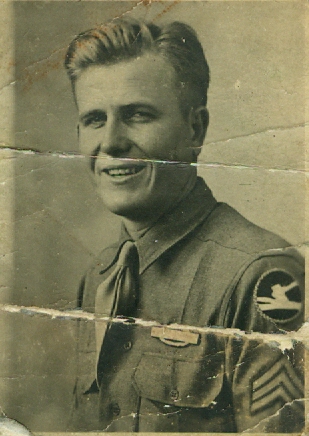
Staff Sergeant James William Hendrickson, Jr. 1945
4. Q: How long did it take you to complete the book?
A: I started scanning the letters at Christmas time in 2010. I read the letters as I scanned, and the idea for the story took root over the next few months.. I began the actual writing four months later. My goal was to complete the book in time for my Mother’s ninetieth birthday on December 8, 2012. Then I received a diagnosis of cancer. Surgery, chemo, and radiation treatment began in August of 2012. I printed a “rough draft” which was a hard-cover family version. Only twenty copies came off the press. Once I had recovered my faculties, such as they are, post chemo, I edited the book with the help of my Writer’s Workshop group. The book has been up on Amazon as a Trade Paperback and e-version since September of 2013.
5. Q: Your mother is a character in the book. What was your mother’s reaction to the story?
A: She says she feels like quite the celebrity. The book has received a very positive response, and she has heard from people from her home town as well as relatives and friends. She did say that she thought I was too hard on Grandma Hendrickson. And every time she reads a section through again, we have a conversation about that during our phone time. I still phone her every Saturday morning. She always tells me that my father would be very proud to read it…and we both laugh. We can see him shaking his head to think that his letters would be available to the world to read.
6. Q: How do you think your father would react to the book?
A: I can only hope that he would feel like it was a true depiction of who he was and who the men were who fought alongside him. Dad’s life was one of sacrifice for others. I think this is true of most men who serve their country, but especially so for the boys who fought in World War II out of conviction for a cause and a sense of duty. Dad wanted to bring his brother back from PW camp. He wanted to right a wrong. He lived his life by those convictions.
7. Q: Would you characterize this book as a romance more than a war novel?
A: I never saw it as a romance. These were just my parents. It was only after reading it aloud, six pages at a time, to my editing group that I had any sense at all that it would be perceived as such. One woman said, “Gail, I have fallen in love with your father.”
I do think that the history piece and the war story he tells might fall into the category of edging on being anti-war. But I have a strong notion that most men who go to war would like to be certain that their children will not have to. Dad’s idea was that this would be the war to end all wars.
The answer to your question should probably be that the book will be seen by the reader as they wish to view it. There are two history teachers I know of who are using the web site for the book with lesson plans to provide a research source for studies of WWII. And there are women who read it just to enjoy the story line provided by the strong relationship my parents were able to forge in war time.
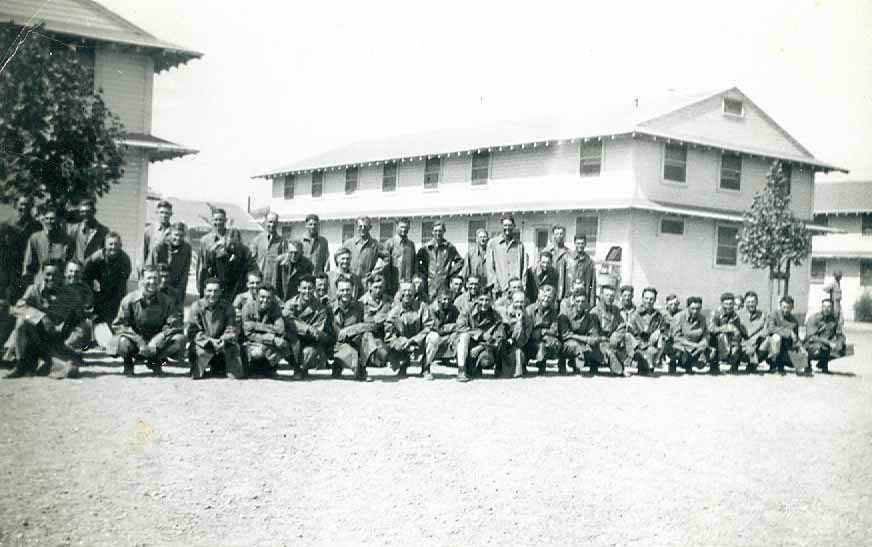
Camp Roberts, Burbank, California
8. Q: The link to your web site is included as a section in the book. Why is that?
A: When I wrote the first version, I scanned all the letters, pictures, etc. and copied them to a thumb drive for my family. As I was editing the final book, I realized that the graphics would make the book far too expensive for printing. Also, folks who read it before publication were, for the most part, interested in the letters. So I decided to set up a web site where people could go and find every letter, document, and photograph Mom saved from those two years of war time. HeWroteHerEveryDay.com is up and running for those who are interested.
9. Q: What kind of response have you gotten from people who have read your book? You mention that the response has been largely positive. Any negatives?
A: Yes, the response has been warm and generous. But then, the people who know me would probably not tell me if they didn’t like it.
Many people who read the advance manuscript wanted to know more about Dad after he got home. So the published version has a brief epilogue that outlines Dad’s life post war.
I did have one relative who wasn’t happy about a small anecdote in the book about someone on my mother’s side of the family. That surprised me, because the story is primarily about my father and the Arizona Hendricksons. But that was the only sour note in the symphony…at least so far.
10. Q: Will there be a sequel?
A: I honestly don’t think so. This book was unique in that it was driven by real events that were already written about by the subject of the book, my father. I am too close to the years following Dad’s war service. That was my childhood and I was his first baby since the twins were 5 months old by the time he got home. I would not know where to begin.
And, after all, the whole point of the book is that my father was just an ordinary man who lived through extraordinary times. He was sent to war. They didn’t just hold the Germans off; they turned the tide of the war. Dad wasn’t expected to survive, but he—and so many thousands of others—did survive. And they came home to America and lived ordinary lives. While that story might not make a good sequel to this book, it certainly made a good life for me and those of my generation. It’s a legacy that I hope we will be able to pass along to our children.
Lloyd Lofthouse, this blog’s host, is a former U.S. Marine and Vietnam Veteran.
His latest novel is the award winning suspense-thrillerRunning with the Enemy. Blamed for a crime he did not commit while serving in Vietnam, his country considers him a traitor. Ethan Card is a loyal U.S. Marine desperate to prove his innocence or he will never go home again.
And the woman he loves and wants to save was fighting for the other side.
To follow this Blog via E-mail see upper left-hand column and click on “FOLLOW!”
As a WW II combat veteran of the 84th Infantry Division (Railsplitters), serving in the same unit as the subject of this book, I [Allan Wilford Howerton] was honored to be asked to read and react to the manuscript of He Wrote Her Everyday prior to its publication.
Note from Blog host: the 84th Infantry Division landed on Omaha Beach, November 1 – 4, 1944, and fought in the Battle of the Bulge in December 1944 – January 1945.
Ms Lindenberg, in getting the story together, has made a grand contribution to the literature of World War II. In addition to a war story, it is a wonderful book about love, longing, and faithfulness under unimaginable hardship and uncertainty.
Anyone with an interest in World War II will like He Wrote Her Everyday. It tells, among many other things, a true story about the plight of replacements rushed to the front lines to augment units suffering heavy casualties in the Siegfried Line and the Battle of the Bulge.
I was there, an infantryman in the same division, but thankfully not a replacement. They were assigned, often in the middle of a battle, knowing no one and without buddies to rely on. Many became casualties but those who survived adjusted pretty rapidly and went on, like the subject of this book, to make major contributions during the drive across Nazi Germany to end the war.
Writing about war experience is difficult for those who experienced it first-hand. It is nearly impossible for someone who wasn’t there to give a believable picture of how things really were. Use of the letters written during the war gives this book a strong sense of the soldier’s walk through the snow.
Lloyd Lofthouse, this blog’s host, is a former U.S. Marine and Vietnam Veteran.
His latest novel is the award winning suspense-thrillerRunning with the Enemy. Blamed for a crime he did not commit while serving in Vietnam, his country considers him a traitor. Ethan Card is a loyal U.S. Marine desperate to prove his innocence or he will never go home again.
And the woman he loves and wants to save was fighting for the other side.
To follow this Blog via E-mail see upper left-hand column and click on “FOLLOW!”
Recently, I logged on to discover another story about a father serving in the United States Navy returning home after a six-month overseas deployment.
I’m a sucker for this genre of YouTube homecoming videos, because as I watch them I relieve that moment forty-seven years ago in December of 1966 when I returned home without warning at three in the morning after a combat tour in Vietnam. I wrote about my return in Coming Home. There was no YouTube back then.
It’s powerful moment to watch a family reunion when a military father or mother returns home from a dangerous war zone.
However, this time I questioned why this homecoming should gain national attention in the media. What was unique about it?
Rachel Martin writing for Indiana News Center.com said, “First Class Petty Officer Scott McComas has been serving overseas on the island of Diego Garcia for the Navy Reserves. McComas says he’s been gone for a year, four times before.”
I was curious where he served the other four times. Maybe one or more of those deployments was in a more dangerous place than Diego Garcia.
The island of Diego Garcia is really remote and isolated. It’s 1,970 nautical miles east of Africa, 967 nautical miles south-southwest of the southern tip of India and 2,550 nautical miles west-northwest of the West coast of Australia.
Princeton University Press says, “The American military base on the island of Diego Garcia is one of the most strategically important and secretive U.S. military installations outside the United States. Located near the remote center of the Indian Ocean and accessible only by military transport, the base was a little-known launch pad for the wars in Iraq and Afghanistan and may house a top-secret CIA prison where terror suspects are interrogated and tortured.”
In addition, the UK forcibly evicted/removed the 2,000 people who lived on Diego Garcia before the U.S. military moved in. Source: Global Post.com
For years I imagined the island of Diego Garcia was a desolate, freezing rock surrounded by nothing but a brutal, stormy ocean. Then I searched YouTube and discovered I was wrong—really wrong.
Diego Garcia is a tropical paradise with warm to hot temperature year around and if you watch the embedded video above you will discover breathtaking beaches and crystal clear water.
What about all the American troops who are serving in dangerous or risky overseas deployments? There are still 69,000 American troops fighting in Afghanistan; 15,000 are in Kuwait; 28,500 in South Korea not far from the threat of the lunatics in North Korea; 3,628 in Kyrgyzstan; 2,714 in Bahrain, and 806 in Qatar. Source: U.S. Deployments Overseas
In fact, the vast majority of Navy deployments are at sea on Naval ships and submarines inside metal hulls. Some of those deployments are in dangerous waters like the Persian Gulf, the Gulf of Aden or the Red Sea.
Then again, maybe it was the uniqueness of that Indiana corn-maze that made this homecoming a worthy news item, and it really had nothing to do with a Navy father coming home from a tropical paradise. And it’s cute to watch a young daughter throw herself in her daddy’s arms because he’s been away from home for six months.
_______________________
Lloyd Lofthouse is a former U.S. Marine and Vietnam Veteran.
His latest novel is the award winning suspense-thriller Running with the Enemy. Blamed for a crime he did not commit while serving in Vietnam, his country considers him a traitor. Ethan Card is a loyal U.S. Marine desperate to prove his innocence or he will never go home again.
And the woman he loves and wants to save was fighting for the other side.
To follow this Blog via E-mail see upper left-hand column and click on “FOLLOW!”