Ignorance of PTSD might be dangerous: Part 2 of 2

It’s been forty-seven years since I served in Vietnam, and over those years, the few times I’ve been in threatening situations, my thoughts are not of running away or breaking down in tears of fear. Instead, I’m thinking of the fastest way I can kill the person I perceive as a threat. If I’m close enough, I’ll be looking at his throat thinking about digging my teeth in and tearing out his jugular.

In the film “Patton”—played by George C. Scott—there is a scene where the general explodes in anger at troops who were in military hospitals suffering from severe PTSD—known as battle fatigue or shell shock back then.  The violence they had experienced had traumatized them severely. But General Patton thought anyone who suffered from PTSD was a coward and a fake.

I think that Russell Ireland, who owns the Big I’s Restaurant in Oxford, Massachusetts, is evidently an uneducated throw back to that World War II era, who does not think a war veteran suffering from PTSD deserves the same respect as a vet who lost body parts and probably also suffers from PTSD.

To Ireland’s way of thinking—just like General Patton—if the injury isn’t physical, it doesn’t count. For example, missing body parts.

I never know when my PTSD is going to flare or what may trigger it. When I’m awake, I’m always vigilant of my surroundings watching for threats.

 At night and early morning hours I often wake up and see enemy combatants in the darkness—they seem real but I’ve experienced this so many times over the decades that I often stare at them and maybe use a flashlight I keep by my bed to make sure it isn’t real before I can go back to sleep.  And by my side is a .45 caliber Glock automatic with a loaded magazine.  In the closet is a pump shotgun. In the gun safe are more weapons and boxes of ammo.

I did not buy these weapons to go hunting. I bought these weapons so I could sleep at night knowing I was prepared for the unexpected that my PTSD keeps reminding me is out there. Watching the daily news also doesn’t help so I avoid it most of the time. Before Vietnam, I read newspapers. After Vietnam, I stopped reading them. Newspapers are filled with reminders of crimes and violence in the United States that may trigger PTSD symptoms.

PTSD wasn’t recognized until the 1980s and then vets started to receive help from the VA.  I have carried the dark shadow of my PTSD with me since 1966 and didn’t get any help from the VA until after 2005 when I discovered that I was eligible.

And ignorant idiots like Russell Ireland don’t have any idea about the time bomb they may be triggering when they confront a vet with combat induced PTSD. He may have been fortunate that James Glaser had his trained service dog by his side.

By the way, it’s been forty-seven years since I served in Vietnam and I haven’t killed or physical attacked anyone yet. As for Dr. Phil, I’ve never been impressed by his show. It’s more of a shock and awe thing promoted by Oprah [she’s the billionaire who owns the show] while Dr. Phil acts the guru to an ignorant mob of fools—Dr. Phil’s net worth is estimated to be $200 million or more earned from his show.

Return or start with Ignorance of PTSD might be dangerous: Part 1

_______________________

Lloyd Lofthouse is a former U.S. Marine and Vietnam Veteran.

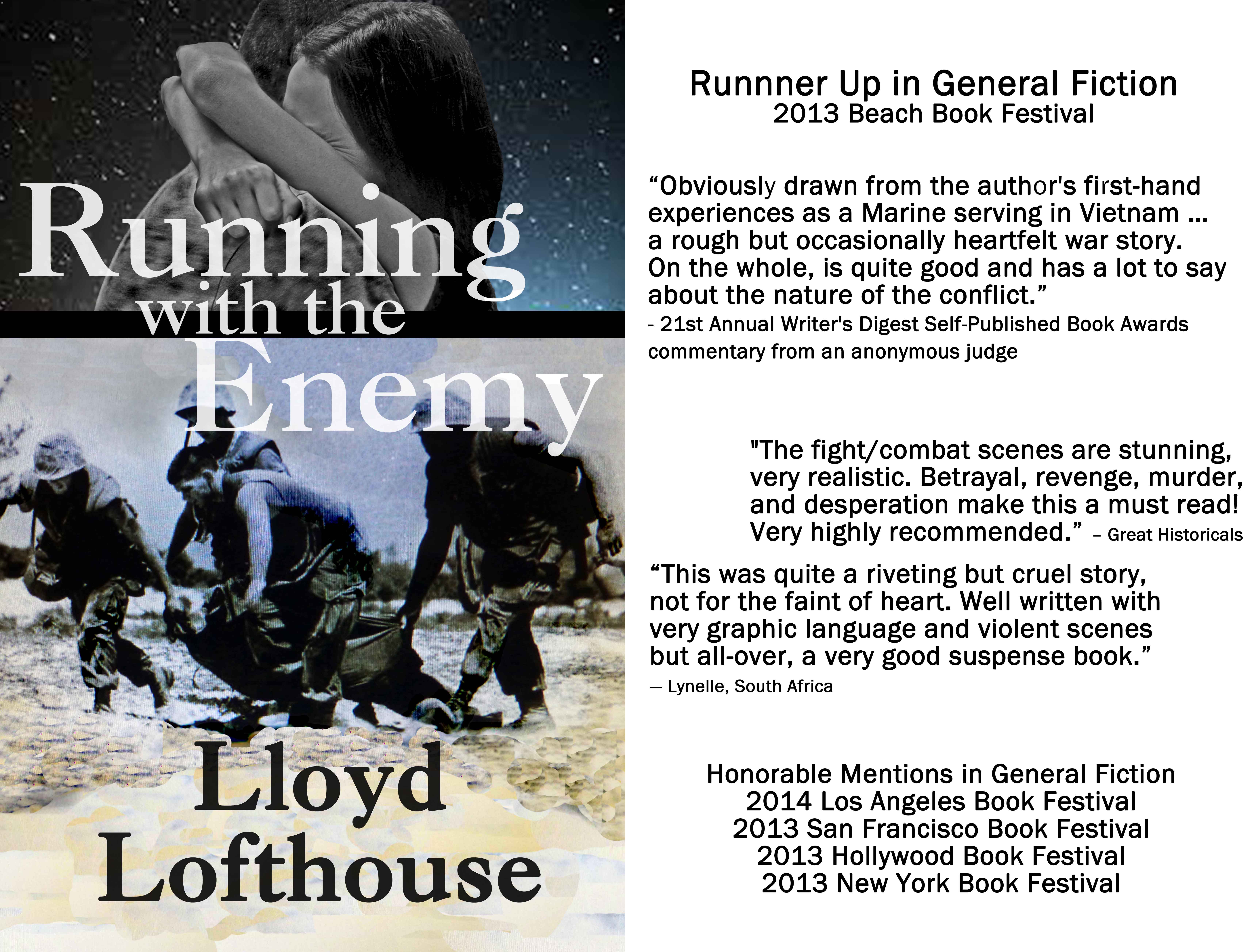
His latest novel is the award winning suspense-thriller Running with the Enemy. Blamed for a crime he did not commit while serving in Vietnam, his country considers him a traitor. Ethan Card is a loyal U.S. Marine desperate to prove his innocence or he will never go home again.

And the woman he loves and wants to save was fighting for the other side.

To follow this Blog via E-mail see upper left-hand column and click on “FOLLOW!”
Ignorance of PTSD might be dangerous: Part 1 of 2

Charlene Sakoda writing for Odd News reported that James Glaser, a retired Air Force veteran, who served in Iraq, was forced to leave a restaurant with his service dog trained to help him keep his PTSD under control.

Glaser called the police and the officer who responded to the call failed to convince the owner of the restaurant that the dog was legitimate. Russell Ireland, the owner of the restaurant, said, “Get that fake service dog out of my restaurant.”

When the police officer said the papers the vet carried on him proved the dog was not fake, Ireland said, “I don’t give a [expletive]”.

Ireland was an ignorant and biased fool. It seems that even Dr. Phil is one of those ignorant fools [watch the following video to see what I mean].

CNN reported that violence is a growing problem among vets with PTSD. “Study after study has highlighted the struggles faced by troops returning home, including substance abuse, relationship problems, aggression or depression…”

And a PTSD service dog is trained to deal with and disarm a PTSD reaction to a situation.

My combat induced PTSD was rated at 30% by the VA, and that was decided after a number of sessions with a VA counselor and Q&A sessions with other VA counselors and shrinks. And I’ve met a vet with a 100% PTSD disability who suffered much worse in Vietnam. Just the sound of a helicopter flying overhead caused him to suffer an awake flashback in daylight [click on A Prisoner of War for Life to discover more].

Suffering from a PTSD flashback does not mean vets turn into a mass of quivering cowardly jello. In fact, the opposite may happen. I’ll explain in Part 2.

Continued on September 24, 2013 in Ignorance of PTSD might be dangerous: Part 2

_______________________

Lloyd Lofthouse is a former U.S. Marine and Vietnam Veteran.

His latest novel is the award winning suspense-thriller Running with the Enemy. Blamed for a crime he did not commit while serving in Vietnam, his country considers him a traitor. Ethan Card is a loyal U.S. Marine desperate to prove his innocence or he will never go home again.

And the woman he loves and wants to save was fighting for the other side.

To follow this Blog via E-mail see upper left-hand column and click on “FOLLOW!”

Wounded Warriors Returning from the Abyss

Dawn Halfaker graduated from West Point as a 1st lieutenant and led a platoon in Iraq in 2004. A few weeks into her deployment, her platoon was ambushed, she was hit and when she woke up in the hospital days later, her right arm was gone.

With her military career over, she decided to help fellow wounded veterans. The Huffington Post interviewed Halfaker, and asked, “What happened on the day you got wounded?”

Halfaker replied, “It was a routine, 3-hour patrol mission looking for enemy activity on a relatively quiet night until, after about two and a half hours, we drove right into an ambush. I was in the first vehicle of the convoy, and one of the rocket-propelled grenades hit me and one of my squad leaders, severely injuring both of us.”

She launched Halfaker and Associates, and today it is an award winning professional services and technology solutions firm. She also is involved as the president of the Wounded Warrior Project that has a vision “to foster the most successful, well-adjusted generation of wounded service members in our nation’s history.”

Serving her country, she lost an arm and was awarded a Bronze Star Medal along with a Purple Heart for her wounds in combat. But her success since that fateful day doesn’t mean she doesn’t have days where she doesn’t hate her life. In 2005, in a New York Times interview, she said, “Some days when I’m holding a cup of coffee, my ID, carrying a bag, trying to open the door at work, I spill coffee on myself. Those are the days I say, ‘I hate my life.’ I cry and think, Why do I have to be this way?”

But no matter how she feels on down days, she always rebounds and wonders how her life turned out so great.

If we learn anything from this retired Army captain, it is that there is no excuse to give up on life.

Why is it that some combat veterans become homeless alcoholics and drug users stricken with severe PTSD and others—for example Halfaker—end up becoming the successful CEO of her own business with 150 employees and a positive role model for the rest of us?

Discover A Prisoner of War for Life

_______________________

Lloyd Lofthouse is a former U.S. Marine and Vietnam Veteran.

His latest novel is the award winning suspense-thriller Running with the Enemy. Blamed for a crime he did not commit while serving in Vietnam, his country considers him a traitor. Ethan Card is a loyal U.S. Marine desperate to prove his innocence or he will never go home again.

And the woman he loves and wants to save was fighting for the other side.

To follow this Blog via E-mail see upper left-hand column and click on “FOLLOW!”

Controlling the Warrior Gene: Part 2/2

To discover more about the triggers that activate the warrior gene, scientists should study the history of berserkers to learn about the right environment and lifestyle.

Britannica.com says the “berserker in pre-medieval and medieval Norse and Germanic history and folklore, [was] a member of unruly warrior gangs that worshipped Odin, the supreme Norse deity, and attached themselves to royal and noble courts as bodyguards and shock troops. … The berserkers were in the habit of raping and murdering at will in their host communities (thus going “berserk”).”

The word “berserker” today applies to anyone who fights with reckless abandon and disregard to even his own life, a concept used during the Vietnam War and in Vietnam-inspired literature (Michael Herr’s Dispatches) and film (Oliver Stone’s Platoon and Adrian Lyne’s Jacob’s Ladder). “Going berserk” in this context refers to an overdose of adrenaline-induced opioids (or military-issued amphetamine for long missions) in the human body and brain leading a soldier to fight with fearless rage and indifference, a state strikingly similar to that of the 9th century berserkers.

“Going berserk” is also used colloquially to describe a person who is acting in a wild rage or in an uncontrolled and irrational manner.

And in When You Hear the Bugle Call by Peter S. Griffin, he says, “Homer [8th century BC] related incidents of some soldiers going berserk, fighting in an enraged, reckless manner, the same as some warriors of the modern age, who participated in intense, frequent and prolonged combat and lost it in battle.”

If true, what would happen if a government had the ability to control this warrior gene in its elite troops with the ability to turn it on at will sort of like controlling a drone from a remote location resulting in super soldiers in combat situations?

Return to or start with Controlling the Warrior Gene: Part 1

_______________________

Lloyd Lofthouse is a former U.S. Marine and Vietnam Veteran.

His latest novel is the award winning suspense-thriller Running with the Enemy. Blamed for a crime he did not commit while serving in Vietnam, his country considers him a traitor. Ethan Card is a loyal U.S. Marine desperate to prove his innocence or he will never go home again.

And the woman he loves and wants to save was fighting for the other side.

To follow this Blog via E-mail see upper left-hand column and click on “FOLLOW!”

Controlling the Warrior Gene: Part 1/2

Up to 20% of U.S. troops returning from Iraq and Afghanistan suffer from PTSD, and research says that emotions and family settings—meaning environment and lifestyle—may all play rolls that trigger genes that lead to some troops coming down with PTSD while others in the same combat situations don’t. Sources:  U.S. National Library of Medicine and the L.A. Times

Therefore—under the right circumstances that may trigger a response through certain genes—are some people wired to be warriors?

In 2009, Science Daily reported on research co-authored by Rose McDermott, professor of political science at Brown University. “Several studies have found a correlation between the low-activity form of MAOA—a gene that regulates an enzyme that breaks down important neurotransmitters in the brain— and aggression in observational and survey-based studies. Only about a third of people in Western populations have the low-activity form of MAOA. By comparison, low-activity MAOA has been reported to be much more frequent (approaching two-thirds of people) in some populations that had a history of warfare. This led to a controversy over MAOA being dubbed the warrior gene.”

We already know that certain genetic triggers are activated because of environmental and lifestyle factors. These factors are called triggers. For example, the U.S. Department of Health and Human Services says that “Heredity plays an important part in determining who is likely to develop type 1 diabetes. Genes are passed down from biological parent to child.  … Some theories suggest that environmental factors trigger the autoimmune destruction of beta cells in people with a genetic susceptibility to diabetes. Other theories suggest that environmental factors play an ongoing role in diabetes, even after diagnosis. … Physical inactivity and obesity are strongly associated with the development of type 2 diabetes. People who are genetically susceptible to type 2 diabetes are more vulnerable when these risk factors are present.”

Other genes have been identified that protect against heart damage from chemotherapy. Source: ScienceCodex.com

In addition, CNNHealth.com reported that “Some people have all the luck. A new study shows that certain individuals with a gene mutation can slurp down milk shakes or other high-fat food and drink without a nasty jump in cholesterol.”

Continued on July 24, 2013 in Controlling the Warrior Gene: Part 2

_______________________

Lloyd Lofthouse is a former U.S. Marine and Vietnam Veteran.

His latest novel is the award winning suspense-thriller Running with the Enemy. Blamed for a crime he did not commit while serving in Vietnam, his country considers him a traitor. Ethan Card is a loyal U.S. Marine desperate to prove his innocence or he will never go home again.

And the woman he loves and wants to save was fighting for the other side.

To follow this Blog via E-mail see upper left-hand column and click on “FOLLOW!”

Shell Shock in 1915 becomes Combat Fatigue by World War II and PTSD in 1980

In World War I, PTSD—known as shell shock then—was such a problem that ‘forward psychiatry’ was begun by French doctors in 1915. Some British doctors tried general anesthesia as a treatment (ether and chloroform), while others preferred application of electricity.

Imagine suffering from PTSD and being strapped down to a table with electrodes attaches followed by jolts of electricity to shock you healthy.

In 1917, four British ‘forward psychiatric units’ were set up. Hospitals for shell-shocked soldiers were also established in Britain, including (for officers) Craiglockhart War Hospital in Edinburgh.

Patients diagnosed to have more serious psychiatric conditions were transferred to the Royal Edinburgh Asylum.

Near the end of 1918, the use of anesthetic and electrical treatments to treat shell shock was gradually replaced with modified Freudian psychodynamic intervention. The efficacy of ‘forward psychiatry’ was controversial.

Psychodynamic therapy focuses on unconscious processes as they are manifested in a person’s present behavior. The goals of psychodynamic therapy are a client’s self-awareness and understanding of the influence of the past on present behavior.

In 1922 the British War Office produced a report on shell shock with recommendations for prevention of war neurosis. However, when World War II broke out in 1939, this seems to have been ignored.

Then during World War II, the term ‘combat fatigue’ was introduced as breakdown rates became alarming, and the value of pre-selection was recognized.

At the Maudsley Hospital in London in 1940, barbiturate abreaction (an emotional release resulting from mentally reliving through the process of catharsis, a long-repressed, painful experience) was advocated for quick relief from severe anxiety and hysteria, using i.v. anesthetics: Somnifaine, paraldehyde, Sodium Amytal. ‘Pentothal narcosis’ and ‘narco-analysis’ were adopted by British and American military psychiatrists.

However, by 1945 medical thinking gradually settled on the same approaches that had seemed to be effective in 1918.

The term PTSD was introduced in 1980.

In the UK the National Institute for Health and Clinical Excellence (NICE) guidelines for management (2005) recommend trauma-focused Cognitive Behavioral Therapy and consideration of antidepressants. Source: Pub Med.gov

Discover The public image of PTSD and the Vietnam Veteran

_______________________

Lloyd Lofthouse is a former U.S. Marine, Vietnam Veteran, journalist and award winning author.

His second novel is the award winning love story and suspense-thriller Running with the Enemy. Blamed for a crime he didn’t do while serving in Vietnam, his country considers him a traitor. Ethan Card is a loyal U.S. Marine desperate to prove his innocence or he will never go home again.

Promo Image with Cover Awards

Where to Buy

To follow this Blog via E-mail see upper left-hand column and click on “FOLLOW!”

Combat casualties and battle-field medicine through the ages: Part 1/2

Starting with the Roman Empire, it has been estimated that Roman Armies suffered about 885,000 casualties over a nine-hundred year period from 400 BC to 500 AD—that adds up to less than 1,000 average combat deaths annually. Source: Body Count of Roman Empire

It seems that the old way of fighting with swords and spears wasn’t as destructive as modern warfare.

The ancient military physicians of the Greeks and the Romans had discovered that certain treatments, such as the application of honey and salt mixtures to wounds—mostly from cuts and jabs—aided the troops to recover.

The decline of the Roman Empire didn’t happen overnight. It took centuries, and when the Roman Empire fell in the 5th century AD, military medical support was almost gone. With the decline of an empire, also came the end of effective medical care in Europe.

About a thousand years would go by before the rebirth of military medicine in Europe in Spain near the end of the 15th century after the Spanish drove out the Islamic Moors. During the wars, the Spanish military copied the mobile hospitals used by the Moorish armies.


But in the 15th century, the introduction of gunpowder in combat caused more casualties, because almost all gunshot wounds became infected due to the injury—clothing, dirt, and other debris was often forced into the wound by the musket ball—and/or from unsanitary conditions following the injury caused by the surgeon probing for the musket ball or shrapnel with unwashed fingers and/or unwashed surgical instruments.

It isn’t as if sterilizing surgical instruments was going to be a new concept. The ancient Chinese, Persians and Egyptians all used methods for water sanitation and disinfection of wounds. In fact, Mercuric chloride was used to prevent infection in wounds by Arabian physicians in the Middle Ages but not in Europe.

In fact, in Europe and American in the 1800’s, infections after surgery caused almost half of the deaths of troops wounded in combat.

Though the number of killed and wounded in the Civil War (1861 – 1865) is not known precisely, most sources agree that the total number killed was between 640,000 and 700,000 resulting in an average of 160,000  – 175,000 combat deaths annually—a massive leap from the average annual combat deaths during the Roman Empire where the well trained and highly disciplined Roman military also had observant medics who wrote down treatments that worked and passed this knowledge on to be used by the next military doctor. In fact, Roman surgeons used about the same tools that American doctors did only one hundred years ago.

However, as it turns out, the bloodiest war in American history was also one of the most influential in battlefield medicine. Civil War surgeons learned fast, and amputation of arms and legs saved more lives from death by infection than any other wartime medical procedure. Sources: Mental Floss.com,  American Civil War Casualties and Military Medicine through the Eighteenth Century

Continued on Wednesday, June 12, 2013 in Combat casualties and battle-field medicine through the ages: Part 2

_______________________

Lloyd Lofthouse is a former U.S. Marine and Vietnam Veteran.

His latest novel is the award winning suspense-thriller Running with the Enemy. Blamed for a crime he did not commit while serving in Vietnam, his country considers him a traitor. Ethan Card is a loyal U.S. Marine desperate to prove his innocence or he will never go home again.

And the woman he loves and wants to save was fighting for the other side.

To follow this Blog via E-mail see upper left-hand column and click on “FOLLOW!”

Acronyms Describing Women in the US Military

In the Iraq and Afghanistan Wars, “military sexual trauma” has been so pervasive it got its own acronym: MST.

There are other acronyms—some now obsolete and some not listed—that are used to describe women in the military. I’ve listed a few here that I found from several lists.

Be warned, some of these acronyms and what they mean may offend a few, and I’m sure the last one will offend many.

­­WAAC = Women’s Auxiliary Army Corps and individual members of – now obsolete

WAC = Women’s Army Corps and individual members of – now obsolete

WAF = Women (in the) air Force and individual members of – now obsolete

WAVES = Women Accepted for Volunteer Emergency Services in the US Navy – now obsolete

WM = Woman/Women Marine(s)

BAM = Broad Assed Marine; pejorative term for women Marines

field 10 = a physically unattractive female service member who becomes an object of desire for male service members after extended time in a field or combat environment away from civilian women.

ma’am = proper method of addressing female officers in particular and all women in general.

WACB (AR 310-50] = Women’s Army Classification Battery

WACSM [AR 310-50] = Women’s Army Corps Service Medal

WEST = weapon effectiveness simulated threat, (AR 310-50] Women’s Enlistment Screening Test

There’s one more acronyms that I could not find—but one I heard more than once from more than one Marine in 1967/68 while I was stationed at Camp Pendleton after my 1966 combat tour in Vietnam.

Marine men called—at least in my unit, the active duty nucleus for the division headquarters of the 4th Marine Division—women Marines SPAM.

Before I define what SPAM meant forty-six years ago, I want to warn you that you might be offended in this age of political correctness with so many words that are considered offensive by one group or another. Just remember, that the SPAM acronym was used by some Marines in the 1960s, and it was never official enough to make any of lists that I researched for this post and probably became obsolete soon after political correctness became a fact of life.

SPAM = Special Prostitute Assigned to the Marines

Considering all of the news about rapes and sexual harassment in the US military today, the use of SPAM to describe women Marines during the Vietnam War might reveal what some military men think about women serving in the military today telling us that maybe the way some men thought back then hasn’t changed much.

Should we be surprised?

The Justice Project reports, “The global sex trade has been increasing over the past 10 years and has now become one of the largest money-makers for criminals, presently taking place as the second largest criminal industry worldwide.”

800,000 are estimated to be trafficked across international borders each year.

80% of these people are females and 50% are minors

The vast majority of these victims will be forced into prostitution, requiring them to service high numbers of clients a day.

There are increasing demands for younger children in the sex slave trade.

Discover Stanford Study shows effect of PTSD trauma on brain

_______________________

Lloyd Lofthouse, a former U.S. Marine and Vietnam Veteran,
is the award winning author of My Splendid Concubine [3rd edition].

image

Buy or Read Now

To follow this Blog via E-mail see upper left-hand column and click on “FOLLOW!”

Is Rape a Hazard of Military Service?

The Associated Press reports, “Sexual assaults in the military are a growing epidemic across the services and thousands of victims are still unwilling to come forward despite a slew of new oversight and assistance programs, according to a new Pentagon report. The report says that of the 1.4 million active duty personnel, 6.1 percent of active duty women — or 12,100 — say they experienced unwanted sexual contact in 2012, a sharp increase over the 8,600 who said that in 2010.”

Do not confuse unwanted sexual contact with sexual assaults. Unwanted Sexual contact is defined as any non-consensual sexual contact, such as touching or fondling of breasts, buttocks, genitals or other sexual/”private” parts. Sexual assault is defined as any sexual activity involving a person who does not or cannot—due to alcohol, drugs, or some sort of incapacitation—consent, and rape may include partner or marital rape.

And unwanted sexual contact and/or sexual assault is not the fault of the victim.

However, there is an explanation for the increase is sexual assaults in the military and it has to do—in part—with the following facts. From 1973 to 2010 the number of active-duty enlisted women in the military increased from about 42,000 to 167,000—a 400% increase.

In addition, the 1991 Gulf War was the first major military deployment where female troops were integrated into almost every military unit, except for combat ground units—this brought more women into daily contact with men suffering from combat induced PTSD.

The increased number of women serving in the US military; integration into almost every military unit and increased numbers of deployments to combat zones leading to more combat induced PTSD explains the increase in sexual assaults in the military.

Why would more combat veterans with PTSD lead to unwanted sexual contact and/or sexual assault?

The Huffington Post reports, “Combat veteran with PTSD were more likely to commit crimes. … A 2009 study of enlisted combat Marines with at least one deployment demonstrated that those with PTSD were six times more likely to be busted on drug charges than Marines without PTSD, and 11 times more likely to be discharged for misconduct.”

The Department of Veterans Affairs says PTSD and alcohol use problems are often found together and alcohol can make PTSD symptoms worse. … If you have a drinking problem, you are more likely than others with your same sort of background to go through a psychological trauma. You may also have problems getting close to others. You may have more conflicts with those people to whom you are close.

In addition, “Alcohol and drugs dis-inhibit people,” says Paul Rinaldi, associate director of the Addiction Institute of New York City.” Source: CBS News

And Helen Benedict writes in her new book “The Lonely Soldier: The Private War of Women Serving in Iraq—one of the symptoms of this disorder (PTSD) is uncontrollable violence (including increased incidents of rape).” Source: Womens enews.org

In conclusion: knowing the cause of this crime is not an excuse for the increase in sexual assaults in the US military, but knowing the cause offers possible solutions. One solution might be to remove military women from combat units and away from veterans—still serving in the military—who abuse alcohol/drugs while suffering from PTSD. Another solution might be through education, intervention and counseling programs for both women and men raising awareness of the problem along with methods to avoid or deal with it.

By The Numbers:

The Air Force has the highest percentage of women: 18% (11,665) are officers and 20% (51,614) are enlisted. In 2012, 790—1.2% of women serving in the Air Force—reported sexual assaults that include women and men.

Army: 15.5% officers (13,560) and 13.2% (59,672) enlisted. In 2012, 1,423—1.9%—reported sexual assaults that include women and men.

Navy: 15.1% (7,769) are officers and 15% (41,294) enlisted. In 2012, 726—1.5%—reported sexual assaults that include women and men.

Marine Corps: 5.8% (1,172) are officers and 6.2% (11,049) enlisted. In 2012, 435—3.6%—reported sexual assaults that include women and men.

Coast Guard: 14.9% (1,212) are officers and 11.6% (3,854) enlisted. One in three women as well as many men in the Coast Guard is going to fall victim of sexual assault and rape. Sources: Daily Kos.com and Slide Share.net

Discover The Dark Side of Humanity

_______________________

Lloyd Lofthouse, a former U.S. Marine and Vietnam Veteran,
is the award winning author of My Splendid Concubine [3rd edition].

His latest novel is Running with the Enemy. Blamed for a crime he did not commit while serving in Vietnam, his country considers him a traitor. Ethan Card is a loyal U.S. Marine desperate to prove his innocence or he will never go home again.

And the woman he loves and wants to save was fighting for the other side.

To follow this Blog via E-mail see upper left-hand column and click on “FOLLOW!”

Returning from Combat with PTSD – the impact on family


I returned from Vietnam late December of 1966, and I did not talk about the war for years. Instead I kept it locked in my head, but I slept with a K-BAR that had a seven-inch blade. The reason I did not sleep with a pistol was because I feared shooting my wife.

I drank too much. I had an explosive temper. When the anger overwhelmed, instead of hitting her, I punched holes in the drywall and drank more.

After falling asleep at night, the flashbacks were vivid, violent and real. There were times that I carried a loaded rifle through the house checking the doors and windows to secure the perimeter. Sometimes I still do. All it takes is an unexpected noise and out comes a loaded weapon and I cannot rest until I know my family is safe.

After the first divorce in 1979, I stopped drinking and fight to contain the anger, and—at the time—most of us still didn’t know what PTSD was. It helped that I started writing about my time in Vietnam in the MFA program I started at Cal Poly, Pomona causing me to open up and talk about what I experienced in the war.

There is no cure for PTSD, but with understanding, the afflicted might be able to manage the trauma better and avoid destroying families and lives. For sure, drugs and alcohol are a bad mix with PTSD.

The impact of PTSD on families is shocking. “Research that has examined the effect of PTSD on intimate relationships reveals severe and pervasive negative effects on marital adjustment, general family functioning, and the mental health of partners.

“These negative effects result in such problems as compromised parenting, family violence, divorce, sexual problems, aggression and caregiver burden.

“About 38% of Vietnam veteran marriages failed within six months of returning from the war. The overall divorce rate among Vietnam veterans is significantly higher than the general population.” Source: ptsd.va.gov


Impact on family

The divorce rate among Afghanistan, Iraq War Vets increased 42% throughout the wars.

A July 2010 report found that child abuse in Army families has been three times higher in homes from which a parent was deployed, for example. From 2001 through 2011, alcohol use associated with physical domestic violence in Army families increased by 54%, and with child abuse by 40%. Source: cost of war.org

In addition, Expedition Balance.org says, “It’s harder for veterans with PTSD to hold jobs.

“The VA reported that more than 130,000 veterans were homeless on any night.

“Studies show that families where a parent has PTSD are characterized by increased anxiety, unhappiness, marital problems and behavioral problems among children.

“People with PTSD are more likely to have problems with drugs and/or alcohol.

“People who suffer from PTSD and depression are significantly more like to take their own lives.

“Female veterans have a higher rate of military sexual trauma. They have a higher rate of divorce and homelessness as well.”

The Huffington Post reported that “Iraq and Afghanistan war veterans who struggle with the anger and emotional outbursts of combat trauma are more than twice as likely as other veterans to be arrested for criminal misbehavior … Veterans ‘who perceive that they have control over their future and who have greater psychological resilience’ are better able to refrain from violence, the study said.”

For me, managing the PTSD—so it does not manage me—is a full time job that is not always successful.

In 2011, there were 21.5 million combat veterans in the United States. Source: American Veterans by the Numbers (that is the cost of America’s endless wars)

Discover A Prisoner of War for Life

_______________________

Lloyd Lofthouse, a former U.S. Marine and Vietnam Veteran,
is the award winning author of My Splendid Concubine [3rd edition].

His latest novel is Running with the Enemy. Blamed for a crime he did not commit while serving in Vietnam, his country considers him a traitor. Ethan Card is a loyal U.S. Marine desperate to prove his innocence or he will never go home again.

And the woman he loves and wants to save was fighting for the other side.

To follow this Blog via E-mail see upper left-hand column and click on “FOLLOW!”