Unwanted Heroes – Part 4/4

 3:  The Daily Grind

AHHHH!

The scream is loud and piercing.

I am in the storeroom in the back and immediately run to the front of the coffee shop, where San Francisco Financial District’s finest are packed around tables steamy cups in hand. Passing the big freezer, I rip open the door and grab a blue ice block fearing burning coffee is hideously scarring someone’s unblemished skin. With great concern for my customers and an inevitable impending lawsuit, I think, Not on my bloody shift!

“Fuck man! You’ve spilled your coffee on my papers. You clumsy asshole! I’ve gotta submit this today. My professor will kill me!”

Oh no. A law student!

“I’m so sorry. I tripped on the strap of her Timbuk2 bag,” the middle-aged businessman replies, pointing to the adjacent table. “At least it missed your laptop.”

Oh no, an optimist!

“If you’d spilled it on my laptop, I’d have sued your ass.”

Assault with a deadly drink … graduating this fall; no doubt plotting to make partner next year!

“Well, I’m glad it missed … oh, wow, is that the new MacBook?”

This man clearly has attention issues.

“Yes, a spanking new one! Look, I’ve gotta finish these corrections.” She picks up the soggy pages. “Just move on.”

But the guy just can’t. Then his tone shifts. “Why did you print it out if you’re still editing? A waste of trees, don’t you think?”

“It’s easier to spot…” She glares, ready to pronounce the death penalty. “What the fuck do you care? I’m trying to…”

This is my cue. I am the barista: a master of the mocha, a connoisseur of the cappuccino. Well, that’s my pick-up line. With careful delivery, I believe it sounds sexy, like a hairstylist, a DJ or an open-heart surgeon. I know from experience—I brew coffee at the corner coffee shop on Mission Street isn’t likely to elicit the coveted phone number.

But for now, I play mediator. The law student accepts wet napkins to clean up the mess and the sympathy of Tabitha. I escort the man to a vacant table on the other side of the coffee shop as far as possible from the threat of litigation. Both receive complimentary drinks, and soon the buzz of many conversations restores normalcy.

The law student stops me when I pass her table. “You’re alright for a Brit, Scarecrow.”

Scarecrow is a nickname that seems to follow me. I am reasonably tall, five-nine I think, thin, and with hair that refuses to be subdued by even a highly disciplining gel. About five minutes after grooming, I am left with, on a good day, the controlled scarecrow effect. I automatically move my hand to flatten the offending spikes and she laughs.

“You look fine.” She giggles.

“And you’re alright too.” I mumble, flattered to get her attention. “At least for a law student.”

Our café borders the financial district and the Embarcadero as well as some law and business schools. This prime location attracts refugees from the intensely caffeinated work culture by day and draws an eclectic crowd in the early evening when The Daily Grind transforms into an intimate wine bar. We also serve tourists who have lost their way to the nearby Ferry Building and the attractions of the Embarcadero.

Like all coffee shops, our weekday has its ebbs and flows. The morning is a madhouse as no self-respecting San Franciscan can possibly begin the day without their caffeine fix. By seven in the morning the line snakes outside our shop. With regulars, I try to remember their usual orders; a good memory ensures that loose change finds its way into the tip jar. If I can’t recall what they drink, I make an educated guess and am rarely far off. Even then, I apologize and explain how I evidently confused them with an actor, singer, sportsman or politician. Compliments generate tips just as effectively as a good memory.

As the day wears on and eventually draws to a close, we place aromatic candles on the tables; vigorously air out the place to lessen the robust coffee aroma and turn on carefully placed spotlights to highlight the heavy, oak wine racks lining the walls. Polished wineglasses take prominence over coffee mugs while jazz plays softly in the background.

The crowd changes, at least in its intent. Tired businessmen and women seek a ritual to cleanse themselves of the workday stress. Couples huddle in the corners wondering over a deep-red Merlot if the person facing them might just be the one. Life is a Cabernet, my friend, and a soul mate is waiting to be found.

It’s a job, a good one, and it pays for my other life. You see, I’m not only a barista. I’m a writer. A well-worn book about famous writers who spent time in San Francisco sits by my bed. I’ve walked in their footsteps, frequented their coffeehouses and wine bars, and opened my Mac in search of the same inspiration.

One day soon, I’ll be a famous author. Someone once defined an author as a writer who never gave up. I’m far from famous, but I’m also far from giving up. Like others of my tribe, I’ve saved the rejection letters—evidence of the emotional scars that all wannabe authors bear.

Let me show you my world: the parallel realities of the barista and the writer, the highs and lows of an aspiring artist, the pitfalls that await a lonely young man with much to give. But first, let me introduce you to San Francisco, the greatest city in the world.

Yeah, I grew up in London with fog rolling off the Thames, but I do not recall locals stopping to admire it. Other cities share similar traits to San Francisco: Rome has hills; London has immigrants and culture, and Paris the artistic mystique. But San Francisco has all of this and it is not thrown in your face. It just is.

I lean over the rails on the Embarcadero and stare out at the looming Bay Bridge, gray and partially veiled by early-morning mist. Next to me stands a metal woman eighteen feet high—a creation welded from hundreds of recycled pieces of junk. She holds hands with a child about eight feet tall and together they stare out to sea.

The metal woman lacks the elegance of the Statue of Liberty. That is what makes San Francisco special. It works without pretentiousness. I am told that the metal mother and child stand at the annual Burning Man festival in the Black Rock desert. Fire courses through her body and out of her hand into the child.

We could do with a fire right now. I shiver as I watch wisps of cloud hover above the water. It is very early and I must open the coffee shop. Despite the cold, I love this hour of the day when the city slumbers but is not asleep. It is simply preparing for the onslaught.  In two hours, tens of thousands of people will spew out of the BART and MUNI public transport tunnels. Others will stubbornly drive in searching for elusive and pricey parking spaces. The more enlightened drivers have recruited passengers from the casual carpool pickup points scattered around the bay thereby paying less for the bridge tolls and utilizing the carpool lanes. The passengers, for their part, get a free ride into town.

Walking down Mission Street, I see Clarence, a huge African American dressed in a shiny black suit. I cannot tell if he is awake behind those big black sunglasses until he raises his saxophone to salute me. The shiny instrument gleams, even in our fog-filled streets, and Clarence lets rip a short riff to announce the barista has arrived!

Clarence customarily stakes his position in the early morning. There are more street musicians than ever these days and, with only a few prime spots, Clarence must claim his territory. But at this time of day, he plays only for me and I feel like a king. Clarence knows I do not have spare change to throw in his open sax case—perhaps he would feel insulted if I did.

Later, around 9.30, when the herd is safely corralled into their office cubicles and Clarence’s muscles are aching; he will come and rest in The Daily Grind. When I think Mr. Tzu, the owner, is not looking, I leave a cup of coffee on Clarence’s table. I used to mutter under my breath that some jerk had changed his order after I had already poured his cup and there is no point wasting it. After about the fortieth time, I figured Clarence had picked up on my ruse so I just place the steaming cup on his table without a word.

No thanks, but I know the gesture is appreciated just as I appreciate Clarence playing for me as I pass him in the early morning. He will sit for an hour or so then slowly move off. I know little of Clarence, but he is part of my life—another strand that weaves this urban tapestry called San Francisco.

Two weeks ago, a bunch of students entered The Daily Grind and their clothes were covered with ‘New Orleans’ insignia. They were excited and boisterous as they passed Clarence at his regular table. From the way Clarence eyed them, I thought that their intrusion annoyed him, but I was wrong.

“Hey! What’s with th’ shirts? What y’all doing with New Orleans?”

A young woman, blond, thin and tanned, excitedly explained how they’d just come back from a week helping rebuild houses damaged by Hurricane Katrina. “You should’ve seen the damage that hurricane did,” she said.

“Ain’t no hurricane did that, gal,” Clarence replied with a growl. “Weren’t no nat’ral disaster. Don’t let ’em bull ya’. The hurricane would’a done some damage, but if those levees had held, if those bastards had built ’em like they should, well, ain’t no one have died there. My grandma’s house waz swept away. Broke her, it did. Such a proud w’man.”

Clarence rose and moved heavily to the door but then turned. We all watched. He spoke now in a softer tone. “But I thank y’all for going down there t’help. It’s import’nt y’all show ya’ care, that some’n shows they care.”

We saw his tears as he walked out the door and left behind a heavy wake of silence. I could not stop myself. I nodded to Tabitha to cover for me and followed him out of the café.

He stood on the corner of Mission and Spear caressing his saxophone and let rip the most beautiful, soulful jazz I have ever heard. He was not playing for me that time; he was not even playing for San Francisco. I could almost see his tune rolling out of the bay along with the fog making its way to the Gulf Coast.

When he finished, I approached unsure what to say. We stared at each other.

“I’m so sorry,” I said. “I’m so sorry.”

I had spoken with Mr. Tzu, that day. I had an idea and from that week, every Friday at lunchtime, Clarence played in The Daily Grind to a packed audience. Big jars were scattered around the tables with labels: All Proceeds to New Orleans Relief Projects and as the music touched our customer’s souls, the jars filled, because San Francisco has a heart, and that heart was bleeding for a sister on the Gulf Coast.

Return to Unwanted Heroes – Part 3 or start with Part 1

____________________

You may buy Unwanted Heroes at Amazon.com

Growing up in London, Alon Shalev has been a political activist since his early teens. He strives through his writing to highlight social and political injustice and to inspire action for change.

Moving to Israel, he helped establish a kibbutz where he lived for 20 years and served in the Israeli army.

Shalev then moved to the San Francisco Bay area and fell hopelessly in love with this unique city. Being new to the US, however, he was shocked to see so many war veterans on the streets. He regularly volunteers at initiatives such as Project Homeless Connect and the San Francisco Food Bank where he meets and talks with war veterans.

To follow this Blog via E-mail see upper right-hand column and click on “Follow”.
Unwanted Heroes – Part 3/4

2:  The Letter

I stare at him in bewilderment as he strides out of the café. I cannot decide whether I admire or fear him and conclude that probably a bit of both is most prudent. Turning back to the counter, I see Tabitha watching me as she hands change to a customer. I feel a sharp wave of panic.

“So they’re onto me?” Her tone is flippant when it is just the two of us. “It’s the addiction, Will. Caffeine and a full moon. Such a fatal combination.” She raises her cup and flutters her eyelashes as she sips.

“Until Mr. Tzu shows up, we’ll have to rearrange the work roster,” I reply somberly. “I assume Ginny has been filling in for Mr. Tzu over the weekend, but you have more experience. You’re going to have to pull the shift opposite mine.”

“But then we won’t get to work together! Who’s going to train me, nurture my career, and bring out my full potential?” She does a credible job pouting like a spoiled child. Then stretching out her hands, she bows her head. “I’m still your humble apprentice, Will, my lord, my barista.”

I relax. “Be mindful of the Force, my young Padma,” I say in my best Yoda-ese, “and keep the fucking Beast clean. Remember, the coffee flows through the Beast.” If only my school counselor had let me pursue a career as a Jedi Knight. “Right now, you’re the only other person supremely qualified to run shifts,” I say, getting back to business.

“But what about the wines?” Tabitha asks.

“George and I will alternate,” I reply.

“Carrot Face?”

“You’re going to call him that to his face one day soon and I might not be around to protect you.”

We both laugh. The prospect of Carrot Face or George and I going a few rounds over Tabitha’s honor is amusing. George is a recent addition to our staff. He knows little about coffee but worked on a vineyard in Napa for a few years. He is skinny, spotty, awkward and … well you can probably guess his hair color.

“But you’re gonna work a lot of hours,” Tabitha says, concerned.

“It’ll only be for a few days. He’ll be back soon.” I hear the doubt in my voice.

I serve two businessmen, who take their drinks swiftly to a table—their discussion never stopping.

Tabitha shrugs. “I bet the bastard rented a sports car and is in Vegas denying his age. Men are jerks, you know.”

“How would I know that?” I roll my eyes.

“You’re a writer, Will. You must’ve noticed them. Jerks.” Tabitha manages a disdainful expression.

“I’m also a man—never mind. The other day when Mr. Tzu chewed you out, has that happened before?”

“No, I’m actually a wonderful asset to the business!” Tabitha replies, her voice feigning hurt, then she frowns. “Hey, Will, you’re worried, aren’t you? You’re not convinced he’ll be back in a day or so?”

“I don’t know,” I say. “I wonder what made him crack.”

Tabitha shuffles and stares down at her scuffed Doc Martin boots.

“Tzu’s always been kinda tight, y’ know. Not big on the conversation, but he’s not a screamer either. That day, though, he was really pissed and not just because I failed to clean the Beast to his standards. He later chewed out Carrot Face after George quipped that, though it was his brother’s birthday, he was ignoring it as they weren’t close.

“Tzu heaped him a nasty lecture about family and loyalty. It wasn’t a fatherly rebuke either. Tzu was really pissed. I figured maybe it’s an Asian thing. They’re very family oriented.”

Tabitha puts down a wineglass that she’s been polishing and sighs. “Look, I don’t know Tzu. I’ve always been a bit scared of him ’cause he never talks or anything, so I’ve kinda kept my distance. You never know what’s going on in his mind. It’s intimidating. I’m not a barista or a wine freak like you. I’m expendable. As a woman, too, I feel vulnerable around him. Asians are pretty patriarchal, y’know, and I’m at the bottom of the food chain.”

“Yeah.” I’m feeling increasingly uncomfortable. “Let’s get back to work.”

A few minutes later I see Tabitha hovering by Tzu’s desk in the back of the store. She’s holding a badly crumpled piece of paper and calls me over.

“Will, look. This letter appeared the morning Tzu wigged out on me and Carrot Face. It had been slipped under the door before we arrived to open the café. I picked it off the floor, but Tzu grabbed it from me and read it immediately. He had it in his hand or his back pocket all morning. Later, I saw him put it in his desk drawer.”

Hoping for a clue, I take the letter. It is dirty and creased, and I just stare at thick, black Chinese characters.

I return the letter to the drawer of Tzu’s desk. It will be here when he returns—probably tomorrow. But Tzu doesn’t return and as the week passes, the whole staff begins to worry for Mr. Tzu and our jobs.

Early Wednesday, an elderly Asian woman enters the café. She wears a thick heavy coat and a green-silk scarf covers her head probably to ward off the chill. I turn to serve her as she approaches.

“Will?” Her voice is unsteady and her English heavily accented.

“Mrs. Tzu?” I hazard a guess.

She nods. “Please, bring green tea and sit with me.” She shuffles over to an empty table. There is a heavy flow of customers. I don’t like the other staff members seeing me sit while they work, but this wasn’t presented as a request.

Mrs. Tzu sips the tea and stares at me. Her face looks tired and worn.

“I’m sorry about Mr. Tzu. I really am,” I say. “Is there anything I can do to help?”

“Husband will come back.” She nods as she says this but without conviction. “He says you are good boy. He says you can be trusted.”

“Thank you, Mrs. Tzu. That is high praise.” I am pleased to hear this. “I love my job and the coffee shop.”

“Good, good.” She nods. “You stay and run place. Mr. Tzu will soon return and give you reward. Okay?”

“Sure, Mrs. Tzu. Do you have any idea where he might be? Could he … could he have gone home to China?” Last night, I dreamed that he had returned there to die, but I don’t feel it prudent to share this.

“Mr. Tzu is American.” She shakes her head. “Left China as very small boy and feels no love for China. Love 49ers and Giants. For him, America is home.”

“What do your children think? Have you talked with other relatives?”

She again shakes her head. “I speak with children. Speak all the time. No brother or sister. This disappearance is very strange. He has gone before when very stressed. Has something in past, something from war.”

“So you don’t think he’s been kidnapped or anything? He doesn’t have any enemies, does he?”

She looks at me for a moment perhaps to see if I am joking. Then she leans forward, her expression serious. “Mr. Tzu is good man. Very fair. Many in city know him. All have high respect for him.”

“I’m sorry. Didn’t mean to imply—” I didn’t know what I didn’t mean to imply, and we both fall silent.

Then Mrs. Tzu leaned forward. “I am from China. Parents die during time of Long March, I think. Maybe later. China was chaos. Hard life then. I brought to US to stay with aunt. Meet Mr. Tzu in city. America is good but for me not home. Mr. Tzu is my home and so America is my home.”

She leans back and sighs. “49ers and Giants, they suck. Coffee not good either. Bad for Shen, for spirit. Green tea is good—keep you young.” She winks. Then she laughs, and I try to laugh with her.

I feel a wave of sympathy toward this brave woman who, like me, is far from her home. I swallow hard. “Mrs. Tzu. I don’t know where he is. I don’t really know him.” I’m getting repetitive perhaps feeling guilty that I haven’t tried to befriend him. “But maybe you could come into the café more and sit here to help look after the staff and customers?”

She flashes the briefest of smiles. “Thank you. Mr. Tzu is right. You are good boy. I go down to visit children in Ventura for few days. Help them not to worry.” She smiles and looks proud, so I think that they have invited her. Then she asks, “You good son to parents, yes?”

I’m a little bewildered by the change of direction but manage to say, “Despite the distance, I try. My father passed away about ten years ago, but I think they were always good to me. My mum’s still in England and I miss her—both of them, I guess.”

“Maybe you send mother flowers to show you think of her? Write letter. I come back and check, yes? After I return from Ventura.”

Write a letter—shit! The letter! I reach into my pocket but something stops me. Mrs. Tzu rises pushing down on the table as she straightens and shuffles out. I remain seated staring at her cup of still-steaming tea, which she hardly touched. Mrs. Tzu could probably have translated the letter her husband received on the day he flew at the staff, yet some strong impulse holds me back. I shrug. I can show her the letter another time.

I pick up her warm cup and hug it between my two palms. As I stare at the door she has just exited, I have a strong feeling that I am getting sucked into something that shouldn’t be part of my life yet unequivocally is. Shit! Maybe I should give up coffee for green tea. It’s bad for my Shen whatever that is.

Continued on February 20, 2013 in Unwanted Heroes – Part 4 or return to Part 2

____________________

Growing up in London, Alon Shalev has been a political activist since his early teens. He strives through his writing to highlight social and political injustice and to inspire action for change.

Moving to Israel, he helped establish a kibbutz where he lived for 20 years and served in the Israeli army.

Shalev then moved to the San Francisco Bay area and fell hopelessly in love with this unique city. Being new to the US, however, he was shocked to see so many war veterans on the streets. He regularly volunteers at initiatives such as Project Homeless Connect and the San Francisco Food Bank where he meets and talks with war veterans.

You may buy Unwanted Heroes at Amazon.com

To follow this Blog via E-mail see upper right-hand column and click on “Follow”.
Unwanted Heroes – Part 2/4

1:  The Disappearance of Mr. Tzu

Monday mornings are tough at the best of times. The Financial District of San Francisco swarms with people craving their caffeine turbo charged as they transition from weekend wildness to the cubical and office. The line for coffee snakes out of The Daily Grind onto Spear Street and I, the barista, marshal my staff to satisfy the needs of my newly adopted city.

Nothing can stop me as steam rises from the Beast, our espresso machine, which hisses and whistles as I concoct cappuccino, mochaccino, latte, espresso, nonfat, low fat, decaf, skinny. I am focused. Nothing can take me out of the groove as I serve the suits, the ripped jeans, the police uniforms.

Police Uniforms? One is a huge ruddy-faced officer while the other is smaller, mustached and maybe Hispanic. I’m still too new in the US to accurately place the myriad of people who make up the melting pot of San Francisco. But I do notice that the smaller officer wears wraparounds even inside our coffee shop.

“Are you the barista?”

“Yes sir. My name’s Will … Will Taylor. What can I get for you?” What are the customers thinking? What did he do? He made such a nice latte. Who would have thought?

“Good morning, Will. I’m Captain O’Connor and this is Sergeant Mendez. We’re SFPD.” Two badges flash against the fluorescent lights held in front of the midnight-blue uniforms. “We’d like to talk to you about your employer, Mr. Tzu.”

“Now?” I glance at the line then my watch. It is a few minutes to nine o’clock and the rush is almost over.

“Can we move this away from the counter, gentlemen, and maybe give me just five minutes here?” My tone is a mix of impatience and a fear of authority—especially in a land I am not used to. “Why don’t you sit over at that vacant table, and I’ll bring you coffee?”

As I continue to work our espresso machine, I recall a conversation on Saturday with Tabitha. Tabs was due to replace me for the afternoon shift but, as she often did, she came in early to hang out, as the weekends are pretty quiet.

Tabitha was my first true friend after I arrived in the US, and we have remained close since. She is young, thin and has a tendency to wear body-clinging clothes that appear to have shrunk several times over. Her mousey blond hair is straight and looks fashionably neglected. She has piercings everywhere. Tabitha can be dead cool or apple pie fresh; apparently, it is somehow related to the moon’s cycle.

“Hey Hemingway,” she said with a chirp.

When we first met, I made the mistake of trying to impress upon her my desire to become a famous writer with a Hemingway quote. I’m pretty sure she uses the nickname as a token of affection.

Tabitha is supposed to be an art student. She is enrolled at the nearby Academy of Art, although she seems to attend with varying degrees of intensity. She never likes to discuss her art or her studies and I have learned to avoid the topic.

Our relationship is purely platonic. She’s been to my apartment a few times for dinner and a movie. Twice she slept over as it was late; yet there was no suggestion of anything sexual. She could be my little sister—I always wanted a younger sibling to bully.

On Saturday, I had been cleaning the Beast, which our boss demands must sparkle and purr. Mr. Tzu was apparently one of the first to import such a fine espresso machine from Europe and was extremely proud of it.

“The Beast looks good,” Tabitha said, patting the metallic giant. “You take good care of …” Her voice had faded.

I stopped cleaning the machine and turned to her. “What’s up, Tabs?”

“Tzu chewed me out the other day.” Her voice quivered, and she played with a hanging lock of hair. “He was brutal.”

Though Mr. Tzu is my boss, I know little about him. When he saw that I could not only function as barista but also as shift manager, he had me running the opposite shifts to him.

An elderly Asian American, Mr. Tzu is nearing retirement. He’s prompt, quiet and formal. Although there is a high staff turnover, I’ve never heard of someone being yelled at or fired acrimoniously. Tzu provides health benefits, not a given in this line of work, and we enjoy the informal work environment and compensation.

“What did you do wrong?” I asked.

“Nothing really.” Her tone was sulky, bottom lip pouting. “I hadn’t cleaned the Beast properly in his eyes.”

“He is very protective of it,” I replied, trying a sympathetic approach.

“The coffee machine wasn’t the reason!” Tabitha snapped. “He was really pissed, Will. There’s something going on.”

I pause, puzzled by her response. “I’m sorry he got mad, but what do you mean?”

“Well, you know. He’s married and has kids somewhere. I’ve never had a meaningful conversation with him, but I sense something is eating at him—something serious.”

“Hmm.” I had nothing else to say.

I hadn’t given it any more thought. My shift finished and I spent the rest of the weekend writing vigorously on my laptop. In fact, this whole scene had slipped my mind until now when the police entered the coffee shop.

Low Res Finished Cover on November 14

“Again, I’m Captain O’Connor.” A thick hand is extended and soon crushes mine. “We’re here about Mr. Tzu.”

“Why? What’s happened?” I sip a glass of water I have with me.

“He’s disappeared, Will. No one has seen him since Thursday. What can you tell us about your boss?”

“Not a lot. I’m curious. A grown man disappears for a few days and the police are already involved?”

“Listen, kid,” replies Captain O’Connor, a big muscular fellow with an imposing mustache and balding head. “San Francisco might seem like a big city to an outsider like yourself—an Englishman no? But we still have neighborhoods, communities, and we still look out for each other. Mr. Tzu is known around these parts and there’s a history. Let’s just say that this isn’t the first time, okay? Now please, tell us what you know about your boss.”

I shrug. “Probably less than you. When he hired me, he was looking to reduce his hours. He’s getting old; probably thinking about slowing down. I’ve considerable experience as both a barista and sommelier, and I studied business for a while in college. I really don’t know him. Once he saw that I’m competent, he pretty much has had me working the opposite shift to him.”

I sip more water and try to think of something else. “There’s a Mrs. Tzu and kids, grown up I think, but I’m not sure how close the family is or where the kids live.” Both O’Connor and Mendez display bored expressions, and I say, “I’m not telling you anything new, am I?”

“No, you’re not,” replies O’Connor. “Think of something that might be relevant to his disappearance. How’s business? Any problems come to mind?”

“I think business is pretty steady,” I say. “But I don’t see the books, so I can’t be certain.”

“What else is sold here, kid?” The second cop, Mendez, leans in and speaks quietly, his voice a fair James Cagney. “Anything, you know, on the side?”

I stare at him for a few moments wondering if he’s joking, but he just stares back blankly awaiting my answer. Mendez, in contrast to his partner, is a small, dark man with jet-black, greased-back hair and sunglasses. We’re a month into a gray San Francisco winter and he’s still sporting sunglasses—indoors. His badge, on the other hand, is extremely shiny and glints when it catches the café’s ceiling lights.

“What do you mean?” It’s about all my brain can muster.

“Drugs, gambling, numbers, you know?” Mendez no doubt reels off such a list a few times a day.

“None of that stuff.” Is he joking?

The Hispanic cop wiggles his nose as if trying to pick up a scent. “You said that he has you working the opposite shifts to himself, correct? Ever thought he did this on purpose?” He stares at me over his steaming coffee cup. There is some froth on his dark mustache. “Perhaps he’s keeping you away from something?”

“Of course not,” I answer. “I told you he’s just slowing down and feels he can trust me.”

“Yes, you did.” He takes another calculated sip of coffee. More foam beds down in his moustache. “Any of the staff mentioned someone coming into the coffee shop and arguing with him? Or have any of them argued with him?”

I glance at Tabitha thinking about her argument with Mr. Tzu over the Beast but shake my head. “No, not that I know of.”

“Anyone fired recently?” Mendez is certainly persistent. “Perhaps someone left feeling like he screwed ’em?”

I’m really no help. “Maybe you should talk with the other employees,” I say. “I need to get back to work. Do you have any more questions?”

“Not for now.” O’Connor says handing over a business card. “If anything comes to mind, call us.”

As the captain walks out the door, his partner leans back in still holding his coffee cup. His James Cagney tone is little more than a whisper.

“Keep an eye on the girl.” His eyes flash toward Tabitha. “We know about their argument, and we know you didn’t tell us. It’s all about the espresso machine. If it ain’t treated right, we can tell.” He taps his nose with a thick, gold-ringed finger. “The customer always knows.”

Continued on February 19, 2013 in Unwanted Heroes – Part 3 or return to Part 1

____________________

Growing up in London, Alon Shalev has been a political activist since his early teens. He strives through his writing to highlight social and political injustice and to inspire action for change.

Moving to Israel, he helped establish a kibbutz where he lived for 20 years and served in the Israeli army.

Shalev then moved to the San Francisco Bay area and fell hopelessly in love with this unique city. Being new to the US, however, he was shocked to see so many war veterans on the streets. He regularly volunteers at initiatives such as Project Homeless Connect and the San Francisco Food Bank where he meets and talks with war veterans.

You may buy Unwanted Heroes at Amazon.com

To follow this Blog via E-mail see upper right-hand column and click on “Follow”.

Unwanted Heroes – Part 1/4

Disclaimer: Lloyd Lofthouse is the editor/publisher of Alon Shalev’s Unwanted Heroes, and for a few days, we will showcase the first three chapter of his novel about surviving with PTSD.

Unwanted Heroes brings together an elderly, battle weary Chinese American war vet and an idealistic and pretentious young Englishmen, who share a love for San Francisco, coffee and wine. They soon discover further common ground when repressed memories abruptly surface, cementing an unlikely relationship that just might release each from the tragic pasts that bind them.

When Will Taylor finds employment as a barista at The Daily Grind in the Financial District, he feels inspired to write his breakout novel. Walking the streets of Kerouac and Ginsberg, Taylor discovers the harsh side of America and an injustice he must try and help right before he loses his sanity and love.

When his boss suddenly disappears, Will needs all the help he can find. A homeless professor, precariously balanced between intellectual pinnacles and mental abyss, offers advice and contacts. Taylor’s Goth girlfriend initiates him into the West Coast counter culture, while her Nob Hill father digs up his own military nightmares to help another haunted soldier in desperate straits.

The unique culture of San Francisco lends itself to the comical aspects of the novel, offset in a rollercoaster of emotions as comic follows tragic. Will finds himself dining with his Goth girlfriend and her parent at their home on Nob Hill and teaching them how to toast in twelve languages. In the next scene, he is frantically searching a military graveyard at night, looking for his boss who has suddenly disappeared for a second time.

Unwanted Heroes confronts the issue of homelessness and, in particular, war vets who could never readjust into society. This novel is a tribute to a beautiful, unique and quirky city, its people, and those who sacrificed so much to keep it and America free.

Continued on February 18, 2013 in Unwanted Heroes – Part 2

____________________

Growing up in London, Alon Shalev has been a political activist since his early teens. He strives through his writing to highlight social and political injustice and to inspire action for change.

Moving to Israel, he helped establish a kibbutz where he lived for 20 years and served in the Israeli army.

Shalev then moved to the San Francisco Bay area and fell hopelessly in love with this unique city. Being new to the US, however, he was shocked to see so many war veterans on the streets. He regularly volunteers at initiatives such as Project Homeless Connect and the San Francisco Food Bank where he meets and talks with war veterans.

You may buy Unwanted Heroes at Amazon.com

To follow this Blog via E-mail see upper right-hand column and click on “Follow”.

A U.S. Marine Deals with his PTSD through Ballet

I faced my PTSD when I started to write about it. Here’s a Marine that did the same thing but with Ballet.

After serving at Fallujah, choreographer Roman Baca channeled his military experience into provocative dance performances.

This post is in addition to a post I reblogged from “Off the Base” — A Marine’s Voice Being Heard from the Dance Stage

“Roman Baca is a Marine Iraq War Veteran and the Artistic Director of Exit 12 Dance Company in NYC.  After a career in dance, Mr. Baca served as a US Marine and was deployed to Fallujah, Iraq from ‘05-’06.”  Source:  Exit 12 Dance Company

_______________________

Lloyd Lofthouse, a former U.S. Marine and Vietnam Veteran, is the award winning author of The Concubine Saga.

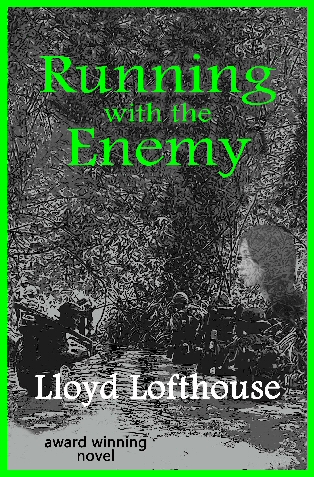
His latest novel is Running with the Enemy. Blamed for a crime he did not commit while serving in Vietnam, his country considers him a traitor. Ethan Card is a loyal U.S. Marine desperate to prove his innocence or he will never go home again.

And the woman he loves and wants to save was trained to hate and kill Americans.

To follow this Blog via E-mail see upper right-hand column and click on “Sign me up!”

Mirror, Mirror on the wall, who is the fairest superhero of them all?

Smithsonian.com published The Psychology Behind Superhero Origin Stories by Robin Rosenberg.

Rosenberg says, “As a clinical psychologist who has written books about the psychology of superheroes, I think origin stories show us not how to become super but how to be heroes, choosing altruism over the pursuit of wealth and power.”

Rosenberg says, “I’ve found that superheroes undergo three types of life-altering experiences that we can relate to.”

1. trauma

2. a life altering force is destiny

3. sheer chance

“At their best,” Rosenberg says, “superhero origin stories inspire us and provide models of coping with adversity, finding meaning in loss and trauma, discovering our strengths and using them for good purpose.”

Reading Rosenberg’s piece in Smithsonian after watching “To Whom it May Concern, Ka Shen’s Journey” the previous night helped me understand his explanation. Ke Shen’s Journey was a documentary on the life of Nancy Kwan.

You may remember Kwan in “The World of Suzie Wong” (1960), or “Flower Drum Song” (1961). And in 1961, she won a Golden Globe Award for Most Promising Newcomer in film.

In fact, Kwan’s father was a hero. During World War II, he was a spy for the British and when the Japanese discovered what he was doing, he took his two, infant children and fled Hong Kong disguised as a Chinese peasant. Another Chinese spy working for the British in Hong Kong wasn’t so fortunate. He was caught and beheaded by the Japanese.

For Kwon, her life altering experience was the loss of her only child, a son from her first marriage. Bernie died at age 33 in 1996. He contracted AIDS from his girlfriend whom Kwan had cautioned him to avoid.

Bernie had unprotected sex with the girl he loved. He didn’t use a condom. The girlfriend died of AIDS first and Bernie stayed by her side and cared for her to the end. Eventually, when the virus threatened his life, he moved home so his mother and stepfather could care for him, and they watched the son they both loved die slowly over a period of three years as he wasted away.

Today, almost age 75, Nancy Kwan actively supports the study of AIDS and the promotion of AIDS awareness.

I think Rosenberg is right, because I’m convinced that what he explains is one reason why I joined the U.S. Marines and later became a classroom teacher in a barrio high school populated by violent street gangs. I made a choice. We all make choices, but why do we make such choices?

For me it wasn’t trauma—at least I don’t think so—that motivated me to join the U.S. Marines. I think it was the role models I saw in Hollywood films. For example, John Wayne’s movies. By the time I joined the Marines in 1964, John Wayne had been in 158 films. A few that stick in my head are: The Fighting Seabees; Back to Bataan; They were Expendable; Fort Apache; She Wore a Yellow Ribbon; Sands of Iwo Jima; The Horse Soldiers; The Alamo, and The Longest Day, etc.

Of course, no film compares to the reality of combat and coming home from war with PTSD and/or recovering from a severe combat wound. Those factors are also a life altering force.

It seems to me that there are a lot of people in America that are not inspired to be a hero or altruistic.

The Department of Veterans Affairs says that 8.1% of the U.S. population are veterans. In addition, the NY Times reported that less than 1% of the American population is serving in the active military.  What does that tell us about the rest of America—not counting the physically and mentally disabled, police, teachers and firefighters?

Discover John Kerry, Purple Hearts, PTSD and WMD

_______________________

Lloyd Lofthouse, a former U.S. Marine and Vietnam Veteran, is the award winning author of The Concubine Saga.

His latest novel is Running with the Enemy. Blamed for a crime he did not commit while serving in Vietnam, his country considers him a traitor. Ethan Card is a loyal U.S. Marine desperate to prove his innocence or he will never go home again.

And the woman he loves and wants to save was trained to hate and kill Americans.

To follow this Blog via E-mail see upper right-hand column and click on “Sign me up!”

Rebuilding Lives

I bought an audio version of The Street of a Thousand Blossoms to listen to while driving (I am an avid reader and listener of books).

Gail Tsukiyama’s novel starts before World War II and concludes years after the war ends. The story is about the violent rebirth of a nation and its people through war and defeat told mostly through the eyes and emotions of two brothers.

Because I served in Vietnam in the US Marines as a field radio operator, my focus has been on what combat does to soldiers—not noncombatants. However, after reading Tsukiyama’s novel, it is easy to see that civilians that experience the horror of war may also suffer from the trauma of PTSD.

To get an idea of the destruction and suffering, more people may have been killed or injured in the firebombing of Tokyo than from the atomic bombs dropped on Hiroshima or Nagasaki near the end of the war.

The Tokyo Metropolitan Police Department reported that almost a 100,000 were killed in addition to a million injured with 286,358 buildings and homes destroyed. There were a million left homeless.

In comparison, it is estimated that 150,000 – 246,000 were killed from the atomic bombs, and if Japan hadn’t surrendered when it did, the US would have had seven more atomic bombs ready to drop on Japan’s cities before October 1945.

What led to the war in the Pacific?

Some of Japan’s leaders wanted to rule over East Asia, including China, and that quest for power cost Japan dearly and the nations it invaded.

However, in defeat, between 500,000 and 1,000,000 Japanese civilians were killed in addition to 2.12 million military. In comparison, in all of World War II, the US lost 1,700 civilians and 416,800 military. At Pearl Harbor, the US lost 2,402 military and 57 civilians.

What is not well known is that the decision to attack the United States was not unanimous in Japan’s government or military.

“Military control in prewar Japan was exercised by the War and Navy Ministers and the General Staffs of the Army and Navy, not by the civil government.” Source: ibiblio.org

In fact, “Higher Navy officials in Japan were against bombing Pearl Harbor, but the fleet commander, Yamamoto, threatened to resign unless given permission to launch the strike and the Navy staff reluctantly permitted it.” Source: Thornley.net

“To the conservative admirals of Japan’s Naval General Staff, a direct confrontation in the central Pacific Ocean between their navy and the Unites States Navy was unthinkable.” Source: Pacific War.org

In addition, Emperor “Hirohito said he was powerless to stop the militarists because any dissent on his part would have led to his assassination.” Source: Net Places.com

Then Japan’s Prime Minister Prince Fumimaro Konoe attempted to avoid war with the United States, and when he failed, he resigned from office on October 16, 1941 – six weeks before Japan attacked Pearl Harbor.”  Source: Wikipedia.org

Hiroshi and Kenji are the main characters in The Street of a Thousand Blossoms, and what they experience during the war is often worse than that of soldiers in combat. The sense of helplessness is acute because the characters in the novel cannot fight back as bombs are dropped on them or as Japanese police force them to comply with harsh wartime regulations.

Hiroshi dreams of becoming a sumotori (a Japanese form of wrestling) while his younger brother, Kenji, is obsessed with the craft of carving wood masks worn by the actors of Noh Theater, a classical Japanese theatrical form—one of the world’s oldest.

Before the war, the brothers’ parents drowned in a boating accident, and they are raised by their grandparents in the Yanaka district of northeastern Tokyo.

The war interferes with the boys’ dreams and rationing leads to hunger and the struggle to survive.

Because we are either with Hiroshi or Kenji during the horrific fire-bombing of Tokyo, and they also experience the iron fist of the city’s police to control the people while Japan is losing the war, we discover what it must be like to live in a nation that is being defeated.

The bombing of Hiroshima and Nagasaki ends the war, but the emotional wounds are slow to heal. However, Hiroshi and Kenji renew their passions and through them we see the healing of a defeated nation. It is a bitter sweet story that I highly recommend—a story of resilience and rebirth.


Gail Tsukiyama was born in San Francisco, California to a Chinese mother from Hong Kong and a Japanese father from Hawaii. She attended San Francisco State University where she received both her Bachelor of Arts Degree and a Master of Arts Degree in English with the emphasis in Creative Writing.

Discover Stanford Study shows effect of PTSD trauma on brain

_______________________

Lloyd Lofthouse, a former U.S. Marine and Vietnam Veteran, is the award winning author of The Concubine Saga.

His latest novel is Running with the Enemy. Blamed for a crime he did not commit while serving in Vietnam, his country considers him a traitor. Ethan Card is a loyal U.S. Marine desperate to prove his innocence or he will never go home again.

And the woman he loves and wants to save was trained to hate and kill Americans.

To follow this Blog via E-mail see upper right-hand column and click on “Sign me up!”

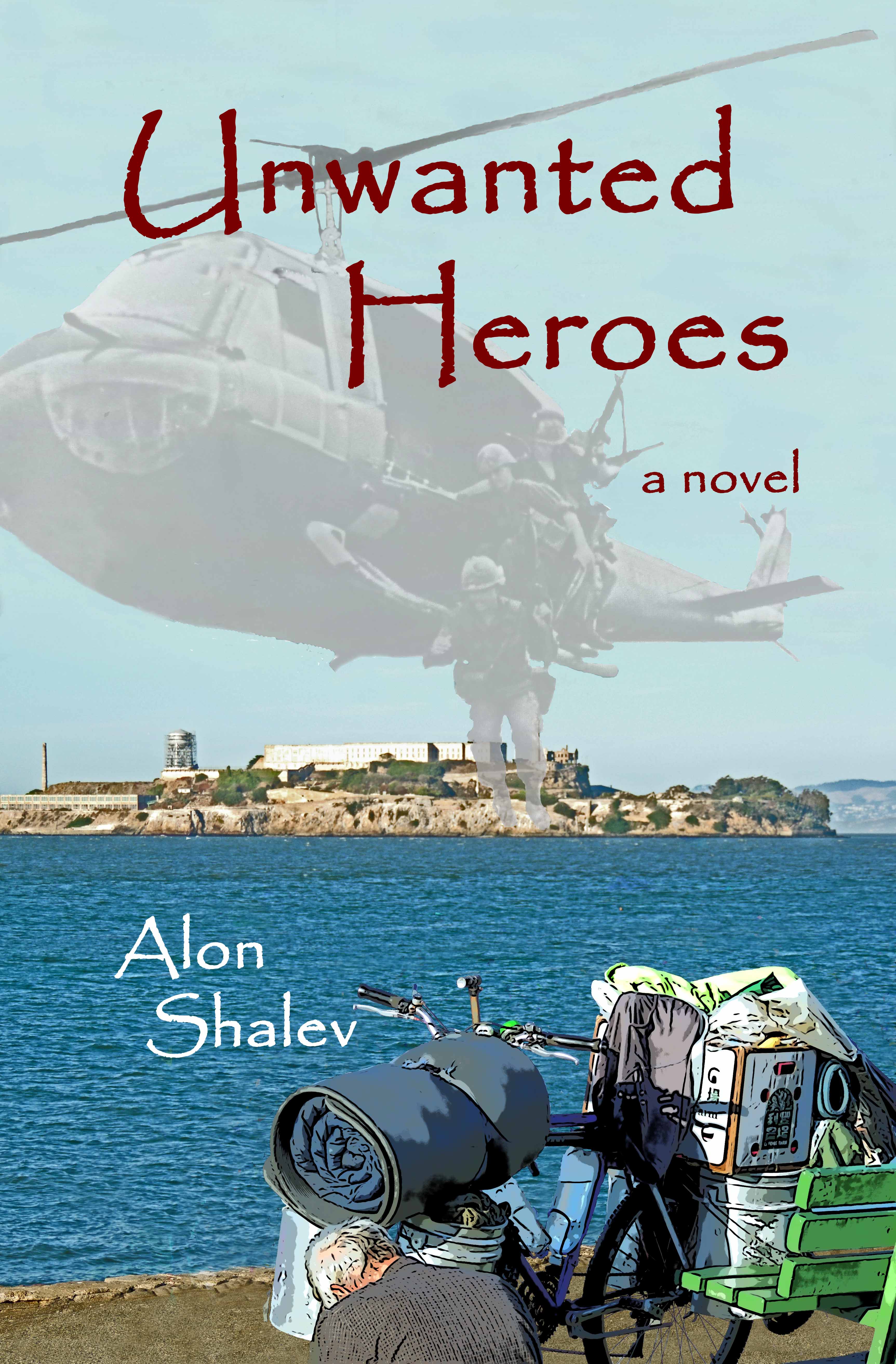
Unwanted Heroes

Many unwanted heroes defend our nation and fight its wars—right or wrong. When America’s leaders declare wars based on lies (for example: Vietnam and Iraq) or the truth (World War I, II, Afghanistan and Korea), unwanted heroes do the fighting and pay the price.

On the side of a bus at the VA medical clinic that I go to, it says, “All gave some; some gave all.” I have a credit card sized VA Department of Veterans Affairs ID card.  It says below my photo: “Service Connected.” That means I have a disability connected to my service in Vietnam in 1966 when I was serving in the US Marines.

What is the price many unwanted heroes pay for trusting their leaders?

This post has the same title of a novel that was recently released, and I had the privilege of editing Unwanted Heroes by Alon Shalev.

In Unwanted Heroes, Shalev brings together a long suffering, battle weary Chinese American Vietnam veteran suffering from the trauma of PTSD and an idealistic and somewhat pretentious young Englishmen, who both share a love for San Francisco, coffee and wine.

Alon Shalev, the author, grew up in London, and has been a political activist since his early teens. He strives through his writing to highlight social and political injustice and to inspire action for change.

Moving to Israel, he helped establish a kibbutz where he lived for 20 years and served in the Israeli army.

Shalev then moved to the San Francisco Bay area and fell hopelessly in love with this unique city. Being new to the US, however, he was shocked to see so many war veterans on the streets. He regularly volunteers at initiatives such as Project Homeless Connect and the San Francisco Food Bank where he meets and talks with war veterans. These experiences lend authenticity to the novel.

In fact, according to NIH (the National Institute of Health) Medline Plus, “PTSD affects about 7.7 million American adults” … and “members of the military exposed to war/combat and other groups at high risk for trauma exposure are at risk for developing PTSD.

“Among veterans returning from the current wars in Iraq and Afghanistan, PTSD and mild to moderate traumatic brain injury (TBI) are often linked and their symptoms may overlap. Blast waves from explosions can cause TBI, rattling the brain inside the skull.

“The U.S. Department of Veterans Affairs estimates that PTSD afflicts almost 31% of Vietnam veterans; as many as 10% of Gulf War (Desert Storm) veterans; 11% of veterans of the war in Afghanistan, and 20% of Iraqi war veterans.”

NIH says, “PTSD is often accompanied by depression, substance abuse, or other anxiety disorders.”

In addition, “between 529,000 and 840,000 veterans are homeless at some time during the year, and on any given night, more than 300,000 veterans are living on the streets or in shelters in the US. … About 33% of homeless males in the US are veterans and veterans are twice as likely as other Americans to become chronically homeless. One of the primary causes of homelessness among veterans is combat-related mental health issues and disability.

The incident of PTSD and suicide rates among veterans is also climbing and 45% of homeless veterans suffer from mental illness including PTSD. Source: Veterans Inc.org

The New York Times reported, “Suicide rates of military personnel and combat veterans have risen sharply since 2005, as the wars in Iraq and Afghanistan intensified. Recently, the Pentagon established a Defense Suicide Prevention Office.”

“The CDC Vietnam Experience Study Mortality Assessment showed that during the first 5 years after discharge, deaths from suicide were 1.7 times more likely among Vietnam veterans than non-Vietnam veterans. …

Why? “The average infantryman in the South Pacific during World War II saw about 40 days of combat in four years. The average infantryman in Vietnam saw about 240 days of combat in one year thanks to the mobility of the helicopter.” Source: History.com – Statistics about the Vietnam War

I did not seek help for my PTSD for thirty-eight years, because I did not know the VA offered counseling.

Discover A Prisoner of War for Life

__________________________

Follow this Blog via Email — sign in near the top-right corner of this screen and click “Follow”

PTSD and Homeless Veterans

In the Marines, we learned to never leave the wounded or dead behind.

I have lived with the symptoms of PTSD for forty-six years. I was fortunate. I was capable of holding down a job. I haven’t forgotten the homeless veteran I met in an alley early one early morning in Pasadena, California. I wrote about it in A Prisoner of War for Life.

The key is to learn how to cope. If you have PTSD, you will never get rid of it as if it were a cold or the flu. PTSD stays with you for life.

USA Today reported, “War might be making young bodies old. … The tragic signs of post-traumatic stress disorder or battlefield concussion are all too evident. Even more alarming for researchers is emerging evidence that these newest American combat veterans — former GIs and Marines in their 20s and 30s — appear to be growing old before their time. Scientists see early signs of heart disease and diabetes, slowed metabolisms and obesity — maladies more common to middle age or later.”

Some veterans are so damaged from combat experience, that they become homeless.

The population of the United States is more than 314 million people. The US Armed Forces that protects America’s civilians numbers 1.458 million—less than one-half-of-one-percent of the total US population. In addition, there are about 860 thousand military reservists.

In fact, the number of military veterans in the United States in 2012 was 21.8 million—6.94% of the total US population.

It doesn’t matter the reason a US citizen joins the military—patriotism or a financial need—and fights in one of America’s foreign wars. The fact that he or she served and put his or her life on the line or risked serious injury in combat,  I think that the ninety-three percent of the population that never served and risked life and limb owes those veterans an obligation.

That also means supporting homeless veterans with jobs and shelter.

The National Alliance to End Homelessness says, “The nation’s homeless population … went from 643,067 in 2009 to 636,017 in 2011. … The only increase was among those unsheltered.”

However, “The national rate of homelessness was 21 homeless people per 10,000 people in the general population. The rate for veterans was 31 homeless veterans per 10,000 veterans in the general population.”


PBS Documentary on Homeless Veterans – WORTH WATCHING if you have the time.

The Veterans Administration is the only federal agency that provides substantial hand-on assistance directly to Veterans who are homeless or at risk of homelessness.

Veteran homelessness is a problem of national importance. According to a count on a January night in 2011, there were 67,495 homeless Veterans. And an estimated 144,842 Veterans spent at least one night in an emergency shelter or transitional housing program in a recent year. Because of this, in 2009, President Obama and U.S. Department of Veterans Affairs Secretary Eric K. Shinseki announced the federal government’s goal to end Veteran homelessness by 2015.

An estimated 144,842 Veterans spent at least one night in an emergency shelter or transitional housing program in one recent year.

Many other Veterans are considered at risk of homelessness because of poverty, lack of support from family and friends, substance use or mental health issues, and precarious living conditions.

The VA has a hot line to support veterans who are homeless or at risk of becoming homeless. That number is: 1-877-4AID-VET (1-877-4243-838) Source: VA.gov/Homeless

In recent months, I have been editing a novel about PTSD and homeless veterans.  It isn’t my work. It was written by Alon Shalev, the author of  The Accidental Activist and A Gardener’s Tale.  His next novel is titled, Unwanted Heroes (to be published soon). It’s a story about healing and/or the failure to heal from PTSD. A love story is part of the mix too.

_______________________
Lloyd Lofthouse is a former U.S. Marine and Vietnam Veteran.

Low-Def Kindle Cover December 11His latest novel is the award winning suspense-thriller Running with the Enemy. Blamed for a crime he did not commit while serving in Vietnam, his country considers him a traitor. Ethan Card is a loyal U.S. Marine desperate to prove his innocence or he will never go home again.

And the woman he loves and wants to save was fighting for the other side.

To follow this Blog via E-mail see upper left-hand column and click on “FOLLOW!”

One Never Forgets

It has been forty-six years since I fought in Vietnam, and watching two movies rebooted my PTSD interrupting my sleep pattern. For years, I usually wake at least once a night and listen. However, since watching the movies, I wake every hour and listen to the night sounds.

In Brothers, one of the two brothers, a captain in the US Marines, goes to Afghanistan on his fourth tour of duty and becomes a tortured and abused POW.  After he is liberated and his captors killed, he returns home suffering from severe PTSD trauma. Tobey Maguire plays Marine Captain Sam Cahill and does a convincing job playing a veteran that is severely damaged by PTSD symptoms.

Watching Maguire act his part reminded me of my first decade back from Vietnam when I drank too much and often woke once or twice and carried a loaded weapon around the house checking the doors and windows.  More than once, when overwhelmed by a burst of anger, I punched holes in walls with fists.

The anger comes fast—one moment you are calm as a rusty doorknob and an instant later an exploding fragmentation grenade.

In the Valley of Elah, Tommy Lee Jones plays a father, who was also a Vietnam combat veteran, searching for answers to explain his son’s death soon after returning from Iraq. In this film, we see how war strips young men of their humanity—that thin veneer that comes with so-called civilization.

From Brothers, I was reminded of the homeless Vietnam veteran I met in an alley in Pasadena, California one early morning. He had been a prisoner of war and similar to the character Tobey Maguire plays, was severely traumatized with PTSD symptoms.

The VA rated the homeless vet I met in that Pasadena alley as 100% disabled by PTSD possibly explaining why he was homeless—not because he could not afford an apartment.  The disability from the VA was more than enough to support him.  However, most of that money went for drugs and booze for him and his homeless buddies.

Then there was another vivid image of a Vietcong POW being tortured by South Korean troops during a field operation I was on.  The South Koreans hung that Vietnamese POW by his heels from a tree limb and pealed the skin off his body while he lived.

In the Valley of Elah reminded me of an ambush where a team of Marines I was a member of went out in a heavy rain at sunset and after an hour or so of slogging through the gloomy downpour, we stopped in a rice paddy with water to our necks and stayed there for more than an hour waiting for complete darkness before moving into position. We shared that rice paddy with a very large king cobra.

In the Marines, one does not question orders—we do or die—so we stayed in that paddy knowing a king cobra was in the water with us.

Both of these films are dramatic examples of what war does to young men and their families.

Some combat veterans avoid seeing films such as these two. However, I do not. I do not want to return to that time where I avoided talking and thinking of my part in the Vietnam War, because at night when we struggle to sleep there is no escape. We cannot hide from the monster that came home with us living inside our skin as if it were an unwanted parasite.

Discover A Prisoner of War for Life

_______________________

Lloyd Lofthouse, a former U.S. Marine and Vietnam Veteran, is the award winning author of The Concubine Saga.

His latest novel is Running with the Enemy. Blamed for a crime he did not commit while serving in Vietnam, his country considers him a traitor. Ethan Card is a loyal U.S. Marine desperate to prove his innocence or he will never go home again.

And the woman he loves and wants to save was trained to hate and kill Americans.

To follow this Blog via E-mail see upper right-hand column and click on “Sign me up!”