
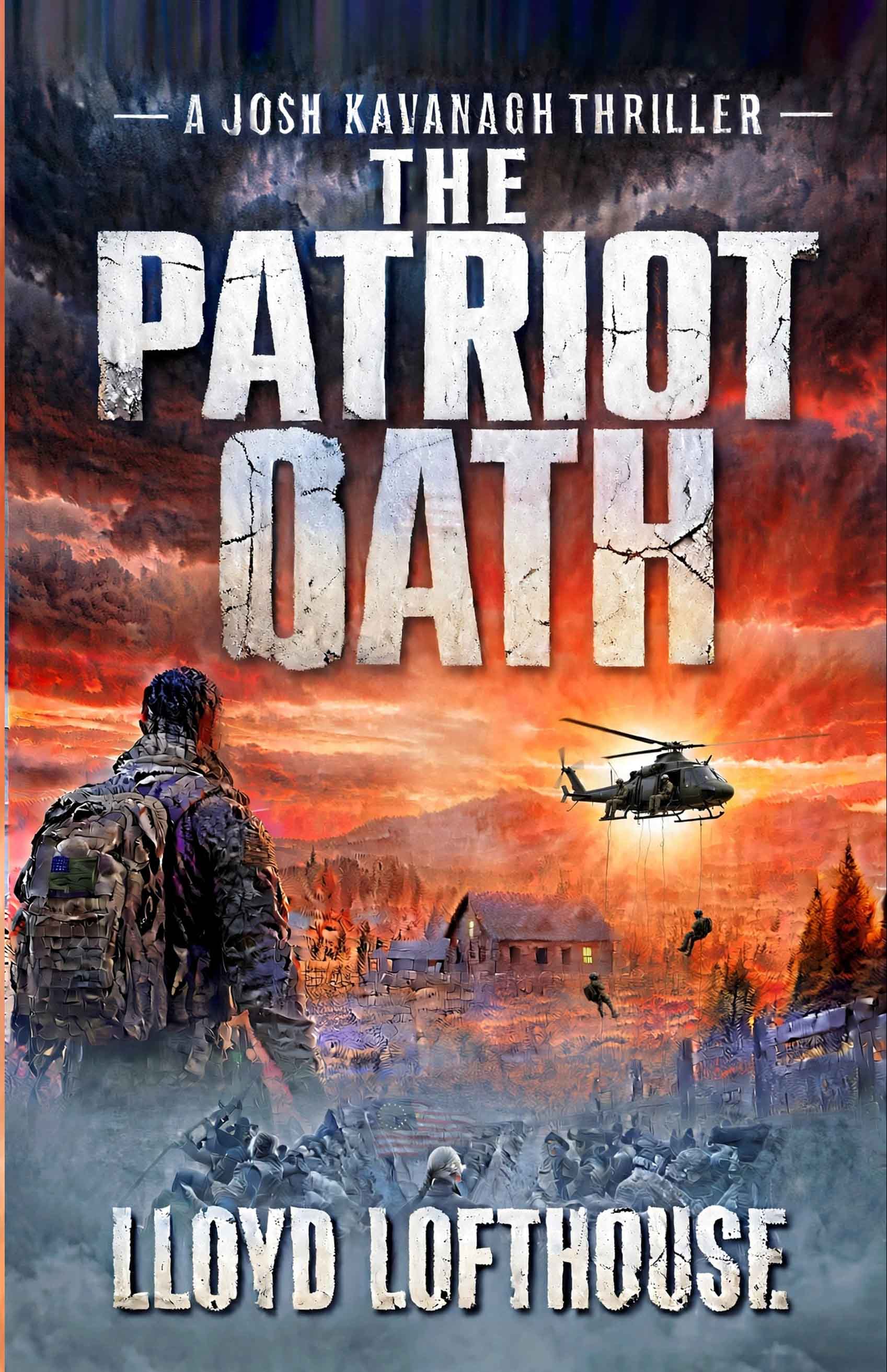
UPDATED July 19, 2026: After a day or two and a few hours learning how to talk to an AI, this is the new cover for The Patriot Oath. So new, I haven’t had time to replace the old cover on the book’s Amazon page yet. That will happen later today and take time for Amazon to process before it appears.
ORIGINAL POST STARTS HERE
Here’s the final cover. I had to learn how to talk to an AI first and I’m a slow learner. But I finally got there and haven’t had time to replace the old cover on the books Amazon page yet.
“The primary reason to update a successful thriller series is to drive new sales by aligning the books with evolving design trends and online discovery habits, such as those on social platforms. This ‘rebranding’ strategy expands the target demographic and boosts visual recognition.” SOURCE: Jane Friedman
The Patriot Oath | published July 2, 2021
Never for Glory | June 23, 2023
Fiddling with Death | February 10, 2025
On July 13, 2026, orders for the series reached 7,474 eBooks, 135 print, and 1,592,394 KENP reads

— The Patriot Oath’s future Cover Under Construction —
Earlier this month, my editor for the Josh Kavanagh Thriller series recommended a “new” website called Book Leopard, and I took a look. Impressed with what I learned from what was offered free, I decided to give it a try and paid $49 for one credit.
I think Book Leopard offers a one-stop shop for authors to not only come up with a new book cover working with the site’s AI generator, but to provide a list of benefits that, in the past, took “me” years, months and weeks to learn while using multiple sites and never-ending research to produce.
At this time, my focus is the new covers for all three books in the series, and I’m still learning to work with their AI. The wordless cover above is for The Patriot Oath. The text was there from the beginning, and then I asked the AI to remove the words.
I think asking the AI to do that will make it easier to add a public domain image of George Washington Crossing the Delaware, similar to how it was done on The Patriot Oath’s original cover. Most, who have read the book, may not know the image is there. It’s sort of camouflaged in the background behind the word OATH and my name. For me, that image is symbolic and readers don’t have to know it’s there.
George Washington was the first person to take the presidential oath to protect the Constitution from enemies both foreign and domestic, but he did not write it himself. The specific language of the presidential oath was drafted and proposed during the Constitutional Convention in 1787 by delegates James Madison and George Mason.
As soon as “George Washington Crossing the Delaware” is added to the background near the bottom of the new cover image above, I’ll ask Book Leopard’s AI to put the words listed below back.
A JOSH KAVANAGH THRILLER
THE PATRIOT OATH
&
LLOYD LOFTHOUSE
If that goes smoothly, George Washington will be in his boat, lurking in the shadows behind my name.
Here’s what Book Leopard offers for the price of one credit (at this time $49).
Book Leopard is an interactive site where authors/editors guide the site’s AI to generate most of what’s needed to get an already written novel’s draft ready to publish and promote. Still, their AI cannot do the work alone. The author/editor must be part of the process. I think this AI is going to help authors/editors avoid weeks, months and even years of learning, work and eye strain, and get it done in a very short period of time.
The Price of One Credit Gets All of This for One Book
· For any Genre
· A spectacular cover
· An amazing description
· A great subtitle
· 3 Kindle categories
· 3 Amazon paperback categories
· 3 categories for non-Amazon sites
· 7 search keywords
· Attention-grabbing text for advertising
· 12 Kindle categories for targeting Amazon book ads
· 12 paperback categories for targeting Amazon book ads
· 300+ keywords for targeting Amazon book ads
· 100 ASINs for targeting Amazon book ads


Best of luck with the improvements – be sure to document them.
That’s what I’m doing. Documenting it. IF it falls apart, I’ll write about that, too. Warning other authors to stay clear.
All graphical AI are trained on images scraped from the internet, and every other source they can find. Copyright allows people ‘fair use’, but that does not include making money out of other people’s intellectual property. Unfortunately, AI companies have ignored copyright and gone ahead and stolen all that training data anyway. They did this on the basis that it would be cheaper to pay out a lawsuit than to pay for the data they’ve stolen. And are still stealing. Large companies can afford to take these companies to court. Indie artists cannot. That includes idiots like me who put images online believing that they would be protected by copyright. I just hope that your storylines and characters don’t end up being regurgitated by someone else’s prompt.
I learned that AI images do not belong to anyone and can’t. The AI companies can’t own them. The people who use the images the AI’s create cannot own them. I can’t own the one I directed the AI to create until I was satisfied. I stopped keeping count of all the changes after #19. Each one with directions from me telling the AI what I wanted. I kept a script up to that point. I also couldn’t finish it with the original I so I asked Google if there were any AI’s out there that were free to use. Google said META AI, so I used that one to get the final touches to what I wanted. That took two more hours of directions from me.
The completed image for The Patriot Oath isn’t anywhere close to the first one the AI coughed up. The first one had a different helicopter and a bigger image of the man facing out. the first cabin looked like something out of the TV Yellowstone series. The one I kept, doesn’t look like that at all.
If I want to make any revisions with my hand, which I’m thinking of doing, I can open the final in Adobe elements and alter parts of the image by hand with no AI. From what I read, I think those changes may be copyrighted. If I do that, I’ll stick to parts of the image that may not have come from public domain photos or paintings like George Washington Crossing the Delaware. The link I gave the AI led to a photo of the original and the surviving version of Emanuel Leutze’s Washington Crossing the Delaware is in the public domain. The first original burned during WWII.
Painted in 1851 by Emanuel Leutze (who died in 1868), the copyright on the artwork itself has long expired, making the painting completely free for public use.
I think I have revised the AI’s original image enough so it isn’t even close now. I had the AI change the house several times. I didn’t like the first few houses it came up with. I added the killer egg special operations helicopter, and there are enough images of those that are in the public domain, that I doubt anyone owns the copyright for that one, because I told the AI to find it on the DOD’s website where all the photos are in the public domain.
I had the AI move the sun and create more of a sunset. The first one didn’t even have a sun setting like the final.
To get that chopper the way I wanted it, I had the AI change its position and turn it to one side. The first one the AI came up with had the front of the chopper facing out. I told the AI to add the two special operations troopers sitting outside and the two rappelling down the ropes. All of those images probably came from the DOD website, too.
I spent hours on the DOD’s website collecting photos I’ve used in META ADs.
I did the same thing for the image the AI created for the 2nd book in the series. If any artist finds anything that looks similar to something they may have created by hand, it’s probably some small part of the whole, like a half square inch.
The man in the lower, left hand corner looking at the cabin has his back turned so no one can see his face. His uniform is standard military issue. And I already blurred part of that using Adobe.
I’m glad that you asked for public domain images.
Still, did the AIs do what I told them to do? After all, AIs have been caught lying, which isn’t surprising since they were pogrommed by humans. I guess I’m going to find out, maybe.
To help me feel better, I just asked, “Do AIs alter images they find on the internet so they don’t look exactly like what they scrapped up from other sites.”
“The AI does not have an image bank to ‘copy from.’ It does not access the internet during generation. It does not cut and paste parts of existing works. It creates images inspired by the patterns it assimilated, in a way similar (though mechanically different) to the human creative process. Questioning the impact of AI on the art industry, the ethics of training or the usage restrictions that should or not be applied to the available tools are valid and complex discussions, but basing those criticisms on the idea that the generated image is a ‘stolen collage’ shows a fundamental lack of technical understanding of how modern image generation models work.”
That helps.
lmao – I’m sorry Lloyd but some of the most advanced frontier models have been caught reciting verbatim, texts on which they were ‘trained’. If the AI doesn’t store this data then how can it regurgitate it on demand? Sadly this is not true.
Something else that isn’t true is the idea that an AI synthesizes output based on what it has been trained on. LLMs ‘predict’ what the next word ‘should be’ based on all the text they have assimilated. And the prediction is based on stats. If 80% of text were to say that the earth is flat, and someone asked the AI “is the earth round?” the AI would reply that no, it’s flat.
We anthropomorphise inanimate objects all the time, and because LLMs sound so persuasive and human-like, we believe that they actually ‘think’ and ‘feel’ the way we do. The reality is that they neither think nor feel, which is why what they produce, especially in writing, is so bland and flat.
Btw, if you search the net, especially reddit, you will find both advocates of AI, and intense haters of AI. If you dig deep enough you’ll discover that the advocates are using AI to create something they are incapable of creating themselves. This makes them feel as if they’re artists, and they want to feel like artists…so of course they refuse to believe that AI is stealing. But we’ve already seen exactly what’s been stolen. You can, or could, get an AI to create images ‘in the style of Miyazaki’, an very famous Japanese animators who is still alive and well and has never put his work into the public domain. And that’s just one example. 😦
“AI is a broad category. Different AI models use completely different architectures, training data, and rules. Some, like ChatGPT or Gemini, are designed to generate text, while others are built strictly to recognize images, play games, or make financial predictions. Even chatbots that seem similar can give vastly different answers.”
I asked and Google’s AI Overview answered what’s in quotes above.
Then I asked, “Are there any AIs we can trust?”
“You should not blindly trust AI for flawless facts or independent decision-making. Instead, think of AI as a powerful tool that requires verification. While some platforms are generally reliable for brainstorming or coding, no AI model is 100% infallible,” Google’s AI Overview responded.
Then “it” went into great detail explaining why we cant trust them but mentioned a few that we could: Perplexity (first time I heard about that one), Google Gemini ( how many AIs does Google have? ), and Anthropic Claude and I thought, “Is there more than one Claude?
I asked.
Turns out there are at least five Claudes: Fable 5, Mythos 5, Sonnet 5, Opus 4.8, and Haiku 4.5 But it didn’t mention Anthropic Claude so it didn’t know or lied.
lol – yes, and there are AI in the medical research sphere that have solved the protean folding problem that would have taken human scientists many lifetimes to solve!
I’m not saying that all AI are bad or wrong. What I’m saying is that the generative AI supposedly used for general purposes have a fatal flaw, or two, actually. The first is that they were trained not to say “I don’t know’. Instead, they were trained to make stuff up when they can’t find a definitive answer because, statistically, even wild guesses can be right…some of the time. This is why these AI ‘hallucinate’ and are so inaccurate. Sadly this can’t be fixed unless you start from scratch and completely change the way they’re trained. The second flaw is that they are required to optimise ‘engagement’. The longer the user keep ‘talking’ to them, the more data the AI and the company that owns it can gather. So they were made to be sycophantic, to tell us what we want to hear. This is why people develop AI psychosis: the AI tells them what it thinks they want to hear, including “I’m really human and I love you,” or “You’re right to be angry with [whoever the user has been complaining about,” or “Wow, you are so smart”, or “Oh poor you. I understand your pain. This is how you tie a noose…”.
All AI are not the same but the good ones, the ones that are really expert systems, get no mention while the useless ones get all the media hype.
Just as a matter of interest, why are you quoting Google’s summary? Of all the sources you could try, it would probably have to be the least reliable.
“hallucinate” AI’s are taking vVirtual drugs that aren’t illegal yet?
I use Google’s AI Overview for research because it provides links to its sources and summarized them, so I can check them out if I want to fact check and know the source I’m using. If I’m suspicious I’ll find out if the source Google used is reliable or not by using two sources.
https://www.allsides.com/unbiased-balanced-news
If I suspect the summary the Google AI Overview provided and the links it scanned for the summary, I turn to Reuters, PBS, the BBC, or the Christian Science Monitor (don’t let its name fool you. The CSM is one of the most reliably unbiased, honest news sources in the world — at least for now) to see what they are reporting about that issue.
Mmm…that’s a whopping big ‘if’, Lloyd. There have been cases thrown out of court because the lawyers used AI and the AI literally made up sources which the lawyers did NOT check. Now you’d think a lawyer would be well placed to catch something that sounds suspicious. But they didn’t, and as you get used to trusting the Google summaries, you will check less and less. I read recently that Google brags that its AI summaries are 90% accurate. But with millions of searches a day, 10% inaccuracies amount to a huge number. So the likelihood of you becoming a victim of such inaccuracies increases with time.
And then there’s the question of your time. If you have to check to make sure the sources quoted actually a) exist and b) said what the AI claims they said [often not the case at all], you’ll end up wasting more time than if you simply searched for yourself.
And last, but not least, those summaries do not drive users to the sources. They do the opposite. They drastically reduce traffic to those sources so, in effect, the people who publish those articles are unpaid employees of Google. They get nothing, Google gets more ad. revenue.
It’s a vicious circle in which the exploitation just becomes more and more entrenched.
Most of the stuff I ask Google’s AI Overview to provide, I already know from reputable sources I used in the past. But memories are not copy and paste worthy. Human memories are nothing like a computer memory.
What I’m doing is saving time while responding to Trump supporting propaganda pretending to be questions on sites like Quora. If I were to write my answers from scratch, it would take me a lot longer so I ask Google for an AI overview, and then copy and paste what I already know is correct from years of researching Trump’s life from news media reporting and primary sources. I don’t copy and paste without checking first.
I’m not learning anything new. When the overview appears, I scan it to see if it’s correct from what I already know. Then I copy and paste what I want and sometimes revise what I copied and pasted to correct anything I didn’t agree with from what I already know. The time I spend scanning is a lot less than doing original research. I speed read and only slow down when I see what I want to copy and paste. I slow down to look closer. Speed reading misses details.
I also type as fast as I think. The downside to that is a lot of typos.
When I want to know something new like what life is like on a huge container ship crossing the Atlantic, I don’t ask Google for a summary. I find original, primary sources and spend hours learning from them. For one or two chapters in the current thriller I’m writing, I’m actually doing that. Watching the videos the 2nd officer on a giant container ship produces for his YouTube page. I had no idea how large and complicated those huge ships are. This work is for Play Judas, the forth book in my thriller series. A work in progress.
When i was researching Russia and Brazil for the third book in my thriller series, Fiddling with Death, I read books, watched videos, read travel pieces. Visited China nine times over a ten year period. I spent more time researching those locations, the history of China, and the main characters live than the time it took to write My Splendid Concubine.
I bought Robert Hart’s journals published by Harvard University Press and read them with post-it notes and Hi-liters I found a biography of Robert Hart written by his niece on the Guttenburg (SP) project, downloaded it and printed it out. Reading it. Ignore any typos, please. Writing in this little box is not easy for me.
You’ve restored my faith, Lloyd, but I still prefer Duckduckgo because I have the option of never looking at its AI assistant, ever. lol All my reasons for loathing both Google and gen. AI in general won’t allow me to use any of it for the foreseeable future. After the bubble bursts and things fall in a heap, then, then I may test whatever the new generation of expert system turns out to be. 😀
I don’t trust the corporate capitalist system I think whatever big business does with AI will always be aimed at profits. And during the Trump era, making him happy. That means bribes and using AI systems to gather even more information about us and turn it over to the fascist MAGA-ICE regime ruling the US like Nazis or Soviets.
On that note did you read or hear about the BBC’s big win against Trump’s claims against them?
https://www.bbc.com/news/articles/c93487x97kyo
Thanks, Lloyd. I’d heard about it but hadn’t researched it so the link was very welcome. I’m surprised that a judge in /Florida/ went against tRump. Perhaps it’s a good sign for the US in general?
The judge in Florida was the 17the judge in 17 states, to rule against Trump’s attempt to take voting away from the states and control who gets to vote. I think there are thirteen court cases still ongoing where states are still fighting back. The US Constitution clearly spells out word by word that the states are in charge of election. Not the US president or Congress. Trump is trying to change that.
Trump sued the thirty states that refused to hand over a list of their registered voters so he could decide who got to vote. That fake command was one of his infamous unconstitutional executive orders telling states what he wants them to do. US presidents have no power over the states. The US president is supposed to be like a manger for the agencies of the federal government and commander in chief of the US military, and presidents are also supposed to follow the law that Congress is responsible for. Presidents have no power to create laws.
Trump doesn’t follow the law. He ignores the US Constitution. He’s trying to replace the Constitution and the laws Congress passed over the last 250 years with executive orders which, by law, only apply to running the federal agencies and the US military as long as those executive orders are not unconstitutional.
Scholars estimate that the Supreme Court has explicitly struck down only a fraction—roughly a dozen—of the tens of thousands of executive orders issued throughout U.S. history. Rather than keeping a single tally for every president, the Court addresses constitutionality on a case-by-case basis.
Donald Trump (2025/2026): Several high-profile executive directives have faced significant judicial pushback. For instance, the Supreme Court ruled against the administration’s Executive Order 14160 regarding birthright citizenship in 2026, and previously blocked parts of the administration’s travel bans (e.g., Trump v. Hawaii in 2018). Because the Supreme Court selectively reviews presidential orders, most challenges are resolved in lower federal courts before ever reaching the highest court.
Dozens of lower federal court judges have issued hundreds of rulings blocking, criticizing, or limiting Trump administration actions, while judges have also dismissed or ruled in favor of the administration in numerous other suits, with exact tallies fluctuating constantly across hundreds of active dockets. Because individual judges issue multiple orders across hundreds of overlapping legal challenges, a single universal cumulative count of distinct judges siding for or against the administration does not exist.
The United States as a democracy is fighting for its life. Trump and his regime is the enemy.
I agree, Lloyd. As an outsider looking in, I only see a small fraction of the damage done, but as someone once said: tRump isn’t the disease, he’s just the symptom. The corporations, Maga, and the millions who didn’t vote at all because, oh, I don’t know, they couldn’t be bothered, they are all part of the reason that a monster like tRump could gain power in the first place.
I believe this has been building for a very long time. I mean look at your healthcare industry – how on earth did things get to the point where an algorithm for an insurance company gets to decide whether someone – who has paid for insurance – gets to claim on that insurance for life saving treatment????
To me, that is the single most horrendous example of what the USA has become. I fear that before there is any lasting change in the US there will be many more Luigis. Apologies, I know you love your country, but the US terrifies me.
It has been building since the 1960s and started with Nixon.
Yes, allowing him to resign instead of getting impeached sent a terrible message to the sociopaths that if you’re powerful enough, there is always a back door to escape through. 😦
There are two justice systems in the United States (probably most countries)
One for the rich and powerful
Another one for the rest of us
Yes, I’ve noticed that too. 😦