Letters from Home

While I was in Vietnam, many Marines in my communication’s platoon didn’t get mail—ever. Since my family and friends wrote often and sent packages with cookies, candy and books like Anne Rice’s Interview with the Vampire and Tolkien’s Lord of the Rings, I had books to fill the days when we weren’t in the field. At night when I was on radio watch in the bunker, I read too. I shared with my “brothers” in uniform who didn’t get anything. The cookies were popular. I loaned the books out too.

If someone who has never faught in a war listens to the news, it sounds like our troops are fighting 24/7. My mother believed it. Evertime she heard about combat and deaths on the news, she cried. My dad told me this after I came home.

Too bad, she didn’t know the truth.  During those down times, soldiers get lonely and think about home. For me, books helped fill the empty hours. Those books also helped get my mind off what was waiting at night and beyond the wire when I wasn’t on a field operation, out at night with patrols or was involved in ambushes that we were setting up. No one wants to be the target of an ambush we don’t plan—I was the target in a couple of those too.

Because of my experiences in Vietnam, during the first Gulf War (2 August 1990 – 28 February 1991), I organized a letter writing campaign with my secondary English students in La Puente, California.  One girl’s older brother was in Kuwait, then he moved on to Iraq after the war started in earnest. When his letters arrived, class time was set aside for his sister to share what was happening to him. I feared we might hear he had been killed. But he was fortunate and made it back in one piece.

Recently, I joined Operation E-Book Drop. This program offers free e-books to our troops in Iraq and Afghanistan. Any troop with a computer may sign onto Smashwords.com and download a book if they have the coupon code. They have to request the codes through the program. More than two hundred authors and nine publishers have joined this program.

Another program, Book Readers for SF (Special Forces—kindlesf@gmailcom), is putting Kindles in the hands of troops that belong to Special Forces in Afghanistan. Many of these soldiers are stationed in remote, rugged, mountain outposts.

Now, I’m adopting a Spc. in an Aviation Regiment from Operation Desert Swap http://operationdesertswap.webs.com/.

I’m mailing a copy of my novel, My Splendid Concubine, and will send cards and gifts when holidays come along.  Once we have been in combat, I don’t think any veteran forgets what it was like.

Discover Stanford Study shows effects of PTSD trauma on brain

_______________________

Lloyd Lofthouse, a former U.S. Marine and Vietnam Veteran, is the award winning author of The Concubine Saga.

His latest novel is Running with the Enemy. Blamed for a crime he did not commit while serving in Vietnam, his country considers him a traitor. Ethan Card is a loyal U.S. Marine desperate to prove his innocence or he will never go home again.

And the woman he loves and wants to save was trained to hate and kill Americans.

To follow this Blog via E-mail see upper right-hand column and click on “Sign me up!”
A Prisoner of War for Life

It was still dark when I reached Dr. Vessey’s house in Pasadena.  It was late 1999 or early 2000. As sunlight leaked over the horizon, we drove to an alley behind a liquor store where the good doctor was going to meet with some homeless people he’d been helping. One of the homeless people was a Vietnam veteran who wouldn’t let the doctor near him. That’s why I was along—to gain the man’s trust.

I was about to find out how bad combat induced PTSD could be when the VA considers a veteran is 100% disabled. Since the vet I was going to meet couldn’t be trusted to handle his VA disability check, his payments went to a pastor, who was his financial guardian. The pastor decided how much to give him when he came to the church asking for money. The VA disability was enough to rent a studio apartment, but this vet chose to live on the streets where he felt safer. His home was under a blue tarp hidden in some thick brush that lined the side of an empty lot. Later, the doctor drove me there so I could see it.

This vet’s story of abuse was inhuman and tragic. He was a chopper pilot in Vietnam and was shot down becoming a POW where, among other things, he was sexually molested by the Vietnamese guards. I’m not sure I would have survived what he went through.

Dr. Vessey and I arrived first. We parked the car and entered the alley to wait. The homeless people started to arrive one or two at a time until there were about a dozen.  One even crawled out of the Dumpster behind the liquor store. The vet along with two women arrived last. We squatted in the alley and talked. I told the disabled vet my Vietnam story, and he said it was obvious that I’d been there.  Then he opened up and told us his story.

Before he finished, a helicopter (media or police—I’m not sure) flew over, and the vet surprised us when he yelled, “Incoming,” and leaped to his feet running toward what he thought must have been a bunker and safety—the back, brick wall of the liquor store. He ran into the wall and the sound of his body hitting the bricks was a sickening thud as if he were a side of beef being hit by a sledgehammer. He bounced off the wall and collapsed unconscious.  We rushed to him and gathered around. One of the homeless women cradled his injured head in her lap. There was a thick, swollen contusion on his forehead.

He had hit that wall hard enough to rattle the shelved bottles inside, and two men working in the liquor store came around the corner a moment later. They thought a car had hit the store.

This vet would always be a prisoner of war.

_______________________

Lloyd Lofthouse is a former U.S. Marine, Vietnam Veteran, journalist and award winning author.

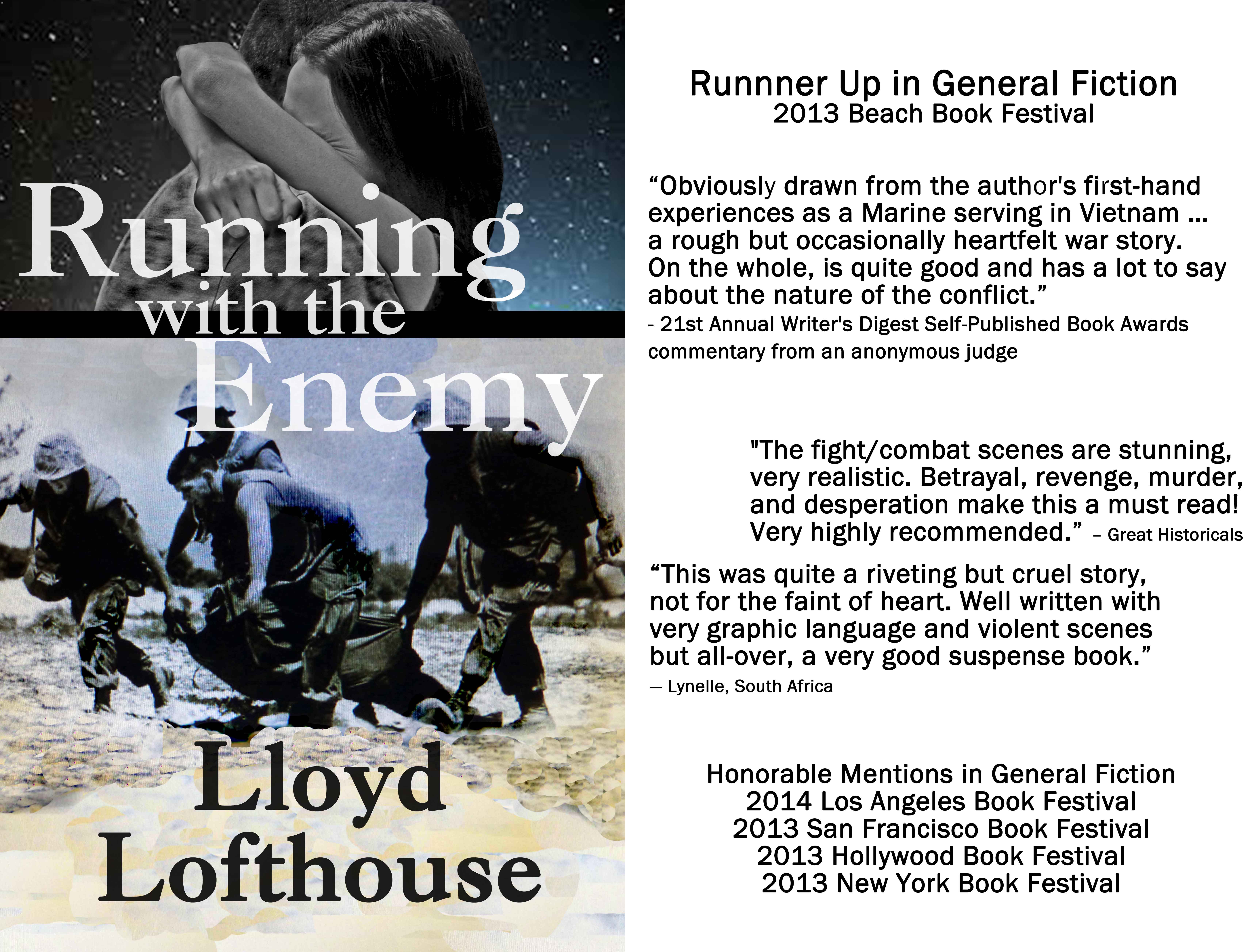
His second novel is the award winning love story and suspense-thriller Running with the Enemy. Blamed for a crime he didn’t do while serving in Vietnam, his country considers him a traitor. Ethan Card is a loyal U.S. Marine desperate to prove his innocence or he will never go home again.

Promo Image with Cover Awards

Where to Buy

To follow this Blog via E-mail see upper left-hand column and click on “FOLLOW!”

What is PTSD?

Most combat veterans that have PTSD, Post Traumatic Stress Disorder, do not talk about it.  Many are heavy drinkers attempting to drowned the disorder to keep the monster at bay. Booze and drugs do not work. They make the vampire worse. Get your life back. Support and understanding is out there.

What is post-traumatic stress disorder, or  PTSD (visit this source for more information)?

PTSD is an illness. You can get PTSD after living through or seeing a dangerous event, such as war, a hurricane, or bad accident. PTSD makes you feel stressed and afraid after the danger is over. It affects your life and the people around you.

If you have PTSD, you can get treatment and feel better.

Who gets PTSD?

PTSD can happen to anyone at any age. Children get PTSD too.

You don’t have to be physically hurt to get PTSD. You can get it after you see other people, such as a friend or family member, get hurt.

What causes PTSD?

Living through or seeing something that’s upsetting and dangerous can cause PTSD. This can include:

  • Being a victim of or seeing violence
  • The death or serious illness of a loved one
  • War or combat
  • Car accidents and plane crashes
  • Hurricanes, tornadoes, and fires
  • Violent crimes, like a robbery or shooting.

There are many other things that can cause PTSD. Talk to your doctor if you are troubled by something that happened to you or someone you care about.

Combat PTSD: What are the Symptoms?

http://ptsdcombat.blogspot.com/2006/03/combat-ptsd-what-are-symptoms.htmlIntrusiveRe-experiencing of the traumatic event(s)

  • Distressing recollections
  • Flashbacks (feeling as if you’re back in combat while awake)
  • Nightmares (frequent recurrent combat images while asleep)
  • Feeling anxious or fearful (as if you’re back in the combat zone again)

AvoidantDrawing inward or becoming emotionally numb

  • Extensive and active avoidance of activities, places, thoughts, feelings, memories, people, or conversations related to or that remind you of your combat experiences
  • Loss of interest
  • Feeling detached from others (finding it hard to have loving feelings or experiencing any strong emotions)
  • Feeling disconnected from the world around you and things that happen to you
  • Restricting your emotions
  • Trouble remembering important parts of what happened during the trauma
  • Shutting down (feeling emotionally and/or physically numb)
  • Things around you seem strange or unreal
  • Feeling strange and/or experiencing weird physical sensations
  • Not feeling pain or other sensations

Since returning from Vietnam in 1966, I couldn’t put a term to the symptoms I was experiencing. For fifteen years, I was a heavy drinker and never talked about what happened. The nightmares that are called flashbacks came at night and were vivid and real. There are many nights even now where I will wake and listen for warning sounds that danger is near. I’ll reach for the weapon I keep close to where I sleep to make sure it is still there.

Learn more from PTSD Vet Charged with Murder

_______________________

Lloyd Lofthouse, a former U.S. Marine and Vietnam Veteran, is the award winning author of The Concubine Saga.

His latest novel is Running with the Enemy. Blamed for a crime he did not commit while serving in Vietnam, his country considers him a traitor. Ethan Card is a loyal U.S. Marine desperate to prove his innocence or he will never go home again.

And the woman he loves and wants to save was trained to hate and kill Americans.

To follow this Blog via E-mail see upper right-hand column and click on “Sign me up!”

The Uncles of World War II

I read a post in another bog yesterday by a GI who came back from Iraq with PTSD. He mentioned that World War II veterans didn’t suffer from PTSD. Someone at the VA told him that.

Bull shit! The truth is that PTSD has been around for thousands of years. It is nothing new. The only difference is that we now have a name for it.

Three of my uncles fought in World War II. Two were in the navy and fought in the Pacific. My mother’s younger brother lied about his age and joined when he was seventeen. He worked with radar and submarines and stayed in the navy for thirty-three years. He retired a lieutenant commander.

My dad’s older brother James was on the USS Hornet when the Japanese sunk her early in the war. Along with hundreds of others, he ran along the flight deck and then the hull as the aircraft carrier rolled over. Destroyers picked him up along with other survivors. Uncle James was a drunk. When he was in his seventies, he died a drunk. I’m sure his drinking was caused by the war.

Uncle James came to the house once and told my dad to leave my mother and his sickly son, because we weren’t worth it. My mom picked up a cast iron frying pan and chased him down the street hitting him with it. She told him to never come to the house again if he was drinking. I never saw him again.

Uncle Lloyd was my mother’s younger brother. Since he worked for the railroad, the Army sent him to India where he was put in charge of munitions trains running bombs and ammunition to the Burma Road where trucks carried death across the mountains. On the other side of the Himalayas, the war with Japan raged in China and Southeast Asia.

Uncle Lloyd hitched a ride in one of the munitions trucks and arrived in Burma close to the front lines. At one point, he had to run for his life during a major Japanese assault. To escape capture or death, he waded across what he thought was a rice paddy only to discover it was an open cesspool.


The construction of the Bruma Road

He escaped, flew back to India and came down with a skin disease. His hair, his fingernails and his skin started to come off. He was sent back to the states and spent months in the hospital as army doctors struggled to save his life from the bacteria/fungus that was eating him alive.

Uncle Lloyd lived to be ninety-three. He told me that every few months he had to go to the nearest VA hospital and soak in a tub of purple liquid to control that bacteria/fungus. Most veterans don’t talk about what haunts them. Uncle Lloyd had his combat demons too. He awoke often through the decades remembering wading through that neck-high shit to escape the Japanese.

_______________________

Lloyd Lofthouse, a former U.S. Marine and Vietnam Veteran, is the award winning author of The Concubine Saga.

His latest novel is Running with the Enemy. Blamed for a crime he did not commit while serving in Vietnam, his country considers him a traitor. Ethan Card is a loyal U.S. Marine desperate to prove his innocence or he will never go home again.

And the woman he loves and wants to save was trained to hate and kill Americans.

To follow this Blog via E-mail see upper right-hand column and click on “Sign me up!”

The Creative Writing Class at war with the Vietnam Vet

The GI Bill helped pay my way through college. In 1971, I was in my third year; attending my third college. My third college was Fresno State. I was in a creative writing class when a debate about the war in Vietnam started after a young girl read her short story about ‘evil’ American pilots dropping bombs on North Vietnamese children.

I was the only Vietnam veteran in the class. I struggled to explain to the obviously brainwashed kids that American pilots dropping bombs over North Vietnam were thousands of feet above the targets and did not see the carnage. They were gone by the time the bombs exploded, and they were following orders. In the military, you followed orders or faced a court martial.

“How could someone sleep at night knowing they had dropped bombs killing innocent children and women,” one girl said. Others joined in, and the discussion turned into an argument. It was them against me. It was frustrating. The consensus was that any American in Vietnam was a baby killer. To them, the American pilots had to know what they were doing and were evil.

Eventually, the professor put a stop to the argument.

My first night in Vietnam, I relayed an order that killed a dozen Vietcong. I never saw the bodies. I never saw them die. I was in the radio tent a hundred yards from the action when a call came from one of the tank commanders saying there was noise in a ravine that led to the top of the hill. During the day, wires had been strung in that ravine with tin cans tied to them and there were rocks in the cans.

The tankers heard the rattle of rocks and called asking for permission to fire napalm into that gully. The officer on watch said yes, and I relayed the order. The tankers lit their flame and fired. The next morning, twelve blackened, burned bodies were found in the ravine. They all had weapons. They were coming to kill United States Marines.

Our colonel had devised a plan, and it succeeded. He had given no orders to build bunkers or spread concertina wire along the perimeter to protect us on our first night in country. The platoon of flame tanks had been left aboard the Navy ship until dark when they were brought ashore and guided to the hill where the platoon of tanks was positioned to protect against an attack.

In Europe during WWII, American bombers firebombed cities nightly during the closing months of the war against Hitler’s Germany. In one night, in one city, forty thousand civilians including women and children had napalm dropped on them. In Japan, firebombs dropped on Tokyo burned a hundred thousand in one day. There were no attempts to avoid hitting civilians to bring Hitler’s Germany and Japan to their knees. It was understood that war was ‘hell,’ and we fought to win. What has changed?

Discover A Night at the “Well of Purity”

_______________________

Lloyd Lofthouse is a former U.S. Marine and Vietnam Veteran.

His latest novel is the award winning suspense-thriller Running with the Enemy. Blamed for a crime he did not commit while serving in Vietnam, his country considers him a traitor. Ethan Card is a loyal U.S. Marine desperate to prove his innocence or he will never go home again.

And the woman he loves and wants to save was fighting for the other side.

To follow this Blog via E-mail see upper left-hand column and click on “FOLLOW!”

John Kerry, Purple Hearts, PTSD and WMDs

John Wayne movies molded my young brain, and fired my imagination. As a child, I dreamed of being a hero. Then at nineteen, I went to war and my thinking changed drastically. Narrow escapes from death ended my hero dreams, and I was fortunate to arrive home from Vietnam without a Purple Heart.

They say close only counts in horseshoes. I say it also counts in war. This morning, I awoke thinking about John Kerry and how his reputation was smeared during his presidential campaign.

 John Kerry fought in Vietnam. He was wounded three times. They were not serious wounds, but they drew blood. Even flesh wounds earn Purple Hearts. One wireman in my communications platoon was awarded a Purple Heart. While in the field sleeping in his shelter half, his unit came under attack. Mortar rounds dropped in like hail. Half asleep, he scrambled out, tripped on one of the lines that held his shelter half up, fell and hit his head on something.  He needed stitches. His sergeant put him in for a Purple Heart.

One of the tankers in that action was scrambling to get into his tank. In his rush to get inside the protection the tank offered, he slammed the turret hatch on one of his hands and crushed all the bones in it. He was also awarded a Purple Heart. He earned a ticket home too, and was discharged from the Marines with a VA disability for the crushed hand.

Bob, a history teacher I taught with, was in the Navy and served in Swift Boats like Kerry. Bob was the mechanic that kept the twin engines running. He told me once that the safest place in that swift boat was between the twin engines. On the water, the swift boat was an easy target and the metal hull was thin.

Those of us that did not bleed during combat and never earned Purple Hearts were still changed by narrow escapes from death. I had several and came home with a case of PTSD that still haunts me decades later.

John Kerry’s flesh wounds show that he came close to death. Yet, during his campaign for president, Swift Boat Veterans for Truth cast doubt on his courage, and George W. Bush, the man who used family influence to get into the National Guard and avoid combat, somehow became a hero, walked into the White House and served as president for eight years starting two wars. I have no idea what kind of president John Kerry would have been. I wonder if he would have used bogus evidence for WMDs and invaded Iraq.

Abraham Lincoln said “You may fool all the people some of the time, you can even fool some of the people all of the time, but you cannot fool all of the people all the time.”

_______________________

Lloyd Lofthouse, a former U.S. Marine and Vietnam Veteran, is the award winning author of The Concubine Saga.

His latest novel is Running with the Enemy. Blamed for a crime he did not commit while serving in Vietnam, his country considers him a traitor. Ethan Card is a loyal U.S. Marine desperate to prove his innocence or he will never go home again.

And the woman he loves and wants to save was trained to hate and kill Americans.

To follow this Blog via E-mail see upper right-hand column and click on “Sign me up!”

Heavy Drinking and Flashbacks Sink a Marriage

In December 1966, I returned from Vietnam.  For fifteen years, I didn’t think about the war or talk about it to anyone, at least not on a conscious level.

Instead, I drank—a lot. Beer, wine, mixed drinks. It didn’t matter. I grew up with an alcoholic father and older brother. My fraternal grandfather was an alcoholic and so was my father’s older brother James. Alcohol almost ended the marriage between my mother and father. After an ultimatum from my mother, dad quit drinking to save the marriage. By then I was twelve. He was a great guy sober.

Due to that childhood environment, I swore I would never drink.

The war changed that. Before shipping out to Vietnam, I started drinking twenty-five cent pitchers of beer on base in Okinawa to fit in since so many Marines drank. There was nothing else to do when off duty. Once, we were so broke, several of the Marines in my unit pooled pennies, and I went into the village across the street from Camp Hanson’s main gate and bought a cheap bottle of Japanese slow gin.  After the first glass, you lost the feeling in your nose, fingers and toes. When you woke up twelve hours later, you were still drunk. The hangover came later. I discovered that codeine or some other drug was part of the mix in that slow-gin bottle. The cheapest drunk was rubbing alcohol mixed with Coke or Pepsi. We filled a helmet and passed it around until the mix was gone. The next morning, some guy would be sitting inside my head pounding on an anvil with a sledgehammer.

During the fifteen years between 1966 and 1981, I often relived the war in surrealistic flashbacks where Vietcong would be in the house, and I went on patrol with a Ka-Bar or a twelve -gauge shotgun. One night in 1977 at 2:00 AM, my first wife left the bedroom to get a glass of water. She returned while I was fighting ghosts.

To me, she was the enemy, and I pushed her against the wall in the hall outside the bedroom and held the tip of that seven-inch blade against her throat. She calmly talked to me until I was somewhat aware of my real surroundings, and we went back to bed. She never mentioned that scene during the remaining years of our marriage, but I have never forgotten.

In 1981, I stopped drinking and soon was talking and writing about the war. I woke this morning thinking about that moment in the hallway in 1977. The war is always close.

Discover A Night at the “Well of Purity”

_______________________

Lloyd Lofthouse, a former U.S. Marine and Vietnam Veteran, is the award winning author of The Concubine Saga.

His latest novel is Running with the Enemy. Blamed for a crime he did not commit while serving in Vietnam, his country considers him a traitor. Ethan Card is a loyal U.S. Marine desperate to prove his innocence or he will never go home again.

And the woman he loves and wants to save was trained to hate and kill Americans.

To follow this Blog via E-mail see upper right-hand column and click on “Sign me up!”