
Tag Archives: marines
Like Frankie McGrath, I wasn’t a baby killer
My review of this realistic, historical action suspense thriller will join hundreds of thousands already on Amazon and Goodreads. Still, how many of those ratings and reviews were written by Vietnam combat vets who were there?
Soon after this novel was released, The Women was mentioned in my VA PTSD support group that meets every Wednesday morning. This support group may differ from many since half are women that served in the Air Force, the Navy, with one a Marine, who served in the Middle East. In combat!
Later that day, I saw The Women at Costco and bought a hardcover.
The main character in this novel is a young Army nurse, and the first half of this brutal combat story mostly takes place in Vietnam. Although Frankie McGrath was an Army nurse saving lives in a field medical unit beyond the front lines, and not behind them, she didn’t fight in combat. Yet she was in combat, every moment, awake or asleep. I’m going to explain what I mean soon.
For me, reading this historical fiction became a triggered journey back in time. And I started losing sleep, waking at the slightest sound. Alert, ready to fight.
Remembering!
And by the time I finished reading, I was angry.
My DD214, a form we get when we leave the military and return to civilian life, had one entry that said I’d gone on one major military operation for a few days during 1966. Yet I was in combat almost daily after climbing down that net (like the kind used on D-Day during World War II) on the side of a Navy transport ship, jumping the last few feet into a landing craft that took us Marines ashore. As we landed, fighting was taking place not that far from our location on the beach. And a few hours later, the first night we were there, my company was hit before we’d finished setting up our base camp. We had no wire surrounding us yet, and none of the bunkers had been completed.
All of Southern Vietnam was a war zone. It didn’t matter if you were inside the wire, in a bunker, we were always in the war. No place was safe. We didn’t have to go out on a major field operation to find the war. It found us almost nightly and sometimes in daylight.
Frankie McGraths’ medical unit was inside the wire, protected by bunkers, almost all the time, yet her unit was also under attack, as VC or North Vietnamese mortar rounds dropped in without warning, looking for random kills.
Like me, McGrath has some close calls inside the bunkers and wire. Like me, she lost friends. Like me, she came home to protestors calling her a baby killer. And she shot no one. Instead, she saved lives, even Vietnamese citizens, including children. She was a nurse. Not a US Marine rifleman. Not a grunt like me.
Some protestor in the story spit on her once she returned to the States. I’d heard about that when I came home in December 1966, but being spit on didn’t happen to me.
McGrath suffered from PTSD as I did, and we still do. Yet when she went to the VA for help, she was told no women served in Vietnam and she couldn’t have PTSD. They sent her back home. When she returned to the VA later, after a traumatic episode of PTSD, and tried to join a group of combat vets to share her trauma with, the men told her she couldn’t stay because she couldn’t be a combat vet. No women served in Vietnam. She left again, with no support.
And yet thousands of military women served in Vietnam.
Maybe what happened to McGrath is like what happened to me.
Her being told women didn’t serve in Vietnam reminded me of something someone working in VA-mental health care said to me after 2005. I don’t remember the exact wording but it was something like, Your PTSD can’t be that bad, since you only went on one military operation.
WTF!
Like McGrath, VC mortar shells dropped into my base camp without warning to kill at random. One time, in daylight, a sniper almost took me out. The round grazing my left ear. An inch further to the right, my body might have been shipped home with a Purple Heart my parents could hang on a wall in the same case the folded US flag arrived in.
Then, unlike McGrath, there were the night patrols and ambushes outside the wire that were not part of a major military operation, that were not mentioned on my DD214.
Or that mad dash with sniper rounds snapping past us while we drove at top speed through the jungle, me in an unarmored jeep with no doors on a one lane dirt road to reach a forward artillery base outside the division perimeter that had been hit hard and needed to be resupplied before they got hit again. While I was there, they got hit again, a rain of mortar shells and rockets, when one Marine lost his life, decapitated by a rocket.
I recommend reading The Women for the reality it paints and when you finish the story, read the author’s notes, to learn that about 10,000 women served in Vietnam, many just like McGrath.
Lloyd Lofthouse is the author of military action suspense thrillers: The Patriot Oath, Never for Glory, and Running with the Enemy, a novel placed in Southeast Asia during the Vietnam War.
War is HELL – People DIE!
I know a combat artist who served two tours in Vietnam. He carried a camera, a sketch pad, and a rifle. I remember him telling us that not too many combat artists in his unit made it back alive from Vietnam. He was there to document the war for the U.S. Army and he spent a lot of time in combat with front line units exposed to enemy fire doing his job because he was taking photographs and sketching U.S. troops in combat, who were being shot at and shooting back, while he was doing his job.
That’s about the same as a combat journalist. They are paid to go where the fighting is taking place.
Since 1990, 2658 journalists have been killed.
“Over 50% of journalists were killed in the ten most dangerous top spots featuring countries which suffered war violence, crime and corruption as well a catastrophic breakdown of law and order. Iraq (339 killed) came top followed by Mexico (175), Philippines (159), Pakistan (138), India (116), Russian Federation (110), Algeria (106), Syria (96)Somalia (93) and Afghanistan (93).”https://www.ifj.org/fileadmin/user_upload/IFJ_white_book__part_1.pdf
“24 hours ago (from the date this post was published) — 63 journalists and media workers were confirmed dead (covering the war in Gaza): 56 Palestinian, 4 Israeli, and 3 Lebanese.”
World War II was the largest and most violent military conflict in human history. Official casualty sources estimate battle deaths at nearly 15 million military personnel and civilian deaths at over 38 million.
The Korean War lasted for three years and claimed the lives of over 800,000 military personnel and around one and a half million civilians.
In 1995 Vietnam released its official estimate of the number of people killed during the Vietnam War: as many as 2,000,000 civilians on both sides and some 1,100,000 North Vietnamese and Viet Cong fighters. The U.S. military has estimated that between 200,000 and 250,000 South Vietnamese soldiers died.
In Afghanistan more than 432,000 civilians have been killed in the fighting since 2001, and even with our troops gone, they are still dying, being murdered by the Taliban because Traitor Trump gave the country back to them when he made a secret agreement to end that war without approval from Congress.
I am a combat vet. I am a former U.S. Marine. I served and fought in Vietnam in 1966. During the time my unit served in Vietnam, 50% of the Marines that served in the 1st Marine Division, 1st tank battalion were casualties.
I could not have kept count of the number of times I was fired at and my unit and division returned fire. War is hell! People get killed and wounded in war. Civilians of all ages, journalists, and troops.
And the evidence is mounting that Hamas, a brutal, ruthless terrorist organization, is deliberately using Palestinian civilians as defenseless human targets, forcing the IDF to kill civilians when having a shootout with terrorists, who do not value life, even their own. It doesn’t matter if those Palestinian civilians are in hospitals or schools. Hamas wants the IDF to kill as many Palestinian civilians as possible because it looks bad for Israel in headlines around the world. When Hamas fires rockets into Israel from Gaza, those rocket launchers are always surrounded by civilians with no place to run, when Israel fires back with rockets and bombs to destroy those Hamas missile launchers and the terrorists that man them.
International rules and laws that say troops shouldn’t kill civilians during a war, never work. NEVER! Bullets and bombs can’t tell the difference between the troops and civilians. If you are in the military in combat and your unit is fired on, you fire back. And while you are shooting to defend yourself and your buddies in uniform, you think, “FUCK THOSE DAMN RULES!”
In Vietnam we had the same rules Israel is expected to fight by, while the world’s media doesn’t condemn Hamas for ignoring those rules and deliberately getting Palestinian civilians killed.
WTF!
Hamas is guilty for every single Palestinian civilian death in Gaza regardless of who shot the bullets, dropped the bombs, or fired the missiles that killed them.
Josh Kavanagh Thriller Series launched with Never for Glory
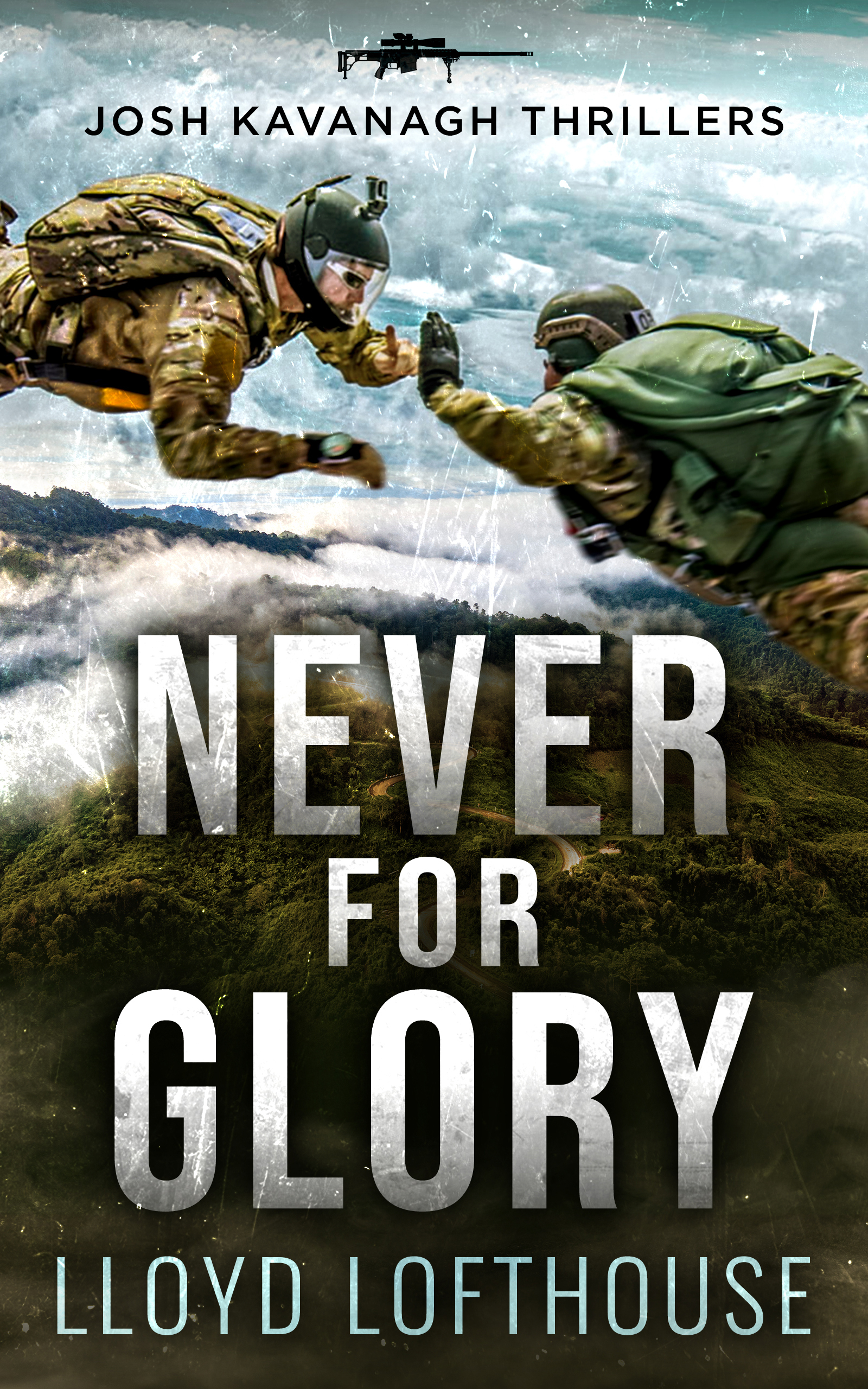
He’d give his life for his country. But this time, it’s personal.
Josh Kavanagh burns for vengeance. Parachuting with no backup into a lawless area of southern Venezuela, the Special Ops legend is intent on hunting down the rogue agent who put his wife in a coma. But as soon as he gets feet on the ground, the loyal protector discovers he’s dropped into a trap… and a sex trafficking operation run by the Russian mob.
Fighting his way out and desperate to rescue the victims with minimal body count, Josh plans a daring raid on a remote ranch. But after learning the identity of the mastermind behind the hit on a former lover, the talented operative takes the law into his own hands on a hell-bent solo mission for revenge…
Will Josh’s single-minded thirst for justice finish on the wrong side of a gun barrel?
Never for Glory is the pulse-pounding second book in the Josh Kavanagh thriller series. If you like determined heroes, tough conflict ripped from the headlines, and page-turning action, then you’ll love Lloyd Lofthouse’s pursuit of payback.
Buy Never for Glory to retaliate with deadly force today!
The first thriller in this series was The Patriot Oath.
“Here’s a pull quote from Chuck Yarling’s 1-star review on Amazon. “Once you started reading it, this was one book that was absolutely hard to put down. It has great characters, action galore, and about a group whose mission is to preserve the American republic. That made it hard not to put it my top ten books I read this year!”
“Yes, it was a gem right up to the near-end …”
He fought for his country. Now he’s home and engaged in the deadliest of battles.
Josh Kavanagh eats and breathes loyalty. Wary of how he’ll fit in after a twenty-four-year absence, the Special Forces legend returns to his family’s Montana ranch on an undercover mission. And though he’s anxious to see the high school sweetheart he abandoned a lifetime ago, the dedicated Marine’s greatest concern is tracking down a dangerous neo-Nazi cell.
Juggling unresolved feelings for the woman he left behind, a sister expecting him to avenge her brutal rape, and keeping his own covert activities secret, Josh discovers the threat to the US is bigger than anyone previously thought. And when a member of his team goes MIA and the danger creeps perilously close to home, the talented military man fears he’ll lose everything he holds dear…
With a tangled web of corruption pulling deadly strings, can he blow a conspiracy apart without paying the ultimate price?
The Patriot Oath is the riveting first book in the Josh Kavanagh thriller series. If you like war-hardened heroes, action-packed fight scenes, and powerful political agendas, then you’ll love Lloyd Lofthouse’s gripping adventure.
“Never for Glory,” a work in progress, the sequel to “The Patriot Oath”
Never for Glory is the unfinished sequel of The Patriot Oath. With 25 completed chapters, there are about 10 to 15 left to finish the first draft. The first five chapters have already been presented to two of the four critique groups I belong to. One of the two groups has heard all of The Patriot Oath. The second group hasn’t, and I am getting conflicting constructive criticism from the two groups. One group is suggesting a lot of changes, and the other group familiar with the first novel in the series likes what they’re hearing with little need for massive revisions.
With this post, I’m inviting readers that have read The Patriot Oath to have a look at Never for Glory’s first chapter and, if wiling, to leave comments letting me know what works, what doesn’t. Thank you. If this early preview works, I have another four chapters I’m willing to add to this post later.
Chapter One
After their first HALO jump together in 2002, Josh and Cheéte vanished into the Hindu Kush Mountains, a rugged area covering 160,000 square miles. Their orders had been to search for targets of opportunity, and for weeks they worked alone with little or no support.
Now, in 2019, seventeen years later, they were doing it again. Still, this time their C-130 belonged to The Oath Group, and it was 30,000 feet over Venezuela.
Getting ready for the repeat was like déjà vu all over again. Back then, they were Marine Corps scout snipers serving in Operation Anaconda against al-Qaeda, Taliban insurgents, and members of the Islamic Movement of Uzbekistan. That had been their last mission together. Cheéte retired a few months later in 2003.
“I can’t believe my ghillie suit still fits,” Josh said. “It feels the same, hot and heavy. Too bad DARPA wouldn’t let me use that invisible, bulletproof combat suit for this mission. It was perfect last summer for our sortie in Montana.”
Cheéte grunted as he finished squeezing into his old camouflaged ghillie suit. Once he had it on, he looked like an unkempt yeti that needed to lose some weight. “Well, some of us don’t always get what we want. You’ve been out for less than a year so I’m not surprised your suit fits, but I think mine is going to eat me like it’s a starving anaconda.”
They were talking to each other through their helmet’s military-grade communication units.
Josh grinned as he fastened a g-suit around his abdomen and legs, covering most of the camouflaged outfit he wore underneath. Then he manually inflated the g-suit’s five air bladders. The pressure around the muscles would prevent blood from pooling in the feet and legs and push blood pressure up to the heart and brain. The last thing he did was to attach the oxygen mask and tactical goggles.
With a frustrating sigh, huffing, and puffing, Cheéte managed to do the same thing. Once they were on the ground, they’d ditch the gear required for the HALO jump. Their ghillie suits were designed to conceal them from prying eyes.
Like most Marine Corps snipers, they’d made their own unique disguises by hand and, when not in use, stored them in sealed, plastic boxes lined in cotton and kept dry with silica gel packets.
“I’m worried my Christian Crow wife knows about my two other common law wives,” Cheéte said, interrupting Josh’s thoughts.
Josh did a double-take and stared at his old friend. “Whoa! Where the hell did that come from?”
“Well, in case I don’t make it home, I wanted you to know what’s going on in my life. My Christian wife said the only reason for sex is to create children for God. When I said no more kids, she cut me off. There’s no way I’m going without. I refuse to let my demons have an excuse to mess up my nights. What about you?”
“I have nothing to confess to anyone,” Josh replied.
“Ah, … what about Rachel and Mia?”
A green light came on, signaling that it was time to jump. At the same time, the C-130’s ramp started to yawn open, depressurizing the cabin.
Josh stood, ready to go.
“Well?” Cheéte asked.
“I haven’t had sex with anyone since Rachel was shot in San Francisco and is still in the hospital. So, I’m not that desperate.” Finished, he walked off the aft ramp and dropped from sight, falling 30,000 feet toward the ground.
“Sheesh,” Cheéte hissed. “That’s not what I wanted to hear.” Then he was dropping with his belly pointed toward the ground, his chin lifted up, and his arms and legs spread out for stability.
As Josh fell hard and fast, he thought about Rachel and Mia. He’d lied to Cheéte. He was desperate, explaining why he was losing a lot of sleep. But he disagreed with the crap that sexual frustration was normal. So, shrug and take it in stride.
Bull shit! he thought. He couldn’t remember ever being celibate this long before.
The temptation to keep both of his lovers, as Mia had suggested, was almost overwhelming. But, when he thought about going through with it, he heard Dr. Tate’s voice telling him that would be wrong. Then there was the Christian guilt his mother instilled in him as a child with the Seventh Commandment, “Thou shall not commit adultery.”
He still didn’t understand why his mother started preaching that to him when he was seven. It couldn’t have been because of his crush on Rachel in 2nd grade. He never told anyone about that. There was no way his mother could have known.
To escape the jumble of depressing thoughts stirring up trouble inside his head, he gave himself over to the plunge. Jumping from 30,000 feet felt more like flying than falling. It was windy, loud, and intense. Josh’s senses became wildly alive. That’s why he had an obsession for HALO jumps. The thrill lasted about three times longer than a basic skydiver’s altitude.
With a stable belly-to-earth position, the fastest speed he’d reach was 120 mph. If he wanted to fly faster, he’d shift position so his head was facing the ground and his feet were pointed up. Then he’d drop at 180 mph. Josh had always wondered what it would be like to die like that. Every time he jumped, he’d been tempted to find out.
Checking out of life like that also offered him an easy way to avoid deciding between Rachel and Mia. Because this was a high altitude low open insertion, the main chute was programmed to open automatically at 1,900 feet. If that failed, the reserve chute deployed at 1,000.
The best way to bail out of life would be to use one of his keen-edged combat knives and cut the straps that held the two ‛chutes to his body. He had about a minute left to make that decision.
Was there a better way to die if you were doing something you loved? He started laughing and thought he sounded possessed.
Still, there was Damian Bran, the man they were hunting. He was the one responsible for Rachel living in a hospital, trapped in a coma. Wasn’t that a good enough reason to hang on?
Bran had been a heartless CIA agent for thirty years who left the agency in 2009. He was also known as the Strawman because of his tall, thin stature. Soon after he retired, he’d joined a white supremacist neo-Nazi militia in Montana and ended up working for a ruthless libertarian billionaire, a match made by Mephistopheles.
Josh had been hunting Bran since Rachel had been shot. His efforts to find the former CIA agent had started by putting the man’s wife under surveillance. There had been no calls or texts in or out. Instead, she hadn’t budged from their home in a remote area of Minnesota and didn’t seem to care if she ever saw her husband again.
After The Oath Group’s successful raid in Northwest Montana on that neo-Nazi training camp, Charles Tweet, the billionaire that financed the militia, revealed it was Bran who introduced him to the profitable sex trade. It turned out that the former field agent had started trafficking children years before he left the agency.
Most of the young sex slaves Bran sold to Tweet had ended up working in massage parlors spread across the United States. But some of the most beautiful had suffered a worse fate. If one of them was unfortunate enough to catch the billionaire’s eye, they were doomed.
His last intended victim had been a seventy-six-pound thirteen-year-old Ukrainian girl. The billionaire had slipped a plastic bag over the child’s head while he was raping her. When Cheéte had burst into the underground room where it was taking place, the girl was being suffocated by Tweet, using a method known as erotic asphyxiation.
Later, during his interrogation, Tweet revealed that Damen Bran had introduced him to that risky erotic method. When the billionaire accidentally murdered his first victim, Bran had shrugged it off and said, “Females were created for two purposes. To give men pleasure, and if they survive, to make babies. Besides, when you’re kidnapping children and selling them for a profit, expect to lose a few. Think of it as collateral damage, a business expense.”
Tweet accepted that justification as gospel and had gone on to murder more than a dozen young girls over the years that followed. Now, the billionaire was in court, fighting to avoid spending the rest of his life in prison. The judge had not approved bail, but his lawyers were claiming the evidence was inadmissible.
The information that pinpointed Bran’s location in Venezuela had come from Mia Belle-Chanson, one of Josh’s best friends and a former lover. To her fans, she was a singer-songwriter and a documentary producer. What her followers didn’t know was what she did away from a studio or stage. Because she’d been kidnapped in Haiti at the age of fourteen to become a sex slave, she now operated a secret network that rescued abducted children all over the world. Josh had met Mia when he and Cheéte had rescued her and several other girls soon after they’d been snatched.
Venezuela was the perfect country for a brute like Bran. After Venezuela’s President, Nicolas Madura’s rise to power in 2013, sex trafficking and child sex tourism had become common, and it was getting worse.
The intel from Mia’s rescue organization reported that Bran was living on an isolated cattle ranch located in Venezuela’s savanna southwest of the Rio Apure River.
Having second thoughts about dying, Josh checked his altimeter to determine how much time he had left to decide one way or the other.
Mosquitoes Before and After the bloodsuckers Attack
For a few days, some of the Marines in my company, including me, were sent to a hill on the perimeter at Chu Lai to watch over an infantry company’s equipment while they were in the hills chasing North Vietnamese ghosts.
There weren’t many of us–just enough for two Marines to man each of the smaller bunkers near the foot of the hill.
Rice paddies surrounded the hill. When night came, the hum of mosquitoes sounded like waves of alien flying saucers, then the rest of the night was a battle against the bloodsuckers.
Several Marines scrambled into the largest bunker at the top of the hill—a two-story model with iron boiler plate for a roof. They thought they would be able to escape the bloodsuckers in there. But as fast as they went in, they came out screaming. The bunker was full of rats and as the first Marine put his boots on the floor, the rats started climbing his legs.
During my watch between midnight and four, I heard a rustling noise near the wire. There would be long stretches of silence (if you don’t count the sound of distant firefights and flares), then another rustling as if someone were crawling up the hill. I couldn’t see anything and thought it might be a small animal.
When my watch ended, I had to visit the latrine. It was a screened, plywood box with a four-hole plywood bench inside. It was black as ink in there. Under the bench were four half-empty, fifty-five gallon metal drums with several inches of diesel fuel in each one. In the mornings, the drums would be dragged out from under the plywood bench and set on fire. When day came, hundreds of columns of black smoke would drift lazily into the morning sky over Chu Lai.
I had cramps—what I call green apple trot. I leaned my weapon just out of reach against the three-foot high plywood wall in front of me and sat. Above the plywood was a screened in open space that allowed air to flow through. There was a tin roof. On both sides was a line of tents where the grunts (infantry) kept their gear and slept.
That’s when the grenades started to go off. I glanced to the left to see a shadowy figure running along the line of tents tossing a grenade through each opening. I reached for my weapon as a wave of cramps doubled me over. I thought I was dead.
No one died on that hill that night. The tents were empty because the grunts were in the hills and we were in the smaller bunkers near the concertina wire. I was closer than anyone in my unit but was fortunate the latrine was ignored.
How many events like this does it take to acquire Post Traumatic Stress? What happened to you? What do you remember?
_______________________
Lloyd Lofthouse, a former U.S. Marine and Vietnam Veteran, is the award winning author of The Concubine Saga.
His latest novel is Running with the Enemy. Blamed for a crime he did not commit while serving in Vietnam, his country considers him a traitor. Ethan Card is a loyal U.S. Marine desperate to prove his innocence or he will never go home again.
And the woman he loves and wants to save was trained to hate and kill Americans.
To follow this Blog via E-mail see upper right-hand column and click on “Sign me up!”
Letters from Home
While I was in Vietnam, many Marines in my communication’s platoon didn’t get mail—ever. Since my family and friends wrote often and sent packages with cookies, candy and books like Anne Rice’s Interview with the Vampire and Tolkien’s Lord of the Rings, I had books to fill the days when we weren’t in the field. At night when I was on radio watch in the bunker, I read too. I shared with my “brothers” in uniform who didn’t get anything. The cookies were popular. I loaned the books out too.
If someone who has never faught in a war listens to the news, it sounds like our troops are fighting 24/7. My mother believed it. Evertime she heard about combat and deaths on the news, she cried. My dad told me this after I came home.
Too bad, she didn’t know the truth. During those down times, soldiers get lonely and think about home. For me, books helped fill the empty hours. Those books also helped get my mind off what was waiting at night and beyond the wire when I wasn’t on a field operation, out at night with patrols or was involved in ambushes that we were setting up. No one wants to be the target of an ambush we don’t plan—I was the target in a couple of those too.
Because of my experiences in Vietnam, during the first Gulf War (2 August 1990 – 28 February 1991), I organized a letter writing campaign with my secondary English students in La Puente, California. One girl’s older brother was in Kuwait, then he moved on to Iraq after the war started in earnest. When his letters arrived, class time was set aside for his sister to share what was happening to him. I feared we might hear he had been killed. But he was fortunate and made it back in one piece.
Recently, I joined Operation E-Book Drop. This program offers free e-books to our troops in Iraq and Afghanistan. Any troop with a computer may sign onto Smashwords.com and download a book if they have the coupon code. They have to request the codes through the program. More than two hundred authors and nine publishers have joined this program.
Another program, Book Readers for SF (Special Forces—kindlesf@gmailcom), is putting Kindles in the hands of troops that belong to Special Forces in Afghanistan. Many of these soldiers are stationed in remote, rugged, mountain outposts.
Now, I’m adopting a Spc. in an Aviation Regiment from Operation Desert Swap — http://operationdesertswap.webs.com/.
I’m mailing a copy of my novel, My Splendid Concubine, and will send cards and gifts when holidays come along. Once we have been in combat, I don’t think any veteran forgets what it was like.
Discover Stanford Study shows effects of PTSD trauma on brain
_______________________
Lloyd Lofthouse, a former U.S. Marine and Vietnam Veteran, is the award winning author of The Concubine Saga.
His latest novel is Running with the Enemy. Blamed for a crime he did not commit while serving in Vietnam, his country considers him a traitor. Ethan Card is a loyal U.S. Marine desperate to prove his innocence or he will never go home again.
And the woman he loves and wants to save was trained to hate and kill Americans.
To follow this Blog via E-mail see upper right-hand column and click on “Sign me up!”
What is PTSD?
Most combat veterans that have PTSD, Post Traumatic Stress Disorder, do not talk about it. Many are heavy drinkers attempting to drowned the disorder to keep the monster at bay. Booze and drugs do not work. They make the vampire worse. Get your life back. Support and understanding is out there.
What is post-traumatic stress disorder, or PTSD (visit this source for more information)?
PTSD is an illness. You can get PTSD after living through or seeing a dangerous event, such as war, a hurricane, or bad accident. PTSD makes you feel stressed and afraid after the danger is over. It affects your life and the people around you.
If you have PTSD, you can get treatment and feel better.
Who gets PTSD?
PTSD can happen to anyone at any age. Children get PTSD too.
You don’t have to be physically hurt to get PTSD. You can get it after you see other people, such as a friend or family member, get hurt.
What causes PTSD?
Living through or seeing something that’s upsetting and dangerous can cause PTSD. This can include:
- Being a victim of or seeing violence
- The death or serious illness of a loved one
- War or combat
- Car accidents and plane crashes
- Hurricanes, tornadoes, and fires
- Violent crimes, like a robbery or shooting.
There are many other things that can cause PTSD. Talk to your doctor if you are troubled by something that happened to you or someone you care about.
Combat PTSD: What are the Symptoms?
http://ptsdcombat.blogspot.com/2006/03/combat-ptsd-what-are-symptoms.htmlIntrusive – Re-experiencing of the traumatic event(s)
- Distressing recollections
- Flashbacks (feeling as if you’re back in combat while awake)
- Nightmares (frequent recurrent combat images while asleep)
- Feeling anxious or fearful (as if you’re back in the combat zone again)
Avoidant – Drawing inward or becoming emotionally numb
- Extensive and active avoidance of activities, places, thoughts, feelings, memories, people, or conversations related to or that remind you of your combat experiences
- Loss of interest
- Feeling detached from others (finding it hard to have loving feelings or experiencing any strong emotions)
- Feeling disconnected from the world around you and things that happen to you
- Restricting your emotions
- Trouble remembering important parts of what happened during the trauma
- Shutting down (feeling emotionally and/or physically numb)
- Things around you seem strange or unreal
- Feeling strange and/or experiencing weird physical sensations
- Not feeling pain or other sensations
Since returning from Vietnam in 1966, I couldn’t put a term to the symptoms I was experiencing. For fifteen years, I was a heavy drinker and never talked about what happened. The nightmares that are called flashbacks came at night and were vivid and real. There are many nights even now where I will wake and listen for warning sounds that danger is near. I’ll reach for the weapon I keep close to where I sleep to make sure it is still there.
Learn more from PTSD Vet Charged with Murder
_______________________
Lloyd Lofthouse, a former U.S. Marine and Vietnam Veteran, is the award winning author of The Concubine Saga.
His latest novel is Running with the Enemy. Blamed for a crime he did not commit while serving in Vietnam, his country considers him a traitor. Ethan Card is a loyal U.S. Marine desperate to prove his innocence or he will never go home again.
And the woman he loves and wants to save was trained to hate and kill Americans.
To follow this Blog via E-mail see upper right-hand column and click on “Sign me up!”
Booze, the Veteran and coming home
I drank a lot after returning from Vietnam. One night during the thirty-day leave home, before reporting to my next duty station at Camp Pendleton north of San Diego, I stopped to buy a fifth of cheap vodka at a local drug store. I drank that vodka straight from the bottle at a friend’s apartment waiting for him to get off work at two a.m. He was a cook at a twenty-four hour coffee shop in West Covina.
Around two, Doug called and said his car wouldn’t start. He asked if I would pick him up. By that time, I’d finished two thirds of the vodka and was feeling no pain. I hadn’t had anything to eat for hours, and I’d already made two trips to the bathroom to dry heave before drinking more vodka.
Doug lived with his six-month pregnant girlfriend. Luckily, she went with me.
At two-thirty in the morning, I was driving on the San Bernardino Freeway through West Covina having trouble staying in one lane. Speed wasn’t a good idea, so I kept the car between twenty-five and thirty while weaving back and forth across three lanes. No one was passing me.
Then the flashing red lights came on behind me, and a West Covina police cruiser pulled me over. When the officer told me to step out of the car, I admitted I was drunk and said I would have trouble standing.
However, the officers wouldn’t let me stay in the car. Once outside, I pulled my wallet out of my back pocket. My military papers were there too and they fell to the ground. I didn’t know I’d dropped them, but the second officer saw the papers and picked them up. While I was leaning on the hood trying to steady the dizzy world around me so I wouldn’t fall over, the second officer was reading that I had just returned from Vietnam.
The officers talked while I leaned against the car to keep from falling over. They asked Doug’s girlfriend if she could drive, and she said yes. They didn’t ask to see a driver’s license. That was a good thing. She didn’t have one. With her driving, we got Doug and returned to his apartment where I crashed on the couch.
It was early January, 1967. No ticket was written. All these years later, I think those two West Covina Police Officers understood the kind of trauma war dishes out and must have felt that one drunk Marine just back from combat didn’t need to end up in jail on a drunk driving charge.
During all those years of protests against the Vietnam War, I would see this type of behavior from the police in other cities. I don’t believe many police sided with the war protesters. They understood what it was like to be under fire and how it messed with your mind.
Discover A Night at the “Well of Purity”
_______________________
Lloyd Lofthouse, a former U.S. Marine and Vietnam Veteran, is the award winning author of The Concubine Saga.
His latest novel is Running with the Enemy. Blamed for a crime he did not commit while serving in Vietnam, his country considers him a traitor. Ethan Card is a loyal U.S. Marine desperate to prove his innocence or he will never go home again.
And the woman he loves and wants to save was trained to hate and kill Americans.
To follow this Blog via E-mail see upper right-hand column and click on “Sign me up!”
The Uncles of World War II
I read a post in another bog yesterday by a GI who came back from Iraq with PTSD. He mentioned that World War II veterans didn’t suffer from PTSD. Someone at the VA told him that.
Bull shit! The truth is that PTSD has been around for thousands of years. It is nothing new. The only difference is that we now have a name for it.
Three of my uncles fought in World War II. Two were in the navy and fought in the Pacific. My mother’s younger brother lied about his age and joined when he was seventeen. He worked with radar and submarines and stayed in the navy for thirty-three years. He retired a lieutenant commander.
My dad’s older brother James was on the USS Hornet when the Japanese sunk her early in the war. Along with hundreds of others, he ran along the flight deck and then the hull as the aircraft carrier rolled over. Destroyers picked him up along with other survivors. Uncle James was a drunk. When he was in his seventies, he died a drunk. I’m sure his drinking was caused by the war.
Uncle James came to the house once and told my dad to leave my mother and his sickly son, because we weren’t worth it. My mom picked up a cast iron frying pan and chased him down the street hitting him with it. She told him to never come to the house again if he was drinking. I never saw him again.
Uncle Lloyd was my mother’s younger brother. Since he worked for the railroad, the Army sent him to India where he was put in charge of munitions trains running bombs and ammunition to the Burma Road where trucks carried death across the mountains. On the other side of the Himalayas, the war with Japan raged in China and Southeast Asia.
Uncle Lloyd hitched a ride in one of the munitions trucks and arrived in Burma close to the front lines. At one point, he had to run for his life during a major Japanese assault. To escape capture or death, he waded across what he thought was a rice paddy only to discover it was an open cesspool.
The construction of the Bruma Road
He escaped, flew back to India and came down with a skin disease. His hair, his fingernails and his skin started to come off. He was sent back to the states and spent months in the hospital as army doctors struggled to save his life from the bacteria/fungus that was eating him alive.
Uncle Lloyd lived to be ninety-three. He told me that every few months he had to go to the nearest VA hospital and soak in a tub of purple liquid to control that bacteria/fungus. Most veterans don’t talk about what haunts them. Uncle Lloyd had his combat demons too. He awoke often through the decades remembering wading through that neck-high shit to escape the Japanese.
_______________________
Lloyd Lofthouse, a former U.S. Marine and Vietnam Veteran, is the award winning author of The Concubine Saga.
His latest novel is Running with the Enemy. Blamed for a crime he did not commit while serving in Vietnam, his country considers him a traitor. Ethan Card is a loyal U.S. Marine desperate to prove his innocence or he will never go home again.
And the woman he loves and wants to save was trained to hate and kill Americans.
To follow this Blog via E-mail see upper right-hand column and click on “Sign me up!”
 The Soulful Veteran's Blog