
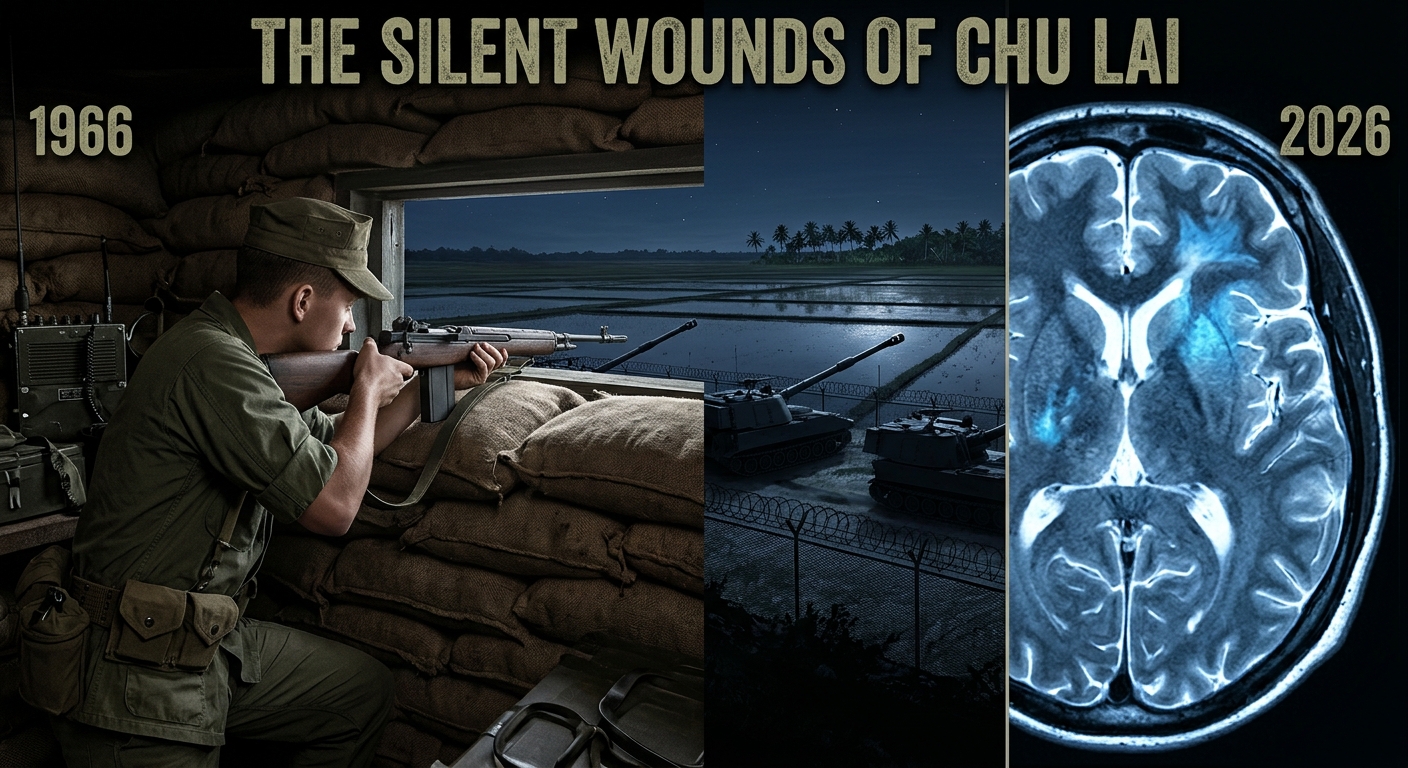
In 1966, on a fortified hill outside the Chu Lai perimeter in Vietnam, my watch was stationed inside a dark bunker built of heavy sandbags. I wasn’t wearing a heavy combat helmet; like most of the time out there, I just wore my soft fabric field cap. My M14 rifle rested on the rough sandbags, its barrel pushed through the narrow gun port while I held it tight, completely on alert and ready to fire. Looking out from our vantage point roughly thirty feet above the ground, I could see a battery of motorized, armored 155mm howitzers stationed at the base of the hill, safely inside the protective perimeter wire. They were situated sideways to my position, showing their armored profiles with their massive barrels pointing sharply to my right. Just on the other side of that wire, flooded night rice paddies stretched away into the darkness, meeting a flat, distant horizon line marked only by a small, low windbreak of tall trees.
The Midnight Blast and the Invisible Casualty
That stillness shattered instantly when the motorized howitzers directly below fired into the night. The sun-bright flash blinded me; the concussive blast deafened me. My sight returned by dawn, my hearing hours later, and I carried on, masking an invisible casualty of war.
I returned home, but the war never left my mind or my body. For sixty years, I lived on constant, exhausting high alert, always ready for combat. The intense PTSD that followed me home triggered violent flashbacks so vivid the rice paddies and the sandbags felt real, tearing through my civilian life and costing me three divorces. Because the wounds were invisible, the chaos felt like a personal, shameful failure. Medical science simply couldn’t see what was wrong; it wasn’t until the early 21st century that the medical community and the VA finally began to understand the true, devastating impact of a TBI on the human brain, a breakthrough made possible by MRIs that were only invented about thirty years ago.
The 2026 Diagnosis: Six Decades for the Truth
It wasn’t until September 2026, after a bad fall, that modern technology unmasked my own truth. But the VA didn’t explain what the results meant. They simply handed me cold, clinical terms: microbleeding, gliosis scarring in my front left brain lobe, and a flattened pituitary gland. They never connected those injuries to the blast in Vietnam. I had to piece the truth together myself, using Google’s AI to translate the medical jargon and unmask the organic, structural foundation of my six decades of struggle.
Validation, Accountability, and the Fight Ahead
Discovering that my relationship wreckage, hyper-vigilance, and sudden mental shutdowns were caused by physical brain damage brought a profound wave of emotional validation. I wasn’t broken; I was injured. Today, with the Trump administration’s sweeping overhauls and cutbacks impacting VA operations, navigating the system and forcing them to provide care is entirely up to me. The frontline staff at the clinic aren’t at fault, but the regime’s policies mean aging veterans must badger the agency just to get the tracking, hormone replacement, and TBI care we earned. To my fellow veterans: the burden to fight for your care is on you, but your wounds are real, and the truth is worth the fight.
Join the Conversation
To my fellow veterans and readers of The Soulful Veteran, I want to hear your story. If you feel comfortable sharing, let’s open up the discussion below:
- Have you ever uncovered a physical or psychological wound decades after your service concluded? What did it take to finally get the medical community or the VA to give you a clear answer?
- How has invisible trauma impacted your personal relationships or your daily civilian life? Did finding out the clinical or physical reason behind your struggles change how you view your past?
- Are you currently fighting to get the VA to acknowledge your specialized medical care or blast-tracking needs? What strategies or tools have you used to advocate for yourself under the current system?
Lloyd Lofthouse is the author of the Josh Kavanagh Military Thriller Series, a series that started as a prompt in March 2018, in a VA support group that used writing to help manage our PTSD.
Customer Reviews
4.3 out of 5 stars
685 global ratings
Billy
5.0 out of 5 stars Great read for all Vets who don’t like Trump
Reviewed in the United States on April 18, 2025
Format: KindleVerified Purchase
I’m a retired Vietnam Vet and I really enjoyed reading this book and can’t wait the start the next one in the series. The political issues and characters could all be real in today’s America, …. I recommend this book to all military Vets.
Ira Kasper
3.0 out of 5 stars Most of the writing is well done, but the author hss TDS.
Reviewed in the United States on November 9, 2026
Format: KindleVerified Purchase
If it weren’t for Lofthouse’s TDS I would have given the book four stars.
I have known Trump too long to ignore the.ignorance.of TDS.
Chuck Yarling
1.0 out of 5 stars Lloyd Lofthouse’s new book was a gem
Reviewed in the United States on November 24, 2021
Format: Kindle
Once you started reading it, this was one book that was absolutely hard to put down. It has great characters, action galore, and about a group whose mission is to preserve the American republic. That made it hard not to put it my top ten books I read this year!
Yes, it was a gem right up to the near-end when Lofthouse wrote totally unneeded and unnecessary personal political comment in just one paragraph. It was definitely a surprise to find it in what should have been a great book!
This brought the whole story to an end for me. If there is a sequel, I am not sure i want to read it.
NOTE from the author: I wrote that paragraph near the end of the thriller that mentions Trump, but it wasn’t a personal political comment from me. It was a fictional character in France, a French citizen, thinking about an opinion piece she read in the Irish Times (based on a real opinion with the author’s name) about Trump separating children from their parents and locking them in cages, which really happened and years later hundreds of those children have not been reunited with their parents.
“I Have Been Here too Long”: Read Letters from the Children Detained at ICE’s Dilly Facitlity
ICE Sent 600 Immigrant Kids to Detention in Federal Shelters This Year. It’s a New Record.
More Than 100,000 American Kids Have Had a Parent Detained in Immigration Sweeps, Report Estimates


