I was never a POW but what about the next American War?

Two things happened in the last few days. First, I was shopping at Wholefoods and while waiting in line to buy dinner, I saw the cover of a May 2014 Economist Magazine with an Eagle sitting on a desktop globe and the banner headline asked: What Would America Fight For? The question haunting its allies

Cover of Economist Magazine May or June 2014

In that cover piece, The Economist said, “A survey last autumn by the Pew Research Centre suggests that 52% (of Americans) want the United States to ‘mind its own business internationally’, the highest figure in five decades of polling.”

After reading that, I laughed and thought: Americans may not have any say about the next war just like they had no real say in Vietnam or the 2nd Iraq War because they were lied to.

That leads me to mention one of my favorite quotes from President Abraham Lincoln: “You can fool all the people some of the time, and some of the people all the time, but you cannot fool all the people all the time.”

You see, the reason I laughed is because all Congress and the President has to do is come up with a lie that fools more than half of all adult Americans to have the okay from the people to start the next war—and when that happens will probably be decided by those who profit the most from war.

It wasn’t that difficult to discover the corporations that benefit the most from death. I Googled: “who profits the most in the United States from wars” and discovered from USA Today that the business of war is profitable. In 2011, the 100 largest contractors sold $410 billion in arms and military services. Just 10 of those companies sold over $208 billion. Based on a list of the top 100 arms-producing and military services companies in 2011 compiled by the Stockholm International Peace Research Institute (SIPRI), 24/7 Wall St. reviewed the 10 companies with the most military sales worldwide.”

The top five were:

  • Lockheed Martin with arms sales of $36.3 billion in 2011—total sales were $46.5 billion
  • Boeing with arms sales of $31.8 billion—total sales were $68.7 billion
  • BAE Systems with arms sales of $29.2 billion—total sales were $30.7 billion
  • General Dynamics with arms sales of $23.8 billion—total sales were $32.7 billion
  • And Raytheon with $22.5 billion in arms sales and $24.9 billion in total sales

What happens to individual fortunes and lost jobs when 78% of Lockheed Martin’s income comes from arms sales; 46% of Boeing’s; 95% for BAE Systems; almost 73% for General Dynamics, and more than 90% for Raytheon?

If you’re curious how much the defense (arms) industry spends to lobby Congress, all you have to do is visit Open Secrets.org to discover that 978 lobbyists who worked for this industry in 2011 spent/donated $138,182,721 to influence elected representatives to make sure the federal government continued to spend heavily on defense and of course the best way to justify this much spending is to start another war, and who will the U.S. attack next?

Then Sunday Morning (May 11), I went to the theater to see “The Railroad Man”, and the horror of war hit home hard. I think this is a film that every adult American should see—especially the CEOs of the arms industry, the lobbyists who work for that industry, Congress and the President. “The Railroad Man” was based on a powerful, real story of British troops who became POWs in Singapore during World War II. The main character, Eric Lomax played by Colin Firth, survived the war but came back with a severe, traumatic case of PTSD that makes what I brought home from Vietnam seem tame in comparison, but I was never a prisoner of war—water boarded and tortured.

Let’s look at the cost of two recent wars: the Vietnam War (1965-1975) cost $738 Billion with 58,209 U.S. deaths and 153,303 wounded, and the 2nd Iraq War (2003-2010) cost $785 Billion with 4,800 U.S. deaths and 31,965 wounded—according to a report issued June 29, 2010 by the Congressional Research Service.

The reason I mention only these two wars was because both were started based on lies fed to America through the corporate owned media so enough Americans would be fooled long enough to support the wars.

What do you think the next lie will be, and where will that war be fought?

_______________________

Lloyd Lofthouse is a former U.S. Marine and Vietnam Veteran.

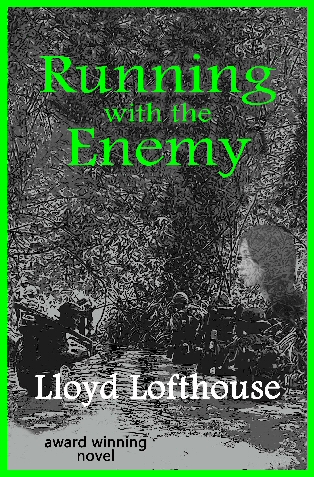
His latest novel is the award winning suspense-thriller Running with the Enemy. Blamed for a crime he did not commit while serving in Vietnam, his country considers him a traitor. Ethan Card is a loyal U.S. Marine desperate to prove his innocence or he will never go home again.
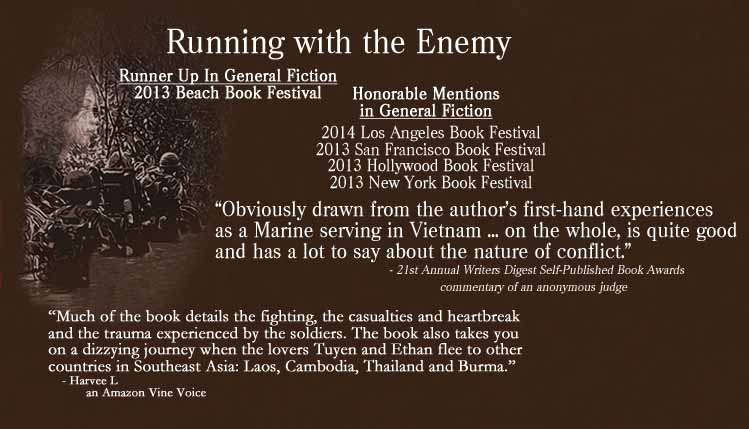
Photo for Amazon Countdown Deal

And the woman he loves and wants to save was fighting for the other side.

To follow this Blog via E-mail see upper left-hand column and click on “FOLLOW!”
A rare and close look at what war is really like through China Beach

There’s no fantasy, hero worship or fake humor in this TV series. Everyone is flawed and injured from the war—even Americans who never served in Vietnam or wore a uniform.

“China Beach” was a TV series from 1988 to 1991, and I didn’t view it until recently after I first heard about it and bought a copy of the series on DVD at Costco. I didn’t buy the complete series that comes with almost 60 hours of run time. I bought Seasons 1 + 2 with about 22 hours.

And I think I know why this excellent TV series was cancelled after four seasons—although the series has more than 249 reviews on Amazon with 4.8 of 5 stars, most Americans can’t deal with the harsh reality of war. After all, less than 7% of Americans are veterans and even fewer have served in combat.

“China Beach” is set in a combat hospital during the Vietnam War in the late 1960s. The title refers to My Khe beach in the city of Da Nang, which was nicknamed “China Beach” in English by American and Australian troops during the war.

The main character is first lieutenant Colleen McMurphy who is a triage nurse dealing with often severely wounded troops.  The directors focused on reality and there were real combat nurses who were consultants. There’s a bonus DVD with this set where we get to meet some of the nurses who served in Vietnam.

The fictional nurse, McMurphy, takes her job saving lives seriously and when she loses wounded troops, she takes the loss personally and is emotionally injured. Her PTSD is visible from the beginning. At times the suffering and drama were so intense, my eyes filled with tears from my own memories.

If you want a close look at the reality of combat and the price the troops and civilians pay, I highly recommend this series. You’ll have a safe front row seat to watch these characters become friends, lovers and then suffer loses that would break most people and scar them for life as it must have scarred the real nurses who served there.

You may question my opinion of this series so it may help to know that I’m a Vietnam combat vet who was a field radio operator in the U.S. Marines. And I was fortunate to never have to be medevaced to a combat hospital although some of the Marines in my unit were.

Now I’m thinking about the seasons of “China Beach” I haven’t seen.

_______________________
Lloyd Lofthouse is a former U.S. Marine and Vietnam Veteran.

Low-Def Kindle Cover December 11His latest novel is the award winning suspense-thriller Running with the Enemy. Blamed for a crime he did not commit while serving in Vietnam, his country considers him a traitor. Ethan Card is a loyal U.S. Marine desperate to prove his innocence or he will never go home again.

And the woman he loves and wants to save was fighting for the other side.

To follow this Blog via E-mail see upper left-hand column and click on “FOLLOW!”

I survived the attack of a ruthless swarm of bloodsuckers and a grenade tossing maniac

Sometime in 1966, for a few days, some Marines from my battalion, including me, were sent to a hill on the perimeter at Chu Lai to watch over an infantry company’s equipment while they were in the hills chasing North Vietnamese ghosts—intelligence said a regiment of NVA had slipped into South Vietnam.

There weren’t many of us—just enough for two Marines to man each of the small bunkers near the base of the hill that was surrounded by coiled barbed wire and then rice paddies.

As daylight faded, the hum of a billion mosquitoes greeted our ears warning us of what was to come as we waged war with the bloodsuckers and lost.

Looking for a way to escape, several Marines scrambled into the largest bunker at the top of the hill—it stood two stories tall with a thick slab of cast iron for a roof offering protection from Vietcong mortar rounds.

Those Marines thought they would be able to escape the bloodsuckers by moving inside the bunker. But as fast as they went in, they came out—screaming like schoolgirls. The bunker was full of rats and when the first Marine’s boots landed on the dirt floor, the rats climbed his legs in a frenzy.

I watched the few who had gone in come shooting out like rockets—eyes wide with shock; faces pale. These were all men who had fought in combat without showing fear when confronted by an enemy who wanted to kill them. Before the cast iron hatch at the top was slammed shut, one Marine tossed a fragmentation grenade in the bunker and it went off with a muffled blast.

Hours later, during my watch between midnight and four, I heard a rustling noise near the wire. There would be long stretches of silence (if you didn’t count the sound of distant firefights and the glare of flares along the division perimeter), then another rustling as if someone were crawling up the hill. I couldn’t see anything and thought it might be a small animal.

When my watch ended, I visited the only latrine that was close to the top of the hill. It was a screened, plywood box with a four-hole plywood bench. Inside, it was black as ink and smelled of urine. Under the bench were four half-empty, fifty-five gallon metal drums with several inches of diesel fuel in each one. In the mornings, the drums would be dragged out from under the plywood bench and set on fire. When it wasn’t raining, hundreds of columns of black smoke could be seen drifting into the morning sky over Chu Lai as the shit was burned.

I had stomach cramps—probably from the twenty-one-year-old canned rations I’d had for my evening meal.  Or maybe from the water we drank that had a strong taste of chlorine to it.

I leaned my weapon just out of reach against the three-foot high plywood wall in front of me and sat. Above the plywood was a screened in open space that allowed air to flow through while keeping the mosquitoes out.

There was a tin roof and the shitter was probably the only place to escape the mosquitoes. If it hadn’t been for the stink, I’d have slept there. On both sides of the shitter was a line of tents where the grunts (infantry) kept their gear and slept when they weren’t in the field.

That’s when the grenades started to go off.  I glanced to the left and saw a shadowy figure running fast along the line of tents tossing a grenade through each opening. I reached for my weapon but a wave of cramps doubled me over as the diarrhea gushed out.

For an instant, I thought I was going to be dead when a grenade was tossed in the shitter.  But from the outside, it must have looked empty and I was spared that fate.

No one died or was wounded on that hill that night. The tents were empty because the grunts were in the hills hunting an elusive enemy, and most of us were in the smaller bunkers near the concertina wire. I was closer than anyone to the lone killer who had slipped inside the wire.

That was just one night out of hundreds during my combat tour in Vietnam.

_______________________

Lloyd Lofthouse is a former U.S. Marine and Vietnam Veteran.

His latest novel is the award winning suspense-thriller Running with the Enemy. Blamed for a crime he did not commit while serving in Vietnam, his country considers him a traitor. Ethan Card is a loyal U.S. Marine desperate to prove his innocence or he will never go home again.

And the woman he loves and wants to save was fighting for the other side.

To follow this Blog via E-mail see upper left-hand column and click on “FOLLOW!”

Rewriting history, literature and film to fit Popular Political Correctness

In the early 1980s, I was working toward an MFA and one of my courses was a self-directed project monitored by a faculty adviser. The project was my memoir of fighting in the Vietnam War. A few years after completing the memoir, I took it to UCLA Extension’s Writers’ Program where the professor convinced me to convert it into fiction—a suspense thriller. The professor was a woman, who later helped find a literary agent to represent my novel.

I spent several years in the program with her as my advisor, and the final product after endless revisions and feedback from the professor and other authors in the program was “Running with the Enemy”. It was fiction but true to my experience of war and its horror.

Fast forward to publication and then June 11, 2013 when a reviewer by the name of “S” posted a 2-star review on Amazon—a review I’m actually proud of.

S concluded her review with:  “I was sucked in by the nitty gritty feng shui of the book, then repelled by the over use of sexual violence and testosterone dousing. Even though the ending was predictable, I still liked that the good guys won and the bad guys lost. However, the limited roles by the female characters left me feeling that half the story still lies buried and voiceless.”

I’m proud of that 2-star review because the book I wrote was about the war I fought in—not the story S wanted me to write that would have been a lie. In the 1960s, the only American women who served in Vietnam that I knew of were nurses and they did not serve in combat units. There were no women in my battalion.  Not one.

What I think S wanted was to see women kicking the shit out of men and beating the men at war. But that wasn’t my Vietnam. Tuyen, the only major woman character in the novel—the others were minor characters—was a half breed, a Eurasian, who had been sexually and physically abused by her half-brother since she had been a young girl.

If you have ever seen the film or the stage play of “Miss Saigon”, you might understand how women are still treated today in Southeast Asia and when that woman was a Eurasian like Tuyen, the treatment was worse, and the term for her was Bụi đời, the “dust of life”.

In fact, “Life was frequently difficult for such Amerasians [and Eurasians]; they existed as pariahs in Vietnamese society. Often, they would be persecuted by the communist government and sometimes even sold into prostitution as children.” [Benge, Michael (22 November 2005). “The Living Hell of Amerasians”. Front Page Magazine]

I think what “S” wanted from me as an author was to write a story that would fit a world she wanted—one that didn’t exist in my world.  She wanted a kick-ass female character.

The latest example of this popular political correctness demanding that history and literature be rewritten may be found in the film “The Hobbit: The Desolation of Smaug”. Tauriel is a female elf who is a kick ass super warrior. The problem is that in the original Hobbit written by J. R. R. Tolkien, there are no major women characters and another fire-breathing modern day feminist—another S—also wanted the plot of this novel rewritten when made into film.

This revisionist was Nicole Lyn Pesce writing for the New York Daily News who said, “The women’s rights movement has made it to Middle-earth. The first ‘Hobbit’ film was criticized by some—like me—for its testosterone-heavy cast, so director Peter Jackson has brought in a kick-ass chick for the sequel.”

Does this mean we should rewrite history due to a modern, popular, political-correct movement? I don’t think so.

My novel was a man’s story just like “The Hobbit” was written by a man. In fact, you may want to read an essay about how J.R.R. Tolkien’s service in the British Army during World War I may have influenced his fiction. [JRR Tolkien and World War I by Nancy Marie Ott]

If Tolkien were alive today, would modern feminists be criticizing him for not including kick-ass women warriors in his novels, who didn’t exist in his day as they didn’t exist in mine?

I have news for “S”. If she had read my novel to the end, she would have discovered Tuyen kicking some serious male ass in the Golden Triangle near the conclusion of the novel. In that scene, Tuyen is so violent she even shocks the kick-ass recon Marine who loves her. Maybe Tuyen just didn’t kick enough male asses to satisfy S or someone like Nicole Lyn Pesce.

Here’s a bit of advice for today’s modern day feminists. Don’t wish for something you know little to nothing about. Take it from someone who has seen war up close and personal, you really don’t want to go there. If men are willing to go to war and die to protect women from that horror, let them.

_______________________

Lloyd Lofthouse is a former U.S. Marine and Vietnam Veteran.

His latest novel is the award winning suspense-thriller Running with the Enemy. Blamed for a crime he did not commit while serving in Vietnam, his country considers him a traitor. Ethan Card is a loyal U.S. Marine desperate to prove his innocence or he will never go home again.

And the woman he loves and wants to save was fighting for the other side.

To follow this Blog via E-mail see upper left-hand column and click on “FOLLOW!”


What has America accomplished as the world’s so-called cop?

To research this topic, I Googled “history of America’s role as global policeman”, and ended with 433-million hits in a third of a second.

I’m going to list the first five:

Americans Tire of ‘World Police’ Role

Syria: The end of America’s role as global cop?

Should America Be the World’s Policeman?

Should America withdraw as the world “Police/peace keepers”?

What if U.S. stops policing the world?

I didn’t read the posts, because I was more interested in rating America’s performance as the self-proclaimed world’s police force?  To do that, I compiled a death count from all the wars, civil wars, revolutions, and genocides since the end of World War II, and I’m sure it is an incomplete list.

It was difficult to come up with a precise number so there are two numbers and the actual number of deaths could be anywhere between the low and high estimates.

1945 – 1950: The expulsion of Germans after World War II was called a population transfer but in reality it turned out to be an ethnic cleansing. The death count was 500 thousand – 3 million

1950 – 1953: Korean War. The death count 400 thousand – 4.5 million

1955 – 1975: Vietnam War. The death count was 800 thousand – 3 million

1965 – 66: Indonesian massacre of anyone connected to the Indonesian Communist Party. The Death count was 100 thousand to 2 million.

1967 – 1970: Nigerian Civil War and genocide. The death count was 1 – 3 million

1971: Bangladesh genocide. The death count was 26,000 – 3 million

1975 – 1979: Cambodian Genocide. The death count was 1 – 3 million; another 800 to 950 thousand died of starvation. The only reason this tragedy ended was because Communist Vietnam invaded and stopped the insanity. Where was the United States? Why did it take one communist country to stop another one from slaughtering its own people?

1975 – 80: Operation Condor in South America was a campaign of political repression by right-wing dictatorships sponsored by the United States. The death count was 50 – 80 thousand.

1979 to Present: Afghan Civil War. The death count is 1.5 – 2 million

1980 – 1988: Soviet War in Afghanistan. The death count was 600 thousand – 2 million

1980 – 1988: Iran–Iraq War. The death count was 500 thousand – 2 million

1983 – 85: Famine in Ethiopia. The death count was 400 thousand – 1 million

1990 – 98: Sanctions against Iraq imposed by the United Nations Security Council that caused excess deaths of young children 175 – 576 thousand

1994: Rwandan genocide death count 500 thousand – 1 million

1998 – 2003: Second Congo War’s death count 2.5 – 5.4 million dead

1998: Sudan famine. Death count was 70,000

After I compiled the list, I thought, what exactly has the United States accomplished to bring about world peace and save lives as the world’s so-called cop? Maybe the world would have been better off if the United States had stayed home and saved a few trillion dollars.

If you want to know how much the United States spends as the world’s so-called cop, visit data360.org to discover that answer, but you may have to spend an hour or so adding it all up. I wanted to find one number but could only find annual lists.

Last year, the world’s top 15 military spenders spent $1.753 Trillion combined, but 39% of that was the United States. The People’s Republic of China was number two at only 9.5% of the total. I found this information from a List of countries by military expenditures on Wiki.

I think that if a real cop in the United States had a similar record, they would be suspended from active duty followed by an investigation and then—for sure—a trial.

Do you think the citizens of the United States should vote in the next Presidential election on America continuing its job as the world’s so-called cop? After all, every American who pays taxes is footing the bill so shouldn’t all the citizens of a democracy have a say?

And of course this brings up another question: Is the United States really a democracy?

_______________________

Lloyd Lofthouse is a former U.S. Marine and Vietnam Veteran.

His latest novel is the award winning suspense-thriller Running with the Enemy. Blamed for a crime he did not commit while serving in Vietnam, his country considers him a traitor. Ethan Card is a loyal U.S. Marine desperate to prove his innocence or he will never go home again.

And the woman he loves and wants to save was fighting for the other side.

To follow this Blog via E-mail see upper left-hand column and click on “FOLLOW!”

The Fussy Librarian

My novel, “Running with the Enemy”, is being featured Sunday, November 10, at The Fussy Librarian, a new website that offers personalized e-book recommendations. Readers choose from 32 genres and indicate preferences about content and then the computers work their magic. It’s pretty cool — check it out! @ www.TheFussyLibrarian.com

Pageflex Persona [document: PRS0000035_00034]

Literary Awards for this novel:

Runner Up in General Fiction
2013 Beach Book Festival

Honorable Mentions in General Fiction
2013 San Francisco Book Festival
2013 Hollywood Book Festival
2013 New York Book Festival

Praise for “Running with the Enemy”

“Obviously drawn from the author’s first-hand experiences as a Marine serving in Vietnam,Running with the Enemy is a rough but occasionally heartfelt war story. … The book is sometimes too obviously drawn from his experience. But ultimately that’s a small complaint about a book that, on the whole, is quite good and has a lot to say about the nature of the conflict …”
– 21st Annual Writer’s Digest Self-Published Book Awards commentary from an anonymous judge

“The author definitely has inlcuded vivid, entrancing descriptions of the country, the people and the military who served there. … It is an action-filled, intriguing story I will not forget soon.”
– 5-star review from KMT through a Library Thing Giveaway

“From the first chapter to the end, it kept me going. Lofthouse writes from his heart and that always makes for a good story.”
– 4-star review from Mahree through a Library Thing Giveaway

“For those who would like to get a sense of what combat was really like, this is an excellent book, which began as a memoir of Vietnam.”
–  4-star review from Harvee L.   [an Amazon Vine Voice]

“The fight/combat scenes are stunning, very realistic. … Betrayal, revenge, murder, and desperation make this a must read! … Very highly recommended.”
– 5-star review from Great Historicals

“This was quite a riveting but cruel story, not for the faint of heart. Well written with very graphic language and violent scenes but all-over, a very good suspense book.”
– 4.5-star review from Lynelle of (South Africa)

Collateral Damage—Dumb Bombs versus Smart Bombs

If you lived in a war zone, would you rather have dumb bombs or smart bombs dropped on targets?

Dylan Stableford—writing for Yahoo News—reported on a documentary about the fear and stress of life under the threat of U.S. drones, and I left this comment: “If people in countries where al Qaeda and the Taliban operate don’t like the U.S. drone attacks, then all they have to do is stop supporting Islamic terrorists and fight back against them so the U.S. troops will go home and take their drones with them.”

An anonymous, faceless person criticized my comment. His or her name was Win—who, as far as I know, could be an al Qaeda or Taliban PR person—wrote, “Lloyd, you sound like the typical dumbshit in government, underestimating how difficult it really is to do that. You are implying these people deserve what happened to them. If either you or me lost all that we have one day for absolutely no reason because some dumbshit from a foreign country willed that it happened to either one of us, I can guarantee, guaran-damn-tee that our blood would boil and our rage fueled.”

From Win’s comment it is obvious that he or she has little or no knowledge about the battlefield in countries where wars are fought. And I want to remind Win that we did not start this war for “absolutely no reason”.  The war was started by Islamic Fundamentalist terrorists on 9/11 in New York City when they killed thousands of civilians by hijacking commercial jets full of passengers and ramming those jets into the World Trade Center and the Pentagon.

Now back to the question: If you lived in a war zone through no fault of your own and you didn’t want anything to do with the war, would you rather have dumb bombs or smart bombs used to hit targets in your country?

In World War II, for example, the United States killed millions of German and Japanese civilians bombing the cities in those countries with dumb bombs.  Fleets of bombers flew over targets and dropped thousands—probably millions—of bombs without knowing exactly where those bombs would land and explode.

In fact, the United States dropped more dumb bombs on Vietnam, Laos and Cambodia than it dropped in all of World War II.

In World War II, civilian deaths in Germany are estimated to be between 1.5 to 3.5 million.  In Japan, civilian deaths were 500-thousand to one million. In comparison, the United States—the country that dropped most of the dumb bombs that caused that collateral damage—only lost 1,700 of its own noncombatants.

To defeat Germany and Japan, the United States and its allies also dropped napalm on German and Japanese cities. In one bombing of Tokyo, for example, 2,000 tons of incendiary dumb-bombs were dropped over the course of 48 hours, and between 80,000 and 130,000 civilians were roasted to death in the firestorm that followed.

In Vietnam, the collateral damage was somewhere between 245,000 and two-million civilian deaths.  But the United States didn’t drop dumb bombs only in Vietnam. The U.S. also dropped dumb bombs In Cambodia and Laos. In Cambodia the collateral damage was 200,000 to 300,000 civilian deaths. In Laos, the collateral damage from dumb bombs was 20,000 to 200,000 dead civilians—and millions were wounded.

Now, let’s focus on civilian casualty counts in the Iraq and Afghanistan Wars to see if the use of smart bombs to target enemy combatants resulted in reduced civilian casualties—that dirty word is known as collateral damage.

Classified US military documents released by Wikileaks in October 2010 recorded that there had been 66,081 civilian deaths in Iraq over a period of six years. But the Iraq Body Count Project’s numbers are higher: 110,937 – 121,227.

When checking these numbers for Iraqi civilian deaths, there were no details on who did the killing and how these civilians died.  And we know that al Qaeda blows up civilians all the time in the streets; on buses; in Mosques and Churches; in restaurants, at weddings and funerals, etc.  Therefore, it’s easy to conclude that American smart bombs were not responsible for all of those deaths. In fact, reports from Afghanistan indicate that collateral damage from Western smart bombs is responsible for less than 10% of all civilian deaths.

One source I checked reported that “In the first six months of 2013, the United Nations Assistance Mission in Afghanistan counted 1,319 civilian deaths and 2,533 civilian injuries with 9% attributable to pro-government forces—this means that collateral damage from the West’s smart bombs may have only killed 119 civilians. Compare that to six months of civilian deaths during World War II in Germany or Japan or in Vietnam when the West was only using dumb bombs and often sent fleets of B52s to carpet bomb urban and rural areas.

That same report said, that in all of 2012, total civilian casualties were 2,754 deaths and 4,805 injured with 8% of those loses attributed to pro-government forces meaning that 92% of the deaths were caused by al Qaeda and/or the Taliban.

In conclusion, the United States is at war in Afghanistan with insurgent forces who started this war on 9/11—the same Islamic fundamentalists who have sworn to destroy Western civilization, and I’m convinced that they would not hesitate to use dirty bombs or nuclear weapons on Western cities like London, Paris, Berlin, Rome, New York, Washington D.C., Los Angeles, San Francisco, etc. killing millions of civilians without any effort to minimize the damage.

On April 11, 1880, General William Tecumseh Sherman, who played an instrumental role in defeating the South during America’s Civil War by ruthlessly destroying everything in his army’s path, said this in Columbus Ohio: “There is many a body here today who looks on war as glory, but boys, it is all hell.”

I fought in Vietnam as a field-radio operator in the United States Marine Corps. We had rules forced on us by civilian “dumb-shits” who said we couldn’t shoot at the enemy unless we could see who was shooting at us first. And most of the time, we couldn’t see who was shooting at us.

We lost the Vietnam War. We didn’t lose World War II.

If the West is going to win the war against al Qaeda and the Taliban, then the West must be as ruthless as it was in World War II, and if the West fails, then civilians will be dying in American and European cities by the millions.

General Sherman was right. War is hell, and if you are reading this and you do not live in a country that is a war zone like Iraq or Afghanistan, then you should bless your fortunate stars and pray that the war doesn’t come to your neighborhood.

No one who is innocent deserves to be killed from a bomb—dumb or smart—but as cruel as it sounds, “Better them then us.” And if you believe in coexistence, then I think you should be the one to—face-to face—convince al-Qaeda to stop killing innocent people.

_______________________

Lloyd Lofthouse is a former U.S. Marine and Vietnam Veteran.

His latest novel is the award winning suspense-thriller Running with the Enemy. Blamed for a crime he did not commit while serving in Vietnam, his country considers him a traitor. Ethan Card is a loyal U.S. Marine desperate to prove his innocence or he will never go home again.

And the woman he loves and wants to save was fighting for the other side.

To follow this Blog via E-mail see upper left-hand column and click on “FOLLOW!”

Ignorance of PTSD might be dangerous: Part 2 of 2

It’s been forty-seven years since I served in Vietnam, and over those years, the few times I’ve been in threatening situations, my thoughts are not of running away or breaking down in tears of fear. Instead, I’m thinking of the fastest way I can kill the person I perceive as a threat. If I’m close enough, I’ll be looking at his throat thinking about digging my teeth in and tearing out his jugular.

In the film “Patton”—played by George C. Scott—there is a scene where the general explodes in anger at troops who were in military hospitals suffering from severe PTSD—known as battle fatigue or shell shock back then.  The violence they had experienced had traumatized them severely. But General Patton thought anyone who suffered from PTSD was a coward and a fake.

I think that Russell Ireland, who owns the Big I’s Restaurant in Oxford, Massachusetts, is evidently an uneducated throw back to that World War II era, who does not think a war veteran suffering from PTSD deserves the same respect as a vet who lost body parts and probably also suffers from PTSD.

To Ireland’s way of thinking—just like General Patton—if the injury isn’t physical, it doesn’t count. For example, missing body parts.

I never know when my PTSD is going to flare or what may trigger it. When I’m awake, I’m always vigilant of my surroundings watching for threats.

 At night and early morning hours I often wake up and see enemy combatants in the darkness—they seem real but I’ve experienced this so many times over the decades that I often stare at them and maybe use a flashlight I keep by my bed to make sure it isn’t real before I can go back to sleep.  And by my side is a .45 caliber Glock automatic with a loaded magazine.  In the closet is a pump shotgun. In the gun safe are more weapons and boxes of ammo.

I did not buy these weapons to go hunting. I bought these weapons so I could sleep at night knowing I was prepared for the unexpected that my PTSD keeps reminding me is out there. Watching the daily news also doesn’t help so I avoid it most of the time. Before Vietnam, I read newspapers. After Vietnam, I stopped reading them. Newspapers are filled with reminders of crimes and violence in the United States that may trigger PTSD symptoms.

PTSD wasn’t recognized until the 1980s and then vets started to receive help from the VA.  I have carried the dark shadow of my PTSD with me since 1966 and didn’t get any help from the VA until after 2005 when I discovered that I was eligible.

And ignorant idiots like Russell Ireland don’t have any idea about the time bomb they may be triggering when they confront a vet with combat induced PTSD. He may have been fortunate that James Glaser had his trained service dog by his side.

By the way, it’s been forty-seven years since I served in Vietnam and I haven’t killed or physical attacked anyone yet. As for Dr. Phil, I’ve never been impressed by his show. It’s more of a shock and awe thing promoted by Oprah [she’s the billionaire who owns the show] while Dr. Phil acts the guru to an ignorant mob of fools—Dr. Phil’s net worth is estimated to be $200 million or more earned from his show.

Return or start with Ignorance of PTSD might be dangerous: Part 1

_______________________

Lloyd Lofthouse is a former U.S. Marine and Vietnam Veteran.

His latest novel is the award winning suspense-thriller Running with the Enemy. Blamed for a crime he did not commit while serving in Vietnam, his country considers him a traitor. Ethan Card is a loyal U.S. Marine desperate to prove his innocence or he will never go home again.

And the woman he loves and wants to save was fighting for the other side.

To follow this Blog via E-mail see upper left-hand column and click on “FOLLOW!”

Ignorance of PTSD might be dangerous: Part 1 of 2

Charlene Sakoda writing for Odd News reported that James Glaser, a retired Air Force veteran, who served in Iraq, was forced to leave a restaurant with his service dog trained to help him keep his PTSD under control.

Glaser called the police and the officer who responded to the call failed to convince the owner of the restaurant that the dog was legitimate. Russell Ireland, the owner of the restaurant, said, “Get that fake service dog out of my restaurant.”

When the police officer said the papers the vet carried on him proved the dog was not fake, Ireland said, “I don’t give a [expletive]”.

Ireland was an ignorant and biased fool. It seems that even Dr. Phil is one of those ignorant fools [watch the following video to see what I mean].

CNN reported that violence is a growing problem among vets with PTSD. “Study after study has highlighted the struggles faced by troops returning home, including substance abuse, relationship problems, aggression or depression…”

And a PTSD service dog is trained to deal with and disarm a PTSD reaction to a situation.

My combat induced PTSD was rated at 30% by the VA, and that was decided after a number of sessions with a VA counselor and Q&A sessions with other VA counselors and shrinks. And I’ve met a vet with a 100% PTSD disability who suffered much worse in Vietnam. Just the sound of a helicopter flying overhead caused him to suffer an awake flashback in daylight [click on A Prisoner of War for Life to discover more].

Suffering from a PTSD flashback does not mean vets turn into a mass of quivering cowardly jello. In fact, the opposite may happen. I’ll explain in Part 2.

Continued on September 24, 2013 in Ignorance of PTSD might be dangerous: Part 2

_______________________

Lloyd Lofthouse is a former U.S. Marine and Vietnam Veteran.

His latest novel is the award winning suspense-thriller Running with the Enemy. Blamed for a crime he did not commit while serving in Vietnam, his country considers him a traitor. Ethan Card is a loyal U.S. Marine desperate to prove his innocence or he will never go home again.

And the woman he loves and wants to save was fighting for the other side.

To follow this Blog via E-mail see upper left-hand column and click on “FOLLOW!”

Sun Tzu’s “The Art of War”: part 10 of 10

On the third day of Gettysburg during Picket’s charge up another hill, only 5,000 survived of 12,000 troops.  Sun Tzu would have been horrified.

Sun Tzu says, “When troops flee, are insubordinate, collapse or are routed in battle, it is the fault of the general.”

Sun Tzu sees a commanding general as someone intelligent and cunning and never rash or arrogant, which is the opposite of the commander of the Chu army more than two thousand years ago.

Sun Tzu won the war against Chu, which had an army ten times larger than his. He did this through preparation, deception and indirect attacks.

After winning the war against Chu, Sun Tzu retires and writes The Art of War.

The first line of Sun Tzu’s rules of war says, “War is a matter of vital importance to the State. It is a matter of life and death, survival or ruin.

Return to Sun Tzu’s “The Art of War”: Part 9 or start with Part 1

View as Single Page

_______________________

Lloyd Lofthouse is a former U.S. Marine and Vietnam Veteran.

His latest novel is the award winning suspense-thriller Running with the Enemy. Blamed for a crime he did not commit while serving in Vietnam, his country considers him a traitor. Ethan Card is a loyal U.S. Marine desperate to prove his innocence or he will never go home again.

And the woman he loves and wants to save was fighting for the other side.

To follow this Blog via E-mail see upper left-hand column and click on “FOLLOW!”