Controlling the Warrior Gene: Part 2/2

To discover more about the triggers that activate the warrior gene, scientists should study the history of berserkers to learn about the right environment and lifestyle.

Britannica.com says the “berserker in pre-medieval and medieval Norse and Germanic history and folklore, [was] a member of unruly warrior gangs that worshipped Odin, the supreme Norse deity, and attached themselves to royal and noble courts as bodyguards and shock troops. … The berserkers were in the habit of raping and murdering at will in their host communities (thus going “berserk”).”

The word “berserker” today applies to anyone who fights with reckless abandon and disregard to even his own life, a concept used during the Vietnam War and in Vietnam-inspired literature (Michael Herr’s Dispatches) and film (Oliver Stone’s Platoon and Adrian Lyne’s Jacob’s Ladder). “Going berserk” in this context refers to an overdose of adrenaline-induced opioids (or military-issued amphetamine for long missions) in the human body and brain leading a soldier to fight with fearless rage and indifference, a state strikingly similar to that of the 9th century berserkers.

“Going berserk” is also used colloquially to describe a person who is acting in a wild rage or in an uncontrolled and irrational manner.

And in When You Hear the Bugle Call by Peter S. Griffin, he says, “Homer [8th century BC] related incidents of some soldiers going berserk, fighting in an enraged, reckless manner, the same as some warriors of the modern age, who participated in intense, frequent and prolonged combat and lost it in battle.”

If true, what would happen if a government had the ability to control this warrior gene in its elite troops with the ability to turn it on at will sort of like controlling a drone from a remote location resulting in super soldiers in combat situations?

Return to or start with Controlling the Warrior Gene: Part 1

_______________________

Lloyd Lofthouse is a former U.S. Marine and Vietnam Veteran.

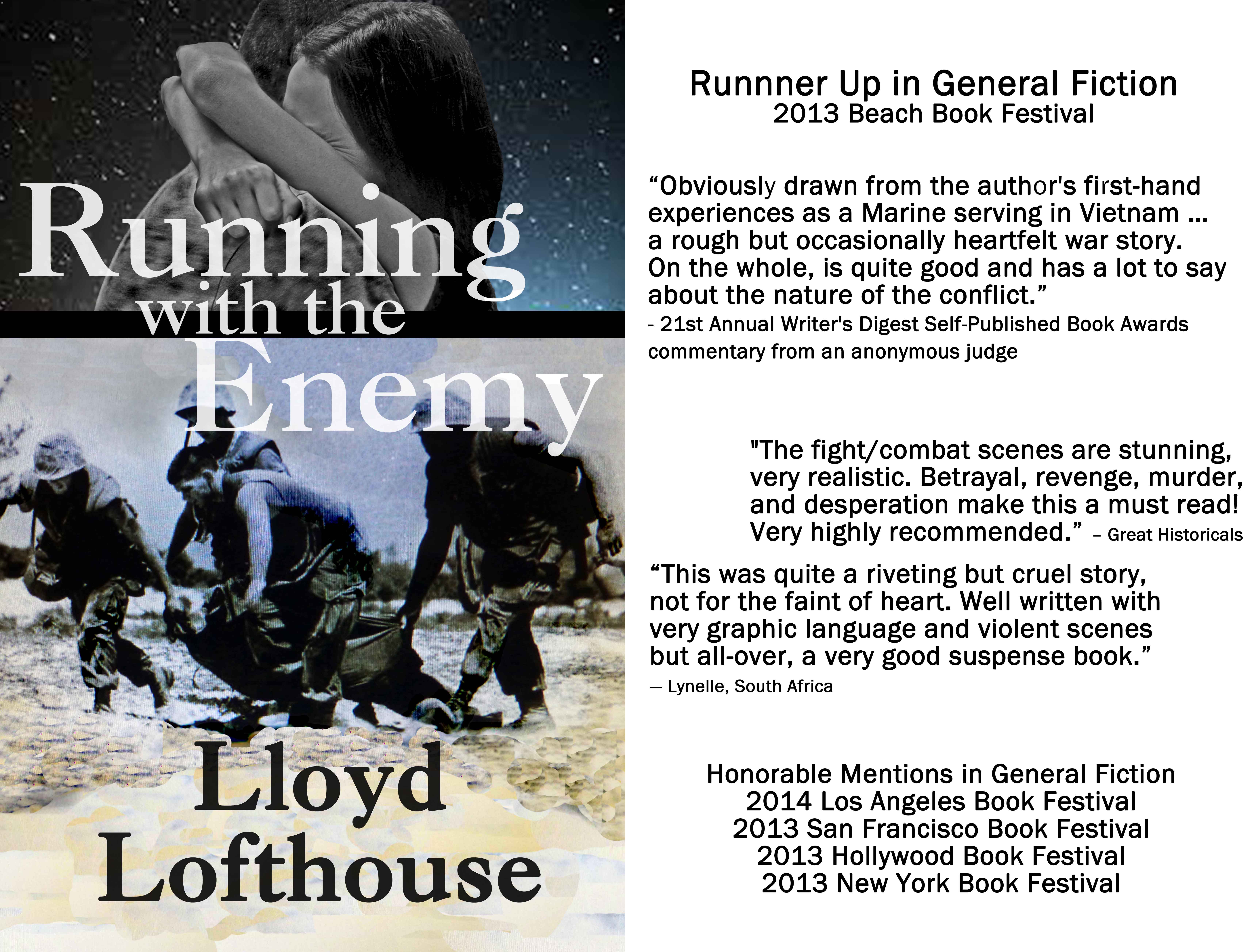
His latest novel is the award winning suspense-thriller Running with the Enemy. Blamed for a crime he did not commit while serving in Vietnam, his country considers him a traitor. Ethan Card is a loyal U.S. Marine desperate to prove his innocence or he will never go home again.

And the woman he loves and wants to save was fighting for the other side.

To follow this Blog via E-mail see upper left-hand column and click on “FOLLOW!”

Controlling the Warrior Gene: Part 1/2

Up to 20% of U.S. troops returning from Iraq and Afghanistan suffer from PTSD, and research says that emotions and family settings—meaning environment and lifestyle—may all play rolls that trigger genes that lead to some troops coming down with PTSD while others in the same combat situations don’t. Sources:  U.S. National Library of Medicine and the L.A. Times

Therefore—under the right circumstances that may trigger a response through certain genes—are some people wired to be warriors?

In 2009, Science Daily reported on research co-authored by Rose McDermott, professor of political science at Brown University. “Several studies have found a correlation between the low-activity form of MAOA—a gene that regulates an enzyme that breaks down important neurotransmitters in the brain— and aggression in observational and survey-based studies. Only about a third of people in Western populations have the low-activity form of MAOA. By comparison, low-activity MAOA has been reported to be much more frequent (approaching two-thirds of people) in some populations that had a history of warfare. This led to a controversy over MAOA being dubbed the warrior gene.”

We already know that certain genetic triggers are activated because of environmental and lifestyle factors. These factors are called triggers. For example, the U.S. Department of Health and Human Services says that “Heredity plays an important part in determining who is likely to develop type 1 diabetes. Genes are passed down from biological parent to child.  … Some theories suggest that environmental factors trigger the autoimmune destruction of beta cells in people with a genetic susceptibility to diabetes. Other theories suggest that environmental factors play an ongoing role in diabetes, even after diagnosis. … Physical inactivity and obesity are strongly associated with the development of type 2 diabetes. People who are genetically susceptible to type 2 diabetes are more vulnerable when these risk factors are present.”

Other genes have been identified that protect against heart damage from chemotherapy. Source: ScienceCodex.com

In addition, CNNHealth.com reported that “Some people have all the luck. A new study shows that certain individuals with a gene mutation can slurp down milk shakes or other high-fat food and drink without a nasty jump in cholesterol.”

Continued on July 24, 2013 in Controlling the Warrior Gene: Part 2

_______________________

Lloyd Lofthouse is a former U.S. Marine and Vietnam Veteran.

His latest novel is the award winning suspense-thriller Running with the Enemy. Blamed for a crime he did not commit while serving in Vietnam, his country considers him a traitor. Ethan Card is a loyal U.S. Marine desperate to prove his innocence or he will never go home again.

And the woman he loves and wants to save was fighting for the other side.

To follow this Blog via E-mail see upper left-hand column and click on “FOLLOW!”

Shell Shock in 1915 becomes Combat Fatigue by World War II and PTSD in 1980

In World War I, PTSD—known as shell shock then—was such a problem that ‘forward psychiatry’ was begun by French doctors in 1915. Some British doctors tried general anesthesia as a treatment (ether and chloroform), while others preferred application of electricity.

Imagine suffering from PTSD and being strapped down to a table with electrodes attaches followed by jolts of electricity to shock you healthy.

In 1917, four British ‘forward psychiatric units’ were set up. Hospitals for shell-shocked soldiers were also established in Britain, including (for officers) Craiglockhart War Hospital in Edinburgh.

Patients diagnosed to have more serious psychiatric conditions were transferred to the Royal Edinburgh Asylum.

Near the end of 1918, the use of anesthetic and electrical treatments to treat shell shock was gradually replaced with modified Freudian psychodynamic intervention. The efficacy of ‘forward psychiatry’ was controversial.

Psychodynamic therapy focuses on unconscious processes as they are manifested in a person’s present behavior. The goals of psychodynamic therapy are a client’s self-awareness and understanding of the influence of the past on present behavior.

In 1922 the British War Office produced a report on shell shock with recommendations for prevention of war neurosis. However, when World War II broke out in 1939, this seems to have been ignored.

Then during World War II, the term ‘combat fatigue’ was introduced as breakdown rates became alarming, and the value of pre-selection was recognized.

At the Maudsley Hospital in London in 1940, barbiturate abreaction (an emotional release resulting from mentally reliving through the process of catharsis, a long-repressed, painful experience) was advocated for quick relief from severe anxiety and hysteria, using i.v. anesthetics: Somnifaine, paraldehyde, Sodium Amytal. ‘Pentothal narcosis’ and ‘narco-analysis’ were adopted by British and American military psychiatrists.

However, by 1945 medical thinking gradually settled on the same approaches that had seemed to be effective in 1918.

The term PTSD was introduced in 1980.

In the UK the National Institute for Health and Clinical Excellence (NICE) guidelines for management (2005) recommend trauma-focused Cognitive Behavioral Therapy and consideration of antidepressants. Source: Pub Med.gov

Discover The public image of PTSD and the Vietnam Veteran

_______________________

Lloyd Lofthouse is a former U.S. Marine, Vietnam Veteran, journalist and award winning author.

His second novel is the award winning love story and suspense-thriller Running with the Enemy. Blamed for a crime he didn’t do while serving in Vietnam, his country considers him a traitor. Ethan Card is a loyal U.S. Marine desperate to prove his innocence or he will never go home again.

Promo Image with Cover Awards

Where to Buy

To follow this Blog via E-mail see upper left-hand column and click on “FOLLOW!”

Combat casualties and battle-field medicine through the ages: Part 1/2

Starting with the Roman Empire, it has been estimated that Roman Armies suffered about 885,000 casualties over a nine-hundred year period from 400 BC to 500 AD—that adds up to less than 1,000 average combat deaths annually. Source: Body Count of Roman Empire

It seems that the old way of fighting with swords and spears wasn’t as destructive as modern warfare.

The ancient military physicians of the Greeks and the Romans had discovered that certain treatments, such as the application of honey and salt mixtures to wounds—mostly from cuts and jabs—aided the troops to recover.

The decline of the Roman Empire didn’t happen overnight. It took centuries, and when the Roman Empire fell in the 5th century AD, military medical support was almost gone. With the decline of an empire, also came the end of effective medical care in Europe.

About a thousand years would go by before the rebirth of military medicine in Europe in Spain near the end of the 15th century after the Spanish drove out the Islamic Moors. During the wars, the Spanish military copied the mobile hospitals used by the Moorish armies.


But in the 15th century, the introduction of gunpowder in combat caused more casualties, because almost all gunshot wounds became infected due to the injury—clothing, dirt, and other debris was often forced into the wound by the musket ball—and/or from unsanitary conditions following the injury caused by the surgeon probing for the musket ball or shrapnel with unwashed fingers and/or unwashed surgical instruments.

It isn’t as if sterilizing surgical instruments was going to be a new concept. The ancient Chinese, Persians and Egyptians all used methods for water sanitation and disinfection of wounds. In fact, Mercuric chloride was used to prevent infection in wounds by Arabian physicians in the Middle Ages but not in Europe.

In fact, in Europe and American in the 1800’s, infections after surgery caused almost half of the deaths of troops wounded in combat.

Though the number of killed and wounded in the Civil War (1861 – 1865) is not known precisely, most sources agree that the total number killed was between 640,000 and 700,000 resulting in an average of 160,000  – 175,000 combat deaths annually—a massive leap from the average annual combat deaths during the Roman Empire where the well trained and highly disciplined Roman military also had observant medics who wrote down treatments that worked and passed this knowledge on to be used by the next military doctor. In fact, Roman surgeons used about the same tools that American doctors did only one hundred years ago.

However, as it turns out, the bloodiest war in American history was also one of the most influential in battlefield medicine. Civil War surgeons learned fast, and amputation of arms and legs saved more lives from death by infection than any other wartime medical procedure. Sources: Mental Floss.com,  American Civil War Casualties and Military Medicine through the Eighteenth Century

Continued on Wednesday, June 12, 2013 in Combat casualties and battle-field medicine through the ages: Part 2

_______________________

Lloyd Lofthouse is a former U.S. Marine and Vietnam Veteran.

His latest novel is the award winning suspense-thriller Running with the Enemy. Blamed for a crime he did not commit while serving in Vietnam, his country considers him a traitor. Ethan Card is a loyal U.S. Marine desperate to prove his innocence or he will never go home again.

And the woman he loves and wants to save was fighting for the other side.

To follow this Blog via E-mail see upper left-hand column and click on “FOLLOW!”

Acronyms Describing Women in the US Military

In the Iraq and Afghanistan Wars, “military sexual trauma” has been so pervasive it got its own acronym: MST.

There are other acronyms—some now obsolete and some not listed—that are used to describe women in the military. I’ve listed a few here that I found from several lists.

Be warned, some of these acronyms and what they mean may offend a few, and I’m sure the last one will offend many.

­­WAAC = Women’s Auxiliary Army Corps and individual members of – now obsolete

WAC = Women’s Army Corps and individual members of – now obsolete

WAF = Women (in the) air Force and individual members of – now obsolete

WAVES = Women Accepted for Volunteer Emergency Services in the US Navy – now obsolete

WM = Woman/Women Marine(s)

BAM = Broad Assed Marine; pejorative term for women Marines

field 10 = a physically unattractive female service member who becomes an object of desire for male service members after extended time in a field or combat environment away from civilian women.

ma’am = proper method of addressing female officers in particular and all women in general.

WACB (AR 310-50] = Women’s Army Classification Battery

WACSM [AR 310-50] = Women’s Army Corps Service Medal

WEST = weapon effectiveness simulated threat, (AR 310-50] Women’s Enlistment Screening Test

There’s one more acronyms that I could not find—but one I heard more than once from more than one Marine in 1967/68 while I was stationed at Camp Pendleton after my 1966 combat tour in Vietnam.

Marine men called—at least in my unit, the active duty nucleus for the division headquarters of the 4th Marine Division—women Marines SPAM.

Before I define what SPAM meant forty-six years ago, I want to warn you that you might be offended in this age of political correctness with so many words that are considered offensive by one group or another. Just remember, that the SPAM acronym was used by some Marines in the 1960s, and it was never official enough to make any of lists that I researched for this post and probably became obsolete soon after political correctness became a fact of life.

SPAM = Special Prostitute Assigned to the Marines

Considering all of the news about rapes and sexual harassment in the US military today, the use of SPAM to describe women Marines during the Vietnam War might reveal what some military men think about women serving in the military today telling us that maybe the way some men thought back then hasn’t changed much.

Should we be surprised?

The Justice Project reports, “The global sex trade has been increasing over the past 10 years and has now become one of the largest money-makers for criminals, presently taking place as the second largest criminal industry worldwide.”

800,000 are estimated to be trafficked across international borders each year.

80% of these people are females and 50% are minors

The vast majority of these victims will be forced into prostitution, requiring them to service high numbers of clients a day.

There are increasing demands for younger children in the sex slave trade.

Discover Stanford Study shows effect of PTSD trauma on brain

_______________________

Lloyd Lofthouse, a former U.S. Marine and Vietnam Veteran,
is the award winning author of My Splendid Concubine [3rd edition].

image

Buy or Read Now

To follow this Blog via E-mail see upper left-hand column and click on “FOLLOW!”

Is Rape a Hazard of Military Service?

The Associated Press reports, “Sexual assaults in the military are a growing epidemic across the services and thousands of victims are still unwilling to come forward despite a slew of new oversight and assistance programs, according to a new Pentagon report. The report says that of the 1.4 million active duty personnel, 6.1 percent of active duty women — or 12,100 — say they experienced unwanted sexual contact in 2012, a sharp increase over the 8,600 who said that in 2010.”

Do not confuse unwanted sexual contact with sexual assaults. Unwanted Sexual contact is defined as any non-consensual sexual contact, such as touching or fondling of breasts, buttocks, genitals or other sexual/”private” parts. Sexual assault is defined as any sexual activity involving a person who does not or cannot—due to alcohol, drugs, or some sort of incapacitation—consent, and rape may include partner or marital rape.

And unwanted sexual contact and/or sexual assault is not the fault of the victim.

However, there is an explanation for the increase is sexual assaults in the military and it has to do—in part—with the following facts. From 1973 to 2010 the number of active-duty enlisted women in the military increased from about 42,000 to 167,000—a 400% increase.

In addition, the 1991 Gulf War was the first major military deployment where female troops were integrated into almost every military unit, except for combat ground units—this brought more women into daily contact with men suffering from combat induced PTSD.

The increased number of women serving in the US military; integration into almost every military unit and increased numbers of deployments to combat zones leading to more combat induced PTSD explains the increase in sexual assaults in the military.

Why would more combat veterans with PTSD lead to unwanted sexual contact and/or sexual assault?

The Huffington Post reports, “Combat veteran with PTSD were more likely to commit crimes. … A 2009 study of enlisted combat Marines with at least one deployment demonstrated that those with PTSD were six times more likely to be busted on drug charges than Marines without PTSD, and 11 times more likely to be discharged for misconduct.”

The Department of Veterans Affairs says PTSD and alcohol use problems are often found together and alcohol can make PTSD symptoms worse. … If you have a drinking problem, you are more likely than others with your same sort of background to go through a psychological trauma. You may also have problems getting close to others. You may have more conflicts with those people to whom you are close.

In addition, “Alcohol and drugs dis-inhibit people,” says Paul Rinaldi, associate director of the Addiction Institute of New York City.” Source: CBS News

And Helen Benedict writes in her new book “The Lonely Soldier: The Private War of Women Serving in Iraq—one of the symptoms of this disorder (PTSD) is uncontrollable violence (including increased incidents of rape).” Source: Womens enews.org

In conclusion: knowing the cause of this crime is not an excuse for the increase in sexual assaults in the US military, but knowing the cause offers possible solutions. One solution might be to remove military women from combat units and away from veterans—still serving in the military—who abuse alcohol/drugs while suffering from PTSD. Another solution might be through education, intervention and counseling programs for both women and men raising awareness of the problem along with methods to avoid or deal with it.

By The Numbers:

The Air Force has the highest percentage of women: 18% (11,665) are officers and 20% (51,614) are enlisted. In 2012, 790—1.2% of women serving in the Air Force—reported sexual assaults that include women and men.

Army: 15.5% officers (13,560) and 13.2% (59,672) enlisted. In 2012, 1,423—1.9%—reported sexual assaults that include women and men.

Navy: 15.1% (7,769) are officers and 15% (41,294) enlisted. In 2012, 726—1.5%—reported sexual assaults that include women and men.

Marine Corps: 5.8% (1,172) are officers and 6.2% (11,049) enlisted. In 2012, 435—3.6%—reported sexual assaults that include women and men.

Coast Guard: 14.9% (1,212) are officers and 11.6% (3,854) enlisted. One in three women as well as many men in the Coast Guard is going to fall victim of sexual assault and rape. Sources: Daily Kos.com and Slide Share.net

Discover The Dark Side of Humanity

_______________________

Lloyd Lofthouse, a former U.S. Marine and Vietnam Veteran,
is the award winning author of My Splendid Concubine [3rd edition].

His latest novel is Running with the Enemy. Blamed for a crime he did not commit while serving in Vietnam, his country considers him a traitor. Ethan Card is a loyal U.S. Marine desperate to prove his innocence or he will never go home again.

And the woman he loves and wants to save was fighting for the other side.

To follow this Blog via E-mail see upper left-hand column and click on “FOLLOW!”

Returning from Combat with PTSD – the impact on family


I returned from Vietnam late December of 1966, and I did not talk about the war for years. Instead I kept it locked in my head, but I slept with a K-BAR that had a seven-inch blade. The reason I did not sleep with a pistol was because I feared shooting my wife.

I drank too much. I had an explosive temper. When the anger overwhelmed, instead of hitting her, I punched holes in the drywall and drank more.

After falling asleep at night, the flashbacks were vivid, violent and real. There were times that I carried a loaded rifle through the house checking the doors and windows to secure the perimeter. Sometimes I still do. All it takes is an unexpected noise and out comes a loaded weapon and I cannot rest until I know my family is safe.

After the first divorce in 1979, I stopped drinking and fight to contain the anger, and—at the time—most of us still didn’t know what PTSD was. It helped that I started writing about my time in Vietnam in the MFA program I started at Cal Poly, Pomona causing me to open up and talk about what I experienced in the war.

There is no cure for PTSD, but with understanding, the afflicted might be able to manage the trauma better and avoid destroying families and lives. For sure, drugs and alcohol are a bad mix with PTSD.

The impact of PTSD on families is shocking. “Research that has examined the effect of PTSD on intimate relationships reveals severe and pervasive negative effects on marital adjustment, general family functioning, and the mental health of partners.

“These negative effects result in such problems as compromised parenting, family violence, divorce, sexual problems, aggression and caregiver burden.

“About 38% of Vietnam veteran marriages failed within six months of returning from the war. The overall divorce rate among Vietnam veterans is significantly higher than the general population.” Source: ptsd.va.gov


Impact on family

The divorce rate among Afghanistan, Iraq War Vets increased 42% throughout the wars.

A July 2010 report found that child abuse in Army families has been three times higher in homes from which a parent was deployed, for example. From 2001 through 2011, alcohol use associated with physical domestic violence in Army families increased by 54%, and with child abuse by 40%. Source: cost of war.org

In addition, Expedition Balance.org says, “It’s harder for veterans with PTSD to hold jobs.

“The VA reported that more than 130,000 veterans were homeless on any night.

“Studies show that families where a parent has PTSD are characterized by increased anxiety, unhappiness, marital problems and behavioral problems among children.

“People with PTSD are more likely to have problems with drugs and/or alcohol.

“People who suffer from PTSD and depression are significantly more like to take their own lives.

“Female veterans have a higher rate of military sexual trauma. They have a higher rate of divorce and homelessness as well.”

The Huffington Post reported that “Iraq and Afghanistan war veterans who struggle with the anger and emotional outbursts of combat trauma are more than twice as likely as other veterans to be arrested for criminal misbehavior … Veterans ‘who perceive that they have control over their future and who have greater psychological resilience’ are better able to refrain from violence, the study said.”

For me, managing the PTSD—so it does not manage me—is a full time job that is not always successful.

In 2011, there were 21.5 million combat veterans in the United States. Source: American Veterans by the Numbers (that is the cost of America’s endless wars)

Discover A Prisoner of War for Life

_______________________

Lloyd Lofthouse, a former U.S. Marine and Vietnam Veteran,
is the award winning author of My Splendid Concubine [3rd edition].

His latest novel is Running with the Enemy. Blamed for a crime he did not commit while serving in Vietnam, his country considers him a traitor. Ethan Card is a loyal U.S. Marine desperate to prove his innocence or he will never go home again.

And the woman he loves and wants to save was fighting for the other side.

To follow this Blog via E-mail see upper left-hand column and click on “FOLLOW!”

Unwanted Heroes – Part 4/4

 3:  The Daily Grind

AHHHH!

The scream is loud and piercing.

I am in the storeroom in the back and immediately run to the front of the coffee shop, where San Francisco Financial District’s finest are packed around tables steamy cups in hand. Passing the big freezer, I rip open the door and grab a blue ice block fearing burning coffee is hideously scarring someone’s unblemished skin. With great concern for my customers and an inevitable impending lawsuit, I think, Not on my bloody shift!

“Fuck man! You’ve spilled your coffee on my papers. You clumsy asshole! I’ve gotta submit this today. My professor will kill me!”

Oh no. A law student!

“I’m so sorry. I tripped on the strap of her Timbuk2 bag,” the middle-aged businessman replies, pointing to the adjacent table. “At least it missed your laptop.”

Oh no, an optimist!

“If you’d spilled it on my laptop, I’d have sued your ass.”

Assault with a deadly drink … graduating this fall; no doubt plotting to make partner next year!

“Well, I’m glad it missed … oh, wow, is that the new MacBook?”

This man clearly has attention issues.

“Yes, a spanking new one! Look, I’ve gotta finish these corrections.” She picks up the soggy pages. “Just move on.”

But the guy just can’t. Then his tone shifts. “Why did you print it out if you’re still editing? A waste of trees, don’t you think?”

“It’s easier to spot…” She glares, ready to pronounce the death penalty. “What the fuck do you care? I’m trying to…”

This is my cue. I am the barista: a master of the mocha, a connoisseur of the cappuccino. Well, that’s my pick-up line. With careful delivery, I believe it sounds sexy, like a hairstylist, a DJ or an open-heart surgeon. I know from experience—I brew coffee at the corner coffee shop on Mission Street isn’t likely to elicit the coveted phone number.

But for now, I play mediator. The law student accepts wet napkins to clean up the mess and the sympathy of Tabitha. I escort the man to a vacant table on the other side of the coffee shop as far as possible from the threat of litigation. Both receive complimentary drinks, and soon the buzz of many conversations restores normalcy.

The law student stops me when I pass her table. “You’re alright for a Brit, Scarecrow.”

Scarecrow is a nickname that seems to follow me. I am reasonably tall, five-nine I think, thin, and with hair that refuses to be subdued by even a highly disciplining gel. About five minutes after grooming, I am left with, on a good day, the controlled scarecrow effect. I automatically move my hand to flatten the offending spikes and she laughs.

“You look fine.” She giggles.

“And you’re alright too.” I mumble, flattered to get her attention. “At least for a law student.”

Our café borders the financial district and the Embarcadero as well as some law and business schools. This prime location attracts refugees from the intensely caffeinated work culture by day and draws an eclectic crowd in the early evening when The Daily Grind transforms into an intimate wine bar. We also serve tourists who have lost their way to the nearby Ferry Building and the attractions of the Embarcadero.

Like all coffee shops, our weekday has its ebbs and flows. The morning is a madhouse as no self-respecting San Franciscan can possibly begin the day without their caffeine fix. By seven in the morning the line snakes outside our shop. With regulars, I try to remember their usual orders; a good memory ensures that loose change finds its way into the tip jar. If I can’t recall what they drink, I make an educated guess and am rarely far off. Even then, I apologize and explain how I evidently confused them with an actor, singer, sportsman or politician. Compliments generate tips just as effectively as a good memory.

As the day wears on and eventually draws to a close, we place aromatic candles on the tables; vigorously air out the place to lessen the robust coffee aroma and turn on carefully placed spotlights to highlight the heavy, oak wine racks lining the walls. Polished wineglasses take prominence over coffee mugs while jazz plays softly in the background.

The crowd changes, at least in its intent. Tired businessmen and women seek a ritual to cleanse themselves of the workday stress. Couples huddle in the corners wondering over a deep-red Merlot if the person facing them might just be the one. Life is a Cabernet, my friend, and a soul mate is waiting to be found.

It’s a job, a good one, and it pays for my other life. You see, I’m not only a barista. I’m a writer. A well-worn book about famous writers who spent time in San Francisco sits by my bed. I’ve walked in their footsteps, frequented their coffeehouses and wine bars, and opened my Mac in search of the same inspiration.

One day soon, I’ll be a famous author. Someone once defined an author as a writer who never gave up. I’m far from famous, but I’m also far from giving up. Like others of my tribe, I’ve saved the rejection letters—evidence of the emotional scars that all wannabe authors bear.

Let me show you my world: the parallel realities of the barista and the writer, the highs and lows of an aspiring artist, the pitfalls that await a lonely young man with much to give. But first, let me introduce you to San Francisco, the greatest city in the world.

Yeah, I grew up in London with fog rolling off the Thames, but I do not recall locals stopping to admire it. Other cities share similar traits to San Francisco: Rome has hills; London has immigrants and culture, and Paris the artistic mystique. But San Francisco has all of this and it is not thrown in your face. It just is.

I lean over the rails on the Embarcadero and stare out at the looming Bay Bridge, gray and partially veiled by early-morning mist. Next to me stands a metal woman eighteen feet high—a creation welded from hundreds of recycled pieces of junk. She holds hands with a child about eight feet tall and together they stare out to sea.

The metal woman lacks the elegance of the Statue of Liberty. That is what makes San Francisco special. It works without pretentiousness. I am told that the metal mother and child stand at the annual Burning Man festival in the Black Rock desert. Fire courses through her body and out of her hand into the child.

We could do with a fire right now. I shiver as I watch wisps of cloud hover above the water. It is very early and I must open the coffee shop. Despite the cold, I love this hour of the day when the city slumbers but is not asleep. It is simply preparing for the onslaught.  In two hours, tens of thousands of people will spew out of the BART and MUNI public transport tunnels. Others will stubbornly drive in searching for elusive and pricey parking spaces. The more enlightened drivers have recruited passengers from the casual carpool pickup points scattered around the bay thereby paying less for the bridge tolls and utilizing the carpool lanes. The passengers, for their part, get a free ride into town.

Walking down Mission Street, I see Clarence, a huge African American dressed in a shiny black suit. I cannot tell if he is awake behind those big black sunglasses until he raises his saxophone to salute me. The shiny instrument gleams, even in our fog-filled streets, and Clarence lets rip a short riff to announce the barista has arrived!

Clarence customarily stakes his position in the early morning. There are more street musicians than ever these days and, with only a few prime spots, Clarence must claim his territory. But at this time of day, he plays only for me and I feel like a king. Clarence knows I do not have spare change to throw in his open sax case—perhaps he would feel insulted if I did.

Later, around 9.30, when the herd is safely corralled into their office cubicles and Clarence’s muscles are aching; he will come and rest in The Daily Grind. When I think Mr. Tzu, the owner, is not looking, I leave a cup of coffee on Clarence’s table. I used to mutter under my breath that some jerk had changed his order after I had already poured his cup and there is no point wasting it. After about the fortieth time, I figured Clarence had picked up on my ruse so I just place the steaming cup on his table without a word.

No thanks, but I know the gesture is appreciated just as I appreciate Clarence playing for me as I pass him in the early morning. He will sit for an hour or so then slowly move off. I know little of Clarence, but he is part of my life—another strand that weaves this urban tapestry called San Francisco.

Two weeks ago, a bunch of students entered The Daily Grind and their clothes were covered with ‘New Orleans’ insignia. They were excited and boisterous as they passed Clarence at his regular table. From the way Clarence eyed them, I thought that their intrusion annoyed him, but I was wrong.

“Hey! What’s with th’ shirts? What y’all doing with New Orleans?”

A young woman, blond, thin and tanned, excitedly explained how they’d just come back from a week helping rebuild houses damaged by Hurricane Katrina. “You should’ve seen the damage that hurricane did,” she said.

“Ain’t no hurricane did that, gal,” Clarence replied with a growl. “Weren’t no nat’ral disaster. Don’t let ’em bull ya’. The hurricane would’a done some damage, but if those levees had held, if those bastards had built ’em like they should, well, ain’t no one have died there. My grandma’s house waz swept away. Broke her, it did. Such a proud w’man.”

Clarence rose and moved heavily to the door but then turned. We all watched. He spoke now in a softer tone. “But I thank y’all for going down there t’help. It’s import’nt y’all show ya’ care, that some’n shows they care.”

We saw his tears as he walked out the door and left behind a heavy wake of silence. I could not stop myself. I nodded to Tabitha to cover for me and followed him out of the café.

He stood on the corner of Mission and Spear caressing his saxophone and let rip the most beautiful, soulful jazz I have ever heard. He was not playing for me that time; he was not even playing for San Francisco. I could almost see his tune rolling out of the bay along with the fog making its way to the Gulf Coast.

When he finished, I approached unsure what to say. We stared at each other.

“I’m so sorry,” I said. “I’m so sorry.”

I had spoken with Mr. Tzu, that day. I had an idea and from that week, every Friday at lunchtime, Clarence played in The Daily Grind to a packed audience. Big jars were scattered around the tables with labels: All Proceeds to New Orleans Relief Projects and as the music touched our customer’s souls, the jars filled, because San Francisco has a heart, and that heart was bleeding for a sister on the Gulf Coast.

Return to Unwanted Heroes – Part 3 or start with Part 1

____________________

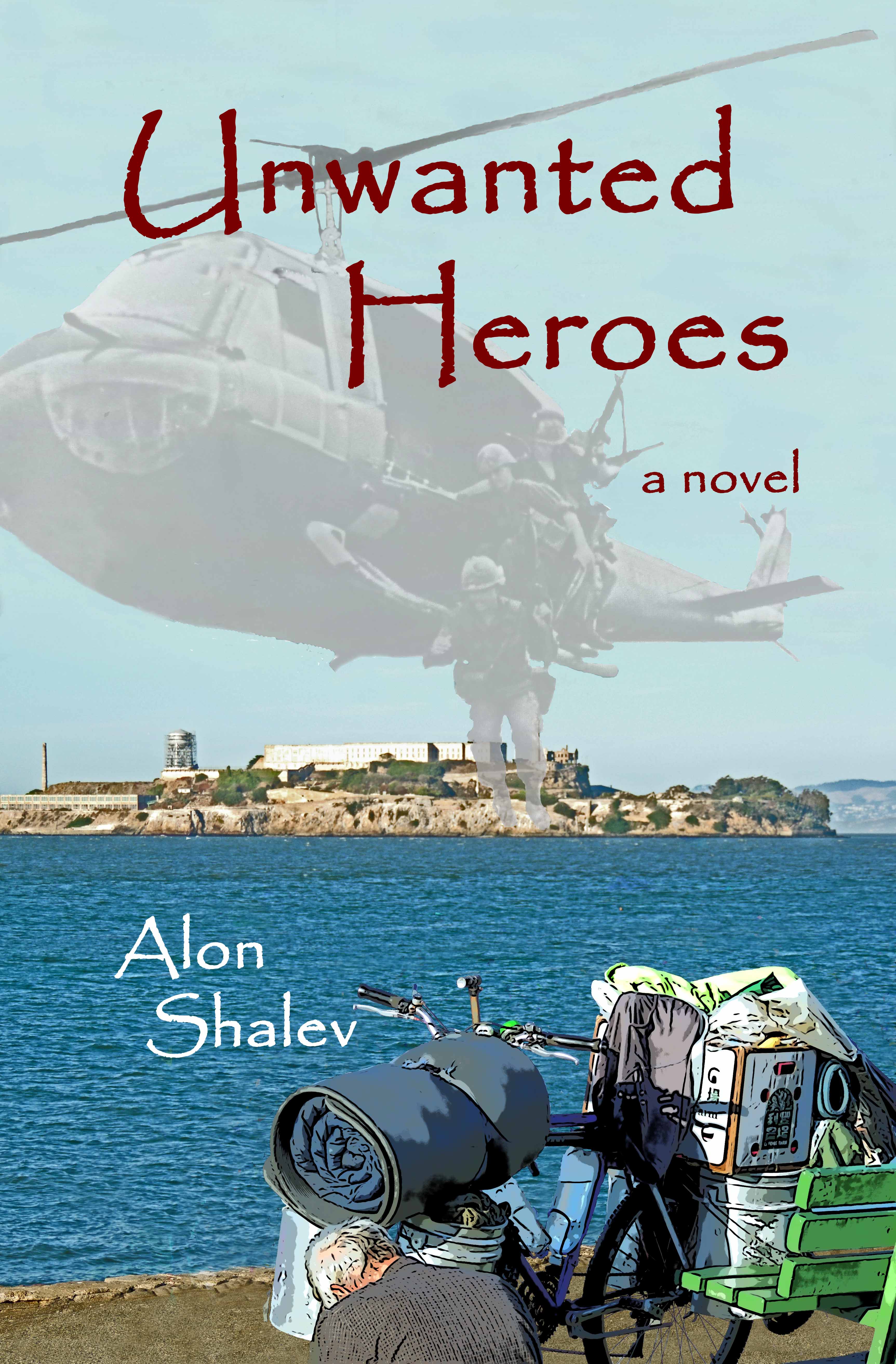
You may buy Unwanted Heroes at Amazon.com

Growing up in London, Alon Shalev has been a political activist since his early teens. He strives through his writing to highlight social and political injustice and to inspire action for change.

Moving to Israel, he helped establish a kibbutz where he lived for 20 years and served in the Israeli army.

Shalev then moved to the San Francisco Bay area and fell hopelessly in love with this unique city. Being new to the US, however, he was shocked to see so many war veterans on the streets. He regularly volunteers at initiatives such as Project Homeless Connect and the San Francisco Food Bank where he meets and talks with war veterans.

To follow this Blog via E-mail see upper right-hand column and click on “Follow”.

Unwanted Heroes – Part 3/4

2:  The Letter

I stare at him in bewilderment as he strides out of the café. I cannot decide whether I admire or fear him and conclude that probably a bit of both is most prudent. Turning back to the counter, I see Tabitha watching me as she hands change to a customer. I feel a sharp wave of panic.

“So they’re onto me?” Her tone is flippant when it is just the two of us. “It’s the addiction, Will. Caffeine and a full moon. Such a fatal combination.” She raises her cup and flutters her eyelashes as she sips.

“Until Mr. Tzu shows up, we’ll have to rearrange the work roster,” I reply somberly. “I assume Ginny has been filling in for Mr. Tzu over the weekend, but you have more experience. You’re going to have to pull the shift opposite mine.”

“But then we won’t get to work together! Who’s going to train me, nurture my career, and bring out my full potential?” She does a credible job pouting like a spoiled child. Then stretching out her hands, she bows her head. “I’m still your humble apprentice, Will, my lord, my barista.”

I relax. “Be mindful of the Force, my young Padma,” I say in my best Yoda-ese, “and keep the fucking Beast clean. Remember, the coffee flows through the Beast.” If only my school counselor had let me pursue a career as a Jedi Knight. “Right now, you’re the only other person supremely qualified to run shifts,” I say, getting back to business.

“But what about the wines?” Tabitha asks.

“George and I will alternate,” I reply.

“Carrot Face?”

“You’re going to call him that to his face one day soon and I might not be around to protect you.”

We both laugh. The prospect of Carrot Face or George and I going a few rounds over Tabitha’s honor is amusing. George is a recent addition to our staff. He knows little about coffee but worked on a vineyard in Napa for a few years. He is skinny, spotty, awkward and … well you can probably guess his hair color.

“But you’re gonna work a lot of hours,” Tabitha says, concerned.

“It’ll only be for a few days. He’ll be back soon.” I hear the doubt in my voice.

I serve two businessmen, who take their drinks swiftly to a table—their discussion never stopping.

Tabitha shrugs. “I bet the bastard rented a sports car and is in Vegas denying his age. Men are jerks, you know.”

“How would I know that?” I roll my eyes.

“You’re a writer, Will. You must’ve noticed them. Jerks.” Tabitha manages a disdainful expression.

“I’m also a man—never mind. The other day when Mr. Tzu chewed you out, has that happened before?”

“No, I’m actually a wonderful asset to the business!” Tabitha replies, her voice feigning hurt, then she frowns. “Hey, Will, you’re worried, aren’t you? You’re not convinced he’ll be back in a day or so?”

“I don’t know,” I say. “I wonder what made him crack.”

Tabitha shuffles and stares down at her scuffed Doc Martin boots.

“Tzu’s always been kinda tight, y’ know. Not big on the conversation, but he’s not a screamer either. That day, though, he was really pissed and not just because I failed to clean the Beast to his standards. He later chewed out Carrot Face after George quipped that, though it was his brother’s birthday, he was ignoring it as they weren’t close.

“Tzu heaped him a nasty lecture about family and loyalty. It wasn’t a fatherly rebuke either. Tzu was really pissed. I figured maybe it’s an Asian thing. They’re very family oriented.”

Tabitha puts down a wineglass that she’s been polishing and sighs. “Look, I don’t know Tzu. I’ve always been a bit scared of him ’cause he never talks or anything, so I’ve kinda kept my distance. You never know what’s going on in his mind. It’s intimidating. I’m not a barista or a wine freak like you. I’m expendable. As a woman, too, I feel vulnerable around him. Asians are pretty patriarchal, y’know, and I’m at the bottom of the food chain.”

“Yeah.” I’m feeling increasingly uncomfortable. “Let’s get back to work.”

A few minutes later I see Tabitha hovering by Tzu’s desk in the back of the store. She’s holding a badly crumpled piece of paper and calls me over.

“Will, look. This letter appeared the morning Tzu wigged out on me and Carrot Face. It had been slipped under the door before we arrived to open the café. I picked it off the floor, but Tzu grabbed it from me and read it immediately. He had it in his hand or his back pocket all morning. Later, I saw him put it in his desk drawer.”

Hoping for a clue, I take the letter. It is dirty and creased, and I just stare at thick, black Chinese characters.

I return the letter to the drawer of Tzu’s desk. It will be here when he returns—probably tomorrow. But Tzu doesn’t return and as the week passes, the whole staff begins to worry for Mr. Tzu and our jobs.

Early Wednesday, an elderly Asian woman enters the café. She wears a thick heavy coat and a green-silk scarf covers her head probably to ward off the chill. I turn to serve her as she approaches.

“Will?” Her voice is unsteady and her English heavily accented.

“Mrs. Tzu?” I hazard a guess.

She nods. “Please, bring green tea and sit with me.” She shuffles over to an empty table. There is a heavy flow of customers. I don’t like the other staff members seeing me sit while they work, but this wasn’t presented as a request.

Mrs. Tzu sips the tea and stares at me. Her face looks tired and worn.

“I’m sorry about Mr. Tzu. I really am,” I say. “Is there anything I can do to help?”

“Husband will come back.” She nods as she says this but without conviction. “He says you are good boy. He says you can be trusted.”

“Thank you, Mrs. Tzu. That is high praise.” I am pleased to hear this. “I love my job and the coffee shop.”

“Good, good.” She nods. “You stay and run place. Mr. Tzu will soon return and give you reward. Okay?”

“Sure, Mrs. Tzu. Do you have any idea where he might be? Could he … could he have gone home to China?” Last night, I dreamed that he had returned there to die, but I don’t feel it prudent to share this.

“Mr. Tzu is American.” She shakes her head. “Left China as very small boy and feels no love for China. Love 49ers and Giants. For him, America is home.”

“What do your children think? Have you talked with other relatives?”

She again shakes her head. “I speak with children. Speak all the time. No brother or sister. This disappearance is very strange. He has gone before when very stressed. Has something in past, something from war.”

“So you don’t think he’s been kidnapped or anything? He doesn’t have any enemies, does he?”

She looks at me for a moment perhaps to see if I am joking. Then she leans forward, her expression serious. “Mr. Tzu is good man. Very fair. Many in city know him. All have high respect for him.”

“I’m sorry. Didn’t mean to imply—” I didn’t know what I didn’t mean to imply, and we both fall silent.

Then Mrs. Tzu leaned forward. “I am from China. Parents die during time of Long March, I think. Maybe later. China was chaos. Hard life then. I brought to US to stay with aunt. Meet Mr. Tzu in city. America is good but for me not home. Mr. Tzu is my home and so America is my home.”

She leans back and sighs. “49ers and Giants, they suck. Coffee not good either. Bad for Shen, for spirit. Green tea is good—keep you young.” She winks. Then she laughs, and I try to laugh with her.

I feel a wave of sympathy toward this brave woman who, like me, is far from her home. I swallow hard. “Mrs. Tzu. I don’t know where he is. I don’t really know him.” I’m getting repetitive perhaps feeling guilty that I haven’t tried to befriend him. “But maybe you could come into the café more and sit here to help look after the staff and customers?”

She flashes the briefest of smiles. “Thank you. Mr. Tzu is right. You are good boy. I go down to visit children in Ventura for few days. Help them not to worry.” She smiles and looks proud, so I think that they have invited her. Then she asks, “You good son to parents, yes?”

I’m a little bewildered by the change of direction but manage to say, “Despite the distance, I try. My father passed away about ten years ago, but I think they were always good to me. My mum’s still in England and I miss her—both of them, I guess.”

“Maybe you send mother flowers to show you think of her? Write letter. I come back and check, yes? After I return from Ventura.”

Write a letter—shit! The letter! I reach into my pocket but something stops me. Mrs. Tzu rises pushing down on the table as she straightens and shuffles out. I remain seated staring at her cup of still-steaming tea, which she hardly touched. Mrs. Tzu could probably have translated the letter her husband received on the day he flew at the staff, yet some strong impulse holds me back. I shrug. I can show her the letter another time.

I pick up her warm cup and hug it between my two palms. As I stare at the door she has just exited, I have a strong feeling that I am getting sucked into something that shouldn’t be part of my life yet unequivocally is. Shit! Maybe I should give up coffee for green tea. It’s bad for my Shen whatever that is.

Continued on February 20, 2013 in Unwanted Heroes – Part 4 or return to Part 2

____________________

Growing up in London, Alon Shalev has been a political activist since his early teens. He strives through his writing to highlight social and political injustice and to inspire action for change.

Moving to Israel, he helped establish a kibbutz where he lived for 20 years and served in the Israeli army.

Shalev then moved to the San Francisco Bay area and fell hopelessly in love with this unique city. Being new to the US, however, he was shocked to see so many war veterans on the streets. He regularly volunteers at initiatives such as Project Homeless Connect and the San Francisco Food Bank where he meets and talks with war veterans.

You may buy Unwanted Heroes at Amazon.com

To follow this Blog via E-mail see upper right-hand column and click on “Follow”.

Unwanted Heroes – Part 2/4

1:  The Disappearance of Mr. Tzu

Monday mornings are tough at the best of times. The Financial District of San Francisco swarms with people craving their caffeine turbo charged as they transition from weekend wildness to the cubical and office. The line for coffee snakes out of The Daily Grind onto Spear Street and I, the barista, marshal my staff to satisfy the needs of my newly adopted city.

Nothing can stop me as steam rises from the Beast, our espresso machine, which hisses and whistles as I concoct cappuccino, mochaccino, latte, espresso, nonfat, low fat, decaf, skinny. I am focused. Nothing can take me out of the groove as I serve the suits, the ripped jeans, the police uniforms.

Police Uniforms? One is a huge ruddy-faced officer while the other is smaller, mustached and maybe Hispanic. I’m still too new in the US to accurately place the myriad of people who make up the melting pot of San Francisco. But I do notice that the smaller officer wears wraparounds even inside our coffee shop.

“Are you the barista?”

“Yes sir. My name’s Will … Will Taylor. What can I get for you?” What are the customers thinking? What did he do? He made such a nice latte. Who would have thought?

“Good morning, Will. I’m Captain O’Connor and this is Sergeant Mendez. We’re SFPD.” Two badges flash against the fluorescent lights held in front of the midnight-blue uniforms. “We’d like to talk to you about your employer, Mr. Tzu.”

“Now?” I glance at the line then my watch. It is a few minutes to nine o’clock and the rush is almost over.

“Can we move this away from the counter, gentlemen, and maybe give me just five minutes here?” My tone is a mix of impatience and a fear of authority—especially in a land I am not used to. “Why don’t you sit over at that vacant table, and I’ll bring you coffee?”

As I continue to work our espresso machine, I recall a conversation on Saturday with Tabitha. Tabs was due to replace me for the afternoon shift but, as she often did, she came in early to hang out, as the weekends are pretty quiet.

Tabitha was my first true friend after I arrived in the US, and we have remained close since. She is young, thin and has a tendency to wear body-clinging clothes that appear to have shrunk several times over. Her mousey blond hair is straight and looks fashionably neglected. She has piercings everywhere. Tabitha can be dead cool or apple pie fresh; apparently, it is somehow related to the moon’s cycle.

“Hey Hemingway,” she said with a chirp.

When we first met, I made the mistake of trying to impress upon her my desire to become a famous writer with a Hemingway quote. I’m pretty sure she uses the nickname as a token of affection.

Tabitha is supposed to be an art student. She is enrolled at the nearby Academy of Art, although she seems to attend with varying degrees of intensity. She never likes to discuss her art or her studies and I have learned to avoid the topic.

Our relationship is purely platonic. She’s been to my apartment a few times for dinner and a movie. Twice she slept over as it was late; yet there was no suggestion of anything sexual. She could be my little sister—I always wanted a younger sibling to bully.

On Saturday, I had been cleaning the Beast, which our boss demands must sparkle and purr. Mr. Tzu was apparently one of the first to import such a fine espresso machine from Europe and was extremely proud of it.

“The Beast looks good,” Tabitha said, patting the metallic giant. “You take good care of …” Her voice had faded.

I stopped cleaning the machine and turned to her. “What’s up, Tabs?”

“Tzu chewed me out the other day.” Her voice quivered, and she played with a hanging lock of hair. “He was brutal.”

Though Mr. Tzu is my boss, I know little about him. When he saw that I could not only function as barista but also as shift manager, he had me running the opposite shifts to him.

An elderly Asian American, Mr. Tzu is nearing retirement. He’s prompt, quiet and formal. Although there is a high staff turnover, I’ve never heard of someone being yelled at or fired acrimoniously. Tzu provides health benefits, not a given in this line of work, and we enjoy the informal work environment and compensation.

“What did you do wrong?” I asked.

“Nothing really.” Her tone was sulky, bottom lip pouting. “I hadn’t cleaned the Beast properly in his eyes.”

“He is very protective of it,” I replied, trying a sympathetic approach.

“The coffee machine wasn’t the reason!” Tabitha snapped. “He was really pissed, Will. There’s something going on.”

I pause, puzzled by her response. “I’m sorry he got mad, but what do you mean?”

“Well, you know. He’s married and has kids somewhere. I’ve never had a meaningful conversation with him, but I sense something is eating at him—something serious.”

“Hmm.” I had nothing else to say.

I hadn’t given it any more thought. My shift finished and I spent the rest of the weekend writing vigorously on my laptop. In fact, this whole scene had slipped my mind until now when the police entered the coffee shop.
Low Res Finished Cover on November 14

“Again, I’m Captain O’Connor.” A thick hand is extended and soon crushes mine. “We’re here about Mr. Tzu.”

“Why? What’s happened?” I sip a glass of water I have with me.

“He’s disappeared, Will. No one has seen him since Thursday. What can you tell us about your boss?”

“Not a lot. I’m curious. A grown man disappears for a few days and the police are already involved?”

“Listen, kid,” replies Captain O’Connor, a big muscular fellow with an imposing mustache and balding head. “San Francisco might seem like a big city to an outsider like yourself—an Englishman no? But we still have neighborhoods, communities, and we still look out for each other. Mr. Tzu is known around these parts and there’s a history. Let’s just say that this isn’t the first time, okay? Now please, tell us what you know about your boss.”

I shrug. “Probably less than you. When he hired me, he was looking to reduce his hours. He’s getting old; probably thinking about slowing down. I’ve considerable experience as both a barista and sommelier, and I studied business for a while in college. I really don’t know him. Once he saw that I’m competent, he pretty much has had me working the opposite shift to him.”

I sip more water and try to think of something else. “There’s a Mrs. Tzu and kids, grown up I think, but I’m not sure how close the family is or where the kids live.” Both O’Connor and Mendez display bored expressions, and I say, “I’m not telling you anything new, am I?”

“No, you’re not,” replies O’Connor. “Think of something that might be relevant to his disappearance. How’s business? Any problems come to mind?”

“I think business is pretty steady,” I say. “But I don’t see the books, so I can’t be certain.”

“What else is sold here, kid?” The second cop, Mendez, leans in and speaks quietly, his voice a fair James Cagney. “Anything, you know, on the side?”

I stare at him for a few moments wondering if he’s joking, but he just stares back blankly awaiting my answer. Mendez, in contrast to his partner, is a small, dark man with jet-black, greased-back hair and sunglasses. We’re a month into a gray San Francisco winter and he’s still sporting sunglasses—indoors. His badge, on the other hand, is extremely shiny and glints when it catches the café’s ceiling lights.

“What do you mean?” It’s about all my brain can muster.

“Drugs, gambling, numbers, you know?” Mendez no doubt reels off such a list a few times a day.

“None of that stuff.” Is he joking?

The Hispanic cop wiggles his nose as if trying to pick up a scent. “You said that he has you working the opposite shifts to himself, correct? Ever thought he did this on purpose?” He stares at me over his steaming coffee cup. There is some froth on his dark mustache. “Perhaps he’s keeping you away from something?”

“Of course not,” I answer. “I told you he’s just slowing down and feels he can trust me.”

“Yes, you did.” He takes another calculated sip of coffee. More foam beds down in his moustache. “Any of the staff mentioned someone coming into the coffee shop and arguing with him? Or have any of them argued with him?”

I glance at Tabitha thinking about her argument with Mr. Tzu over the Beast but shake my head. “No, not that I know of.”

“Anyone fired recently?” Mendez is certainly persistent. “Perhaps someone left feeling like he screwed ’em?”

I’m really no help. “Maybe you should talk with the other employees,” I say. “I need to get back to work. Do you have any more questions?”

“Not for now.” O’Connor says handing over a business card. “If anything comes to mind, call us.”

As the captain walks out the door, his partner leans back in still holding his coffee cup. His James Cagney tone is little more than a whisper.

“Keep an eye on the girl.” His eyes flash toward Tabitha. “We know about their argument, and we know you didn’t tell us. It’s all about the espresso machine. If it ain’t treated right, we can tell.” He taps his nose with a thick, gold-ringed finger. “The customer always knows.”

Continued on February 19, 2013 in Unwanted Heroes – Part 3 or return to Part 1

____________________

Growing up in London, Alon Shalev has been a political activist since his early teens. He strives through his writing to highlight social and political injustice and to inspire action for change.

Moving to Israel, he helped establish a kibbutz where he lived for 20 years and served in the Israeli army.

Shalev then moved to the San Francisco Bay area and fell hopelessly in love with this unique city. Being new to the US, however, he was shocked to see so many war veterans on the streets. He regularly volunteers at initiatives such as Project Homeless Connect and the San Francisco Food Bank where he meets and talks with war veterans.

You may buy Unwanted Heroes at Amazon.com

To follow this Blog via E-mail see upper right-hand column and click on “Follow”.