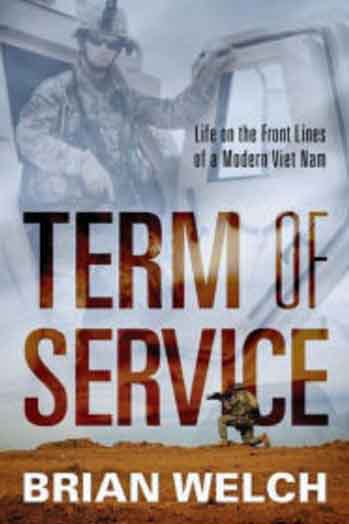
It isn’t a secret that military veterans tend to be conservative and vote Republican. In fact, Gallup reports that veterans are more likely to be Republican than are those of comparable ages who are not veterans. The reason I mention this is because Brian Welch’s memoir takes readers through Army boot camp to Iraq for two deployments, and Welch is brutally honest with his conservative views—a fresh perspective that most who serve in the U.S. military share but is missing from many films about war where the focus is usually on heroism, debauchery or the horrors of war. In fact, most films seem to be more concerned with political correctness than reality. But Term of Service (click link to visit Amazon and buy this book) avoids Hollywood hype and serves us combat as it really is.
When we first meet the author in boot camp, he’s eager to fight for his country, but that eagerness fades when confronted by an elusive enemy that is seldom seen. For instance, unseen insurgents planting roadside bombs; invisible snipers shooting from a distance, or terrorists who become human bombs that infiltrate our lines and blow themselves up among U.S. Troops. The type of combat our troops faced in World War I, World War II and Korea seems to be a thing of the past. Instead of armies clashing with armies, today our troops often fight an invisible enemy.
This modern form of warfare grinds our troops down just like it did to combat vets in Vietnam where I fought decades earlier. I think Welch’s honesty is refreshing, and anyone who wants to experience the tension of combat—the endless waiting not knowing what will happen next—and what it does to most of the troops, should read this book. War takes boys, runs them through the blades of a blender and when they come out, they are often cut and bruised physically and mentally.
_______________________
Lloyd Lofthouse is a former U.S. Marine and Vietnam Veteran.
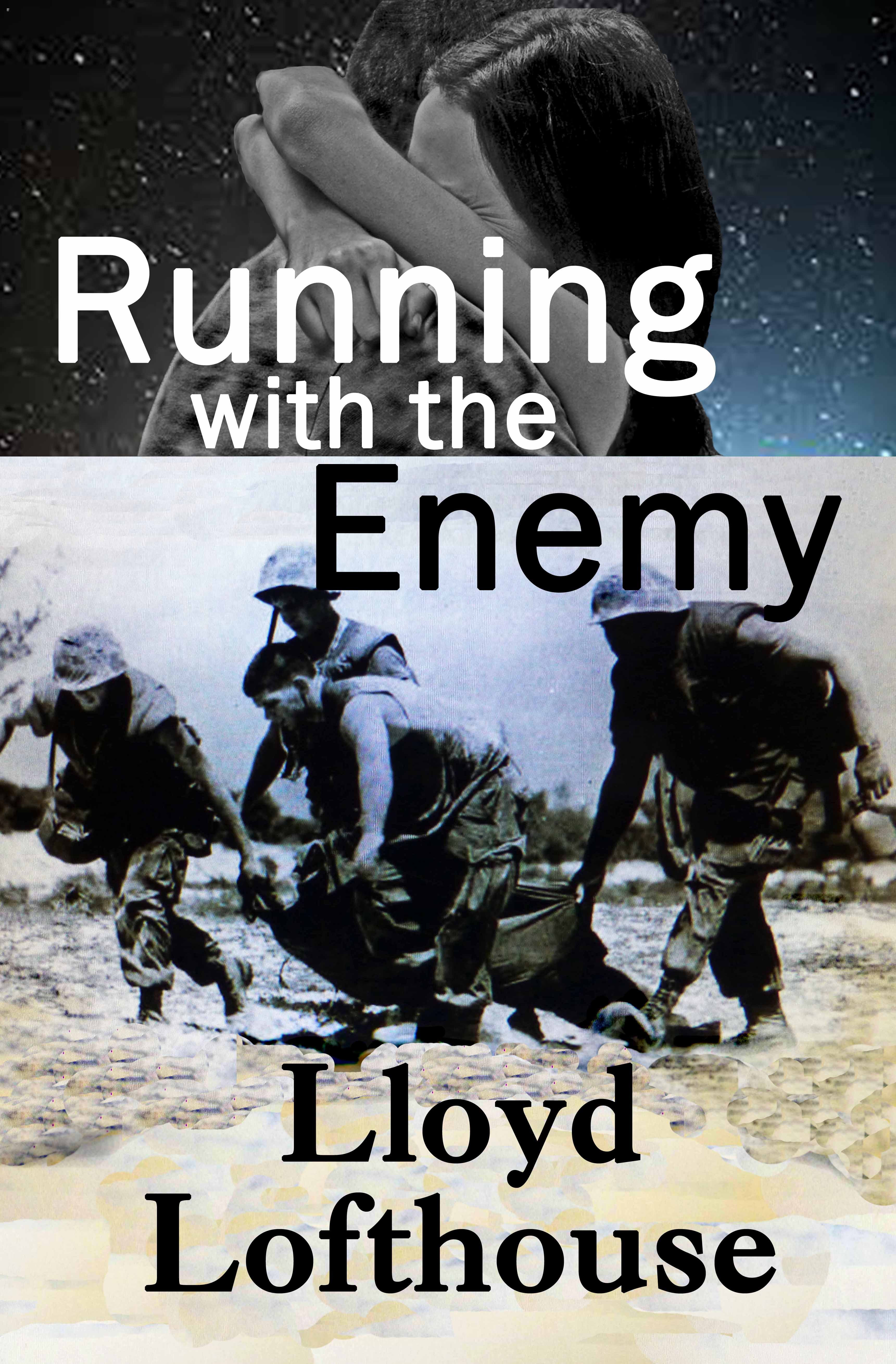
His second novel is the award winning love story and suspense-thriller Running with the Enemy. Blamed for a crime he didn’t do while serving in Vietnam, his country considers him a traitor. Ethan Card is a loyal U.S. Marine desperate to prove his innocence or he will never go home again.
I can’t remember when I paid $3 at Half Price Books for an audio book of Pardonable Lies by Jacqueline Winspear. You see, I enjoy reading. That’s why I buy books—audio and the old fashioned kind on paper—and DVD’s of films and TV series faster than I watch or read/listen to them, and they are all around me in the study where I write. They are also books in storage under the house. I think I’ll have to live another thousand years to read them all—as long as I don’t buy more.
In an attempt to read faster, I started reading with my ears when I’m in the car on the way to the farmer’s market, Costco, Trader Joe’s and Whole Foods. And I drive in the slow lane to gain more listening time.
The reason I am now a fan of Winspear’s work, and specifically Maisie Dobbs, the main character in eleven of the author’s twelve novels, is because Maisie has a serious and convincing case of PTSD, and I came home in 1966 from Vietnam with PTSD.
As I wrote this post, I visited the author’s website, and saw that Pardonable Lies is the 3rd novel in the Maisie Dobbs series, and I smiled, because that means I have ten more to read—hopefully with my ears since I’m reading about four or five audio books to every tree book.
This is where I copy and paste from Winspear’s page on The World of Maisie Dobbs: “The period of time from the mid-1900’s until the 1930’s was a time of unprecedented change in Britain. The devastation of The Great War, mass emigration to America and Canada, rapid social changes—not least votes for women—to be followed by the Roaring Twenties, the General Strike and the Depression. It was a time of burgeoning artistic expression, with the movements that we now know as Art Nouveau and Art Deco demonstrating a dramatic departure from the Victorian age.
“The Great War demanded that there was hardly a field of endeavor left untouched by a woman’s hand, so that men could be released for the battlefield. The first women joined the police force, they worked in construction, on the trains and buses, on the land and in all manner of military support roles. The made munitions and they worked close to the front lines as nurses, ambulance drivers; as intelligence agents and code-breakers. And after the war, it was these same remarkable women who, more often than not, faced a life alone, for the men they might have married had been lost to war.
“It was also during these first decades of the century that scientific methods of detection were being rapidly developed. From medicine to international travel to the study of the human mind, all benefited from a time that was both terrifyingly painful in terms of the cost to human life, and yet demonstrated a hunger for innovation and a fascination with the avant-garde.
“It is in this world that Maisie Dobbs came of age.”
_______________________
Lloyd Lofthouse is a former U.S. Marine and Vietnam Veteran.
His second novel is the award winning love story and suspense-thriller Running with the Enemy. Blamed for a crime he didn’t do while serving in Vietnam, his country considers him a traitor. Ethan Card is a loyal U.S. Marine desperate to prove his innocence or he will never go home again.
This is a love story that might cost the lovers everything—even their lives.
To follow this Blog via E-mail see upper left-hand column and click on “FOLLOW!”
According to Box Office Mojo, Killing Season’s widest release was to 12 theaters for seven days and then it went to DVD. I think this decision was made because most film audiences in American prefer romance and fantasies—not the brutal, bloody reality of gory, brutal up close and personal hand-to-hand combat.
The film was released on July 11, 2013, and it was a flop at the box office earning a total of $39,881 in theaters. Peter Sobczynski reviewed the film and gave it less than one star. Sobczynski says, “The film is quite awful—badly written, ineptly staged, horribly acted, historically suspect and boring beyond belief—and fully deserving of its ignominious fate.”
Here’s the thing, I don’t agree with Sobczynski. I didn’t think it was a bad film—and was that because I have no taste, or because I’m a former U.S. Marine who fought in Vietnam?
To me, this film reveals rather brutally what combat does to two men, and how war might leave mental scars that run deep. In fact, similar brutality appears in my novel, “Running with the Enemy”. If you have a weak stomach and lose sleep easily over reading about or watching extreme violence, this film and my novel are not for you.
Here’s a brief plot summary without spoilers: In Belgrade, Serbia, former Scorpions soldier Emil Kovač (Travolta) meets an informant to retrieve a file on American military veteran and former NATO operative Colonel Benjamin Ford (De Niro). Ford has fled to a cabin retreat somewhere in the Appalachian Mountains, to forget the war. Now a recluse, he meets Kovač, posing as a European tourist, during a hunting trip. The two men become friendly, until Kovač reveals his true identity. Intent on revenge for something Ford allegedly did in Serbia, he initiates a gory game of cat-and-mouse with Ford. The latter is badly injured but is quick to rebound.
I find it interesting that the film had 257 customer reviewson Amazon, and 132 were 4-and-5 star reviews—that’s 51%. Only 62 were 1-and-2 stars—that’s 24%. More than twice as many reviewers enjoyed the film, and I was one of them.
The Most Helpful Review said, “Killing Season is a movie that thrills and leaves you thinking. It is timely because the tension echoes many of the current situations going on in society. In their own right each of the two in the movie have their reasons (and justifications) for their points and places. In the end (sorry, no spoiler here) the stark realization of the view from the other side really brings home the powerful moral of this movie. De Niro is his usual amazing self and Travolta delivers a nearly convincing eastern bloc persona. Well worth seeing.”
I also scanned the 1-star reviews and the most detailed one I read ended with: “If you’ve ever wanted to see De Niro piss on his own leg to heal a gaping wound this is your chance. You won’t get another.”
I asked Google why it might have been a good idea for De Nrio to piss on his wound, andWise Geek.org says, “As difficult as it might be for some to comprehend, the medical benefits of urine have been widely studied in many areas including, but not limited to, the effect of pee on wounds. Normal urine is not only pH balanced, it is non-toxic and is believed to contain many nutrients and healing compounds. Normal urine is both anti-viral and anti-bacterial, making it a potentially ideal treatment for cuts, abrasions, wounds, and skin infections of any kind.”
>>>Focus on the key word there: “normal” urine.<<<
I don’t know about you, but don’t expect me to pee on my wound if I was in the same situation. I’d rather use powdered cayenne. I keep some in the car, bathroom, kitchen and my wood shop. In fact,Earth Clinic.com says, “For stopping profuse bleeding, we eagerly recommend using powdered cayenne to speed up the coagulation process and close the wound.”
I learned about using powdered cayenne on wounds when I belonged to a wood-carving club. Every veteran wood carver in that club had some fine ground pepper/powdered cayenne stored in their tool box with their super-sharp carving knives—just don’t put powdered cayenne or black pepper in your eyes, mouth or nose. It burns really bad, but surprisingly doesn’t burn when sprinkled on cuts and gashes—at least that has been my experience.
_______________________
Lloyd Lofthouse is a former U.S. Marine and Vietnam Veteran.
His latest novel is the award winning suspense-thriller Running with the Enemy. Blamed for a crime he did not commit while serving in Vietnam, his country considers him a traitor. Ethan Card is a loyal U.S. Marine desperate to prove his innocence or he will never go home again.
And the woman he loves and wants to save was fighting for the other side.
To follow this Blog via E-mail see upper left-hand column and click on “FOLLOW!”
Two things happened in the last few days. First, I was shopping at Wholefoods and while waiting in line to buy dinner, I saw the cover of a May 2014 Economist Magazine with an Eagle sitting on a desktop globe and the banner headline asked: What Would America Fight For? The question haunting its allies
In that cover piece, The Economist said, “A survey last autumn by the Pew Research Centre suggests that 52% (of Americans) want the United States to ‘mind its own business internationally’, the highest figure in five decades of polling.”
After reading that, I laughed and thought: Americans may not have any say about the next war just like they had no real say in Vietnam or the 2nd Iraq War because they were lied to.
That leads me to mention one of my favorite quotes from President Abraham Lincoln: “You can fool all the people some of the time, and some of the people all the time, but you cannot fool all the people all the time.”
You see, the reason I laughed is because all Congress and the President has to do is come up with a lie that fools more than half of all adult Americans to have the okay from the people to start the next war—and when that happens will probably be decided by those who profit the most from war.
It wasn’t that difficult to discover the corporations that benefit the most from death. I Googled: “who profits the most in the United States from wars” and discovered from USA Today that the business of war is profitable. In 2011, the 100 largest contractors sold $410 billion in arms and military services. Just 10 of those companies sold over $208 billion. Based on a list of the top 100 arms-producing and military services companies in 2011 compiled by the Stockholm International Peace Research Institute (SIPRI), 24/7 Wall St. reviewed the 10 companies with the most military sales worldwide.”
The top five were:
Lockheed Martin with arms sales of $36.3 billion in 2011—total sales were $46.5 billion
Boeing with arms sales of $31.8 billion—total sales were $68.7 billion
BAE Systems with arms sales of $29.2 billion—total sales were $30.7 billion
General Dynamics with arms sales of $23.8 billion—total sales were $32.7 billion
And Raytheon with $22.5 billion in arms sales and $24.9 billion in total sales
What happens to individual fortunes and lost jobs when 78% of Lockheed Martin’s income comes from arms sales; 46% of Boeing’s; 95% for BAE Systems; almost 73% for General Dynamics, and more than 90% for Raytheon?
If you’re curious how much the defense (arms) industry spends to lobby Congress, all you have to do is visit Open Secrets.org to discover that 978 lobbyists who worked for this industry in 2011 spent/donated $138,182,721 to influence elected representatives to make sure the federal government continued to spend heavily on defense and of course the best way to justify this much spending is to start another war, and who will the U.S. attack next?
Then Sunday Morning (May 11), I went to the theater to see “The Railroad Man”, and the horror of war hit home hard. I think this is a film that every adult American should see—especially the CEOs of the arms industry, the lobbyists who work for that industry, Congress and the President. “The Railroad Man” was based on a powerful, real story of British troops who became POWs in Singapore during World War II. The main character, Eric Lomax played by Colin Firth, survived the war but came back with a severe, traumatic case of PTSD that makes what I brought home from Vietnam seem tame in comparison, but I was never a prisoner of war—water boarded and tortured.
Let’s look at the cost of two recent wars: the Vietnam War (1965-1975) cost $738 Billion with 58,209 U.S. deaths and 153,303 wounded, and the 2nd Iraq War (2003-2010) cost $785 Billion with 4,800 U.S. deaths and 31,965 wounded—according to a report issued June 29, 2010 by the Congressional Research Service.
The reason I mention only these two wars was because both were started based on lies fed to America through the corporate owned media so enough Americans would be fooled long enough to support the wars.
What do you think the next lie will be, and where will that war be fought?
_______________________
Lloyd Lofthouse is a former U.S. Marine and Vietnam Veteran.
His latest novel is the award winning suspense-thriller Running with the Enemy. Blamed for a crime he did not commit while serving in Vietnam, his country considers him a traitor. Ethan Card is a loyal U.S. Marine desperate to prove his innocence or he will never go home again.
And the woman he loves and wants to save was fighting for the other side.
To follow this Blog via E-mail see upper left-hand column and click on “FOLLOW!”
There’s no fantasy, hero worship or fake humor in this TV series. Everyone is flawed and injured from the war—even Americans who never served in Vietnam or wore a uniform.
“China Beach” was a TV series from 1988 to 1991, and I didn’t view it until recently after I first heard about it and bought a copy of the series on DVD at Costco. I didn’t buy the complete series that comes with almost 60 hours of run time. I bought Seasons 1 + 2 with about 22 hours.
And I think I know why this excellent TV series was cancelled after four seasons—although the series has more than 249 reviews on Amazon with 4.8 of 5 stars, most Americans can’t deal with the harsh reality of war. After all, less than 7% of Americans are veterans and even fewer have served in combat.
“China Beach” is set in a combat hospital during the Vietnam War in the late 1960s. The title refers to My Khe beach in the city of Da Nang, which was nicknamed “China Beach” in English by American and Australian troops during the war.
The main character is first lieutenant Colleen McMurphy who is a triage nurse dealing with often severely wounded troops. The directors focused on reality and there were real combat nurses who were consultants. There’s a bonus DVD with this set where we get to meet some of the nurses who served in Vietnam.
The fictional nurse, McMurphy, takes her job saving lives seriously and when she loses wounded troops, she takes the loss personally and is emotionally injured. Her PTSD is visible from the beginning. At times the suffering and drama were so intense, my eyes filled with tears from my own memories.
If you want a close look at the reality of combat and the price the troops and civilians pay, I highly recommend this series. You’ll have a safe front row seat to watch these characters become friends, lovers and then suffer loses that would break most people and scar them for life as it must have scarred the real nurses who served there.
You may question my opinion of this series so it may help to know that I’m a Vietnam combat vet who was a field radio operator in the U.S. Marines. And I was fortunate to never have to be medevaced to a combat hospital although some of the Marines in my unit were.
Now I’m thinking about the seasons of “China Beach” I haven’t seen.
_______________________
Lloyd Lofthouse is a former U.S. Marine and Vietnam Veteran.
His latest novel is the award winning suspense-thriller Running with the Enemy. Blamed for a crime he did not commit while serving in Vietnam, his country considers him a traitor. Ethan Card is a loyal U.S. Marine desperate to prove his innocence or he will never go home again.
And the woman he loves and wants to save was fighting for the other side.
To follow this Blog via E-mail see upper left-hand column and click on “FOLLOW!”
Are we all crazy? Does PTSD ever go away? I’m sure that most members of the US military have a much better understanding of PTSD than the general public.
There are currently about 1.4 million active troops serving in the U.S. military and 21.5 million military veterans. But the U.S. population has more than 317 million people. That means 0.44% are serving in the active military and 6.7% are veterans leaving 93.15% of the population mostly clueless.
So, where does the general population acquire its perception of PTSD?
To answer that, we must ask how many Hollywood movies have painted a positive picture of combat veterans compared to movies that show veterans as angry, violent, dangerous drug users and/or alcoholics (mostly brought on by PTSD).
Three Vietnam Veterans have run for President of the United States—all three lost. One was a Republican and two were Democrats.
Al Gore served in Vietnam as a reporter/journalist for five months. He was stationed with the 20th Engineer Brigade in Bien Hoa and was a journalist with The Castle Courier. He received an honorable discharge from the Army in May 1971.
Gore said, “I don’t pretend that my own military experience matches in any way what others here have been through … I didn’t do the most, or run the gravest danger. But I was proud to wear my country’s uniform. And my own experiences gave me strong beliefs about America’s obligation to keep our national defenses strong.”
John Kerry reported for duty at Coastal Squadron 1 in Cam Ranh Bay in South Vietnam on November 17, 1968. In his role as an officer in charge of swift boats, Kerry led five-man crews on a number of patrols into enemy-controlled areas.
John McCain requested a combat assignment, and was assigned to the aircraft carrier USS Forrestal flying A-4 Skyhawks. His combat duty began when he was thirty, in mid-1967.
John McCain became a prisoner of war on October 26, 1967. He was flying his 23rd bombing mission over North Vietnam when his aircraft was shot down by a missile over Hanoi.
What is your opinion about the public image of combat veterans? Do you think these three men lost the White House because of that image?
Lloyd Lofthouse is a former U.S. Marine and Vietnam Veteran.
His latest novel is the award winning suspense-thriller Running with the Enemy. Blamed for a crime he did not commit while serving in Vietnam, his country considers him a traitor. Ethan Card is a loyal U.S. Marine desperate to prove his innocence or he will never go home again.
And the woman he loves and wants to save was fighting for the other side.
To follow this Blog via E-mail see upper left-hand column and click on “FOLLOW!”
I’m currently watching The Walking Dead, season three on DVD, and the main character’s son—Carl—who isn’t even a teenager, has become an efficient killing machine of both humans and zombies.
But that isn’t what this post is about because The Walking Dead is fiction.
In this post, I am writing nonfiction for someone who has no voice. We now know that many who grow up to be racists, criminals and killers were victims of parental neglect, but this post isn’t about that either. [Turning Children into Killers]
This post is about George Sandefur—a smoker who died from an aggressive form of lung cancer—and I have not forgotten one story he told me at lunch one day when we were alone in the staff lounge.
At the time, he taught math and I taught English at Giano Intermediate School in La Puente, California and it was the early 1980s. He had the classroom next to mine. George told me this story a few years before the lung cancer took him.
You see, George served in the U.S. Army in the Korean War [1950 – 1953]. He told me about one patrol on a cold day. The narrow trail they followed clung to the side of a steep mountain he didn’t know the name of.
George brought up the rear and from his vantage point saw several young Korean children coming their way. None of these kids could have been over ten. The rest of American patrol had gone around a fold in the mountain and couldn’t see the children.
George stopped. He sensed something was wrong, and when he saw the machine gun strapped to the back of a little girl, he knew that the other troops in his patrol were walking into a trap and certain death.
He was the only one who had a clear shot, so he pulled the trigger.
It turned out those kids were heavily armed with explosives and the machine gun. All that little girl had to do was lean over so the seven or eight-year-old boy standing behind her could pull the trigger to kill the US troops.
George took lives that day but also saved lives, and he was left with a mental scar that followed him the rest of his life.
That one defining moment changed who George was and how he saw the world.
His latest novel is the award winning suspense-thriller Running with the Enemy. Blamed for a crime he did not commit while serving in Vietnam, his country considers him a traitor. Ethan Card is a loyal U.S. Marine desperate to prove his innocence or he will never go home again.
And the woman he loves and wants to save was fighting for the other side.
To follow this Blog via E-mail see upper left-hand column and click on “FOLLOW!”
It’s been forty-seven years since I served in Vietnam, and over those years, the few times I’ve been in threatening situations, my thoughts are not of running away or breaking down in tears of fear. Instead, I’m thinking of the fastest way I can kill the person I perceive as a threat. If I’m close enough, I’ll be looking at his throat thinking about digging my teeth in and tearing out his jugular.
In the film “Patton”—played by George C. Scott—there is a scene where the general explodes in anger at troops who were in military hospitals suffering from severe PTSD—known as battle fatigue or shell shock back then. The violence they had experienced had traumatized them severely. But General Patton thought anyone who suffered from PTSD was a coward and a fake.
I think that Russell Ireland, who owns the Big I’s Restaurant in Oxford, Massachusetts, is evidently an uneducated throw back to that World War II era, who does not think a war veteran suffering from PTSD deserves the same respect as a vet who lost body parts and probably also suffers from PTSD.
To Ireland’s way of thinking—just like General Patton—if the injury isn’t physical, it doesn’t count. For example, missing body parts.
I never know when my PTSD is going to flare or what may trigger it. When I’m awake, I’m always vigilant of my surroundings watching for threats.
At night and early morning hours I often wake up and see enemy combatants in the darkness—they seem real but I’ve experienced this so many times over the decades that I often stare at them and maybe use a flashlight I keep by my bed to make sure it isn’t real before I can go back to sleep. And by my side is a .45 caliber Glock automatic with a loaded magazine. In the closet is a pump shotgun. In the gun safe are more weapons and boxes of ammo.
I did not buy these weapons to go hunting. I bought these weapons so I could sleep at night knowing I was prepared for the unexpected that my PTSD keeps reminding me is out there. Watching the daily news also doesn’t help so I avoid it most of the time. Before Vietnam, I read newspapers. After Vietnam, I stopped reading them. Newspapers are filled with reminders of crimes and violence in the United States that may trigger PTSD symptoms.
PTSD wasn’t recognized until the 1980s and then vets started to receive help from the VA. I have carried the dark shadow of my PTSD with me since 1966 and didn’t get any help from the VA until after 2005 when I discovered that I was eligible.
And ignorant idiots like Russell Ireland don’t have any idea about the time bomb they may be triggering when they confront a vet with combat induced PTSD. He may have been fortunate that James Glaser had his trained service dog by his side.
By the way, it’s been forty-seven years since I served in Vietnam and I haven’t killed or physical attacked anyone yet. As for Dr. Phil, I’ve never been impressed by his show. It’s more of a shock and awe thing promoted by Oprah [she’s the billionaire who owns the show] while Dr. Phil acts the guru to an ignorant mob of fools—Dr. Phil’s net worth is estimated to be $200 million or more earned from his show.
Lloyd Lofthouse is a former U.S. Marine and Vietnam Veteran.
His latest novel is the award winning suspense-thriller Running with the Enemy. Blamed for a crime he did not commit while serving in Vietnam, his country considers him a traitor. Ethan Card is a loyal U.S. Marine desperate to prove his innocence or he will never go home again.
And the woman he loves and wants to save was fighting for the other side.
To follow this Blog via E-mail see upper left-hand column and click on “FOLLOW!”
Charlene Sakoda writing for Odd News reported that James Glaser, a retired Air Force veteran, who served in Iraq, was forced to leave a restaurant with his service dog trained to help him keep his PTSD under control.
Glaser called the police and the officer who responded to the call failed to convince the owner of the restaurant that the dog was legitimate. Russell Ireland, the owner of the restaurant, said, “Get that fake service dog out of my restaurant.”
When the police officer said the papers the vet carried on him proved the dog was not fake, Ireland said, “I don’t give a [expletive]”.
Ireland was an ignorant and biased fool. It seems that even Dr. Phil is one of those ignorant fools [watch the following video to see what I mean].
CNN reported that violence is a growing problem among vets with PTSD. “Study after study has highlighted the struggles faced by troops returning home, including substance abuse, relationship problems, aggression or depression…”
And a PTSD service dog is trained to deal with and disarm a PTSD reaction to a situation.
My combat induced PTSD was rated at 30% by the VA, and that was decided after a number of sessions with a VA counselor and Q&A sessions with other VA counselors and shrinks. And I’ve met a vet with a 100% PTSD disability who suffered much worse in Vietnam. Just the sound of a helicopter flying overhead caused him to suffer an awake flashback in daylight [click on A Prisoner of War for Life to discover more].
Suffering from a PTSD flashback does not mean vets turn into a mass of quivering cowardly jello. In fact, the opposite may happen. I’ll explain in Part 2.
Lloyd Lofthouse is a former U.S. Marine and Vietnam Veteran.
His latest novel is the award winning suspense-thriller Running with the Enemy. Blamed for a crime he did not commit while serving in Vietnam, his country considers him a traitor. Ethan Card is a loyal U.S. Marine desperate to prove his innocence or he will never go home again.
And the woman he loves and wants to save was fighting for the other side.
To follow this Blog via E-mail see upper left-hand column and click on “FOLLOW!”
Dawn Halfaker graduated from West Point as a 1st lieutenant and led a platoon in Iraq in 2004. A few weeks into her deployment, her platoon was ambushed, she was hit and when she woke up in the hospital days later, her right arm was gone.
With her military career over, she decided to help fellow wounded veterans. The Huffington Post interviewed Halfaker, and asked, “What happened on the day you got wounded?”
Halfaker replied, “It was a routine, 3-hour patrol mission looking for enemy activity on a relatively quiet night until, after about two and a half hours, we drove right into an ambush. I was in the first vehicle of the convoy, and one of the rocket-propelled grenades hit me and one of my squad leaders, severely injuring both of us.”
She launched Halfaker and Associates, and today it is an award winning professional services and technology solutions firm. She also is involved as the president of the Wounded Warrior Project that has a vision “to foster the most successful, well-adjusted generation of wounded service members in our nation’s history.”
Serving her country, she lost an arm and was awarded a Bronze Star Medal along with a Purple Heart for her wounds in combat. But her success since that fateful day doesn’t mean she doesn’t have days where she doesn’t hate her life. In 2005, in a New York Times interview, she said, “Some days when I’m holding a cup of coffee, my ID, carrying a bag, trying to open the door at work, I spill coffee on myself. Those are the days I say, ‘I hate my life.’ I cry and think, Why do I have to be this way?”
But no matter how she feels on down days, she always rebounds and wonders how her life turned out so great.
If we learn anything from this retired Army captain, it is that there is no excuse to give up on life.
Why is it that some combat veterans become homeless alcoholics and drug users stricken with severe PTSD and others—for example Halfaker—end up becoming the successful CEO of her own business with 150 employees and a positive role model for the rest of us?
Lloyd Lofthouse is a former U.S. Marine and Vietnam Veteran.
His latest novel is the award winning suspense-thrillerRunning with the Enemy. Blamed for a crime he did not commit while serving in Vietnam, his country considers him a traitor. Ethan Card is a loyal U.S. Marine desperate to prove his innocence or he will never go home again.
And the woman he loves and wants to save was fighting for the other side.
To follow this Blog via E-mail see upper left-hand column and click on “FOLLOW!”





 The Soulful Veteran's Blog