I was not there when John Wayne dropped by the Battalion CP of the 1st Marine Division’s Tank Battalion in 1966 at Chu Lai, Vietnam. Instead, I was in the field. I don’t remember what I was doing in the field. I was on a night patrol, a recon, an ambush or a field operation but I wasn’t there.
I was in the field getting shot at—a walking target with a radio on my back or driving a radio jeep with no armor. The jeep I drove in Vietnam was more than twenty years old and had a canvas top with open sides (no doors). Today, it would be unthinkable to send our troops into combat in one of those.
I was told Wayne drove in by himself in a 1945 Willys Jeep and walked around talking to Marines, drank a few warm beers with enlisted men then ate with the officers in their mess tent.
Years later, I wondered if Wayne really visited US troops in Vietnam and discovered, thanks to Google, that he did.
“Once again, John Wayne found himself in the midst of a heated political controversy. It started in June 1966, when Wayne visited Vietnam to cheer American troops on the front and wounded soldiers in hospitals. The mission of the tour was twofold: It was a good-will trip, and at the same time provided him the opportunity to gather first-hand material for a film.
“It is unclear whether the idea to make a film on Vietnam originated before or during the trip. Before he left for the three-week tour, sponsored by the Department of Defense, Wayne said he was “going around the hinterlands to give the boys something to break the monotony.” “I can’t sing or dance,” he said, but “I can sure shake a lot of hands.” Source: Emanuel Levy Cinema 24/7
If anyone instilled a sense of patriotism in me for the US (not its political leaders), it was growing up watching John Wayne movies.
As a child, I knew nothing of politics but too much, thanks to my mother, of God and the Bible.
My father didn’t believe in God, didn’t vote and didn’t belong to any political party. He deeply distrusted politicians and said they were all liars and couldn’t be trusted. Today, I suspect that what he believed came from having survived the Great Depression (1929 to mid 1940s). At fourteen, he dropped out of school to find a job to survive. He would work for forty-six years before he retired on a union pension.
It doesn’t matter if I agree with Wayne’s conservative, hawkish, right-wing politics, because his screen image did more to instill my sense of patriotism than anything else did. In fact, he may have agreed with my father’s political beliefs.
Wayne’s attitude toward politics was at best ambivalent, considering it a necessary evil. “I hate politics and most politicians,” he repeatedly declared, and “I am not a political figure.” At the same time, he conceded that, “When things get rough and people are saying things that aren’t true, I sometimes open my mouth and eventually get in trouble.”
“About the only thing you have to guide you,” he said, “is your conscience.” One should not let “social groups or petty ambitions or political parties or any institution tempt you to sacrifice your moral standards,” but he conceded that, “It takes a long time to develop a philosophy that enables you to do that.” Integrity and self-respect were his most cherished values, “If you lose your self-respect, you’ve lost everything.” Source: Emanuel Levy Cinema 24/7
Good for Wayne. I respect him for being true to what he believed and standing up for it. To this day, I wished I’d been there at my base camp in 1966 the day he drove in to visit the troops, so I could shake his hand and listen to what he had to say. Two years later, his movie, Green Berets, came out the same year as the Tet Offensive—considered by many to be the turning point in the war that led to the defeat of US goals.
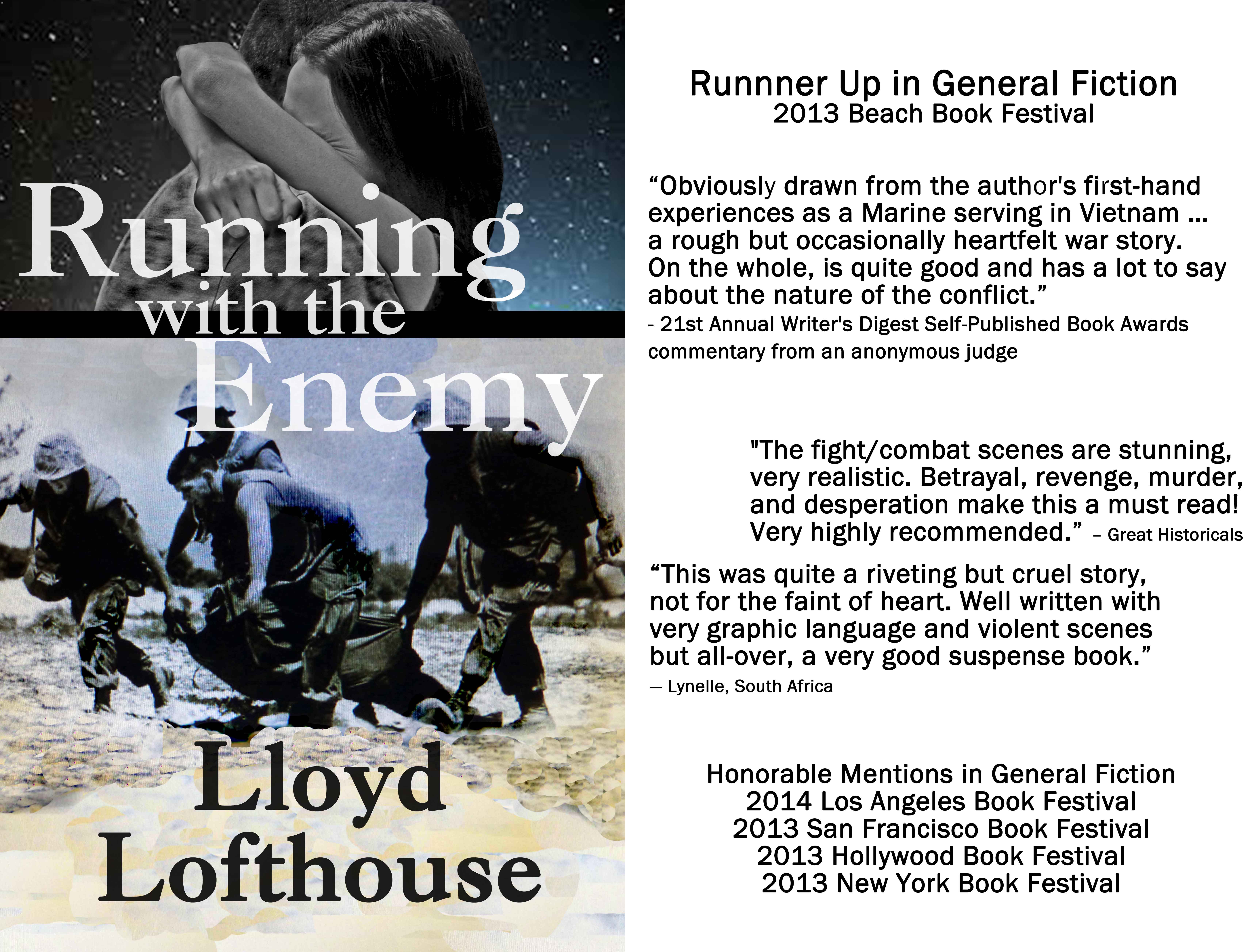
His latest novel is Running with the Enemy. Blamed for a crime he did not commit while serving in Vietnam, his country considers him a traitor. Ethan Card is a loyal U.S. Marine desperate to prove his innocence or he will never go home again.
And the woman he loves and wants to save was trained to hate and kill Americans.
To follow this Blog via E-mail see upper right-hand column and click on “Sign me up!”
I’m sure that all governments do it—manipulate public opinion to support war. It doesn’t matter if the country has an autocratic government ruled by a dictator or a democracy ruled by elected public officials—the people must be convinced that the enemy is evil and war necessary.
If we follow public support for America’s largest wars, we discover the US government’s learning curve to use the media to drum up support of wars. This manipulation of public opinion may be explained by Abraham Lincoln who said, “You can fool all of the people some of the time, and some of the people all of the time, but you cannot fool all the people all the time.”
The idea is to fool enough people to start a war. After that, it’s easier to keep a war going even when public support turns against it—for a while anyway.
That learning curve started with the American Revolution. For example, many think that the American Revolutionary War (1774 – 1783) was a war fought with the unanimous support of the people for independence from Great Britain.
But in North America, the colonists generally considered themselves loyal British citizens, asserting rightful constitutional claims that had been previously established through their colonial charters or contracts. … Many colonists (and eventually foreign nations) had to be persuaded to join in this revolution. Source: GilderLehrman.org
Then “as the colonists discovered how difficult and dangerous military service could be, enthusiasm waned. Many men preferred to remain home, in the safety of what Gen. George Washington described as their Chimney Corner.”
In fact, Washington predicted that “after the first emotions are over,” those who were willing to serve from a belief in the “goodness of the cause” would amount to little more than “a drop in the Ocean.” And he was correct. Source: Smithsonian Magazine
But how did the colonial government drum up public support?
“American printers played a vital role in swaying public opinion in the years leading up to the American Revolution. A heavy use of propaganda, or the spreading of information and rumors, was used. American printers wrote a great deal against the British which helped to raise morale within the American colonies.” Source: VoicesYahoo.com
And what would have happened to America’s Founding Fathers if the Revolution had been lost? Well, pretty much what’s happening to Edward Snowden but worse. Snowden is a traitor for spilling American secrets, and if the U.S. catches him, he may spend the rest of his life in prison. In the 18th century, the Founding Fathers would have been hanged. Now you may understand why that propaganda and those rumors was so important to these future leaders of a fledgling country.
The contrast between the War of 1812, and the Mexican-American War demonstrates the important use of the media to manipulate public opinion—something America’s leaders were still learning.
The War of 1812 to March 1815 was also known as the Second War of Independence
The United States entered the war with confused objectives and divided loyalties and made peace without settling any of the issues that had induced the nation to go to war. Source: history.army.mil
Why? Because the prosecution of the war was marred by considerable bungling and mismanagement. This was partly due to the nature of the republic. The nation was too young and immature—and its government too feeble and inexperienced—to prosecute a major war efficiently. Politics also played a part. Federalists vigorously opposed the conflict, and so too did some Republicans. Even those who supported the war feuded among themselves and never displayed the sort of patriotic enthusiasm that has been so evident in other American wars.
It is this lack of success that may best explain why the war is so little remembered. Americans have characteristically judged their wars on the basis of their success. The best-known wars—the Revolution, the Civil War, and World War II—were all clear-cut successes. Source: pbs.org
Then we have the Mexican American War (1846 – 1848) where public opinion was divided at first. Many accused President Polk of provoking a war. … The Mexican War was not popular among certain people, especially in the north. They thought it was meant to expand the territory of slavery. … In the end—thrilled by sensationalized newspaper accounts of American victories— the public embraced the war. Source: archives.nbclearn.com
As you can see, the government needs the media to popularize a war. It also helps if the war is short. Long wars tend to lose public support.
The American Civil War (1861 – 1865) “was absolutely an important moment in the history of the press,” says Penn State’s Risley. “The practices, technological development you begin to see during the war—the importance of the telegraph, the use of illustrations, for example—and the growth in demand for newspapers, so many of these things came together during this remarkable and tragic event.”
The demand for newspapers in both the North and South soared during the Civil War, says Risley, whose book is Civil War Journalism(Praeger, 2012).
This demand for information continued after the war and pushed more newspapers to broaden their readership. “America really became a nation of newspaper readers during the war.” The Civil War also showed officials how powerful the press could be in shaping public opinion, and government officials often struggled finding an even-handed approach in their handling of the press.
“Abraham Lincoln recognized that the press played a role in public opinion and he used the press effectively,” says Risley. “But, he wasn’t afraid to shut down newspapers, something that would not have been acceptable today.” Source: futurity.org
Perhaps more importantly, newspapers were responsible for editorializing the war. They were the propaganda machines of the day. Though not universally true, many newspapers published biased accounts of events, “factual” testimonials of enemy atrocities, articles proselytizing for specific political and military goals, and emotionally charged letters from citizens affected by the conflict. A quiet war for public support was waged both in the North and the South with the newspapers serving on the front lines. Issues like conscription, use of slaves as soldiers, and the validity of total war were hotly debated in the papers. The newspapers controlled the ebb and flow of public opinion and a particularly popular circulation could determine the outcomes of city or state politics. … Some newspapers were known to falsely report casualty rates or results of battle to bolster public morale. Source: OregonState.edu
But if the Civil War taught the government about the importance of the media, The Spanish-American War (1898) may have been the first true “media war”.
Today, historians point to the Spanish-American War as the first press-driven war. Although it may be an exaggeration to claim that Hearst and the other yellow journalists started the war, it is fair to say that the press fueled the public’s passion for war.Without sensational headlines and stories about Cuban affairs, the mood for Cuban intervention may have been very different. Source: pbs.org
World War One (1917 – 1918) was deeply unpopular. “once public opinion polling did start appearing in the 1930’s, early surveys on World War Oneshowed only 28% of the country thought entering the war was a good idea, while 64% opposed it.”
In the years after World War I Americans quickly reached the conclusion that their country’s participation in that war had been a disastrous mistake, one which should never be repeated again. During the 1920s and 1930s, therefore, they pursued a number of strategies aimed at preventing war. Source: neh.gov
And Support for World War II (1941 – 1945) was also not widely popular. Even as public opinion in favor of war increased after France fell to Nazi Germany during World War Two, only 42% of the country thought entry into the war was a good idea, while 39% of the country still considered it a mistake.
In fact, entering this war was unpopular until Japanese aircraft attacked Pearl Harbor on December 7, 1941. Then it was clear that the US couldn’t stay out of the Second World War.
Once the war began in earnest, America increased the flood of propaganda, utilizing especially the radio and visual media, most specifically posters. … Since American leaders realized that the best hope of winning the war was through increased production and labor, many posters were circulated urging increased labor and production as well as conservation of materials for the war effort.… During World War II, America produced some of the most successful propaganda campaigns in history. The pushes for increased production, labor, and conservation may well have won the war for America. Source: thinkquest.org
Next, the Korean War (1950 – 1953): When Americans were first asked (by Gallup), in August 1950, if deciding to defend South Korea was a mistake, only 20% thought it was, while 65% said it was not a mistake.
But by the following January, opinion had shifted dramatically, and 49% thought the decision was a mistake, while 38% said it was not—13% had no opinion.
Over several months, as Gallup asked the public if “going into war in Korea” was a mistake, opinion remained relatively stable, with more Americans saying it was than saying it was not. Six months later, as truce talks were being conducted at Kaesong, Americans were feeling more positive—42% felt the war was a mistake, while 47% said it wasn’t. But the numbers shifted again six months later in February 1952, when a majority said the war was a mistake for the United States, soon after a POW exchange proposal by the United Nations was rejected, and riots in the United Nations’ overcrowded Koje-do prison camp resulted in the deaths of many North Korean prisoners.
Soon after Eisenhower was elected president in 1953 and truce talks began again, the American opinion shifted yet again, with half of Americans saying the war was not a mistake, while a low of 36% said it was a mistake.
For Vietnam (1953 – 1975): In 1965—soon after the so-called Tonkin Gulf Incident (the Vietnam War’s Pearl Harbor that was the propaganda to drum up support for war)—only 25% thought the war was a mistake. Source: DailyKos.com
In fact, Anup Shah writing for Global Issues, says it required massive propaganda to create the belief that U.S. involvement in Vietnam was because non-communist South Vietnam was invaded by communist North Vietnam and that the regime in the South was democratic—but there never was a democracy in South Vietnam.
This was all untrue. In addition, many think that the Vietnam War was lost due to the media revealing atrocities but this was also untrue. Noam Chomsky says the American elite typically regarded Vietnam as a “mistake” or tragedy.
Television news in particular was said to have helped America “lose” the war. Yet, television news coverage was arguably poor, and full of news-bites, rather than detailed documentaries. … The Vietnam experience highlights a multitude of factors that contributed to what can only be termed as propaganda for Cold War ideological battles: a mixture of ideological goals, geopolitical and military goals, and issues to do with the nature of reporting and the structure of the media and how it worked, combined with cultural norms, all impacted the way that things were reported, not reported, portrayed, or misrepresented, and this ultimately provided legitimacy for a war that saw millions killed. Source: Global Issues.org
Gallup reported that in 1965, soon after the so-called Tonkin Gulf Incident, 61% of American’s polled said that sending U.S. troops to fight in Vietnam was not a mistake. But by 1971, 70% would say yes—it was a mistake—to the same question.
Again, we hear the echo of President Abraham Lincoln’s words: “You can fool all of the people some of the time, and some of the people all of the time, but you cannot fool all the people all the time.” In 1965, the majority of the American people were fooled but by 1971, only a few were still fools.
For the Gulf War—also known as Operation Desert Storm (August 1990 – February 1991)—we learn that under the first President Bush short wars with decisive victories provide less time for the public to change its mind. … In addition, President George H. W. Bush (1989 – 1993), remembering the lessons of Vietnam, sought public support … and he got it. The vast majority of Americans and a narrow majority of the Congress supported the President’s actions. Source: Source: US History.org
But the 43rd President of the United States, George W. Bush, had his Pearl Harbor on 9/11, and he squandered the public support by relying on false reports of Weapons of Mass Destruction to declare war on Iraq. But this false propaganda succeeded leading to Operation Iraqi Freedom (2003 – 2011).
“Being able to exploit the national anguish and anger over 9/11 was a critical ingredient, of course. But the success of the war-selling campaign was testimony to what a determined use of the opinion-molding capabilities of the government of the day, including the bully pulpit of the presidency, can accomplish.” Source: The National Interest
After Powell’s speech at the UN about WMDs in Iraq, a Gallup poll concluded that 79% of Americans thought the war was justified. However, by 2007, 65% would disapprove of the Iraq War thinking it was not worth fighting, and in March 2013, another survey found that 51.9% of the American public felt that the Iraq War had been a mistake—after all, you cannot fool all of the people, all of the time.
Operation Enduring Freedom in Afghanistan (2001 to present): In 2001, Gallup reported that eight of ten Americans (80%) supported a ground war in Afghanistan. But by March 2012—more than a decade later—sixty-nine percent of Americans thought that the United States should not be at war in Afghanistan.
His latest novel is the award winning suspense-thriller Running with the Enemy. Blamed for a crime he did not commit while serving in Vietnam, his country considers him a traitor. Ethan Card is a loyal U.S. Marine desperate to prove his innocence or he will never go home again.
And the woman he loves and wants to save was fighting for the other side.
To follow this Blog via E-mail see upper left-hand column and click on “FOLLOW!”
It was still dark when I reached Dr. Vessey’s house in Pasadena. It was late 1999 or early 2000. As sunlight leaked over the horizon, we drove to an alley behind a liquor store where the good doctor was going to meet with some homeless people he’d been helping. One of the homeless people was a Vietnam veteran who wouldn’t let the doctor near him. That’s why I was along—to gain the man’s trust.
I was about to find out how bad combat induced PTSD could be when the VA considers a veteran is 100% disabled. Since the vet I was going to meet couldn’t be trusted to handle his VA disability check, his payments went to a pastor, who was his financial guardian. The pastor decided how much to give him when he came to the church asking for money. The VA disability was enough to rent a studio apartment, but this vet chose to live on the streets where he felt safer. His home was under a blue tarp hidden in some thick brush that lined the side of an empty lot. Later, the doctor drove me there so I could see it.
This vet’s story of abuse was inhuman and tragic. He was a chopper pilot in Vietnam and was shot down becoming a POW where, among other things, he was sexually molested by the Vietnamese guards. I’m not sure I would have survived what he went through.
Dr. Vessey and I arrived first. We parked the car and entered the alley to wait. The homeless people started to arrive one or two at a time until there were about a dozen. One even crawled out of the Dumpster behind the liquor store. The vet along with two women arrived last. We squatted in the alley and talked. I told the disabled vet my Vietnam story, and he said it was obvious that I’d been there. Then he opened up and told us his story.
Before he finished, a helicopter (media or police—I’m not sure) flew over, and the vet surprised us when he yelled, “Incoming,” and leaped to his feet running toward what he thought must have been a bunker and safety—the back, brick wall of the liquor store. He ran into the wall and the sound of his body hitting the bricks was a sickening thud as if he were a side of beef being hit by a sledgehammer. He bounced off the wall and collapsed unconscious. We rushed to him and gathered around. One of the homeless women cradled his injured head in her lap. There was a thick, swollen contusion on his forehead.
He had hit that wall hard enough to rattle the shelved bottles inside, and two men working in the liquor store came around the corner a moment later. They thought a car had hit the store.
This vet would always be a prisoner of war.
_______________________
Lloyd Lofthouse is a former U.S. Marine, Vietnam Veteran, journalist and award winning author.
His second novel is the award winning love story and suspense-thriller Running with the Enemy. Blamed for a crime he didn’t do while serving in Vietnam, his country considers him a traitor. Ethan Card is a loyal U.S. Marine desperate to prove his innocence or he will never go home again.
In September 2009 , I found the 1966 Vietnam letters I wrote home that my mother had saved. Sitting on the floor sorting them, I noticed that my dad had written a lot while I was overseas. My dad was a man of few words, and the number of letters told me how much he cared.
My dad has been dead for twenty years and my mother for ten. These letters had been in a box for more than forty years. They showed that people now dead cared when I was in harm’s way as our troops are in harm’s way in Iraq and Afghanistan. Sitting on the floor with those letters scattered around me, I started to cry. After the tears dried, I read some more.
One of the letters was from Linda Grey, my dad’s best friend’s oldest daughter. By the way, when I was a kid, my family and friends called me Skip.
Hi Skip,
How are you doing over there, Skip? Your mother is teaching me how to cook for you, so when you get back I will cook a dinner for you, okay. That Tim just loves to tease me all the time. And it makes me mad! I hope you like the candy I made. We all miss you very much, and that is why we call Tim, Skip.
I’m sorry I haven’t been writing to you, but I have been working a lot this summer. Skip, have you met any beautiful girls over there? Skip, for my summer vacation I went to Yosemite National Park with my grandmother, my cousin, my sister and I went horseback riding for four hours. When we got through going horseback riding, we went bicycle riding for one hour. Skip, could you find out how much does a culture pearl cost? Well, I will say good-by for now.
Love,
Miss Linda Grey.
Sitting on top of that bunker in Vietnam in 1966, I stared at the word “Love,” and wondered what she met and was afraid of my own imagination.
What if those thoughts were wrong?
It was a sunny, clear day with a deep-blue sky. That’s when the sniper fired. I felt and heard the round as it snapped by my ear brushing the skin but not breaking it. One more inch to the left, and I would have been dead.
Instantly, I rolled off the back of the bunker, grabbed my M-14 on the way down, hit the ground, flipped off the safety, rolled to the right into the open and searched for a target. There was no one beyond the concertina wire at the base of the hill. The rice paddies were empty—the trees a smudge in the distance.
A few weeks later, another letter arrived from my mother and she told me to write Linda and tell her that that I was too old for her. Linda was a teenager then—about four or five years younger than me. I turned twenty-one soon after arriving in Vietnam.
For the next month, my depression was deep. As a child growing up, I’d known Linda for years, and she was a great kid to have as a friend. She also grew up to be a real beauty. I know now—decades later—that after she graduated from high school, she married the wrong guy, who abused her horribly, and her life was a mess for some time before she divorced him and eventually found love again.
After that narrow escape from death in Vietnam—one of several while I was there—I didn’t read letters on top of bunkers again. I also never forget the letters that the adolescent Miss Linda Grey wrote that ended with the word “Love“.
Are there any special letters or e-mails that you remember—ones that will still be in your thoughts decades later?
His latest novel is Running with the Enemy. Blamed for a crime he did not commit while serving in Vietnam, his country considers him a traitor. Ethan Card is a loyal U.S. Marine desperate to prove his innocence or he will never go home again.
And the woman he loves and wants to save was trained to hate and kill Americans.
To follow this Blog via E-mail see upper right-hand column and click on “Sign me up!”