Unwanted Heroes – Part 3/4

2:  The Letter

I stare at him in bewilderment as he strides out of the café. I cannot decide whether I admire or fear him and conclude that probably a bit of both is most prudent. Turning back to the counter, I see Tabitha watching me as she hands change to a customer. I feel a sharp wave of panic.

“So they’re onto me?” Her tone is flippant when it is just the two of us. “It’s the addiction, Will. Caffeine and a full moon. Such a fatal combination.” She raises her cup and flutters her eyelashes as she sips.

“Until Mr. Tzu shows up, we’ll have to rearrange the work roster,” I reply somberly. “I assume Ginny has been filling in for Mr. Tzu over the weekend, but you have more experience. You’re going to have to pull the shift opposite mine.”

“But then we won’t get to work together! Who’s going to train me, nurture my career, and bring out my full potential?” She does a credible job pouting like a spoiled child. Then stretching out her hands, she bows her head. “I’m still your humble apprentice, Will, my lord, my barista.”

I relax. “Be mindful of the Force, my young Padma,” I say in my best Yoda-ese, “and keep the fucking Beast clean. Remember, the coffee flows through the Beast.” If only my school counselor had let me pursue a career as a Jedi Knight. “Right now, you’re the only other person supremely qualified to run shifts,” I say, getting back to business.

“But what about the wines?” Tabitha asks.

“George and I will alternate,” I reply.

“Carrot Face?”

“You’re going to call him that to his face one day soon and I might not be around to protect you.”

We both laugh. The prospect of Carrot Face or George and I going a few rounds over Tabitha’s honor is amusing. George is a recent addition to our staff. He knows little about coffee but worked on a vineyard in Napa for a few years. He is skinny, spotty, awkward and … well you can probably guess his hair color.

“But you’re gonna work a lot of hours,” Tabitha says, concerned.

“It’ll only be for a few days. He’ll be back soon.” I hear the doubt in my voice.

I serve two businessmen, who take their drinks swiftly to a table—their discussion never stopping.

Tabitha shrugs. “I bet the bastard rented a sports car and is in Vegas denying his age. Men are jerks, you know.”

“How would I know that?” I roll my eyes.

“You’re a writer, Will. You must’ve noticed them. Jerks.” Tabitha manages a disdainful expression.

“I’m also a man—never mind. The other day when Mr. Tzu chewed you out, has that happened before?”

“No, I’m actually a wonderful asset to the business!” Tabitha replies, her voice feigning hurt, then she frowns. “Hey, Will, you’re worried, aren’t you? You’re not convinced he’ll be back in a day or so?”

“I don’t know,” I say. “I wonder what made him crack.”

Tabitha shuffles and stares down at her scuffed Doc Martin boots.

“Tzu’s always been kinda tight, y’ know. Not big on the conversation, but he’s not a screamer either. That day, though, he was really pissed and not just because I failed to clean the Beast to his standards. He later chewed out Carrot Face after George quipped that, though it was his brother’s birthday, he was ignoring it as they weren’t close.

“Tzu heaped him a nasty lecture about family and loyalty. It wasn’t a fatherly rebuke either. Tzu was really pissed. I figured maybe it’s an Asian thing. They’re very family oriented.”

Tabitha puts down a wineglass that she’s been polishing and sighs. “Look, I don’t know Tzu. I’ve always been a bit scared of him ’cause he never talks or anything, so I’ve kinda kept my distance. You never know what’s going on in his mind. It’s intimidating. I’m not a barista or a wine freak like you. I’m expendable. As a woman, too, I feel vulnerable around him. Asians are pretty patriarchal, y’know, and I’m at the bottom of the food chain.”

“Yeah.” I’m feeling increasingly uncomfortable. “Let’s get back to work.”

A few minutes later I see Tabitha hovering by Tzu’s desk in the back of the store. She’s holding a badly crumpled piece of paper and calls me over.

“Will, look. This letter appeared the morning Tzu wigged out on me and Carrot Face. It had been slipped under the door before we arrived to open the café. I picked it off the floor, but Tzu grabbed it from me and read it immediately. He had it in his hand or his back pocket all morning. Later, I saw him put it in his desk drawer.”

Hoping for a clue, I take the letter. It is dirty and creased, and I just stare at thick, black Chinese characters.

I return the letter to the drawer of Tzu’s desk. It will be here when he returns—probably tomorrow. But Tzu doesn’t return and as the week passes, the whole staff begins to worry for Mr. Tzu and our jobs.

Early Wednesday, an elderly Asian woman enters the café. She wears a thick heavy coat and a green-silk scarf covers her head probably to ward off the chill. I turn to serve her as she approaches.

“Will?” Her voice is unsteady and her English heavily accented.

“Mrs. Tzu?” I hazard a guess.

She nods. “Please, bring green tea and sit with me.” She shuffles over to an empty table. There is a heavy flow of customers. I don’t like the other staff members seeing me sit while they work, but this wasn’t presented as a request.

Mrs. Tzu sips the tea and stares at me. Her face looks tired and worn.

“I’m sorry about Mr. Tzu. I really am,” I say. “Is there anything I can do to help?”

“Husband will come back.” She nods as she says this but without conviction. “He says you are good boy. He says you can be trusted.”

“Thank you, Mrs. Tzu. That is high praise.” I am pleased to hear this. “I love my job and the coffee shop.”

“Good, good.” She nods. “You stay and run place. Mr. Tzu will soon return and give you reward. Okay?”

“Sure, Mrs. Tzu. Do you have any idea where he might be? Could he … could he have gone home to China?” Last night, I dreamed that he had returned there to die, but I don’t feel it prudent to share this.

“Mr. Tzu is American.” She shakes her head. “Left China as very small boy and feels no love for China. Love 49ers and Giants. For him, America is home.”

“What do your children think? Have you talked with other relatives?”

She again shakes her head. “I speak with children. Speak all the time. No brother or sister. This disappearance is very strange. He has gone before when very stressed. Has something in past, something from war.”

“So you don’t think he’s been kidnapped or anything? He doesn’t have any enemies, does he?”

She looks at me for a moment perhaps to see if I am joking. Then she leans forward, her expression serious. “Mr. Tzu is good man. Very fair. Many in city know him. All have high respect for him.”

“I’m sorry. Didn’t mean to imply—” I didn’t know what I didn’t mean to imply, and we both fall silent.

Then Mrs. Tzu leaned forward. “I am from China. Parents die during time of Long March, I think. Maybe later. China was chaos. Hard life then. I brought to US to stay with aunt. Meet Mr. Tzu in city. America is good but for me not home. Mr. Tzu is my home and so America is my home.”

She leans back and sighs. “49ers and Giants, they suck. Coffee not good either. Bad for Shen, for spirit. Green tea is good—keep you young.” She winks. Then she laughs, and I try to laugh with her.

I feel a wave of sympathy toward this brave woman who, like me, is far from her home. I swallow hard. “Mrs. Tzu. I don’t know where he is. I don’t really know him.” I’m getting repetitive perhaps feeling guilty that I haven’t tried to befriend him. “But maybe you could come into the café more and sit here to help look after the staff and customers?”

She flashes the briefest of smiles. “Thank you. Mr. Tzu is right. You are good boy. I go down to visit children in Ventura for few days. Help them not to worry.” She smiles and looks proud, so I think that they have invited her. Then she asks, “You good son to parents, yes?”

I’m a little bewildered by the change of direction but manage to say, “Despite the distance, I try. My father passed away about ten years ago, but I think they were always good to me. My mum’s still in England and I miss her—both of them, I guess.”

“Maybe you send mother flowers to show you think of her? Write letter. I come back and check, yes? After I return from Ventura.”

Write a letter—shit! The letter! I reach into my pocket but something stops me. Mrs. Tzu rises pushing down on the table as she straightens and shuffles out. I remain seated staring at her cup of still-steaming tea, which she hardly touched. Mrs. Tzu could probably have translated the letter her husband received on the day he flew at the staff, yet some strong impulse holds me back. I shrug. I can show her the letter another time.

I pick up her warm cup and hug it between my two palms. As I stare at the door she has just exited, I have a strong feeling that I am getting sucked into something that shouldn’t be part of my life yet unequivocally is. Shit! Maybe I should give up coffee for green tea. It’s bad for my Shen whatever that is.

Continued on February 20, 2013 in Unwanted Heroes – Part 4 or return to Part 2

____________________

Growing up in London, Alon Shalev has been a political activist since his early teens. He strives through his writing to highlight social and political injustice and to inspire action for change.

Moving to Israel, he helped establish a kibbutz where he lived for 20 years and served in the Israeli army.

Shalev then moved to the San Francisco Bay area and fell hopelessly in love with this unique city. Being new to the US, however, he was shocked to see so many war veterans on the streets. He regularly volunteers at initiatives such as Project Homeless Connect and the San Francisco Food Bank where he meets and talks with war veterans.

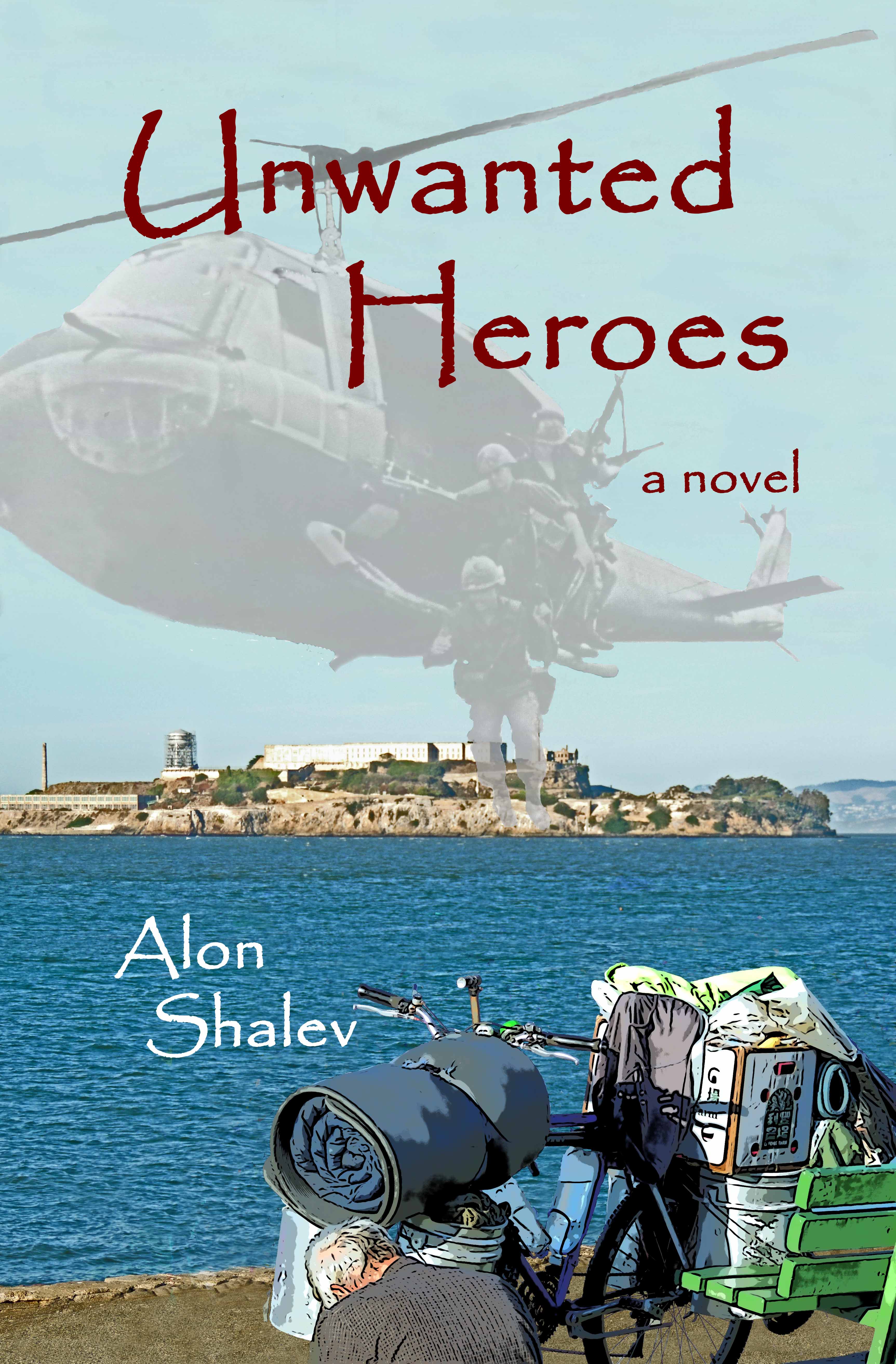
You may buy Unwanted Heroes at Amazon.com

To follow this Blog via E-mail see upper right-hand column and click on “Follow”.
Unwanted Heroes – Part 2/4

1:  The Disappearance of Mr. Tzu

Monday mornings are tough at the best of times. The Financial District of San Francisco swarms with people craving their caffeine turbo charged as they transition from weekend wildness to the cubical and office. The line for coffee snakes out of The Daily Grind onto Spear Street and I, the barista, marshal my staff to satisfy the needs of my newly adopted city.

Nothing can stop me as steam rises from the Beast, our espresso machine, which hisses and whistles as I concoct cappuccino, mochaccino, latte, espresso, nonfat, low fat, decaf, skinny. I am focused. Nothing can take me out of the groove as I serve the suits, the ripped jeans, the police uniforms.

Police Uniforms? One is a huge ruddy-faced officer while the other is smaller, mustached and maybe Hispanic. I’m still too new in the US to accurately place the myriad of people who make up the melting pot of San Francisco. But I do notice that the smaller officer wears wraparounds even inside our coffee shop.

“Are you the barista?”

“Yes sir. My name’s Will … Will Taylor. What can I get for you?” What are the customers thinking? What did he do? He made such a nice latte. Who would have thought?

“Good morning, Will. I’m Captain O’Connor and this is Sergeant Mendez. We’re SFPD.” Two badges flash against the fluorescent lights held in front of the midnight-blue uniforms. “We’d like to talk to you about your employer, Mr. Tzu.”

“Now?” I glance at the line then my watch. It is a few minutes to nine o’clock and the rush is almost over.

“Can we move this away from the counter, gentlemen, and maybe give me just five minutes here?” My tone is a mix of impatience and a fear of authority—especially in a land I am not used to. “Why don’t you sit over at that vacant table, and I’ll bring you coffee?”

As I continue to work our espresso machine, I recall a conversation on Saturday with Tabitha. Tabs was due to replace me for the afternoon shift but, as she often did, she came in early to hang out, as the weekends are pretty quiet.

Tabitha was my first true friend after I arrived in the US, and we have remained close since. She is young, thin and has a tendency to wear body-clinging clothes that appear to have shrunk several times over. Her mousey blond hair is straight and looks fashionably neglected. She has piercings everywhere. Tabitha can be dead cool or apple pie fresh; apparently, it is somehow related to the moon’s cycle.

“Hey Hemingway,” she said with a chirp.

When we first met, I made the mistake of trying to impress upon her my desire to become a famous writer with a Hemingway quote. I’m pretty sure she uses the nickname as a token of affection.

Tabitha is supposed to be an art student. She is enrolled at the nearby Academy of Art, although she seems to attend with varying degrees of intensity. She never likes to discuss her art or her studies and I have learned to avoid the topic.

Our relationship is purely platonic. She’s been to my apartment a few times for dinner and a movie. Twice she slept over as it was late; yet there was no suggestion of anything sexual. She could be my little sister—I always wanted a younger sibling to bully.

On Saturday, I had been cleaning the Beast, which our boss demands must sparkle and purr. Mr. Tzu was apparently one of the first to import such a fine espresso machine from Europe and was extremely proud of it.

“The Beast looks good,” Tabitha said, patting the metallic giant. “You take good care of …” Her voice had faded.

I stopped cleaning the machine and turned to her. “What’s up, Tabs?”

“Tzu chewed me out the other day.” Her voice quivered, and she played with a hanging lock of hair. “He was brutal.”

Though Mr. Tzu is my boss, I know little about him. When he saw that I could not only function as barista but also as shift manager, he had me running the opposite shifts to him.

An elderly Asian American, Mr. Tzu is nearing retirement. He’s prompt, quiet and formal. Although there is a high staff turnover, I’ve never heard of someone being yelled at or fired acrimoniously. Tzu provides health benefits, not a given in this line of work, and we enjoy the informal work environment and compensation.

“What did you do wrong?” I asked.

“Nothing really.” Her tone was sulky, bottom lip pouting. “I hadn’t cleaned the Beast properly in his eyes.”

“He is very protective of it,” I replied, trying a sympathetic approach.

“The coffee machine wasn’t the reason!” Tabitha snapped. “He was really pissed, Will. There’s something going on.”

I pause, puzzled by her response. “I’m sorry he got mad, but what do you mean?”

“Well, you know. He’s married and has kids somewhere. I’ve never had a meaningful conversation with him, but I sense something is eating at him—something serious.”

“Hmm.” I had nothing else to say.

I hadn’t given it any more thought. My shift finished and I spent the rest of the weekend writing vigorously on my laptop. In fact, this whole scene had slipped my mind until now when the police entered the coffee shop.

Low Res Finished Cover on November 14

“Again, I’m Captain O’Connor.” A thick hand is extended and soon crushes mine. “We’re here about Mr. Tzu.”

“Why? What’s happened?” I sip a glass of water I have with me.

“He’s disappeared, Will. No one has seen him since Thursday. What can you tell us about your boss?”

“Not a lot. I’m curious. A grown man disappears for a few days and the police are already involved?”

“Listen, kid,” replies Captain O’Connor, a big muscular fellow with an imposing mustache and balding head. “San Francisco might seem like a big city to an outsider like yourself—an Englishman no? But we still have neighborhoods, communities, and we still look out for each other. Mr. Tzu is known around these parts and there’s a history. Let’s just say that this isn’t the first time, okay? Now please, tell us what you know about your boss.”

I shrug. “Probably less than you. When he hired me, he was looking to reduce his hours. He’s getting old; probably thinking about slowing down. I’ve considerable experience as both a barista and sommelier, and I studied business for a while in college. I really don’t know him. Once he saw that I’m competent, he pretty much has had me working the opposite shift to him.”

I sip more water and try to think of something else. “There’s a Mrs. Tzu and kids, grown up I think, but I’m not sure how close the family is or where the kids live.” Both O’Connor and Mendez display bored expressions, and I say, “I’m not telling you anything new, am I?”

“No, you’re not,” replies O’Connor. “Think of something that might be relevant to his disappearance. How’s business? Any problems come to mind?”

“I think business is pretty steady,” I say. “But I don’t see the books, so I can’t be certain.”

“What else is sold here, kid?” The second cop, Mendez, leans in and speaks quietly, his voice a fair James Cagney. “Anything, you know, on the side?”

I stare at him for a few moments wondering if he’s joking, but he just stares back blankly awaiting my answer. Mendez, in contrast to his partner, is a small, dark man with jet-black, greased-back hair and sunglasses. We’re a month into a gray San Francisco winter and he’s still sporting sunglasses—indoors. His badge, on the other hand, is extremely shiny and glints when it catches the café’s ceiling lights.

“What do you mean?” It’s about all my brain can muster.

“Drugs, gambling, numbers, you know?” Mendez no doubt reels off such a list a few times a day.

“None of that stuff.” Is he joking?

The Hispanic cop wiggles his nose as if trying to pick up a scent. “You said that he has you working the opposite shifts to himself, correct? Ever thought he did this on purpose?” He stares at me over his steaming coffee cup. There is some froth on his dark mustache. “Perhaps he’s keeping you away from something?”

“Of course not,” I answer. “I told you he’s just slowing down and feels he can trust me.”

“Yes, you did.” He takes another calculated sip of coffee. More foam beds down in his moustache. “Any of the staff mentioned someone coming into the coffee shop and arguing with him? Or have any of them argued with him?”

I glance at Tabitha thinking about her argument with Mr. Tzu over the Beast but shake my head. “No, not that I know of.”

“Anyone fired recently?” Mendez is certainly persistent. “Perhaps someone left feeling like he screwed ’em?”

I’m really no help. “Maybe you should talk with the other employees,” I say. “I need to get back to work. Do you have any more questions?”

“Not for now.” O’Connor says handing over a business card. “If anything comes to mind, call us.”

As the captain walks out the door, his partner leans back in still holding his coffee cup. His James Cagney tone is little more than a whisper.

“Keep an eye on the girl.” His eyes flash toward Tabitha. “We know about their argument, and we know you didn’t tell us. It’s all about the espresso machine. If it ain’t treated right, we can tell.” He taps his nose with a thick, gold-ringed finger. “The customer always knows.”

Continued on February 19, 2013 in Unwanted Heroes – Part 3 or return to Part 1

____________________

Growing up in London, Alon Shalev has been a political activist since his early teens. He strives through his writing to highlight social and political injustice and to inspire action for change.

Moving to Israel, he helped establish a kibbutz where he lived for 20 years and served in the Israeli army.

Shalev then moved to the San Francisco Bay area and fell hopelessly in love with this unique city. Being new to the US, however, he was shocked to see so many war veterans on the streets. He regularly volunteers at initiatives such as Project Homeless Connect and the San Francisco Food Bank where he meets and talks with war veterans.

You may buy Unwanted Heroes at Amazon.com

To follow this Blog via E-mail see upper right-hand column and click on “Follow”.

Unwanted Heroes – Part 1/4

Disclaimer: Lloyd Lofthouse is the editor/publisher of Alon Shalev’s Unwanted Heroes, and for a few days, we will showcase the first three chapter of his novel about surviving with PTSD.

Unwanted Heroes brings together an elderly, battle weary Chinese American war vet and an idealistic and pretentious young Englishmen, who share a love for San Francisco, coffee and wine. They soon discover further common ground when repressed memories abruptly surface, cementing an unlikely relationship that just might release each from the tragic pasts that bind them.

When Will Taylor finds employment as a barista at The Daily Grind in the Financial District, he feels inspired to write his breakout novel. Walking the streets of Kerouac and Ginsberg, Taylor discovers the harsh side of America and an injustice he must try and help right before he loses his sanity and love.

When his boss suddenly disappears, Will needs all the help he can find. A homeless professor, precariously balanced between intellectual pinnacles and mental abyss, offers advice and contacts. Taylor’s Goth girlfriend initiates him into the West Coast counter culture, while her Nob Hill father digs up his own military nightmares to help another haunted soldier in desperate straits.

The unique culture of San Francisco lends itself to the comical aspects of the novel, offset in a rollercoaster of emotions as comic follows tragic. Will finds himself dining with his Goth girlfriend and her parent at their home on Nob Hill and teaching them how to toast in twelve languages. In the next scene, he is frantically searching a military graveyard at night, looking for his boss who has suddenly disappeared for a second time.

Unwanted Heroes confronts the issue of homelessness and, in particular, war vets who could never readjust into society. This novel is a tribute to a beautiful, unique and quirky city, its people, and those who sacrificed so much to keep it and America free.

Continued on February 18, 2013 in Unwanted Heroes – Part 2

____________________

Growing up in London, Alon Shalev has been a political activist since his early teens. He strives through his writing to highlight social and political injustice and to inspire action for change.

Moving to Israel, he helped establish a kibbutz where he lived for 20 years and served in the Israeli army.

Shalev then moved to the San Francisco Bay area and fell hopelessly in love with this unique city. Being new to the US, however, he was shocked to see so many war veterans on the streets. He regularly volunteers at initiatives such as Project Homeless Connect and the San Francisco Food Bank where he meets and talks with war veterans.

You may buy Unwanted Heroes at Amazon.com

To follow this Blog via E-mail see upper right-hand column and click on “Follow”.

The Dark Side of Humanity

Sarah McCoy wrote a post for the Huffington Book Blog about “Men of War are Conflicted Characters“. After I read her post, I wanted to leave a comment but couldn’t because that section was closed, so I’m writing it here.

You may want to read McCoy’s post. It’s well written and deals with an author’s dilemma when she has to crawl inside the skin of someone most of the world considers a monster, because he fought for Hitler during World War II and was tagged with the term Nazi.

However, it was McCoy’s conclusion that I wanted to leave a comment for. She said, “I’ll be honest, it was an onerous task to write under the psychological hood of war. I struggled but knew it was essential to the story and my attempt to unearth a truth. War asks us to give up our humanity, but if we do, aren’t we losing what we’re fighting for in the first place?”

I say no. War does not ask us to give up our humanity. It asks us to reveal the horror of our humanity—to let the dark side we spend a lifetime struggling to suppress out of its bloody bag. Inside our skin lives both demons and angels. When an individual fails to keep the lid on his or her demons, we end up with people like Luis Garavito of Colombia who may have murdered more than 400 people. He was a serial killer known as The Beast.

These killers, who cannot control the dogs of war, live all over the world. Instead of listing them, you may want to visit this page on Wiki and see for yourself what happens when the lid comes off on its own and stays off.

In war, troops are trained to open that door and let the beast out.  Then they are expected to stuff it back in the box when we come home.

We can’t pretend it isn’t there, because just like night and day, sunrise and sunset, each person has a bright and dark side and it is the dark that we struggle to keep under control.

Carl Gustav Jung (1875 – 1961), the founder of analytical psychology, called it the shadow: The shadow is an unconscious complex that is defined as the repressed and suppressed aspects of the conscious self.

There are constructive and destructive types of shadow.

On the destructive side, it often represents everything that the conscious person does not wish to acknowledge within themselves. For instance, someone who identifies as being kind has a shadow that is harsh or unkind. Conversely, an individual who is brutal has a kind shadow. The shadow of persons who are convinced that they are ugly appears to be beautiful. Source: Psychologist Anywhere Anytime.com

Some men that wear uniforms might go to war conflicted, but I think to most trained warriors, it’s just a job. Ethan Card, the main character in my novel, Running with the Enemy, is an example of what I’m talking about. To succeed and survive, he must trust the beast from the dark side of humanity to help him get the job done.

It is the only way to win a war. If you disagree, show me a war that was won by fighting with a set of rules based on modern, humanitarian principals that did not exist a few decades ago.

What do you think was going through the mind of the pilot of the Enola Gay as he dropped “Little Boy” on the city of Hiroshima and killed 80,000 people in one nuclear flash? Next was Nagasaki with another 40,000 killed instantly. Some children had been evacuated out of the city, for fear of bombing, but many remained. “1,653 primary school children and 74 of their teachers died in Nagasaki.” Source: Ban the Bomb.org

Discover Children as Weapons of Death

_______________________

Lloyd Lofthouse, a former U.S. Marine and Vietnam Veteran, is the award winning author of The Concubine Saga.

His latest novel is Running with the Enemy. Blamed for a crime he did not commit while serving in Vietnam, his country considers him a traitor. Ethan Card is a loyal U.S. Marine desperate to prove his innocence or he will never go home again.

And the woman he loves and wants to save was trained to hate and kill Americans.

To follow this Blog via E-mail see upper right-hand column and click on “FOLLOW”.

MM's avatarJason "Mayhem" Miller

This past week, i had the pleasure of training a group of United States Marines, at the Boot Camp in San Diego. I say pleasure, in that it was fulfilling to work with the fighting men of the United States, and share with them the techniques that I have learned over 15 years of competing in MMA.

I’ve taught hundreds of seminars in my life, but this one had a special vibe to it. I normally run my practices like a drill sergeant, but it was a bit futile, as almost all of the guys I was training were Actual Drill Sergeants. They listened intently as I explained each move, and were very receptive to coaching.

When we hit a snag and many of the guys were having trouble with one of the techniques, I burst into shouting and everyone snapped to attention from their place on the mat. I…

View original post 256 more words

A U.S. Marine Deals with his PTSD through Ballet

I faced my PTSD when I started to write about it. Here’s a Marine that did the same thing but with Ballet.

After serving at Fallujah, choreographer Roman Baca channeled his military experience into provocative dance performances.

This post is in addition to a post I reblogged from “Off the Base” — A Marine’s Voice Being Heard from the Dance Stage

“Roman Baca is a Marine Iraq War Veteran and the Artistic Director of Exit 12 Dance Company in NYC.  After a career in dance, Mr. Baca served as a US Marine and was deployed to Fallujah, Iraq from ‘05-’06.”  Source:  Exit 12 Dance Company

_______________________

Lloyd Lofthouse, a former U.S. Marine and Vietnam Veteran, is the award winning author of The Concubine Saga.

His latest novel is Running with the Enemy. Blamed for a crime he did not commit while serving in Vietnam, his country considers him a traitor. Ethan Card is a loyal U.S. Marine desperate to prove his innocence or he will never go home again.

And the woman he loves and wants to save was trained to hate and kill Americans.

To follow this Blog via E-mail see upper right-hand column and click on “Sign me up!”

Bobbie O'Brien's avatarOff The Base

village_voiceThere are many voices of Iraq and Afghanistan war veterans. One that caught my ear today is from Marine Sergeant Roman Baca.

His story, as told to  Jonathan Wei, is featured in the Village Voice. It’s about Baca’s life as a ballet dancer turned Marine combatant and how ballet brought him back after a tour in Iraq.

Here’s how he described a confrontation with his girlfriend who sat him down six months after he returned from deployment in Fallujah:

And she’s like, “You’re not OK. I don’t like the person you are.” She said I was anxious, I was depressed, I was angry. I was mean. I had some episodes when I was driving on the freeway, and traffic was getting bad. I wanted to ram into other cars.

That was part of the standard operating procedure when you were dealing with other cars in Iraq. You take care…

View original post 169 more words

Jane Fonda: a real American Patriot! – Part 3/3

Jane Fonda visited Hanoi, North Vietnam in July 1972 at age thirty-five. At that time, the anti-war movement was at its highest point and sentiments against the war were running loud and strong in the United States.

In fact, on April 23, 1971, Vietnam veterans threw away over 700 medals on the West Steps of the Capital building. The next day, antiwar organizers claimed that 500,000 marched, making this the largest antiwar demonstration since the November 1969 march.

In addition, by May 1971, public support for the war had reached 28%. This was the last time Gallup polled this question: “In view of developments since we entered the fighting in Vietnam, do you think the U.S. made a mistake sending troops to fight in Vietnam?”

If you subtract 28 from 100, what is the answer that shows the percentage of Americans that were against the Vietnam War in 1971?

The highest rating for public support of the war was in 1966, the year I was there and that was 59%.

During her 1972 trip, Fonda made ten radio broadcasts in which she denounced American political and military leaders as “war criminals”.

Fonda’s visits to the POW camps in North Vietnam led to persistent and exaggerated rumors repeated widely in the American media, and decades later have continued to circulate on the Internet. Fonda has personally denied the rumors. Interviews with two of the alleged victims specifically named in the emails found these allegations to be false as they had never met Fonda.

Because of her time in North Vietnam, the ensuing circulated rumors regarding the visit, and statements made following her return, resentment against her among some veterans and those currently serving in the U.S. military still exists.

Snopes.com has this to say about Jane’s Fonda’s visit to Vietnam:

“Although Fonda’s actions in visiting North Vietnam were sufficient to earn her the wrath of many Americans, in the years since those events took place they have been embellished to the point that the one tale most commonly associated with her Vietnam Trip is an incident that never took place—a tale about U.S. POWs who furtively slipped messages to Fonda while she was meeting with them and whom Fonda promptly betrayed by turning those messages over to the POWs’ North Vietnamese captors (resulting in several of those prisoner’s being beaten, tortured, or killed). The fact is that while in North Vietnam, Fonda met with only a single group of seven U.S. POWs: all seven of those POWs agreed to meet with her, no POWs were tortured for declining to meet with her (or for behaving inappropriately during the meeting), and no POWs secretly slipped Fonda messages which she turned over to the North Vietnamese. The persons named in inflammatory claims about this apocryphal incident have repeatedly and categorically denied the events they supposedly were part of.”

There’s more at Snopes.com, and I urge you to read that entire entry. In fact, Snopes says, “Some of the POWs who did meet with Fonda have spoken out on the record to disclaim the apocryphal story about her alleged betrayal …”

Then there are these facts reported by the New York Times (also worth reading) that supports Fonda’s claim that America’s political and military leaders were “war criminals”.

The evidence that supports Fonda comes from the architect of the Vietnam War, Robert S. McNamara, the United States Secretary of Defense for Presidents John F. Kennedy and Lyndon B. Johnson from January 21,1961 – February 29, 1968.

The NY Times reported, “The war became his personal nightmare. Nothing he did, none of the tools at his command—the power of American weapons, the forces of technology and logic, or the strength of American soldiers—could stop the armies of North Vietnam and their South Vietnamese allies, the Vietcong. He concluded well before leaving the Pentagon that the war was futile, but he did not share that insight with the public until late in life.”

McNamara recalled, “‘If we’d lost the war, we’d all have been prosecuted as war criminals.’ and I’d say I—were behaving as war criminals.”

Then McNamara was quoted asking, “What makes it immoral if you lose and not immoral if you win?”

“We are the strongest nation in the world today,” McNamara said in The Fog of War, released at the time of the 2003 invasion of Iraq. “I do not believe that we should ever apply that economic, political, and military power unilaterally. If we had followed that rule in Vietnam, we wouldn’t have been there. None of our allies supported us. Not Japan, not Germany, not Britain or France. If we can’t persuade nations with comparable values of the merit of our cause, we’d better re-examine our reasoning.”

“War is so complex it’s beyond the ability of the human mind to comprehend,” McNamara concluded. “Our judgment, our understanding, are not adequate. And we kill people unnecessarily.”

Speaking out and protesting dramatically as Jane Fonda did in 1972 brands her as a true patriot and hero—not a traitor.  It takes courage—or stupidity—to stand up and tell millions of trained killers they were wrong and were being led by war criminals, and the truth—of course—hurts those who refuse to hear it.

Patriots and heroes speak out when his or her government is wrong, but those who do not speak our may be as guilty as their leaders.

Return to Jane Fonda: a real American Patriot! – Part 2 or start with Part 1

_______________________

Lloyd Lofthouse, a former U.S. Marine and Vietnam Veteran, is the award winning author of The Concubine Saga.

His latest novel is Running with the Enemy. Blamed for a crime he did not commit while serving in Vietnam, his country considers him a traitor. Ethan Card is a loyal U.S. Marine desperate to prove his innocence or he will never go home again.

And the woman he loves and wants to save was trained to hate and kill Americans.

To follow this Blog via E-mail see upper right-hand column and click on “Sign me up!”

Jane Fonda: a real American Patriot! – Part 2/3

Before calling someone—anyone—a “traitor”, especially Jane Fonda, you should do your homework first.

I fought in Vietnam too (1966, field radio operator, U.S. Marines), but I do not blame Fonda for what she did when she went to North Vietnam, because when she spoke out, she was the voice of America’s conscience and she was not alone—at the time, a vast majority of Americans may have felt the same way she did.

After I came out of my PTSD shell in the early 1980s and stopped drinking, I started to learn the truth about the Vietnam War.

Most American troops went to Vietnam in honor, some came back tainted with innocent blood but many came back untainted but damaged physically and/or mentally as I did with PTSD.

The Vietnam War was based on a lie about the Tonkin Gulf Incident. You may want to read “30-year Anniversary: Tonkin Gulf Lie launched Vietnam War” by Jeff Cohen and Norman Solomon published July 27, 1994. The conclusion of that report says, “We Americans are the ultimate innocents. We are forever desperate to believe that this time the government is telling us the truth.”

On October, 2005 the New York Times reported that Robert J. Hanyok, a historian for the U.S. National Security Agency, had concluded that the NSA deliberately distorted the intelligence reports that it had passed on to policy-makers regarding the August 4, 1964 incident. He concluded that the motive was not political but was probably to cover up honest intelligence errors.

In addition, before President Kennedy was assassinated, his brother Robert later said he was planning to pull out of Vietnam, because he saw it turning into quagmire if we stayed.

Then there is the fact that South Vietnam was ruled by a brutal dictator possibly worse than the leadership in North Vietnam.

And during most of the war, the U.S. leadership ran the war with the concept that we could win the war by killing as many people as possible. and to achieve that goal, the U.S. dropped more bombs than it dropped in all of World War II.

Pete Larson reports that the United States dropped 280 million bombs in Laos alone and that 80 million never exploded. Today, the population of Laos is estimated to be 6.5 million. That equals about 43 bombs dropped for each of today’s citizens in Laos. Do you know how many people lived in Laos during the Vietnam War?

If you click on Yale.edu, you will discover a map of Cambodia that shows where the bombs were dropped on 113,716 sites in 230,516 sorties dropping 2,756,941 tons of ordnance (explosives).

Libcom.org reports, “By the end of the war, 7 million tons of bombs had been dropped on Vietnam, Laos, and Cambodia – more than twice the amount of bombs dropped on Europe and Asia in World War II.”

Then there is the history of Vietnam.  For one thousand years, Vietnam was occupied by the Chinese (221 BC – 928 AD) and the Vietnamese resisted and fought to be free.

Then the French arrived in 1859 and occupied Vietnam, and eventually the Vietnamese fought to rid themselves of the French and the Japanese in the first Indochina War (1941 – 1954)

When the French left, the Americans moved into Vietnam in the late 1950s and stayed for almost 20 years. When the U.S. left, the soil was drenched with Agent Orange and millions—in Laos, Cambodia and Vietnam combined—had been killed.

Vietnam is America’s shame and it took courage for someone like Jane Fonda to speak up and confront America’s leadership for this crime. The only honorable Americans in Vietnam were troops like your husband and me that went there as patriots believing we were fighting for freedom when the truth is that we were being lied to by our corrupt leaders.

Then there is the CIA and Air America. To this day the CIA denies that Air America was running drugs into the U.S. and supplying weapons to drug lords in the Gold Triangle with the design of creating an armed buffer between Communist China and Southeast Asia.

I refuse to condemn Jane Fonda for standing up to the corruption and lies of America’s leaders. More evidence that supports my opinion will appear in Jane Fonda: a real American Patriot! – Part 3 on February 12, 2013 or you may return/start with Part 1.

_______________________

Lloyd Lofthouse, a former U.S. Marine and Vietnam Veteran, is the award winning author of The Concubine Saga.

His latest novel is Running with the Enemy. Blamed for a crime he did not commit while serving in Vietnam, his country considers him a traitor. Ethan Card is a loyal U.S. Marine desperate to prove his innocence or he will never go home again.

And the woman he loves and wants to save was trained to hate and kill Americans.

To follow this Blog via E-mail see upper right-hand column and click on “Sign me up!”

Jane Fonda: a real American Patriot! – Part 1/3

Nazi war criminals, who worked for Hitler during and before World War II, used what is now known as the “Nuremberg Defense” during the Nuremberg Trials in 1945 and 1946. Basically, the defendant claimed he or she was “only following orders and was therefore not responsible for his or her crimes”.

The “Nuremberg Defense” brings up questions about patriotism to one’s country. After all, Nazi’s were German patriots who were only following the orders of their leaders.

  • Is patriotism blind obedience to government and political leaders?
  • Is patriotism defense of country and family?
  • Is patriotism dictated and guided by the political correctness of a vigilante citizen mob?

The Free Dictionary by Farlex says patriotism is:

  • love of and devotion to one’s country
  • devotion to one’s own country and concern for its defense
  • a devoted love, support, and defense of one’s country; national loyalty
  • love of country and willingness to sacrifice for it

Did you see anything in those four meanings of patriotism that says we have to blindly obey and support the actions of our leaders when we suspect they might be telling lies?

Regarding Jane Fonda patriotism: the U.S. Constitution’s 1st Amendment says, “Congress shall make no law respecting an establishment of religion, or prohibiting the free exercise thereof; or abridging the freedom of speech, or of the press; or the right of the people peaceably to assemble, and to petition the Government for a redress of grievances.”

However, the 1st Amendment does not stop a politically correct mob from stepping in and attempting to deny an individual of her rights or branding her as a traitor because she dared to speak out against America’s leaders and the Vietnam War.

For example, recently I received an e-mail from an old friend from my youth. I haven’t seen her in probably more than fifty years. That e-mail was titled “Queen of Traitors”, and it was about Jane Fonda.

The old childhood friend wrote, “I almost threw up when I read this !!!!!  She is going to be honored ?????? No wonder her father cried and hung his head in shame when asked about the political activities of his daughter. Poor Henry Fonda. We have always been forbidden to say the name Jane Fonda in our home, even to this day. My husband served in Vietnam. He will never forget or forgive!!!!!  He gets so angry he can’t even talk about it. The damage she did, the lives she cost will never be undone. She will be judged by God, as will we all. God have mercy on us.”

My response to that e-mail will appear in Jane Fonda: a real American Patriot! – Part 2 on February 11, 2013.

_______________________

Lloyd Lofthouse, a former U.S. Marine and Vietnam Veteran, is the award winning author of The Concubine Saga.

His latest novel is Running with the Enemy. Blamed for a crime he did not commit while serving in Vietnam, his country considers him a traitor. Ethan Card is a loyal U.S. Marine desperate to prove his innocence or he will never go home again.

And the woman he loves and wants to save was trained to hate and kill Americans.

To follow this Blog via E-mail see upper right-hand column and click on “Sign me up!”