Lasers, Drones and Killer Robots – the future is now: Part 2/2

More than 70 countries already use unmanned drones—aerial vehicles capable of gathering intelligence, or seeking and, if necessary, eliminating targets.

Now thanks to the fact that the science fiction of Star Trek and Star Wars has become a reality, the United Nations has questioned the ethics of “killer robots”. In fact, there was a call for a halt to their use until the ethical issues could be worked out—sort of late, I think, because of those 70 countries already using these weapons to spy and wage war.

Do you think the development and use of drones and killer robots is going to be put on hold honoring this UN request?

It isn’t as if this topic was new. The question of the ethics of these types of weapons first appeared in 1942 when Isaac Asimov introduced the three laws of robotics in his short story “Run Around”.

·         A robot may not injure a human being or, through inaction, allow a human being to come to harm.

·         A robot must obey the orders given to it by human beings, except where such orders would conflict with the First Law.

·         A robot must protect its own existence as long as such protection does not conflict with the First or Second Laws.

But Gizmodo.com says Asimov’s Laws of Robotics are Total BS.

Gizmodo says, “Rather, we need to start wrestling with the ethics of the people behind the machines. Where is the code of ethics in the robotics field for what gets built and what doesn’t?” and “What about me? Is it within my 2nd Amendment right to have a robot that bears arms?”

I don’t know about you, but—in today’s world—I wouldn’t mind having a heavily armed robot warrior on guard 24/7 programed to protect my family and home. In fact, it would be nice if when the kids were at school (including college) that a killer drone was hovering over his or her head at all times keeping an eye on his or her safety.

What think you? And I wonder if one day these killer drones and robots will also suffer from cyber PTSD making them even more dangerous.

Return to Lasers, Drones and Killer Robots – Part 1

_______________________

Lloyd Lofthouse is a former U.S. Marine and Vietnam Veteran.

His latest novel is the award winning suspense-thriller Running with the Enemy. Blamed for a crime he did not commit while serving in Vietnam, his country considers him a traitor. Ethan Card is a loyal U.S. Marine desperate to prove his innocence or he will never go home again.
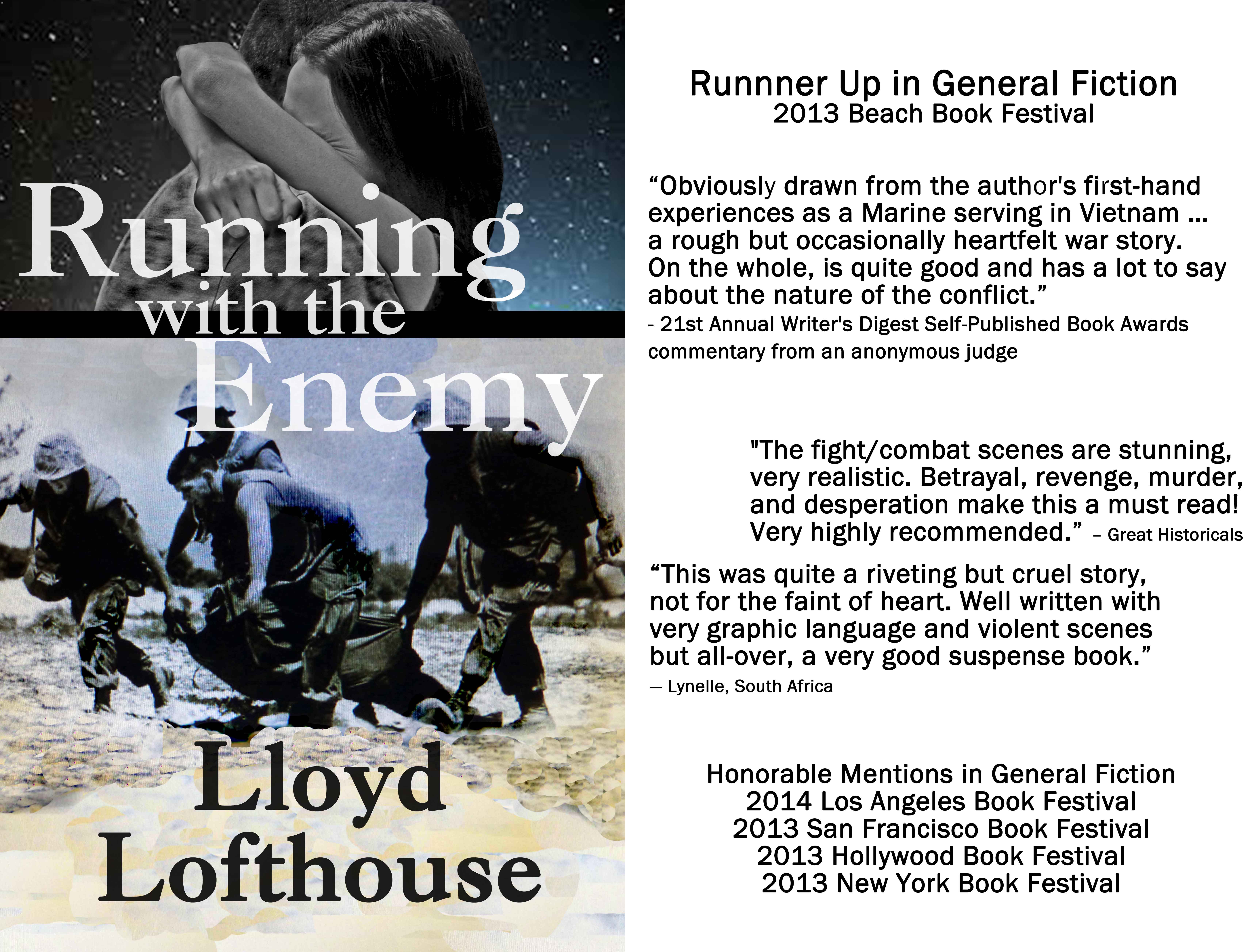
And the woman he loves and wants to save was fighting for the other side.

To follow this Blog via E-mail see upper left-hand column and click on “FOLLOW!”

Lasers, Drones and Killer Robots – the future is now: Part 1/2

When the world was first introduced to Star Trek—the TV series—in 1966 and then the Star Wars films, starting with A New Hope in 1977, the world did not have killer lasers in addition to drones/robot weapons and Internet cyber warfare.

The laser/energy weapons, and the droids and robots in those early Star Trek and Star Wars films have now become a reality, because in 1999, the Department of Defense (DoD) formally recognized lasers as future weapons and began research and development (R&D).

Now, the R&D has resulted in headlines like Lockheed laser weapon hits its mark again – cnet.com

“Against rockets and missiles, laser weapons work by fixing a high-energy beam on the side wall of the projectile for several seconds, heating it up enough to rupture the skin.”


Killer Robots – Drone Strikes of the future? Young Turks

Another headline says, Military drone with no human control – Smart Planet.com

 “The X-47B is a completely unmanned drone. Meaning, not only no pilot but no human control from the ground. Its missions are initially planned by humans but once these things are airborne they are guided and controlled by on-board computers.”

And Popsci.com reports about A Working Assault Rifle Made with a 3-D Printer

“HaveBlue then decided to push the limits of what was possible and use his printer to make an AR-15 rifle. To do this, he downloaded plans for an AR-15 receiver in the Solidworks file format from a site called CNCGunsmith.com. After some small modifications to the design, he fed about $30 of ABS plastic feedstock into his late-model Stratasys printer. The result was a functional AR-15 rifle. Early testing shows that it works, although it still has some minor feed and extraction problems to be worked out.”

With weapons like the few mentioned in this post, how long before there is no safe place on the Earth and the entire world—including your home—is a battlefield or are we already there?

Continued on June 19, 2013 in Lasers, Drones and Killer Robots – Part 2

_______________________

Lloyd Lofthouse is a former U.S. Marine and Vietnam Veteran.

His latest novel is the award winning suspense-thriller Running with the Enemy. Blamed for a crime he did not commit while serving in Vietnam, his country considers him a traitor. Ethan Card is a loyal U.S. Marine desperate to prove his innocence or he will never go home again.

And the woman he loves and wants to save was fighting for the other side.

To follow this Blog via E-mail see upper left-hand column and click on “FOLLOW!”

Combat casualties and battle-field medicine through the ages: Part 2/2

With the introduction of gun powder, combat casualties increased dramatically, but medical treatment in the battlefield also improved. Field hospitals were introduced by Napoleon. During the Civil War and later in World War I and World War II, trained military medics joined combat units to treat casualties in the field as troops were wounded.

By comparing deaths and the number wounded starting with World War I, we gain a better understanding of how those advances in battlefield medical care improved the odds of survival.

  • World War I (April 6, 1917 – November 11, 1918—one year and eight months): 53,402 deaths and 204,002 wounded in action—an average of 32,170 combat deaths annually.
  • World War II (Dec. 1941 to Aug. 14, 1945—three years and about nine months): 407,300 deaths and 670,846 wounded in action—an average of 108,613 combat deaths annually.

The introduction of the helicopter in Korea and then Vietnam to quickly medevac wounded troops to field hospitals saved many lives.

  • Korea (1950 – 1953—three years): 54,246 deaths and 92,134 wounded in combat—an average of 18,082 combat deaths annually.
  • Vietnam (1956 – 1975—nineteen years): 58,193 deaths and 153,303 wounded in combat—an average of 3,063 combat deaths annually.
  • Desert Storm (1990 – 1991—seven months): 378 deaths and 1,000 wounded in combat—an average of 54 combat deaths a month.
  • Iraq (March 2003 – December 2011—about eight years): 4,403 deaths and 31,827 wounded in combat—an average of 550 combat deaths annually.
  • Afghanistan (October 7, 2001 to present—about eleven years) 2,094 and 18,584 wounded in action—an average of 190 combat deaths annually while back home in the United States more than 30,000 die in vehicle accidents on the roads and highways every year. Sources: Timeline of U.S. Wars and Conflicts and Defense.gov

Today, there are more casualties from suicide than combat. In 2012, the number of active-duty casualties from suicide actually outnumbered the combat deaths in all of Afghanistan, 349 -295.  But it’s even worse than that if you look at the number of suicides by America’s veterans. As of February 4th, TWENTY-TWO veterans kill themselves EVERY DAY. That’s one EVERY 65 MINUTES. Source: Innocence-Clinic.law

Now the challenge is to discover how to treat the invisible wounds and trauma of the mind.

Return to or start with Combat casualties and battle-field medicine through the ages: Part 1

_______________________

Lloyd Lofthouse is a former U.S. Marine and Vietnam Veteran.

His latest novel is the award winning suspense-thriller Running with the Enemy. Blamed for a crime he did not commit while serving in Vietnam, his country considers him a traitor. Ethan Card is a loyal U.S. Marine desperate to prove his innocence or he will never go home again.

And the woman he loves and wants to save was fighting for the other side.

To follow this Blog via E-mail see upper left-hand column and click on “FOLLOW!”

Good News Twice in One Day

Early this morning—before I went out to work on the patio-fence with more than one gate project that I’m building from scratch—I checked my e-mail and discovered that my suspense-thriller, Running with the Enemy, had been awarded an Honorable Mention in General Fiction at the 2103 New York Book Festival.

A good way to start the day.

Fast forward several hours—I finished working on the project about 3:00 pm, took a shower, and then logged-on to check my e-mail only to discover that Running with the Enemy had been named Runner Up (2nd Place) in General Fiction at the 2013 Beach Book Festival.

A good way to end the day.

In twelve days on June 22, the 2013 New York Book Festival will be held at the Radisson Martinique on Broadway in New York City’s Midtown Manhattan—just steps from the Empire State Building.

When Running with the Enemy picked up its first honorable mention at the 2013 San Francisco Book Festival, I attended the free seminars and the private award ceremony, but I’m not planning on buying a ticket to fly to New York at this late date. With the lowest nightly rate for the Radisson at $385.00 and flights to New York from San Francisco costing $583 – $2,072 (depending on the airline you book a flight with), I’m staying home. The grand prize winner wins $1,500, but an honorable mention and a runner-up do not come with a cash prize.

However, if you live near New York and you are a writer, poet, author and/or an avid reader, you may want to take advantage of the free seminars. The San Francisco event was well worth my time, and I’m planning on going next year. The price of a BART ticket to ride into San Francisco from where we live is about $10 round trip.

NEW YORK BOOK FESTIVAL DAY SCHEDULE
– this event is free –

  • 11 a.m.-12:15 p.m. The Art of Marketing and Promotion – An examination of what it takes to get your book noticed in a crowded marketplace. 
  • 1:00 p.m.-2:10 p.m. Writing About Your Life – “Write what you know” is one of the most debated axioms of an author’s life. A panel that drew on their experiences and career paths discusses what it takes to put it all down in book form.
  • 2:30 p.m.-3:30 p.m. Children’s Books in a Modern Age – Authors/publishers of award-winning books from the San Francisco Book Festival talk about their books and the market.
    Panelists: 
  • 3:40 p.m.-4:00 p.m. Dr. Neal Hall – the poetry winner of the San Francisco/New York/New England/Paris and Los Angeles festivals reads from his work and answers questions.
  • 4:10 p.m.-4:45 p.m. The Future of Books – The rise of eBooks, the shrinking retail scene, the consolidation of big publishing and the explosion of the online world. A discussion on where everything appears to be heading and how you can leverage these developments.
  • 4:45 to 5 p.m. A Conversation with the New York Book Festival grand prize winner

The grand-prize winner of the 2013 New York Book Festival was Searching for Zion: The Quest for Home in the African Diaspora by Emily Raboteau (Atlantic Monthly Press). The Rainbow Troops by Andrea Hirata was the winner of the general-fiction category and it was first published in Indonesia in 2005 selling more than five-million copies. The English translation of Hirata’s novel was published by Sarah Crichton Books (February 5, 2013)

The grand-prize winner of the 2013 Beach Book Festival was Inside Linda Lovelace’s Deep Throat by Darin Porter published by Blood Moon Productions, March 12, 2013. The winner of the general-fiction category was Rosi’s Time by Edward Eaton, published by Dragonfly Publishing.

The private-award ceremony will be held June 21 at the Grolier Club in Manhattan.

_______________________

Lloyd Lofthouse is a former U.S. Marine and Vietnam Veteran.

His latest novel is the award winning suspense-thriller Running with the Enemy. Blamed for a crime he did not commit while serving in Vietnam, his country considers him a traitor. Ethan Card is a loyal U.S. Marine desperate to prove his innocence or he will never go home again.

And the woman he loves and wants to save was fighting for the other side.

To follow this Blog via E-mail see upper left-hand column and click on “FOLLOW!”

Combat casualties and battle-field medicine through the ages: Part 1/2

Starting with the Roman Empire, it has been estimated that Roman Armies suffered about 885,000 casualties over a nine-hundred year period from 400 BC to 500 AD—that adds up to less than 1,000 average combat deaths annually. Source: Body Count of Roman Empire

It seems that the old way of fighting with swords and spears wasn’t as destructive as modern warfare.

The ancient military physicians of the Greeks and the Romans had discovered that certain treatments, such as the application of honey and salt mixtures to wounds—mostly from cuts and jabs—aided the troops to recover.

The decline of the Roman Empire didn’t happen overnight. It took centuries, and when the Roman Empire fell in the 5th century AD, military medical support was almost gone. With the decline of an empire, also came the end of effective medical care in Europe.

About a thousand years would go by before the rebirth of military medicine in Europe in Spain near the end of the 15th century after the Spanish drove out the Islamic Moors. During the wars, the Spanish military copied the mobile hospitals used by the Moorish armies.


But in the 15th century, the introduction of gunpowder in combat caused more casualties, because almost all gunshot wounds became infected due to the injury—clothing, dirt, and other debris was often forced into the wound by the musket ball—and/or from unsanitary conditions following the injury caused by the surgeon probing for the musket ball or shrapnel with unwashed fingers and/or unwashed surgical instruments.

It isn’t as if sterilizing surgical instruments was going to be a new concept. The ancient Chinese, Persians and Egyptians all used methods for water sanitation and disinfection of wounds. In fact, Mercuric chloride was used to prevent infection in wounds by Arabian physicians in the Middle Ages but not in Europe.

In fact, in Europe and American in the 1800’s, infections after surgery caused almost half of the deaths of troops wounded in combat.

Though the number of killed and wounded in the Civil War (1861 – 1865) is not known precisely, most sources agree that the total number killed was between 640,000 and 700,000 resulting in an average of 160,000  – 175,000 combat deaths annually—a massive leap from the average annual combat deaths during the Roman Empire where the well trained and highly disciplined Roman military also had observant medics who wrote down treatments that worked and passed this knowledge on to be used by the next military doctor. In fact, Roman surgeons used about the same tools that American doctors did only one hundred years ago.

However, as it turns out, the bloodiest war in American history was also one of the most influential in battlefield medicine. Civil War surgeons learned fast, and amputation of arms and legs saved more lives from death by infection than any other wartime medical procedure. Sources: Mental Floss.com,  American Civil War Casualties and Military Medicine through the Eighteenth Century

Continued on Wednesday, June 12, 2013 in Combat casualties and battle-field medicine through the ages: Part 2

_______________________

Lloyd Lofthouse is a former U.S. Marine and Vietnam Veteran.

His latest novel is the award winning suspense-thriller Running with the Enemy. Blamed for a crime he did not commit while serving in Vietnam, his country considers him a traitor. Ethan Card is a loyal U.S. Marine desperate to prove his innocence or he will never go home again.

And the woman he loves and wants to save was fighting for the other side.

To follow this Blog via E-mail see upper left-hand column and click on “FOLLOW!”

The Virtual Wall of one War’s Casualties

The Virtual Wall is an index by state and city of Americans who died in the Vietnam War.

When I learned of the Virtual Wall, I visited to see who died from my home towns.  I started with Pasadena, California where I was born and lived my first two or three years of life. Then I visited Azusa, California where I lived ages 3 to 6.  My last search was for Glendora, California where I lived ages 7 to 19 when I graduated from high school and joined the US Marines.

I counted thirty-one casualties from Pasadena, nine from Azusa and nine from Glendora.

Click on the link above and search for your state and hometown/s to discover who died in Vietnam, and you will be taken to a page that has information about those casualties. Click on an individual’s name and discover more about that person.

Americans who joined the US Military in Glendora, California—who may have attended Glendora High School—and who died in Vietnam were Cummings Jr, Liptak, Smith, Kuebel, Rowles, Talley, Leake Jr, Saunders and Willard Jr.

All of these combat casualties were born within a few years of my birth year so we may have been in the same classrooms and walked in the hallways between classes.

When I worked in the high school library as a student aide, I may have helped one of them find a book for a class report.

The last casualty on the list— Willard Jr—served in the US Marines in the 1st Marine Division—the same division I served in while in Vietnam in 1966. Willard died a few months after I left the combat zone. Liptak, Talley and Kuebel were also Marines who enlisted from Glendora, California.

Sobering thoughts that my name could have been on that list too.

Discover The Creative Writing Class at war with the Vietnam Vet

_______________________

Lloyd Lofthouse is a former U.S. Marine and Vietnam Veteran.

His latest novel is the award winning suspense-thriller Running with the Enemy. Blamed for a crime he did not commit while serving in Vietnam, his country considers him a traitor. Ethan Card is a loyal U.S. Marine desperate to prove his innocence or he will never go home again.

And the woman he loves and wants to save was fighting for the other side.

To follow this Blog via E-mail see upper left-hand column and click on “FOLLOW!”

“Divine Justice” reviewed

I’m a fan of David Baldacci’s Camel Club series, and I haven’t read one of his books with my eyes, but I’ve listened to them on unabridged audio books while driving. In fact, I’ve been listening to audio book for decades. I also read tree books at home. I’d like to read more e-books but the two Kindles I have bought keep telling me that I’m not who I am and won’t let me read the books I buy.

The Camel Club has four members who are obsessively loyal to each other, and if the group has a leader, it’s the man who goes by the name of Oliver Stone. His real name is John Carr and before he was reborn as Oliver Stone, he served in the US military and is a combat veteran who was recruited by the CIA to become a US government assassin—maybe the best assassin that ever lived, but as Oliver Stone he is a thorn in the side of men in the government who abuse their power.

Baldacci never served in the U.S. Military but that has not stopped me from enjoying his novels. The reason I enjoy these books is because John Carr aka Oliver Stone is a man with a conscience, and he is loyal to those who are loyal to him. He will die to protect his friends.

To date, I’ve listened to three of the five books in this series: “The Camel Club,” “Hell’s Corner,” and now “Divine Justice”.  The remaining two are on my—to listen to or read list—“The Collectors” and “Stone Cold”.

In “Divine Justice,” John Carr (aka: Oliver Stone) has become the most wanted man in America after he assassinates a powerful senator and America’s intelligence chief—these are the men who destroyed his life by murdering his wife years earlier and then taking his young daughter from him.

After the two-shot assassinations—one shot for each target—Carr is on the run. To escape, he takes an Amtrak train toward New Orleans, but his plans change drastically when he comes to the assistance of a young man who is being beat up by three bullies. Carr beats up the bullies and then befriends the young man, who seems to have a huge unfriendly chip on his shoulder.

This takes Carr to the remote coal-mining town of Divine, Virginia where he finds himself once again helping the victims of evil, powerful and corrupt men, but Carr also finds unexpected love—giving him a second chance at life—that is if he can stay alive and protect the woman he has fallen in love with, because she is a target too.

But Oliver Stone is not alone. The other members of the Camel Club are coming to help by shadowing Joe Knox, the government agent who has been sent to find Carr and deliver him to his executioner.

Will the Camel Club make it in time to save Stone/Carr? I’m not going to spoil the story, but I will recommend this series of books if you enjoy thriller-suspense novels that I think will keep you wanting more.

Discover A Night at the “Well of Purity”

_______________________

Lloyd Lofthouse is a former U.S. Marine and Vietnam Veteran.

His latest novel is the award winning suspense-thriller Running with the Enemy. Blamed for a crime he did not commit while serving in Vietnam, his country considers him a traitor. Ethan Card is a loyal U.S. Marine desperate to prove his innocence or he will never go home again.

And the woman he loves and wants to save was fighting for the other side.

To follow this Blog via E-mail see upper left-hand column and click on “FOLLOW!”

The Different Faces of War

We are at war every day, and I’m not talking about Afghanistan. As an author, I know that there are many different types of conflict—there is man vs. man, man vs. nature, and man vs. himself.

When we think of war, we often think of World War I, WWII, Korea, Vietnam, Afghanistan, Iraq, and we ignore the other battles fought daily all over the world.

For example, the tornado in Oklahoma. That was a battle against nature and it was just as devastating as combat in Afghanistan. In Oklahoma—in sixteen minutes—more than fifty died and twenty were children.

Natural disasters are battles in man’s unending war against nature. For a few examples:

  • the tropical cyclone that hit Galveston in 1900 caused 6,000 – 12,000 fatalities.
  • In 1906, the San Francisco earthquake killed 3,000 – 6,000.
  • In 2004, an Indian Ocean earthquake caused a tidal wave that killed 230,000 people.
  • In 2005, Hurricane Katrina killed 1,836 people.

Then there is the war with viruses—man vs. nature—such as the flu. For example, the CDC estimates that from the 1976-77 to the 2006-07 flu season, flu-associated deaths ranged from a low of about 3,000 to a high of about 49,000 people (annually).

On January 18, 2013 Bloomberg reported, the flu season, which has now been at epidemic levels for two straight weeks, may result in 36,000 deaths, said William Schaffner, chairman of the department of preventive medicine at Vanderbilt University School of Medicine in Nashville, Tennessee.


Top FIVE Deadliest Diseases – this video is an entertaining way to scare yourself to death

For another example, there is the war raging on America’s roads every minute of every day. The US Census says that in 2009 alone, there were 35.9 thousand deaths from motor vehicle accidents and that was a low year. In fact, from 1990 to 2009, about 740,000 people lost their lives in vehicle accidents (about 39,000 annually).

In 2012, The Washington Post reported that “The U.S. has far more gun-related killings than any other developed country.” In fact, The U.S. gun murder rate is about 20 times the average for all other developed countries.

How many gun deaths are there in the US every year?

In 2011 alone, the figures from the Centers for Disease Control (CDC) reported that 31,940 people died in the United States from gun injuries.

  • In 2010 that number was 31,328
  • In 2009 it was 31,177
  • In 2007 it was 31,224
  • In 2004 it was 29,569.

Breaking down deaths from firearms in 2011:

  • Accidental discharge = 851
  • Suicide = 19,766 (man vs. himself) Note: the CDC says that the total number of suicides from all methods was 38,364 for just 2011.
  • Homicide = 11,101
  • Undetermined Intent = 222

By comparison, in World War I, the United States had 53,401 combat deaths (1917-1918) or 26,700 annually.

  • In World War II there were 291,557 combat deaths (1941-1945) or 58,311 annually.
  • In the Korean War there were 33,686 combat deaths (1951 – 1953) or 11,229 annually.
  • In Vietnam there were 47,424 (1955-1975) or 2,371 annually.
  • In Afghanistan there have been 2,012 combat deaths (2001-present) or 168 annually.
  • In Iraq there were 3,542 combat deaths (2003-2011) or 443 annually.

Why do we hear so much about combat deaths and very little about highway deaths, suicide deaths, deaths by virus, natural-disaster deaths, and firearm deaths?

The fatal casualty numbers for Vietnam, Afghanistan and Iraq show us that the odds of dying a violent death in the United States are much higher than in a combat zone. It seems to me that we’d be safer joining the Army or the Marines and going off to fight in one of America’s wars.

Ignoring the numbers, why is death in combat considered more dramatic and devastating than someone going out to buy a quart of milk and dying in an accident on an American road or accidentally shooting himself cleaning a Smith and Wesson revolver while watching Dancing with the Stars?

Discover how a U.S. Marine Deals with his PTSD through Ballet

_______________________

Lloyd Lofthouse is a former U.S. Marine and Vietnam Veteran.

His latest novel is the award winning suspense-thriller Running with the Enemy. Blamed for a crime he did not commit while serving in Vietnam, his country considers him a traitor. Ethan Card is a loyal U.S. Marine desperate to prove his innocence or he will never go home again.

And the woman he loves and wants to save was fighting for the other side.

To follow this Blog via E-mail see upper left-hand column and click on “FOLLOW!”

Coming Home

I flew to Okinawa in late December 2005 and spent the New Year inside a Quonset hut during heavy rain and a typhoon warning. A few weeks later, we boarded a troop transport and my battalion shipped out to Chu Lei, Vietnam.

Fast forward to December 2006, and I was deep underground in a communications bunker. It was 2:00 am and I was alone when I heard the clatter of feet running down the stairs, slowing at the grenade trap and then moving fast again.

At the time, I was sitting in front of the radio set leaning back in a chair. Then another radio operator burst through the door. When I heard “We’re going home,” I fell over backwards and landed with a crash.

With little warning—before noon—three of us were on a flight to Da Nang where we boarded a civilian airliner and flew home to land at LAX fourteen hours later. After being processed, I rented a Mustang using my military driver’s license and headed home to the San Gabriel Valley south of Los Angeles.

It was three in the morning when I pulled into the driveway of my parent’s house. I was twenty-one. I didn’t have a wife, girlfriend or child. I had an older brother and sister who were married and had their own homes.

There was a light on in my father’s half bath. I knew that he was in there shaving and getting ready to go to work.

I rang the doorbell and heard him say, “Who the hell could that be at this hour?”

When the door opened, half of my dad’s face was covered in shaving cream. He was wearing his work pants and a T-shirt. Without saying a word, he stared in stunned shock, then spun around and ran through the house shouting for my mother, who was still in bed sleeping. Then I heard her surprised voice and feet rushing down the hall to the kitchen.

That was my homecoming from war.

Today, returning from war can be a very different experience, but the emotions are the same. Now homecomings are often filmed and posted on You Tube—something impossible in 1966. And when I watch them, which I do, my eyes fill with tears and I remember that early morning in December 1966 when my dad opened the kitchen door.

Discover The Sniper and the Dear-John letter

_______________________

Lloyd Lofthouse is a former U.S. Marine and Vietnam Veteran.

His latest novel is the award winning suspense-thriller Running with the Enemy. Blamed for a crime he did not commit while serving in Vietnam, his country considers him a traitor. Ethan Card is a loyal U.S. Marine desperate to prove his innocence or he will never go home again.

And the woman he loves and wants to save was fighting for the other side.

To follow this Blog via E-mail see upper left-hand column and click on “FOLLOW!”