Pain, Pollution and People

It’s difficult to write when I’m gasping for air and blowing my top. When I was still teaching, walking into a classroom in the morning made me sick—and no, I wasn’t allergic to my students, but I should have been.

Then I retired and for five years, I have been free of wheezy lungs and sinus infections that always arrived with the start of each school year when I worked in those old buildings at the high school where I taught. Have you heard of sick building syndrome? I lived it.

This new, peaceful world changed several weeks ago. Workers came with power tools and mud-caked boots. I should have fled, but I stayed at my computer as a stupid, stubborn, former United States Marine would.

My office has three doors. One that leads toward the other rooms and one that opens to the outside. Then there is the door that opens to the space under the second story and the foundation. That crew drilled, pounded, cut and tracked dirt from room to room—always in my office. I had trouble concentrating. I suffered from memory loss. Plastic tarps covered most of the furniture, and I couldn’t find things. When I left the office to find a moment of peace, I covered the computer and printers with a bed sheet. The noise reminded me of combat but worse, because I was nineteen and then twenty when I was in Vietnam—noise did not bother me as it does now.
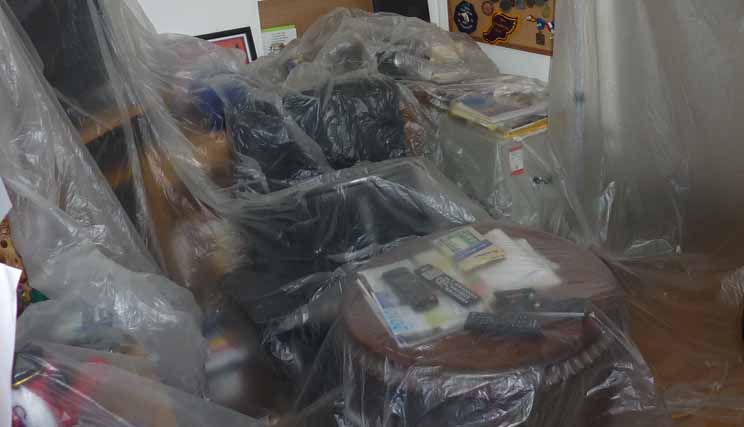
covered office furniture

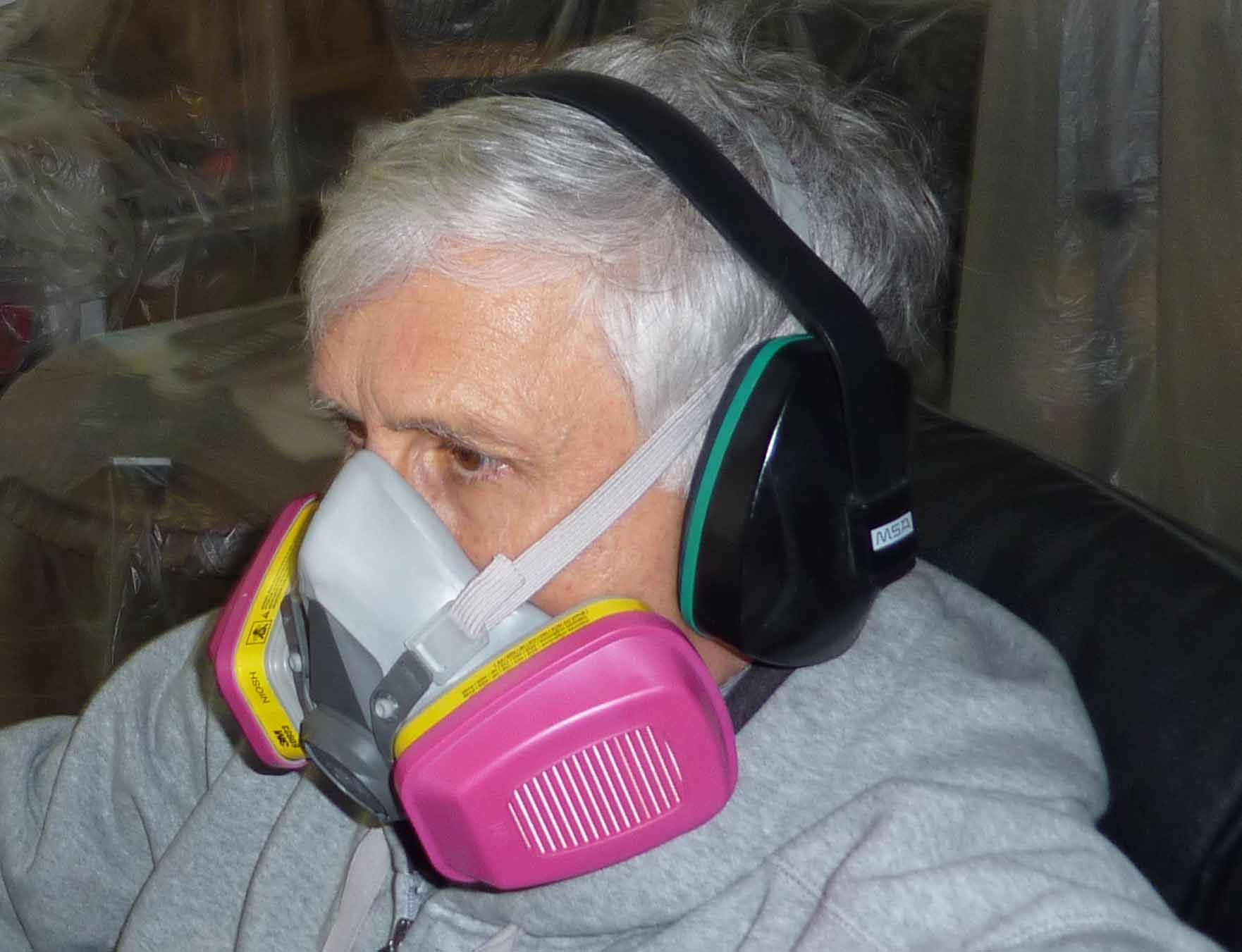
Concrete dust floated through the air and my sinuses and lungs rebelled, so I put on a 3M mask with two pink HEPA filters attached. The last time I wore a mask like this was when I was teaching. I searched the garage and found the noise suppresser to help mute the pounding and drilling.  I looked like an explorer to Mars or a survivor of trench warfare struggling to write while the frigid air froze my fingers.

The crew had arrived to bolster the foundation against future earthquakes that might never arrive. Even if a hard tumbler did visit, I doubt that all that work would hold our sixty-year old hillside house together. It still might slide down the hill into the middle of the street blocking traffic.

I could have moved, but I didn’t want to disconnect all the cables and cart the equipment to another room for a few days to escape the dust and noise—something (I soon discovered) that would have been impossible without checking into a hotel.

Even with a noise suppresser covering my ears, muted sounds intruded and the last place I wanted to be was in this chair writing about China, the Vietnam War or being a teacher in the tortured American public schools. I stuck with it for days as my suppressed anger fueled by PTSD started to simmer and fume.
It was a relief when the workers finished. I thought I was going to have the tranquility back where the only noise would be the click of the keys as my warmed hands flew across the keyboard meeting my Blogging goals.

But the workers left something behind.

I started sneezing. My sinuses ran hundred mile marathons. I went to the doctor and he prescribed medications that didn’t work. The sneezing went volcanic—like Mt. Saint Helena blowing its top.  One time, I sneezed so bad, I blew the 3M mask off my face—so much for a mask that’s supposed to protect you from every gas and plague Islamic terrorists can brew. Upstairs or outside, I was fine. But in my office, I was a goner. “Blam, blam, balm,” my nose exploded like rapid shots from a fifty-caliber submachine gun.

I could have opened windows, but it’s been raining for weeks.  The sky has been overcast.  The air breezy and cold.  Then today, the sun came out and I finally let the outside in and the sneezing stopped—I’m crossing my fingers and knocking on wood. I’m afraid to close the windows, but night will come and with it lower temperatures. I fear that whatever industrial poison is haunting my once tranquil office space might return.

Return to A Repeat of Agent Orange in America’s Heartland?

_______________________

Lloyd Lofthouse, a former U.S. Marine and Vietnam Veteran, is the award winning author of The Concubine Saga.

His latest novel is Running with the Enemy. Blamed for a crime he did not commit while serving in Vietnam, his country considers him a traitor. Ethan Card is a loyal U.S. Marine desperate to prove his innocence or he will never go home again.

And the woman he loves and wants to save was trained to hate and kill Americans.

To follow this Blog via E-mail see upper right-hand column and click on “Sign me up!”

A Morning Burst of Anger

I woke up this morning and wanted to hit something. In the 1960s and 70s, I would have smashed a hole in the nearest drywall.

This is what set me off: “In the past six weeks, you’ve had the Fort Hood attack, the D.C. Five and now the attempted attack on the plane in Detroit … and they all underscored the clear philosophical difference between the administration and us,” said Rep. Pete Hiekstra (R-Mich.), the ranking Republican on the House Intelligence Committee.

http://news.yahoo.com/s/politico/20091228/pl_politico/31016

The Republican spin machine is trying to score points blaming Obama for what almost happened last week on Northwest Flight 253.

Why did I get angry? Because I immediately flashed back to an incident in Vietnam.

We’d been out for hours on a night patrol slipping silently through the rice paddies that surrounded our hill, and we were returning as dawn arrived—tired but alert as we straggled along the dirt road that climbed into the hills where our Battalion CP was located.

A washed out blue sky was spreading from the east and it was still dark in the west. Then the ground trembled as if an earthquake were taking place.  The sound of the explosion blew over us. We stopped and turned to see flames and a thick spire of black smoke rising into the sky from where the airstrip was located. One of the jobs the 1st Marine Division at Chu Lai had in 1966 was to protect that airstrip and the jet fighters that used it.

One Vietcong had slipped past an entire Marine division and made it to the airstrip where he managed to blow up a large portion of the stored jet fuel. That Vietcong didn’t just slip past one defensive line, but several.

I “hate” dirty politics—the same kind that started wars like Vietnam and Iraq so young men as I was then, in our patriotic zeal, would fly off to war believing we were serving a just cause when in the truth, we had been lied to.

It is almost impossible to stop an individual from doing something like what happened on that airplane a few days ago just as an entire Marine division couldn’t stop that Vietcong from infiltrating our lines.

There were 300 people on Northwest Flight 253. For sure, someone will suffer some PTSD symptoms and have trouble sleeping as they relieve the moment they thought they might die. Some may never fly again.

If you agree with Rep. Pete Hiekstra, then George W. Bush is responsible for what happened on September 11, 2001.

Instead of pointing fingers of blame looking for a “scapegoat”, Republicans and Democrats should be looking for ways to do a better job than the Homeland Security our current president inherited.

Discover more about PTSD?

_______________________

Lloyd Lofthouse, a former U.S. Marine and Vietnam Veteran, is the award winning author of The Concubine Saga.

His latest novel is Running with the Enemy. Blamed for a crime he did not commit while serving in Vietnam, his country considers him a traitor. Ethan Card is a loyal U.S. Marine desperate to prove his innocence or he will never go home again.

And the woman he loves and wants to save was trained to hate and kill Americans.

To follow this Blog via E-mail see upper right-hand column and click on “Sign me up!”

The Public’s Image of PTSD and the Vietnam Veteran

Are we all crazy?  Does PTSD ever go away?

How many Hollywood movies have painted a positive picture of Vietnam Veterans compared to movies that show Vietnam veterans as angry, violent, dangerous drug users and/or alcholics (mostly brought on by PTSD)?

Three Vietnam Veterans that I know of have run for President of the United States.  All three lost.

Al Gore served in Vietnam as a reporter/journalist for five months. He Gore was stationed with the 20th Engineer Brigade in Bien Hoa and was a journalist with The Castle Courier. He received an honorable discharge from the Army in May 1971.

Of his time in the Army, Gore later stated, “I don’t pretend that my own military experience matches in any way what others here have been through […] I didn’t do the most, or run the gravest danger. But I was proud to wear my country’s uniform. And my own experiences gave me strong beliefs about America’s obligation to keep our national defenses strong.” He also later stated that his experience in Vietnam “didn’t change my conclusions about the war being a terrible mistake, but it struck me that opponents to the war, including myself, really did not take into account the fact that there were an awful lot of South Vietnamese who desperately wanted to hang on to what they called freedom. Coming face to face with those sentiments expressed by people who did the laundry and ran the restaurants and worked in the fields was something I was naively unprepared for.”

John Kerry reported for duty at Coastal Squadron 1 in Cam Ranh Bay in South Vietnam on November 17, 1968. In his role as an officer in charge of Swift boats, Kerry led five-man crews on a number of patrols into enemy-controlled areas. His first command was Swift boat PCF-44, from December 6, 1968 to January 21, 1969, when the crew was disbanded. They were based at Coastal Division 13 at Cat Lo from December 13, 1968 to January 6, 1969. Otherwise, they were stationed at Coastal Division 11 at An Thoi. On January 30, 1969, Kerry took charge of PCF-94 and its crew, which he led until he departed An Thoi on March 26, 1969, and subsequently the crew was disbanded.

On January 22, 1969, Kerry and several other officers had a meeting in Saigon with Admiral Elmo Zumwalt, the commander of U.S. Naval forces in Vietnam, and U.S. Army General Creighton Abrams, the overall commander of U.S. forces in Vietnam. Kerry and the other officers reported that the “free-fire zone” policy was alienating the Vietnamese and that the Swift boats’ actions were not accomplishing their ostensible goal of interdicting Viet Cong supply lines.

John McCain requested a combat assignment, and was assigned to the aircraft carrier USS Forrestal flying A-4 Skyhawks. His combat duty began when he was 30 years old, in mid-1967,  during the Vietnam War. McCain and his fellow pilots became frustrated by micromanagement from Washington, and he would later write that “In all candor, we thought our civilian commanders were complete idiots who didn’t have the least notion of what it took to win the war.”

John McCain became a prisnor of war on October 26, 1967.

He was flying his 23rd bombing mission over North Vietnam when his aircraft was shot down by a missile over Hanoi. McCain fractured both arms and a leg ejecting from the aircraft. Although McCain was badly wounded, his captors refused to treat his injuries, beating and interrogating him to get information; he was given medical care only when the North Vietnamese discovered that his father was a top admiral.

Does John McCain suffer from PTSD?

George Bush, Karl Rove exploit John Kerry’s PTSD in 2004

What is your opinion about the public image of Vietnam Veterans? Do you think these three men lost the White House because they served in Vietnam?

Discover A Prisoner of War for Life

_______________________

Lloyd Lofthouse is a former U.S. Marine, Vietnam Veteran, journalist and award winning author.

His second novel is the award winning love story and suspense-thriller Running with the Enemy. Blamed for a crime he didn’t do while serving in Vietnam, his country considers him a traitor. Ethan Card is a loyal U.S. Marine desperate to prove his innocence or he will never go home again.

Promo Image with Cover Awards

Where to Buy

To follow this Blog via E-mail see upper left-hand column and click on “FOLLOW!”

The LBJ Induced Anger and Rage

This is a rant. If you are a die-hard Democrat or Republican with more loyalty to your political party than to the country, you do not want to read this. It will get your blood pressure up.

Each time I write one of these posts, I open the cage where the demon raptors live. I write about what happened in Vietnam—the anger, the experiences, the flashbacks or someone else’s experiences, and I hope one of those raptors will use its flaming wings to take flight and never come back.

After forty years, I’ve learned there is no guarantee those raptors will stay away.

Starting last week, I have been angry with LBJ, the Democrat, and GWB, the Republican—AGAIN!

I’m also disappointed in the people that voted for them. President Lincoln said, “You can fool some of the people most of the time and most of the people some of the time, but you can’t fool all of the people all of the time.” If so, there are many fools out there and some of them will call me worse for writing this.

I don’t know about LBJ, but there are millions that still believe what GWB did in Iraq was right. Those people are probably the ditto heads that listen to idiots like Rush Limbaugh.

LBJ and GWB have a lot in common. Both started wars with lies and deceit. The facts say that both Vietnam and Iraq were unnecessary, and many that served with courage in those wars now live with roadside bombs inside their heads and never know when one might go off.

It’s been documented many times that GWB wanted to start a war in Iraq well before 9/11. “He was thinking about invading Iraq in 1999,” said author and journalist Mickey Herskowitz. “It was on his mind. He said to me: ‘One of the keys to being seen as a great leader is to be seen as a commander-in-chief.’ And he said, ‘My father had all this political capital built up when he drove the Iraqis out of Kuwait and he wasted it.’ He said, ‘If I have a chance to invade Iraq, if I had that much capital, I’m not going to waste it—”

But enough about GWB. It’s LBJ’s turn to burn, who, it seems, started the Vietnam War with lies.

Before he was assassinated, President Kennedy talked about getting out of Vietnam. Listen to what Tip O’Neill, former speaker of the house, says.

The next blow to America was the CIA’s alleged involvement bringing drugs into the United States, possibly creating today’s drug problems that are eating the country like a malignant cancer.

What is it that sets America apart from most of the World? The Bill of Rights, right?

The reason for The Bill of Rights was to protect American citizens from the corruption of government. Sad to say, the evidence shows that The Bill of Rights has become a rusty, leaky bucket.

_______________________

Lloyd Lofthouse, a former U.S. Marine and Vietnam Veteran, is the award winning author of The Concubine Saga.

His latest novel is Running with the Enemy. Blamed for a crime he did not commit while serving in Vietnam, his country considers him a traitor. Ethan Card is a loyal U.S. Marine desperate to prove his innocence or he will never go home again.

And the woman he loves and wants to save was trained to hate and kill Americans.

To follow this Blog via E-mail see upper right-hand column and click on “Sign me up!”

Before PTSD, it was called Combat Fatigue or Shell Shock

In World War II, they called it combat fatigue or shell shock. After the Vietnam war, they called it post-Vietnam syndrome (as if it had never existed before Vietnam).

Now, it is called PTSD and the military is trying to do something about it. Researchers are testing soldiers to see if they can learn who will be more affected by traumatic events.  The ongoing wars have provided scientists with opportnuites to learn more.

Here’s a link to a piece by Alicia Chang, Associated Press: http://health.yahoo.com/news/ap/us_med_predicting_ptsd.html

Resource Guide  

_______________________

Lloyd Lofthouse, a former U.S. Marine and Vietnam Veteran, is the award winning author of The Concubine Saga.

His latest novel is Running with the Enemy. Blamed for a crime he did not commit while serving in Vietnam, his country considers him a traitor. Ethan Card is a loyal U.S. Marine desperate to prove his innocence or he will never go home again.

And the woman he loves and wants to save was trained to hate and kill Americans.

To follow this Blog via E-mail see upper right-hand column and click on “Sign me up!”

A Prisoner of War for Life

It was still dark when I reached Dr. Vessey’s house in Pasadena.  It was late 1999 or early 2000. As sunlight leaked over the horizon, we drove to an alley behind a liquor store where the good doctor was going to meet with some homeless people he’d been helping. One of the homeless people was a Vietnam veteran who wouldn’t let the doctor near him. That’s why I was along—to gain the man’s trust.

I was about to find out how bad combat induced PTSD could be when the VA considers a veteran is 100% disabled. Since the vet I was going to meet couldn’t be trusted to handle his VA disability check, his payments went to a pastor, who was his financial guardian. The pastor decided how much to give him when he came to the church asking for money. The VA disability was enough to rent a studio apartment, but this vet chose to live on the streets where he felt safer. His home was under a blue tarp hidden in some thick brush that lined the side of an empty lot. Later, the doctor drove me there so I could see it.

This vet’s story of abuse was inhuman and tragic. He was a chopper pilot in Vietnam and was shot down becoming a POW where, among other things, he was sexually molested by the Vietnamese guards. I’m not sure I would have survived what he went through.

Dr. Vessey and I arrived first. We parked the car and entered the alley to wait. The homeless people started to arrive one or two at a time until there were about a dozen.  One even crawled out of the Dumpster behind the liquor store. The vet along with two women arrived last. We squatted in the alley and talked. I told the disabled vet my Vietnam story, and he said it was obvious that I’d been there.  Then he opened up and told us his story.

Before he finished, a helicopter (media or police—I’m not sure) flew over, and the vet surprised us when he yelled, “Incoming,” and leaped to his feet running toward what he thought must have been a bunker and safety—the back, brick wall of the liquor store. He ran into the wall and the sound of his body hitting the bricks was a sickening thud as if he were a side of beef being hit by a sledgehammer. He bounced off the wall and collapsed unconscious.  We rushed to him and gathered around. One of the homeless women cradled his injured head in her lap. There was a thick, swollen contusion on his forehead.

He had hit that wall hard enough to rattle the shelved bottles inside, and two men working in the liquor store came around the corner a moment later. They thought a car had hit the store.

This vet would always be a prisoner of war.

_______________________

Lloyd Lofthouse is a former U.S. Marine, Vietnam Veteran, journalist and award winning author.

His second novel is the award winning love story and suspense-thriller Running with the Enemy. Blamed for a crime he didn’t do while serving in Vietnam, his country considers him a traitor. Ethan Card is a loyal U.S. Marine desperate to prove his innocence or he will never go home again.

Promo Image with Cover Awards

Where to Buy

To follow this Blog via E-mail see upper left-hand column and click on “FOLLOW!”

Booze, the Veteran and coming home

I drank a lot after returning from Vietnam. One night during the thirty-day leave home, before reporting to my next duty station at Camp Pendleton north of San Diego, I stopped to buy a fifth of cheap vodka at a local drug store. I drank that vodka straight from the bottle at a friend’s apartment waiting for him to get off work at two a.m. He was a cook at a twenty-four hour coffee shop in West Covina.

Around two, Doug called and said his car wouldn’t start. He asked if I would pick him up. By that time, I’d finished two thirds of the vodka and was feeling no pain. I hadn’t had anything to eat for hours, and I’d already made two trips to the bathroom to dry heave before drinking more vodka.

Doug lived with his six-month pregnant girlfriend. Luckily, she went with me.

At two-thirty in the morning, I was driving on the San Bernardino Freeway through West Covina having trouble staying in one lane. Speed wasn’t a good idea, so I kept the car between twenty-five and thirty while weaving back and forth across three lanes. No one was passing me.

Then the flashing red lights came on behind me, and a West Covina police cruiser pulled me over. When the officer told me to step out of the car, I admitted I was drunk and said I would have trouble standing.

However, the officers wouldn’t let me stay in the car. Once outside, I pulled my wallet out of my back pocket. My military papers were there too and they fell to the ground. I didn’t know I’d dropped them, but the second officer saw the papers and picked them up. While I was leaning on the hood trying to steady the dizzy world around me so I wouldn’t fall over, the second officer was reading that I had just returned from Vietnam.

The officers talked while I leaned against the car to keep from falling over. They asked Doug’s girlfriend if she could drive, and she said yes. They didn’t ask to see a driver’s license. That was a good thing. She didn’t have one. With her driving, we got Doug and returned to his apartment where I crashed on the couch.

It was early January, 1967. No ticket was written. All these years later, I think those two West Covina Police Officers understood the kind of trauma war dishes out and must have felt that one drunk Marine just back from combat didn’t need to end up in jail on a drunk driving charge.

During all those years of protests against the Vietnam War, I would see this type of behavior from the police in other cities. I don’t believe many police sided with the war protesters. They understood what it was like to be under fire and how it messed with your mind.

Discover A Night at the “Well of Purity”

_______________________

Lloyd Lofthouse, a former U.S. Marine and Vietnam Veteran, is the award winning author of The Concubine Saga.

His latest novel is Running with the Enemy. Blamed for a crime he did not commit while serving in Vietnam, his country considers him a traitor. Ethan Card is a loyal U.S. Marine desperate to prove his innocence or he will never go home again.

And the woman he loves and wants to save was trained to hate and kill Americans.

To follow this Blog via E-mail see upper right-hand column and click on “Sign me up!”

The Creative Writing Class at war with the Vietnam Vet

The GI Bill helped pay my way through college. In 1971, I was in my third year; attending my third college. My third college was Fresno State. I was in a creative writing class when a debate about the war in Vietnam started after a young girl read her short story about ‘evil’ American pilots dropping bombs on North Vietnamese children.

I was the only Vietnam veteran in the class. I struggled to explain to the obviously brainwashed kids that American pilots dropping bombs over North Vietnam were thousands of feet above the targets and did not see the carnage. They were gone by the time the bombs exploded, and they were following orders. In the military, you followed orders or faced a court martial.

“How could someone sleep at night knowing they had dropped bombs killing innocent children and women,” one girl said. Others joined in, and the discussion turned into an argument. It was them against me. It was frustrating. The consensus was that any American in Vietnam was a baby killer. To them, the American pilots had to know what they were doing and were evil.

Eventually, the professor put a stop to the argument.

My first night in Vietnam, I relayed an order that killed a dozen Vietcong. I never saw the bodies. I never saw them die. I was in the radio tent a hundred yards from the action when a call came from one of the tank commanders saying there was noise in a ravine that led to the top of the hill. During the day, wires had been strung in that ravine with tin cans tied to them and there were rocks in the cans.

The tankers heard the rattle of rocks and called asking for permission to fire napalm into that gully. The officer on watch said yes, and I relayed the order. The tankers lit their flame and fired. The next morning, twelve blackened, burned bodies were found in the ravine. They all had weapons. They were coming to kill United States Marines.

Our colonel had devised a plan, and it succeeded. He had given no orders to build bunkers or spread concertina wire along the perimeter to protect us on our first night in country. The platoon of flame tanks had been left aboard the Navy ship until dark when they were brought ashore and guided to the hill where the platoon of tanks was positioned to protect against an attack.

In Europe during WWII, American bombers firebombed cities nightly during the closing months of the war against Hitler’s Germany. In one night, in one city, forty thousand civilians including women and children had napalm dropped on them. In Japan, firebombs dropped on Tokyo burned a hundred thousand in one day. There were no attempts to avoid hitting civilians to bring Hitler’s Germany and Japan to their knees. It was understood that war was ‘hell,’ and we fought to win. What has changed?

Discover A Night at the “Well of Purity”

_______________________

Lloyd Lofthouse is a former U.S. Marine and Vietnam Veteran.

His latest novel is the award winning suspense-thriller Running with the Enemy. Blamed for a crime he did not commit while serving in Vietnam, his country considers him a traitor. Ethan Card is a loyal U.S. Marine desperate to prove his innocence or he will never go home again.

And the woman he loves and wants to save was fighting for the other side.

To follow this Blog via E-mail see upper left-hand column and click on “FOLLOW!”

John Kerry, Purple Hearts, PTSD and WMDs

John Wayne movies molded my young brain, and fired my imagination. As a child, I dreamed of being a hero. Then at nineteen, I went to war and my thinking changed drastically. Narrow escapes from death ended my hero dreams, and I was fortunate to arrive home from Vietnam without a Purple Heart.

They say close only counts in horseshoes. I say it also counts in war. This morning, I awoke thinking about John Kerry and how his reputation was smeared during his presidential campaign.

 John Kerry fought in Vietnam. He was wounded three times. They were not serious wounds, but they drew blood. Even flesh wounds earn Purple Hearts. One wireman in my communications platoon was awarded a Purple Heart. While in the field sleeping in his shelter half, his unit came under attack. Mortar rounds dropped in like hail. Half asleep, he scrambled out, tripped on one of the lines that held his shelter half up, fell and hit his head on something.  He needed stitches. His sergeant put him in for a Purple Heart.

One of the tankers in that action was scrambling to get into his tank. In his rush to get inside the protection the tank offered, he slammed the turret hatch on one of his hands and crushed all the bones in it. He was also awarded a Purple Heart. He earned a ticket home too, and was discharged from the Marines with a VA disability for the crushed hand.

Bob, a history teacher I taught with, was in the Navy and served in Swift Boats like Kerry. Bob was the mechanic that kept the twin engines running. He told me once that the safest place in that swift boat was between the twin engines. On the water, the swift boat was an easy target and the metal hull was thin.

Those of us that did not bleed during combat and never earned Purple Hearts were still changed by narrow escapes from death. I had several and came home with a case of PTSD that still haunts me decades later.

John Kerry’s flesh wounds show that he came close to death. Yet, during his campaign for president, Swift Boat Veterans for Truth cast doubt on his courage, and George W. Bush, the man who used family influence to get into the National Guard and avoid combat, somehow became a hero, walked into the White House and served as president for eight years starting two wars. I have no idea what kind of president John Kerry would have been. I wonder if he would have used bogus evidence for WMDs and invaded Iraq.

Abraham Lincoln said “You may fool all the people some of the time, you can even fool some of the people all of the time, but you cannot fool all of the people all the time.”

_______________________

Lloyd Lofthouse, a former U.S. Marine and Vietnam Veteran, is the award winning author of The Concubine Saga.

His latest novel is Running with the Enemy. Blamed for a crime he did not commit while serving in Vietnam, his country considers him a traitor. Ethan Card is a loyal U.S. Marine desperate to prove his innocence or he will never go home again.

And the woman he loves and wants to save was trained to hate and kill Americans.

To follow this Blog via E-mail see upper right-hand column and click on “Sign me up!”

Lightning strikes O.P. 39

I went to sleep at 11:00 p.m. and woke to dark listening to the crickets, noisy sentries that say all was well.  It wasn’t raining and there was no thunder or lightning. However, staring at the glowing red numbers on the clock radio reminded of the rainy days I spent on O.P. 39 in 1966. There’s a picture on my Website. It’s about two-thirds of the way down the page. The thirty-nine meant the elevation above sea level.

I have no idea what triggered that particular memory. No one shot at me. No mortar rounds or rockets hit the hill. The fighting was taking place miles away. Maybe it was those red numbers on the clock radio. On the other hand, O.P. 39 offered a lesson on how fragile life was. Such lessons taught most of us veterans not to take life for granted.

There were two of us from the 1st Tank Battalion there. We were working a radio relay during a major offensive north of Chu-Lai. It rained most of the time. There were other units involved in that operation so there were other radio operators. The radios were on folding tables in a tent near my shelter half. There was also an artillery unit that fired support for the grunts fighting in the hills.

Outside that tent was a metal-lattice tower with a bunch of antennas on top. My watch started around six. I woke early when I rolled off the air mattress to flounder in several inches of water. It had rained hard all night and flooded the spot where I had pitched my shelter-half. I’d picked a spot surrounded by boulders that offered protection from incoming fire. That spot may have been safer than most, but it was in a slight depression.

After I stripped off the soaked clothing, changed into something dry, then slipped into my poncho, I heated up a can of C-Rations, ate, and afterwards brushed my teeth. While this was going on, thunder rumbled and lightning strikes blossomed around the hill. Soon, I was on my way to the radio tent to stand watch. I was going to start early.

If I had been ten minutes earlier, I would have been killed. The Marine I was replacing died moments before I arrived. Lightning hit the antenna array, went into his body through the headset and cooked him. The medics were carrying his corpse out of the tent when I arrived.

There was no time to be shocked or ponder why him and not me. Regardless of the fact that the rain, thunder and lightning were still around, I had a job to do. I powered up my radio jeep and used the set behind the front seats. I grounded the radio, turned the speaker loud and did not use the headset.

Discover The ambush; the king cobra and the water buffalo

_______________________

Lloyd Lofthouse, a former U.S. Marine and Vietnam Veteran, is the award winning author of The Concubine Saga.

His latest novel is Running with the Enemy. Blamed for a crime he did not commit while serving in Vietnam, his country considers him a traitor. Ethan Card is a loyal U.S. Marine desperate to prove his innocence or he will never go home again.

And the woman he loves and wants to save was trained to hate and kill Americans.

To follow this Blog via E-mail see upper right-hand column and click on “Sign me up!”