Unwanted Heroes – Part 1/4

Disclaimer: Lloyd Lofthouse is the editor/publisher of Alon Shalev’s Unwanted Heroes, and for a few days, we will showcase the first three chapter of his novel about surviving with PTSD.

Unwanted Heroes brings together an elderly, battle weary Chinese American war vet and an idealistic and pretentious young Englishmen, who share a love for San Francisco, coffee and wine. They soon discover further common ground when repressed memories abruptly surface, cementing an unlikely relationship that just might release each from the tragic pasts that bind them.

When Will Taylor finds employment as a barista at The Daily Grind in the Financial District, he feels inspired to write his breakout novel. Walking the streets of Kerouac and Ginsberg, Taylor discovers the harsh side of America and an injustice he must try and help right before he loses his sanity and love.

When his boss suddenly disappears, Will needs all the help he can find. A homeless professor, precariously balanced between intellectual pinnacles and mental abyss, offers advice and contacts. Taylor’s Goth girlfriend initiates him into the West Coast counter culture, while her Nob Hill father digs up his own military nightmares to help another haunted soldier in desperate straits.

The unique culture of San Francisco lends itself to the comical aspects of the novel, offset in a rollercoaster of emotions as comic follows tragic. Will finds himself dining with his Goth girlfriend and her parent at their home on Nob Hill and teaching them how to toast in twelve languages. In the next scene, he is frantically searching a military graveyard at night, looking for his boss who has suddenly disappeared for a second time.

Unwanted Heroes confronts the issue of homelessness and, in particular, war vets who could never readjust into society. This novel is a tribute to a beautiful, unique and quirky city, its people, and those who sacrificed so much to keep it and America free.

Continued on February 18, 2013 in Unwanted Heroes – Part 2

____________________

Growing up in London, Alon Shalev has been a political activist since his early teens. He strives through his writing to highlight social and political injustice and to inspire action for change.

Moving to Israel, he helped establish a kibbutz where he lived for 20 years and served in the Israeli army.

Shalev then moved to the San Francisco Bay area and fell hopelessly in love with this unique city. Being new to the US, however, he was shocked to see so many war veterans on the streets. He regularly volunteers at initiatives such as Project Homeless Connect and the San Francisco Food Bank where he meets and talks with war veterans.

You may buy Unwanted Heroes at Amazon.com

To follow this Blog via E-mail see upper right-hand column and click on “Follow”.
A U.S. Marine Deals with his PTSD through Ballet

I faced my PTSD when I started to write about it. Here’s a Marine that did the same thing but with Ballet.

After serving at Fallujah, choreographer Roman Baca channeled his military experience into provocative dance performances.

This post is in addition to a post I reblogged from “Off the Base” — A Marine’s Voice Being Heard from the Dance Stage

“Roman Baca is a Marine Iraq War Veteran and the Artistic Director of Exit 12 Dance Company in NYC.  After a career in dance, Mr. Baca served as a US Marine and was deployed to Fallujah, Iraq from ‘05-’06.”  Source:  Exit 12 Dance Company

_______________________

Lloyd Lofthouse, a former U.S. Marine and Vietnam Veteran, is the award winning author of The Concubine Saga.

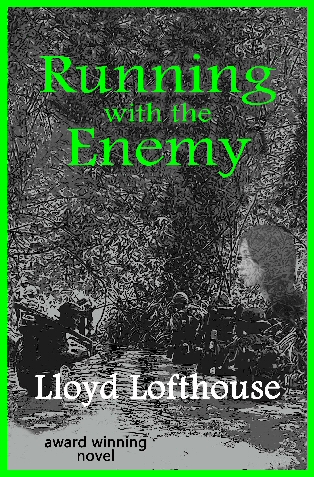
His latest novel is Running with the Enemy. Blamed for a crime he did not commit while serving in Vietnam, his country considers him a traitor. Ethan Card is a loyal U.S. Marine desperate to prove his innocence or he will never go home again.

And the woman he loves and wants to save was trained to hate and kill Americans.

To follow this Blog via E-mail see upper right-hand column and click on “Sign me up!”

Mirror, Mirror on the wall, who is the fairest superhero of them all?

Smithsonian.com published The Psychology Behind Superhero Origin Stories by Robin Rosenberg.

Rosenberg says, “As a clinical psychologist who has written books about the psychology of superheroes, I think origin stories show us not how to become super but how to be heroes, choosing altruism over the pursuit of wealth and power.”

Rosenberg says, “I’ve found that superheroes undergo three types of life-altering experiences that we can relate to.”

1. trauma

2. a life altering force is destiny

3. sheer chance

“At their best,” Rosenberg says, “superhero origin stories inspire us and provide models of coping with adversity, finding meaning in loss and trauma, discovering our strengths and using them for good purpose.”

Reading Rosenberg’s piece in Smithsonian after watching “To Whom it May Concern, Ka Shen’s Journey” the previous night helped me understand his explanation. Ke Shen’s Journey was a documentary on the life of Nancy Kwan.

You may remember Kwan in “The World of Suzie Wong” (1960), or “Flower Drum Song” (1961). And in 1961, she won a Golden Globe Award for Most Promising Newcomer in film.

In fact, Kwan’s father was a hero. During World War II, he was a spy for the British and when the Japanese discovered what he was doing, he took his two, infant children and fled Hong Kong disguised as a Chinese peasant. Another Chinese spy working for the British in Hong Kong wasn’t so fortunate. He was caught and beheaded by the Japanese.

For Kwon, her life altering experience was the loss of her only child, a son from her first marriage. Bernie died at age 33 in 1996. He contracted AIDS from his girlfriend whom Kwan had cautioned him to avoid.

Bernie had unprotected sex with the girl he loved. He didn’t use a condom. The girlfriend died of AIDS first and Bernie stayed by her side and cared for her to the end. Eventually, when the virus threatened his life, he moved home so his mother and stepfather could care for him, and they watched the son they both loved die slowly over a period of three years as he wasted away.

Today, almost age 75, Nancy Kwan actively supports the study of AIDS and the promotion of AIDS awareness.

I think Rosenberg is right, because I’m convinced that what he explains is one reason why I joined the U.S. Marines and later became a classroom teacher in a barrio high school populated by violent street gangs. I made a choice. We all make choices, but why do we make such choices?

For me it wasn’t trauma—at least I don’t think so—that motivated me to join the U.S. Marines. I think it was the role models I saw in Hollywood films. For example, John Wayne’s movies. By the time I joined the Marines in 1964, John Wayne had been in 158 films. A few that stick in my head are: The Fighting Seabees; Back to Bataan; They were Expendable; Fort Apache; She Wore a Yellow Ribbon; Sands of Iwo Jima; The Horse Soldiers; The Alamo, and The Longest Day, etc.

Of course, no film compares to the reality of combat and coming home from war with PTSD and/or recovering from a severe combat wound. Those factors are also a life altering force.

It seems to me that there are a lot of people in America that are not inspired to be a hero or altruistic.

The Department of Veterans Affairs says that 8.1% of the U.S. population are veterans. In addition, the NY Times reported that less than 1% of the American population is serving in the active military.  What does that tell us about the rest of America—not counting the physically and mentally disabled, police, teachers and firefighters?

Discover John Kerry, Purple Hearts, PTSD and WMD

_______________________

Lloyd Lofthouse, a former U.S. Marine and Vietnam Veteran, is the award winning author of The Concubine Saga.

His latest novel is Running with the Enemy. Blamed for a crime he did not commit while serving in Vietnam, his country considers him a traitor. Ethan Card is a loyal U.S. Marine desperate to prove his innocence or he will never go home again.

And the woman he loves and wants to save was trained to hate and kill Americans.

To follow this Blog via E-mail see upper right-hand column and click on “Sign me up!”

Rebuilding Lives

I bought an audio version of The Street of a Thousand Blossoms to listen to while driving (I am an avid reader and listener of books).

Gail Tsukiyama’s novel starts before World War II and concludes years after the war ends. The story is about the violent rebirth of a nation and its people through war and defeat told mostly through the eyes and emotions of two brothers.

Because I served in Vietnam in the US Marines as a field radio operator, my focus has been on what combat does to soldiers—not noncombatants. However, after reading Tsukiyama’s novel, it is easy to see that civilians that experience the horror of war may also suffer from the trauma of PTSD.

To get an idea of the destruction and suffering, more people may have been killed or injured in the firebombing of Tokyo than from the atomic bombs dropped on Hiroshima or Nagasaki near the end of the war.

The Tokyo Metropolitan Police Department reported that almost a 100,000 were killed in addition to a million injured with 286,358 buildings and homes destroyed. There were a million left homeless.

In comparison, it is estimated that 150,000 – 246,000 were killed from the atomic bombs, and if Japan hadn’t surrendered when it did, the US would have had seven more atomic bombs ready to drop on Japan’s cities before October 1945.

What led to the war in the Pacific?

Some of Japan’s leaders wanted to rule over East Asia, including China, and that quest for power cost Japan dearly and the nations it invaded.

However, in defeat, between 500,000 and 1,000,000 Japanese civilians were killed in addition to 2.12 million military. In comparison, in all of World War II, the US lost 1,700 civilians and 416,800 military. At Pearl Harbor, the US lost 2,402 military and 57 civilians.

What is not well known is that the decision to attack the United States was not unanimous in Japan’s government or military.

“Military control in prewar Japan was exercised by the War and Navy Ministers and the General Staffs of the Army and Navy, not by the civil government.” Source: ibiblio.org

In fact, “Higher Navy officials in Japan were against bombing Pearl Harbor, but the fleet commander, Yamamoto, threatened to resign unless given permission to launch the strike and the Navy staff reluctantly permitted it.” Source: Thornley.net

“To the conservative admirals of Japan’s Naval General Staff, a direct confrontation in the central Pacific Ocean between their navy and the Unites States Navy was unthinkable.” Source: Pacific War.org

In addition, Emperor “Hirohito said he was powerless to stop the militarists because any dissent on his part would have led to his assassination.” Source: Net Places.com

Then Japan’s Prime Minister Prince Fumimaro Konoe attempted to avoid war with the United States, and when he failed, he resigned from office on October 16, 1941 – six weeks before Japan attacked Pearl Harbor.”  Source: Wikipedia.org

Hiroshi and Kenji are the main characters in The Street of a Thousand Blossoms, and what they experience during the war is often worse than that of soldiers in combat. The sense of helplessness is acute because the characters in the novel cannot fight back as bombs are dropped on them or as Japanese police force them to comply with harsh wartime regulations.

Hiroshi dreams of becoming a sumotori (a Japanese form of wrestling) while his younger brother, Kenji, is obsessed with the craft of carving wood masks worn by the actors of Noh Theater, a classical Japanese theatrical form—one of the world’s oldest.

Before the war, the brothers’ parents drowned in a boating accident, and they are raised by their grandparents in the Yanaka district of northeastern Tokyo.

The war interferes with the boys’ dreams and rationing leads to hunger and the struggle to survive.

Because we are either with Hiroshi or Kenji during the horrific fire-bombing of Tokyo, and they also experience the iron fist of the city’s police to control the people while Japan is losing the war, we discover what it must be like to live in a nation that is being defeated.

The bombing of Hiroshima and Nagasaki ends the war, but the emotional wounds are slow to heal. However, Hiroshi and Kenji renew their passions and through them we see the healing of a defeated nation. It is a bitter sweet story that I highly recommend—a story of resilience and rebirth.


Gail Tsukiyama was born in San Francisco, California to a Chinese mother from Hong Kong and a Japanese father from Hawaii. She attended San Francisco State University where she received both her Bachelor of Arts Degree and a Master of Arts Degree in English with the emphasis in Creative Writing.

Discover Stanford Study shows effect of PTSD trauma on brain

_______________________

Lloyd Lofthouse, a former U.S. Marine and Vietnam Veteran, is the award winning author of The Concubine Saga.

His latest novel is Running with the Enemy. Blamed for a crime he did not commit while serving in Vietnam, his country considers him a traitor. Ethan Card is a loyal U.S. Marine desperate to prove his innocence or he will never go home again.

And the woman he loves and wants to save was trained to hate and kill Americans.

To follow this Blog via E-mail see upper right-hand column and click on “Sign me up!”

Unwanted Heroes

Many unwanted heroes defend our nation and fight its wars—right or wrong. When America’s leaders declare wars based on lies (for example: Vietnam and Iraq) or the truth (World War I, II, Afghanistan and Korea), unwanted heroes do the fighting and pay the price.

On the side of a bus at the VA medical clinic that I go to, it says, “All gave some; some gave all.” I have a credit card sized VA Department of Veterans Affairs ID card.  It says below my photo: “Service Connected.” That means I have a disability connected to my service in Vietnam in 1966 when I was serving in the US Marines.

What is the price many unwanted heroes pay for trusting their leaders?

This post has the same title of a novel that was recently released, and I had the privilege of editing Unwanted Heroes by Alon Shalev.

In Unwanted Heroes, Shalev brings together a long suffering, battle weary Chinese American Vietnam veteran suffering from the trauma of PTSD and an idealistic and somewhat pretentious young Englishmen, who both share a love for San Francisco, coffee and wine.

Alon Shalev, the author, grew up in London, and has been a political activist since his early teens. He strives through his writing to highlight social and political injustice and to inspire action for change.

Moving to Israel, he helped establish a kibbutz where he lived for 20 years and served in the Israeli army.

Shalev then moved to the San Francisco Bay area and fell hopelessly in love with this unique city. Being new to the US, however, he was shocked to see so many war veterans on the streets. He regularly volunteers at initiatives such as Project Homeless Connect and the San Francisco Food Bank where he meets and talks with war veterans. These experiences lend authenticity to the novel.

In fact, according to NIH (the National Institute of Health) Medline Plus, “PTSD affects about 7.7 million American adults” … and “members of the military exposed to war/combat and other groups at high risk for trauma exposure are at risk for developing PTSD.

“Among veterans returning from the current wars in Iraq and Afghanistan, PTSD and mild to moderate traumatic brain injury (TBI) are often linked and their symptoms may overlap. Blast waves from explosions can cause TBI, rattling the brain inside the skull.

“The U.S. Department of Veterans Affairs estimates that PTSD afflicts almost 31% of Vietnam veterans; as many as 10% of Gulf War (Desert Storm) veterans; 11% of veterans of the war in Afghanistan, and 20% of Iraqi war veterans.”

NIH says, “PTSD is often accompanied by depression, substance abuse, or other anxiety disorders.”

In addition, “between 529,000 and 840,000 veterans are homeless at some time during the year, and on any given night, more than 300,000 veterans are living on the streets or in shelters in the US. … About 33% of homeless males in the US are veterans and veterans are twice as likely as other Americans to become chronically homeless. One of the primary causes of homelessness among veterans is combat-related mental health issues and disability.

The incident of PTSD and suicide rates among veterans is also climbing and 45% of homeless veterans suffer from mental illness including PTSD. Source: Veterans Inc.org

The New York Times reported, “Suicide rates of military personnel and combat veterans have risen sharply since 2005, as the wars in Iraq and Afghanistan intensified. Recently, the Pentagon established a Defense Suicide Prevention Office.”

“The CDC Vietnam Experience Study Mortality Assessment showed that during the first 5 years after discharge, deaths from suicide were 1.7 times more likely among Vietnam veterans than non-Vietnam veterans. …

Why? “The average infantryman in the South Pacific during World War II saw about 40 days of combat in four years. The average infantryman in Vietnam saw about 240 days of combat in one year thanks to the mobility of the helicopter.” Source: History.com – Statistics about the Vietnam War

I did not seek help for my PTSD for thirty-eight years, because I did not know the VA offered counseling.

Discover A Prisoner of War for Life

__________________________

Follow this Blog via Email — sign in near the top-right corner of this screen and click “Follow”

PTSD and Homeless Veterans

In the Marines, we learned to never leave the wounded or dead behind.

I have lived with the symptoms of PTSD for forty-six years. I was fortunate. I was capable of holding down a job. I haven’t forgotten the homeless veteran I met in an alley early one early morning in Pasadena, California. I wrote about it in A Prisoner of War for Life.

The key is to learn how to cope. If you have PTSD, you will never get rid of it as if it were a cold or the flu. PTSD stays with you for life.

USA Today reported, “War might be making young bodies old. … The tragic signs of post-traumatic stress disorder or battlefield concussion are all too evident. Even more alarming for researchers is emerging evidence that these newest American combat veterans — former GIs and Marines in their 20s and 30s — appear to be growing old before their time. Scientists see early signs of heart disease and diabetes, slowed metabolisms and obesity — maladies more common to middle age or later.”

Some veterans are so damaged from combat experience, that they become homeless.

The population of the United States is more than 314 million people. The US Armed Forces that protects America’s civilians numbers 1.458 million—less than one-half-of-one-percent of the total US population. In addition, there are about 860 thousand military reservists.

In fact, the number of military veterans in the United States in 2012 was 21.8 million—6.94% of the total US population.

It doesn’t matter the reason a US citizen joins the military—patriotism or a financial need—and fights in one of America’s foreign wars. The fact that he or she served and put his or her life on the line or risked serious injury in combat,  I think that the ninety-three percent of the population that never served and risked life and limb owes those veterans an obligation.

That also means supporting homeless veterans with jobs and shelter.

The National Alliance to End Homelessness says, “The nation’s homeless population … went from 643,067 in 2009 to 636,017 in 2011. … The only increase was among those unsheltered.”

However, “The national rate of homelessness was 21 homeless people per 10,000 people in the general population. The rate for veterans was 31 homeless veterans per 10,000 veterans in the general population.”


PBS Documentary on Homeless Veterans – WORTH WATCHING if you have the time.

The Veterans Administration is the only federal agency that provides substantial hand-on assistance directly to Veterans who are homeless or at risk of homelessness.

Veteran homelessness is a problem of national importance. According to a count on a January night in 2011, there were 67,495 homeless Veterans. And an estimated 144,842 Veterans spent at least one night in an emergency shelter or transitional housing program in a recent year. Because of this, in 2009, President Obama and U.S. Department of Veterans Affairs Secretary Eric K. Shinseki announced the federal government’s goal to end Veteran homelessness by 2015.

An estimated 144,842 Veterans spent at least one night in an emergency shelter or transitional housing program in one recent year.

Many other Veterans are considered at risk of homelessness because of poverty, lack of support from family and friends, substance use or mental health issues, and precarious living conditions.

The VA has a hot line to support veterans who are homeless or at risk of becoming homeless. That number is: 1-877-4AID-VET (1-877-4243-838) Source: VA.gov/Homeless

In recent months, I have been editing a novel about PTSD and homeless veterans.  It isn’t my work. It was written by Alon Shalev, the author of  The Accidental Activist and A Gardener’s Tale.  His next novel is titled, Unwanted Heroes (to be published soon). It’s a story about healing and/or the failure to heal from PTSD. A love story is part of the mix too.

_______________________
Lloyd Lofthouse is a former U.S. Marine and Vietnam Veteran.

Low-Def Kindle Cover December 11His latest novel is the award winning suspense-thriller Running with the Enemy. Blamed for a crime he did not commit while serving in Vietnam, his country considers him a traitor. Ethan Card is a loyal U.S. Marine desperate to prove his innocence or he will never go home again.

And the woman he loves and wants to save was fighting for the other side.

To follow this Blog via E-mail see upper left-hand column and click on “FOLLOW!”

One Never Forgets

It has been forty-six years since I fought in Vietnam, and watching two movies rebooted my PTSD interrupting my sleep pattern. For years, I usually wake at least once a night and listen. However, since watching the movies, I wake every hour and listen to the night sounds.

In Brothers, one of the two brothers, a captain in the US Marines, goes to Afghanistan on his fourth tour of duty and becomes a tortured and abused POW.  After he is liberated and his captors killed, he returns home suffering from severe PTSD trauma. Tobey Maguire plays Marine Captain Sam Cahill and does a convincing job playing a veteran that is severely damaged by PTSD symptoms.

Watching Maguire act his part reminded me of my first decade back from Vietnam when I drank too much and often woke once or twice and carried a loaded weapon around the house checking the doors and windows.  More than once, when overwhelmed by a burst of anger, I punched holes in walls with fists.

The anger comes fast—one moment you are calm as a rusty doorknob and an instant later an exploding fragmentation grenade.

In the Valley of Elah, Tommy Lee Jones plays a father, who was also a Vietnam combat veteran, searching for answers to explain his son’s death soon after returning from Iraq. In this film, we see how war strips young men of their humanity—that thin veneer that comes with so-called civilization.

From Brothers, I was reminded of the homeless Vietnam veteran I met in an alley in Pasadena, California one early morning. He had been a prisoner of war and similar to the character Tobey Maguire plays, was severely traumatized with PTSD symptoms.

The VA rated the homeless vet I met in that Pasadena alley as 100% disabled by PTSD possibly explaining why he was homeless—not because he could not afford an apartment.  The disability from the VA was more than enough to support him.  However, most of that money went for drugs and booze for him and his homeless buddies.

Then there was another vivid image of a Vietcong POW being tortured by South Korean troops during a field operation I was on.  The South Koreans hung that Vietnamese POW by his heels from a tree limb and pealed the skin off his body while he lived.

In the Valley of Elah reminded me of an ambush where a team of Marines I was a member of went out in a heavy rain at sunset and after an hour or so of slogging through the gloomy downpour, we stopped in a rice paddy with water to our necks and stayed there for more than an hour waiting for complete darkness before moving into position. We shared that rice paddy with a very large king cobra.

In the Marines, one does not question orders—we do or die—so we stayed in that paddy knowing a king cobra was in the water with us.

Both of these films are dramatic examples of what war does to young men and their families.

Some combat veterans avoid seeing films such as these two. However, I do not. I do not want to return to that time where I avoided talking and thinking of my part in the Vietnam War, because at night when we struggle to sleep there is no escape. We cannot hide from the monster that came home with us living inside our skin as if it were an unwanted parasite.

Discover A Prisoner of War for Life

_______________________

Lloyd Lofthouse, a former U.S. Marine and Vietnam Veteran, is the award winning author of The Concubine Saga.

His latest novel is Running with the Enemy. Blamed for a crime he did not commit while serving in Vietnam, his country considers him a traitor. Ethan Card is a loyal U.S. Marine desperate to prove his innocence or he will never go home again.

And the woman he loves and wants to save was trained to hate and kill Americans.

To follow this Blog via E-mail see upper right-hand column and click on “Sign me up!”

It is Time – Relief for Victims of Lone-Wolf Killers such as James Holmes

What happened in that theater outside Denver, Colorado on July 25, 2012 or, for example, the terrorist bomb attack on the Alfred P. Murray Federal Building in Downtown Oklahoma City on April 19, 1995, were acts of terrorism and/or combat no different from what happened on 9/11 or in America’s foreign wars such as Vietnam, Iraq and Afghanistan.

In fact, twelve days after 9/11, the US Congress enacted the September 11th Victim Compensation fund of 2001. This $6 billion program was intended to compensate any individual (or the personal representative of a deceased individual) who was physically injured or killed as a result of the terrorist attacks on September 11, 2011. Source: Homeland Security: 9/11 Victim Relief Funds

We already know what happens to America’s combat veterans in similar situations—and US troops are trained, armed and ready.

In July 2010, PBS News Hour reported, “Of the more than two million men and women who served in Afghanistan and Iraq, it’s estimated one in five will come home with post-traumatic stress disorder or PTSD,” said health correspondent Betty Ann Bowser.

Bowser quoted U. S. President Barack Obama, who said, “I don’t think our troops on the battlefield should have to keep notes just in case they need to apply for a claim. And I have met enough veterans to know that you don’t have to engage in a firefight to endure the trauma of war.”

Before President Obama, the rules required veterans to document events like firefights or bomb explosions that could have caused PTSD. Such documentation was often time-consuming and difficult, and sometimes was impossible. … Under the new rules a veteran need show only that he or she served in a war and performed a job during which events could have happened that could cause the disorder.

But what about the innocent victims of combat in the United States?

I’m not talking about the homicide rate (which is in decline) or riots (which most people may avoid by staying away from the location of the riot). I’m talking about the victims of lone-wolf mass killings such as what happened recently near Denver, Colorado.


What Motivates “Lone-Wolf” Shooters – there are thousands hiding in public!

According to The Arizona Republic, “There has been no corresponding decline in mass murder—these sudden, stunning eruptions of violence with multiple victims, often perpetrated by gunmen who researchers refer to as ‘pseudo-commandos.’ Such a killer, clad in body armor and with a small arsenal of firearms, struck Friday in Aurora, Colo., leaving a dozen dead, 58 wounded and a nation horrified. …

“The United States experienced 645 mass-murder events—killings with at least four victims—from 1976 to 2010, according to Northeastern University criminologist James Alan Fox. When graphed, these incidents show no obvious trend. The numbers go up and down and up again. The total body count: 2,949.”

The total number killed in the terrorist attack in New York City on September 11, 2001 was 2,819.

If what happened in that Colorado Theater does not qualify as a home grown terrorist attack by a ‘pseudo-commando’, what does?

Lone-wolf acts of violence in the United States must be considered the same as any disaster and be included under the Robert T. Stafford Disaster Relief and Emergency Assistance Act of 1988. Under this act, the Federal share of the costs of such efforts is to be no less than 75 percent of the eligible costs. Total assistance under this Act for one emergency is to be limited to no more than $5,000,000, except when the President determines additional funds are needed. If additional funds are needed, the President must report to Congress on the extent of the additional need.

If what happened in Colorado is not covered under the Stafford Act, we need a new law that will. After all, it is the government’s responsibility to safeguard innocent, law abiding US citizens and in acts of lone-wolf violence, the government has failed 645 times since 1976.

It’s time to take care of our own in situations such as a lone-wolf mass-murder events. If the US Federal government can spend $49 billion for foreign aid in 2012, it must help the victims of acts of violence similar to what happened in Colorado in that Century Theater—the victims in such acts of violence should be treated the same as if they were 9/11 victims, wounded in combat or came home with PTSD from Vietnam, Iraq or Afghanistan.

Discover The Creative Writing Class at war with the Vietnam Vet

_______________________

Lloyd Lofthouse, a former U.S. Marine and Vietnam Veteran, is the award winning author of The Concubine Saga.

His latest novel is Running with the Enemy. Blamed for a crime he did not commit while serving in Vietnam, his country considers him a traitor. Ethan Card is a loyal U.S. Marine desperate to prove his innocence or he will never go home again.

And the woman he loves and wants to save was trained to hate and kill Americans.

To follow this Blog via E-mail see upper right-hand column and click on “Sign me up!”

The PTSD Connection – help from friends, family, loved ones and maybe marijuana

On the walk home from the theater after seeing the film Savages (Oliver Stone directed the film), I thought of one of the characters played by Taylor Kitsch—Chon is a former Navy Seal that served combat tours in Iraq and then Afghanistan.

Near the beginning of the film, it is obvious that Chon has PTSD but by the end Ophelia and Ben will have it too. What these characters experience in the film was traumatic in the worst way without joining the military and serving in a war.

If you see the movie or read the novel by Don Winslow, pay attention to how Chon deals with danger. There is one film scene in a restaurant where a server drops a tray of dishes and Chon, in a flash, is under the table with pistol in hand. He also handles dangerous situations ruthlessly.

In the movie, Chon and Ben produce high-quality marijuana and sell it legally and illegally, and all three of the main characters smoke their own product, which may be explained away by a study conducted at Haifa University in Israel that found rats with PTSD treated with marijuana within 24 hours of a traumatic experience successfully avoided any PTSD symptoms (maybe the US military should include some marijuana in the rations of all combat troops in Afghanistan).

However, that would not have helped me. I’m allergic to marijuana smoke and cannot be in the same room where someone else is smoking weed.

Winslow, the author of Savages, was once a private detective in New York City. His career as an investigator would repeatedly bring him to California to look into arson cases, so maybe he has some PTSD from that experience.

It is a fact that anyone can have PTSD—it isn’t exclusive to combat veterans. After all, Ophelia and Ben never served in the military and were not combat veterans from Vietnam, Iraq or Afghanistan, but by the end of the movie the odds are they both will have PTSD.

It doesn’t hurt that Oliver Stone, the film’s director, enlisted in the United States Army, fought in Vietnam with the 25th Infantry Division, then with the First Calvary Division, earning a Bronze Star with Combat V, an Army Commendation Medal and a Purple Heart with Oak Leaf Cluster before his discharge.

After Stone’s experience in Vietnam, PTSD may have followed him home adding authenticity to the film.

However, if you have PTSD or you know someone with PTSD and you have severe allergic reactions to smoking marijuana, as I do, then you may have to look for support from family, loved ones and friends.

That brings us to Charlene Rubush’s Blog—Win Over PTSD.


This video has nothing to do with Rubush’s Blog but does focus on PTSD.

Rubush’s experience as a former wife of a Vietnam veteran with Post-Traumatic Stress Disorder led to years of research on the subject, and she recently published a guest post by Ryan Rivera on How to Be the Partner of Someone with PTSD.

Rivera says, “One of the most important recovery tools for someone living with PTSD is social support. The more they know that they have real, true friends behind them, the better the outcome of their PTSD treatments. The problem is that PTSD can be hard to understand, and those in a relationship with someone living with PTSD often find that they are struggling with how to keep the relationship together.”

In Savages, Chon’s true friends are Ophelia and Ben. He knows he can count on them accepting him as he is, PTSD included—they are a family.

If you try the marijuana therapy, make sure to do it legally and if you don’t do it legally, don’t get caught. A term in prison may make the PTSD worse—a lot worse.

Discover Booze, the Veteran and coming home

_______________________

Lloyd Lofthouse, a former U.S. Marine and Vietnam Veteran, is the award winning author of The Concubine Saga.

His latest novel is Running with the Enemy. Blamed for a crime he did not commit while serving in Vietnam, his country considers him a traitor. Ethan Card is a loyal U.S. Marine desperate to prove his innocence or he will never go home again.

And the woman he loves and wants to save was trained to hate and kill Americans.

To follow this Blog via E-mail see upper right-hand column and click on “Sign me up!”

Furry Friendly Therapy for PTSD

Lauran Neergaard, writing for The Huffington Post, reported, “Brain Scans Reveals Invisible Damage of PTSD.”

Powerful scans measure how some of the brain’s regions are altered/damaged in the vicious cycle that is PTSD, where patients feel as if they are reliving a trauma instead of understanding that it’s just a memory.

With these scans, doctors may see how the brain has been changed in veterans with post-traumatic stress disorder.”

In fact, Brain Facts.org reported that “Long-term or high levels of cortisol (brought on by PTSD) can also have damaging effects, causing toxicity and shrinkage of brain regions such as the hippocampus, a structure involved in memory formation.… an especially traumatic event can cause post-traumatic stress disorder (PTSD), which occurs when the stress system fails to recover from the event. This results in recurring flashbacks that can disrupt everyday life.”

However, Neergaard reports that these changes to the brain need not be permanent and may change with treatment.

One such treatment is canine therapy. In May 2010, the US Congress introduced the Veterans Dog Training Therapy Act through H.R. 3885, which required the Department of Veterans Affairs (VA) to establish a pilot program through which veterans diagnosed with PTSD or other mental health conditions would train service doges for use by disabled veterans. The pilot program would operate in three to five medical centers over a five-year period.

Next, in July 2011, VA.gov’s VAntage Point reported in Finding Solace in Companion Dogs that this new pilot program authorized by Congress was launched at the Marion VA Medical Center in Illinois. The focus has moved beyond the idea that dogs are only for guide purposes (example: the blind). The focus has shifted to their companionship
and therapeutic potential.

In addition, Palo Alto Online News reported that at the VA in Palo Alto: “Melissa Puckett, recreational therapist and PTSD supervisor in the men’s and women’s trauma-recovery program, said many vets deal with emotional numbness as part of PTSD. The dogs help them to receive touch and spontaneous affection and to express love — ‘things they thought they would never have again,’ she said.”

Then The New York Times reported in For the Battle-Scarred, Comfort at Leash’s End that “Veterans rely on their dogs to gauge the safety of their surroundings, allowing them to venture into public places without constantly scanning for snipers, hidden bombs and other dangers lurking in the minds of those with the disorder.”

Discover Before PTSD, it was called Combat Fatigue or Shell Shock

_______________________

Lloyd Lofthouse, a former U.S. Marine and Vietnam Veteran, is the award winning author of The Concubine Saga.

His latest novel is Running with the Enemy. Blamed for a crime he did not commit while serving in Vietnam, his country considers him a traitor. Ethan Card is a loyal U.S. Marine desperate to prove his innocence or he will never go home again.

And the woman he loves and wants to save was trained to hate and kill Americans.

To follow this Blog via E-mail see upper right-hand column and click on “Sign me up!”