This is a rant. If you are a die-hard Democrat or Republican with more loyalty to your political party than to the country, you do not want to read this. It will get your blood pressure up.
Each time I write one of these posts, I open the cage where the demon raptors live. I write about what happened in Vietnam—the anger, the experiences, the flashbacks or someone else’s experiences, and I hope one of those raptors will use its flaming wings to take flight and never come back.
After forty years, I’ve learned there is no guarantee those raptors will stay away.
Starting last week, I have been angry with LBJ, the Democrat, and GWB, the Republican—AGAIN!
I’m also disappointed in the people that voted for them. President Lincoln said, “You can fool some of the people most of the time and most of the people some of the time, but you can’t fool all of the people all of the time.” If so, there are many fools out there and some of them will call me worse for writing this.
I don’t know about LBJ, but there are millions that still believe what GWB did in Iraq was right. Those people are probably the ditto heads that listen to idiots like Rush Limbaugh.
LBJ and GWB have a lot in common. Both started wars with lies and deceit. The facts say that both Vietnam and Iraq were unnecessary, and many that served with courage in those wars now live with roadside bombs inside their heads and never know when one might go off.
It’s been documentedmany times that GWB wanted to start a war in Iraq well before 9/11. “He was thinking about invading Iraq in 1999,” said author and journalist Mickey Herskowitz. “It was on his mind. He said to me: ‘One of the keys to being seen as a great leader is to be seen as a commander-in-chief.’ And he said, ‘My father had all this political capital built up when he drove the Iraqis out of Kuwait and he wasted it.’ He said, ‘If I have a chance to invade Iraq, if I had that much capital, I’m not going to waste it—”
Before he was assassinated, President Kennedy talked about getting out of Vietnam. Listen to what Tip O’Neill, former speaker of the house, says.
The next blow to America was the CIA’s alleged involvement bringing drugs into the United States, possibly creating today’s drug problems that are eating the country like a malignant cancer.
What is it that sets America apart from most of the World? The Bill of Rights, right?
The reason for The Bill of Rights was to protect American citizens from the corruption of government. Sad to say, the evidence shows that The Bill of Rights has become a rusty, leaky bucket.
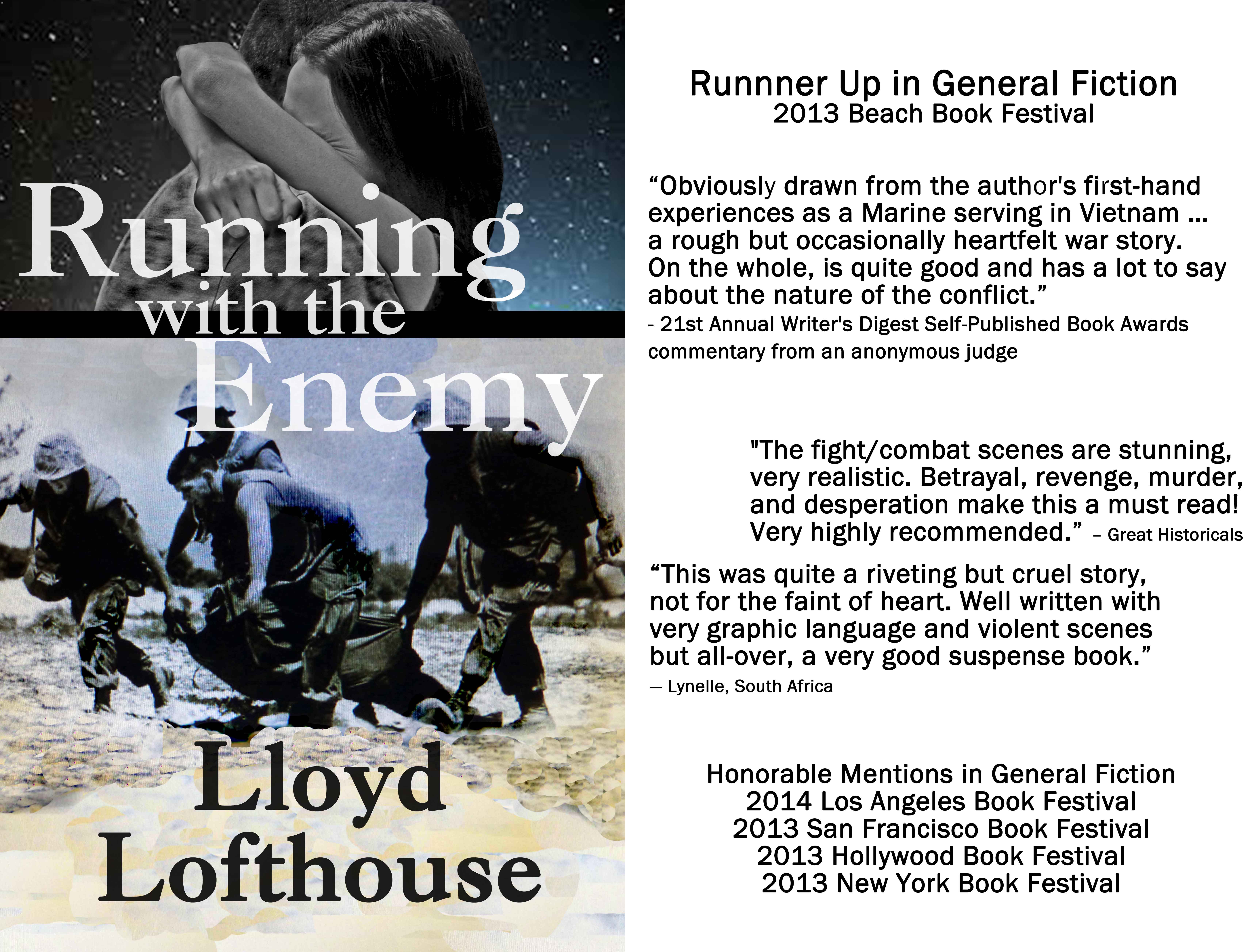
His latest novel is Running with the Enemy. Blamed for a crime he did not commit while serving in Vietnam, his country considers him a traitor. Ethan Card is a loyal U.S. Marine desperate to prove his innocence or he will never go home again.
And the woman he loves and wants to save was trained to hate and kill Americans.
To follow this Blog via E-mail see upper right-hand column and click on “Sign me up!”
I read this in a headline this morning and thought, there was a time when I could have been that veteran. My anger is unpredictable. Although I work at controlling it and have struggled with that anger for decades, like an earthquake it can strike and sweep away reason at any time.
“Mom befriends wife of PTSD vet charged with murder”.
This piece was written by Joe Mandak for the Associated Press. I read it in the Contra Costa Times and found a link to The Seattle Times to share here.
The wife of the veteran who is charged with murder is scared. She has received hate mail for what her husband did.
Hate mail like this shows the ignorance that still exists in society–an almost total misunderstanding of what it is like to suffer from PTSD that, like a violent virus, was caught in combat fighting for one’s country.
But there are those that understand, who have suffered from PTSD too. To find out more, click the link and read about Laurie Claar whose son, a combat veteran with PTSD, killed himself.
His latest novel is Running with the Enemy. Blamed for a crime he did not commit while serving in Vietnam, his country considers him a traitor. Ethan Card is a loyal U.S. Marine desperate to prove his innocence or he will never go home again.
And the woman he loves and wants to save was trained to hate and kill Americans.
To follow this Blog via E-mail see upper right-hand column and click on “Sign me up!”
In World War II, they called it combat fatigue or shell shock. After the Vietnam war, they called it post-Vietnam syndrome (as if it had never existed before Vietnam).
Now, it is called PTSD and the military is trying to do something about it. Researchers are testing soldiers to see if they can learn who will be more affected by traumatic events. The ongoing wars have provided scientists with opportnuites to learn more.
His latest novel is Running with the Enemy. Blamed for a crime he did not commit while serving in Vietnam, his country considers him a traitor. Ethan Card is a loyal U.S. Marine desperate to prove his innocence or he will never go home again.
And the woman he loves and wants to save was trained to hate and kill Americans.
To follow this Blog via E-mail see upper right-hand column and click on “Sign me up!”
Often, the memories wake me in the dead of night, and I listen carefully to every sound. Sometimes, I remember one rainy night with the King Cobra and the water buffalo.
If you have never been in combat, you may not understand what happens for a soldier to develop PTSD (Post Traumatic Stress). I wrote about one event in the short story, A Night at the Well of Purity. I’ve written about others here and in a few of the poems I’ve posted on Authors Den.
It was 1966, and the rain was coming down hard as we left the safety of our base camp. The First Tank Battalion sat on a hill centered on the First Marine Division’s perimeter at Chu Lai, a spit of sand jutting into the South China Sea. Concertina wire, bunkers, and a platoon of flame tanks protected the camp. There were two adjoining hills. One held an artillery company. The third held a company of Ontos, a self-propelled, lightly armored anti-tank vehicle that mounted six M40 106 mm recoilless rifles.
Military intelligence had reported that there might be several boatloads of Vietcong moving down a canal that night near our hill. On our way to set up the ambush, we avoided the villages and moved through rice paddies instead of walking on land. The idea was to stay out of sight. As the radio operator, I was situated in the center of the column of poncho clad Marines.
When a Vietnamese farmer was seen working in an adjacent rice paddy, we squatted with the dark paddy water to our chins and propped our weapons on our helmets. The rain was coming down in sheets. That was when I saw the full sized King Cobra. It was moving parallel to our column about ten feet from my position. Its hood was open as if it were ready to strike. I watched as the head dropped into the water among the bright green shoots of rice and vanished. The King Cobra is the world’s longest poisonous snake and can reach a length up to 5.6 m (18.5 ft). It can easily kill a man with a single bite.
We had to stay submerged in that rice paddy, so I imagined that King Cobra moving below the water toward me. Every inch of my body tingled, and I wanted out but I did not move. Time slowed to a snail’s crawl.
Later, we slipped into position on the dike that ran along the canal with a BAR (Browning Automatic Rifle) on each flank. Hours went by. Marines fell asleep, then the world exploded with the roar of those BARs. Everyone joined in, and the night was filled with glowing tracer rounds.
At dawn, we discovered one tough water buffalo staggering around full of holes. There was no sign of any dead Vietcong, but that was not unusual. The Vietcong often took their dead with them.
His latest novel is the award winning suspense-thriller Running with the Enemy. Blamed for a crime he did not commit while serving in Vietnam, his country considers him a traitor. Ethan Card is a loyal U.S. Marine desperate to prove his innocence or he will never go home again.
And the woman he loves and wants to save was fighting for the other side.
To follow this Blog via E-mail see upper left-hand column and click on “FOLLOW!”
While I was in Vietnam, many Marines in my communication’s platoon didn’t get mail—ever. Since my family and friends wrote often and sent packages with cookies, candy and books like Anne Rice’s Interview with the Vampire and Tolkien’s Lord of the Rings, I had books to fill the days when we weren’t in the field. At night when I was on radio watch in the bunker, I read too. I shared with my “brothers” in uniform who didn’t get anything. The cookies were popular. I loaned the books out too.
If someone who has never faught in a war listens to the news, it sounds like our troops are fighting 24/7. My mother believed it. Evertime she heard about combat and deaths on the news, she cried. My dad told me this after I came home.
Too bad, she didn’t know the truth. During those down times, soldiers get lonely and think about home. For me, books helped fill the empty hours. Those books also helped get my mind off what was waiting at night and beyond the wire when I wasn’t on a field operation, out at night with patrols or was involved in ambushes that we were setting up. No one wants to be the target of an ambush we don’t plan—I was the target in a couple of those too.
Because of my experiences in Vietnam, during the first Gulf War (2 August 1990 – 28 February 1991), I organized a letter writing campaign with my secondary English students in La Puente, California. One girl’s older brother was in Kuwait, then he moved on to Iraq after the war started in earnest. When his letters arrived, class time was set aside for his sister to share what was happening to him. I feared we might hear he had been killed. But he was fortunate and made it back in one piece.
Recently, I joined Operation E-Book Drop. This program offers free e-books to our troops in Iraq and Afghanistan. Any troop with a computer may sign onto Smashwords.com and download a book if they have the coupon code. They have to request the codes through the program. More than two hundred authors and nine publishers have joined this program.
Another program, Book Readers for SF (Special Forces—kindlesf@gmailcom), is putting Kindles in the hands of troops that belong to Special Forces in Afghanistan. Many of these soldiers are stationed in remote, rugged, mountain outposts.
I’m mailing a copy of my novel, My Splendid Concubine, and will send cards and gifts when holidays come along. Once we have been in combat, I don’t think any veteran forgets what it was like.
His latest novel is Running with the Enemy. Blamed for a crime he did not commit while serving in Vietnam, his country considers him a traitor. Ethan Card is a loyal U.S. Marine desperate to prove his innocence or he will never go home again.
And the woman he loves and wants to save was trained to hate and kill Americans.
To follow this Blog via E-mail see upper right-hand column and click on “Sign me up!”
It was still dark when I reached Dr. Vessey’s house in Pasadena. It was late 1999 or early 2000. As sunlight leaked over the horizon, we drove to an alley behind a liquor store where the good doctor was going to meet with some homeless people he’d been helping. One of the homeless people was a Vietnam veteran who wouldn’t let the doctor near him. That’s why I was along—to gain the man’s trust.
I was about to find out how bad combat induced PTSD could be when the VA considers a veteran is 100% disabled. Since the vet I was going to meet couldn’t be trusted to handle his VA disability check, his payments went to a pastor, who was his financial guardian. The pastor decided how much to give him when he came to the church asking for money. The VA disability was enough to rent a studio apartment, but this vet chose to live on the streets where he felt safer. His home was under a blue tarp hidden in some thick brush that lined the side of an empty lot. Later, the doctor drove me there so I could see it.
This vet’s story of abuse was inhuman and tragic. He was a chopper pilot in Vietnam and was shot down becoming a POW where, among other things, he was sexually molested by the Vietnamese guards. I’m not sure I would have survived what he went through.
Dr. Vessey and I arrived first. We parked the car and entered the alley to wait. The homeless people started to arrive one or two at a time until there were about a dozen. One even crawled out of the Dumpster behind the liquor store. The vet along with two women arrived last. We squatted in the alley and talked. I told the disabled vet my Vietnam story, and he said it was obvious that I’d been there. Then he opened up and told us his story.
Before he finished, a helicopter (media or police—I’m not sure) flew over, and the vet surprised us when he yelled, “Incoming,” and leaped to his feet running toward what he thought must have been a bunker and safety—the back, brick wall of the liquor store. He ran into the wall and the sound of his body hitting the bricks was a sickening thud as if he were a side of beef being hit by a sledgehammer. He bounced off the wall and collapsed unconscious. We rushed to him and gathered around. One of the homeless women cradled his injured head in her lap. There was a thick, swollen contusion on his forehead.
He had hit that wall hard enough to rattle the shelved bottles inside, and two men working in the liquor store came around the corner a moment later. They thought a car had hit the store.
This vet would always be a prisoner of war.
_______________________
Lloyd Lofthouse is a former U.S. Marine, Vietnam Veteran, journalist and award winning author.
His second novel is the award winning love story and suspense-thriller Running with the Enemy. Blamed for a crime he didn’t do while serving in Vietnam, his country considers him a traitor. Ethan Card is a loyal U.S. Marine desperate to prove his innocence or he will never go home again.
Most combat veterans that have PTSD, Post Traumatic Stress Disorder, do not talk about it. Many are heavy drinkers attempting to drowned the disorder to keep the monster at bay. Booze and drugs do not work. They make the vampire worse. Get your life back. Support and understanding is out there.
What is post-traumatic stress disorder, or PTSD (visit this source for more information)?
PTSD is an illness. You can get PTSD after living through or seeing a dangerous event, such as war, a hurricane, or bad accident. PTSD makes you feel stressed and afraid after the danger is over. It affects your life and the people around you.
If you have PTSD, you can get treatment and feel better.
Who gets PTSD?
PTSD can happen to anyone at any age. Children get PTSD too.
You don’t have to be physically hurt to get PTSD. You can get it after you see other people, such as a friend or family member, get hurt.
What causes PTSD?
Living through or seeing something that’s upsetting and dangerous can cause PTSD. This can include:
Being a victim of or seeing violence
The death or serious illness of a loved one
War or combat
Car accidents and plane crashes
Hurricanes, tornadoes, and fires
Violent crimes, like a robbery or shooting.
There are many other things that can cause PTSD. Talk to your doctor if you are troubled by something that happened to you or someone you care about.
Flashbacks (feeling as if you’re back in combat while awake)
Nightmares (frequent recurrent combat images while asleep)
Feeling anxious or fearful (as if you’re back in the combat zone again)
Avoidant – Drawing inward or becoming emotionally numb
Extensive and active avoidance of activities, places, thoughts, feelings, memories, people, or conversations related to or that remind you of your combat experiences
Loss of interest
Feeling detached from others (finding it hard to have loving feelings or experiencing any strong emotions)
Feeling disconnected from the world around you and things that happen to you
Restricting your emotions
Trouble remembering important parts of what happened during the trauma
Shutting down (feeling emotionally and/or physically numb)
Since returning from Vietnam in 1966, I couldn’t put a term to the symptoms I was experiencing. For fifteen years, I was a heavy drinker and never talked about what happened. The nightmares that are called flashbacks came at night and were vivid and real. There are many nights even now where I will wake and listen for warning sounds that danger is near. I’ll reach for the weapon I keep close to where I sleep to make sure it is still there.
His latest novel is Running with the Enemy. Blamed for a crime he did not commit while serving in Vietnam, his country considers him a traitor. Ethan Card is a loyal U.S. Marine desperate to prove his innocence or he will never go home again.
And the woman he loves and wants to save was trained to hate and kill Americans.
To follow this Blog via E-mail see upper right-hand column and click on “Sign me up!”
I drank a lot after returning from Vietnam. One night during the thirty-day leave home, before reporting to my next duty station at Camp Pendleton north of San Diego, I stopped to buy a fifth of cheap vodka at a local drug store. I drank that vodka straight from the bottle at a friend’s apartment waiting for him to get off work at two a.m. He was a cook at a twenty-four hour coffee shop in West Covina.
Around two, Doug called and said his car wouldn’t start. He asked if I would pick him up. By that time, I’d finished two thirds of the vodka and was feeling no pain. I hadn’t had anything to eat for hours, and I’d already made two trips to the bathroom to dry heave before drinking more vodka.
Doug lived with his six-month pregnant girlfriend. Luckily, she went with me.
At two-thirty in the morning, I was driving on the San Bernardino Freeway through West Covina having trouble staying in one lane. Speed wasn’t a good idea, so I kept the car between twenty-five and thirty while weaving back and forth across three lanes. No one was passing me.
Then the flashing red lights came on behind me, and a West Covina police cruiser pulled me over. When the officer told me to step out of the car, I admitted I was drunk and said I would have trouble standing.
However, the officers wouldn’t let me stay in the car. Once outside, I pulled my wallet out of my back pocket. My military papers were there too and they fell to the ground. I didn’t know I’d dropped them, but the second officer saw the papers and picked them up. While I was leaning on the hood trying to steady the dizzy world around me so I wouldn’t fall over, the second officer was reading that I had just returned from Vietnam.
The officers talked while I leaned against the car to keep from falling over. They asked Doug’s girlfriend if she could drive, and she said yes. They didn’t ask to see a driver’s license. That was a good thing. She didn’t have one. With her driving, we got Doug and returned to his apartment where I crashed on the couch.
It was early January, 1967. No ticket was written. All these years later, I think those two West Covina Police Officers understood the kind of trauma war dishes out and must have felt that one drunk Marine just back from combat didn’t need to end up in jail on a drunk driving charge.
During all those years of protests against the Vietnam War, I would see this type of behavior from the police in other cities. I don’t believe many police sided with the war protesters. They understood what it was like to be under fire and how it messed with your mind.
His latest novel is Running with the Enemy. Blamed for a crime he did not commit while serving in Vietnam, his country considers him a traitor. Ethan Card is a loyal U.S. Marine desperate to prove his innocence or he will never go home again.
And the woman he loves and wants to save was trained to hate and kill Americans.
To follow this Blog via E-mail see upper right-hand column and click on “Sign me up!”
I read a post in another bog yesterday by a GI who came back from Iraq with PTSD. He mentioned that World War II veterans didn’t suffer from PTSD. Someone at the VA told him that.
Bull shit! The truth is that PTSD has been around for thousands of years. It is nothing new. The only difference is that we now have a name for it.
Three of my uncles fought in World War II. Two were in the navy and fought in the Pacific. My mother’s younger brother lied about his age and joined when he was seventeen. He worked with radar and submarines and stayed in the navy for thirty-three years. He retired a lieutenant commander.
My dad’s older brother James was on the USS Hornet when the Japanese sunk her early in the war. Along with hundreds of others, he ran along the flight deck and then the hull as the aircraft carrier rolled over. Destroyers picked him up along with other survivors. Uncle James was a drunk. When he was in his seventies, he died a drunk. I’m sure his drinking was caused by the war.
Uncle James came to the house once and told my dad to leave my mother and his sickly son, because we weren’t worth it. My mom picked up a cast iron frying pan and chased him down the street hitting him with it. She told him to never come to the house again if he was drinking. I never saw him again.
Uncle Lloyd was my mother’s younger brother. Since he worked for the railroad, the Army sent him to India where he was put in charge of munitions trains running bombs and ammunition to the Burma Road where trucks carried death across the mountains. On the other side of the Himalayas, the war with Japan raged in China and Southeast Asia.
Uncle Lloyd hitched a ride in one of the munitions trucks and arrived in Burma close to the front lines. At one point, he had to run for his life during a major Japanese assault. To escape capture or death, he waded across what he thought was a rice paddy only to discover it was an open cesspool.
The construction of the Bruma Road
He escaped, flew back to India and came down with a skin disease. His hair, his fingernails and his skin started to come off. He was sent back to the states and spent months in the hospital as army doctors struggled to save his life from the bacteria/fungus that was eating him alive.
Uncle Lloyd lived to be ninety-three. He told me that every few months he had to go to the nearest VA hospital and soak in a tub of purple liquid to control that bacteria/fungus. Most veterans don’t talk about what haunts them. Uncle Lloyd had his combat demons too. He awoke often through the decades remembering wading through that neck-high shit to escape the Japanese.
His latest novel is Running with the Enemy. Blamed for a crime he did not commit while serving in Vietnam, his country considers him a traitor. Ethan Card is a loyal U.S. Marine desperate to prove his innocence or he will never go home again.
And the woman he loves and wants to save was trained to hate and kill Americans.
To follow this Blog via E-mail see upper right-hand column and click on “Sign me up!”
In this post, I have combined the ten-part series on Sun Tzu’s “The Art of War” in one post and added more content.
The reason for learning about Sun Tzu’s The Art of War has to do with a study by The Pew Research Center, which reported that one in three Iraq and Afghanistan veterans of the post-9/11 military see these wars as a waste.
And NPR’s Jackie Northam reported as the wars drag on, interest among Americans has dropped from 90 percent supporting the invasion of Iraq and Afghanistan before the war started to 25 percent today.
Northam quotes Andrew Kohut, president of the Pew Research Center. “The public soured on the decision to go to war in Iraq by 2004, when not only were there no weapons of mass destruction (WMD) found, but all of a sudden, the cost of that war began to increase, [and] casualties began to be rather substantial.”
In addition, Fair Game (2010), a movie of CIA operative Valerie Plame and her husband, who wrote a 2003 New York Times op-ed piece on the topic of WMD in Iraq, alleged that the Bush administration had manipulated intelligence about weapons of mass destruction to justify the invasion of Iraq—an accusation of fraud in the White House.
According to the wisdom of Sun Tzu, these three points are enough to indicate a “high” possibility of failure by the United States.
So, who better to turn to than Sun Tzu to see if the goals of these wars are possible to achieve.
It is time to reexamine the master that West Point cadets study. Sun Tzu dates to China’s Warring States Period (476 – 221 BC). Traditional accounts place him in the Spring and Autumn Period of China as a military general serving under King Helu of Wu (544-496 BC).
You have to be good to still be taken seriously about 2500 years after your death.
There are three key principals to The Art of War.
1. Know your enemy and know yourself — understanding your opponent is crucial to victory.
2. Sun Tzu prizes the general who can outwit instead of outfight his opponent — to subdue the enemy without fighting is the height of skill.
3. Avoid what is strong. Attack what is weak.
In the case of President George W. Bush, when he went to war in Iraq and Afghanistan, it is clear that he did not know his enemy (or much at all about the culture and politics of the Middle East and of Islam).
Bush also resorted to subduing his enemy with force instead of outwitting him—as if President Bush was capable of outwitting Al-Qaeda, since finding the weakness of an organization that is like smoke would be a challenge to any president.
As for Sun Tzu, around 500 BC, the King of Wu summons him, one of the greatest military minds in history, to save his kingdom from a more powerful enemy.
Sun Tzu was a warrior and a philosopher. He was important because he had a cohesive, holistic philosophy on strategy.
Sun Tzu tells the King of Wu he can defeat the enemy with a smaller army. Doubting him, the king challenges Sun Tzu to turn the palace concubines into a fighting force and Sun Tzu accepts.
Sun Tzu shows the concubines what to do, selects the best two students and puts them in charge of the others. When Sun Tzu orders the exercise to begin, the woman laugh.
He tries again but the concubines laugh again.
Sun Tzu says, “If instructions are not clear and commands not explicit, it is the fault of the general. But if the orders are clear, and my orders are clear, it is the fault of the subordinate officers.”
Without warning, Sun Tzu beheads the two concubines he had selected to lead the others. To Sun Tzu, war is a matter of life and death. This is the key principal of his teachings. Once understood, everyone from the general to the solider will be motivated to win.
However, in Vietnam, Iraq and Afghanistan, the United States fought wars with rules that hamper victory and ignore the fact that war is a matter of life and death.
Instead, politics and public opinion decide the rules of the battle field.
While the bodies of the first two concubines are still warm, Sun Tzu appoints two new concubines to lead the others. This time the concubines follow his orders without hesitation. The king of Wu is convinced and appoints Sun Tzu commander of the Wu army.
Sun Tzu now must train an army of 30 thousand troops to fight a force ten times larger.
The state of Wu has only 33,000 troops while Chu can field a force of 300 thousand.
Outnumbered ten to one, Sun Tzu could build his defenses and wait for the attack. However, he does the unexpected. He invades Chu.
He doesn’t attack Chu’s main army. Instead, he attacks outposts and weaker targets. When Chu sends an army to fight, Sun Tzu slips away emphasizing maneuver, surprise and deception.
After every battle, Sun Tzu learns more about his enemy.
During another war more than two thousand years later, Sun Tzu’s ultimate secret becomes more evident. In the mid 1960s, the world’s largest super power fought in Vietnam—a country smaller than the state of Montana.
The American general sees the battlefield like a chessboard where armies stand and fight. However, Vietnam has no clear objectives to attack and destroy.
The Communist general understands Sun Tzu and uses the Viet Cong in hit and run attacks against fixed US positions.
Sun Tzu said, “It is more important to outthink your enemy than outfight him. In war, numbers alone confer no advantage. Do not advance relying on sheer military power.”
The US commander breaks these rules.
Sun Tzu liked the enemy to maneuver and respond to his moves so he would be in charge of the battlefield.
A US report after the Vietnam War revealed that 80% of the time, it was the North Vietnamese and Vietcong who decided where and when to fight.
Sun Tzu said, “Once you know the enemy’s strengths and weaknesses, you can avoid the strengths and attack the weaknesses.” At the beginning of the war, almost 80% of Americans supported the.
As the Vietnam War continued with mounting US causalities, support at home shifted against the war, which achieved another of Sun Tzu’s rules, “The skillful leader subdues enemy’s troops without any fighting. One does not win wars by winning battles.”
Although the North Vietnamese and Vietcong did not win battles, they won the war by turning the American people against the war. To achieve this goal, the North Vietnamese commander was willing to lose ten men for every American killed.
In the end, the US lost 53 thousand troops and the North Vietnamese and Vietcong more than a million with several million more noncombatants killed as collateral damage to the American bombing—the U.S. dropped more bombs in Vietnam, Laos and Cambodia than it dropped in all of World War II.
Sun Tzu felt spies were important, and he devoted one chapter to spies. He said, “Use your spies for every kind of business,” and the North Vietnamese and Vietcong followed that advice.
Sun Tzu said, “An accurate knowledge of the enemy is worth ten divisions.”
He also said, “Let your plans be as dark as night – then strike like a thunderbolt.” The Tet Offensive in January of 1968 was that thunderbolt.
Sun Tzu said, “Keep plans as dark as night.”
The NVA (North Vietnamese Army) and Vietcong did this by moving supplies and troops through miles of tunnels built in the 1950 and 60s.
Deception was also one of Sun Tzu’s rules.
To achieve deception, the NVA and Vietcong announced they would honor a cease-fire on January 31, 1968, the Tet New-Year Holiday.
Sun Tzu said, “In battle use a direct attack to engage and an indirect attack to win,” meaning to deceive your enemy so you can win your real objective.
To achieve this goal, the NVA launched a surprise attack on Khe Sanh, a remote US base, one week before the Tet Offensive.
The South Vietnamese and American military were surprised when the NVA launches the Tet Offensive. At first, it looks like the Vietcong will win, but the NVA ignored one of Sun Tzu’s rules—moral influence.
Moral influence means a leader must have the people behind him to win.
During the early days of the Tet, the Vietcong rounded up and brutally assassinated several-thousand South Vietnamese government workers and killed many Catholic nuns losing the support of the people.
However, in America, watching the violence of the Tet Offensive on TV turned more Americans against the war.
Eight years later, in 1975, Saigon falls to the NVA and America loses the war even though the US had military superiority.
In China about 500 BC Sun Tzu’s hit-and-run campaign against the state of Chu worked. The Chu prime minister lost support and the moral of his troops dropped.
Throughout the countryside of Chu, the people feared where Sun Tzu will strike next. When the larger Chu army threatened one of Sun Tzu’s allies, Sun Tzu uses another rule of war, “To move your enemy, entice him with something he is certain to take.”
Then, when his own forces are surrounded, Sun Tzu says, “Put the army in the face of death where there is no escape and they will not flee or be afraid – there is nothing they cannot achieve.” Discover The Long March
What happened to Sun Tzu when his small army was surrounded also happened on June 6, 1944 when allied troops in World War II invaded Europe during D-day.
Sun Tzu says, “All warfare is deception. If you can deceive your enemy before battle, you are more likely to win.”
That’s what General Eisenhower did before the invasion of Normandy. To succeed, the allies used deception to convince the Germans the attack would not take place in Normandy.
Sun Tzu says, “It is essential to seek out enemy agents who have come to spy against you and bribe them to serve you.” In The Art of War, double agents are the most important spies.
That is what the Allies did in World War II before the Normandy Invasion of France. No one used double agents better than the British did.
Britain turned almost every spy Germany sent during the war. These double agents made the Germans believed the invasion would take place at Pas de Calais and not Normandy.
Sun Tzu says, “The way a wise general can achieve greatness beyond ordinary men is through foreknowledge.” The allies had foreknowledge because they broke the German code and knew what the Germans were thinking and planning.
Sun Tzu would have praised the allied preparation for the invasion and the use of deception but he would have condemned the actual assault.
Sun Tzu says, “When a falcon’s strike breaks the body of its prey, it is because of timing. When torrential water tosses boulders, it is because of momentum.”
Sun Tzu believes that the best attack can be ruined if momentum is lost, and he would have predicted the cost of lives during the Normandy invasion more than two-thousand years before it took place.
During the invasion of Normandy, the allies survived on death ground exactly as Sun Tzu predicted by fighting together and never giving up.
Sun Tzu meant when you put troops in a combat position where they must fight or die, there is no choice but to fight.
Another reason the Allies succeeded during D-day was another of Sun Tzu’s rules of war. He said, “It is essential for victory that generals are unconstrained by their [political] leaders.”
The allied command structure gave total authority to General Eisenhower as supreme commander.
However, Germany under Hitler did not have the same command structure.
Hitler had set up a confusing system of overlapping authority so no one had total control over the military leaving Hitler the only one who made final decisions.
Hitler’s command structure is a perfect example of what Sun Tzu says about “no interference from the leader”.
The allies in France are bogged down in difficult terrain. The combat losses are horrible and little progress is made.
The solution is found in Sun Tzu’s rules of war. “Make your enemy prepare on his left and he will be weak on his right.”
The allies will follow this rule.
Sun Tzu says you must behave like the snake. When your enemy attacks, you must be flexible.
Throughout the invasion of Normandy, France, Sun Tzu’s rules of war guided the Allies to victory. The Allies used deception, foreknowledge, and a superior command structure that motivated the army to fight as one.
Sun Tzu says, “The winning army realizes the conditions for victory first then fights. The losing army fights first then seeks victory.”
More than two thousand years before the Battle of Normandy, the battle between the kingdoms of Wu and Chu raged on.
Even with a smaller army, Sun Tzu is not worried. He has split his army. While the Chu army is surrounding his smaller force, the main part of his army is moving toward the unprotected Chu capital.
And once the Chu commander learns of this, he turns from the smaller Wu force under Sun Tzu’s command and rushes back to save the capital.
Sun Tzu says, “No nation has ever benefitted from prolonged war.” The American Civil War is Sun Tzu’s nightmare scenario. Possibly the wars in Iraq and Afghanistan are the same since so many of Sun Tzu’s rules of war have been ignored.
Sun Tzu says, “Those skilled in war bring the enemy to the field of battle. They are not brought by him.” This will happen to General Robert E. Lee in 1863.
Sun Tzu says if the orders are unclear, it is the fault of the commanding general.
General Lee told one of his generals to “Attack when you think it is practical.” That general decides it is not practical and does nothing.
At the Battle Gettysburg, Lee did not give clear orders.
Robert E. Lee made a tactical mistake when he did not follow Sun Tzu’s rule to “Move only when you see an advantage and there is something to gain. Only fight if a position is critical.”
Sun Tzu says, “When the enemy occupies high ground, do not confront him. If he attacks downhill, do not oppose him.” Robert E. Lee did not listen and decides to attack the Union positions on the high ground.
General Longstreet disagrees. He does not want to attack the high ground. Instead, he wants to go around the Union Army toward the North’s capital, Washington D.C.
Sun Tzu says, “There are some armies that should not be fought and some ground that should not be contested.”
After two days of horrible losses, Robert E. Lee orders what is left of his army to attack uphill a third time. General Longstreet urges Lee not to do this. Lee ignores him.
On the third day of Gettysburg during Picket’s charge up another hill, only 5,000 survived of 12,000 troops. Sun Tzu would have been horrified.
Sun Tzu says, “When troops flee, are insubordinate, collapse or are routed in battle, it is the fault of the general.”
Sun Tzu sees a commanding general as someone intelligent and cunning and never rash or arrogant, which is the opposite of the commander of the Chu army more than two thousand years ago.
Sun Tzu won the war against Chu, which had an army ten times larger than his. He did this through preparation, deception and indirect attacks.
After winning the war against Chu, Sun Tzu retires and writes The Art of War.
The first line of Sun Tzu’s rules of war says, “War is a matter of vital importance to the State. It is a matter of life and death, survival or ruin.
As I finished the series on Sun Tzu’s The Art of War, I thought of President Lyndon Johnson who invaded Vietnam (1950 to 1975)—a war where a super power lost to a third-world country as Chu did to Wu about twenty-five hundred years ago.
Nations that fought with the United States lost more than 300 thousand troops with almost 1.5 million wounded. North Vietnam and the Communists lost almost 1.2 million troops and more than 4 million civilian dead. Source: Vietnam War – Wiki
President G. W. Bush rushed into a war in Iraq and Afghanistan on faulty evidence, which may have been based on lies. For these wars, the casualties and losses continue.
Several American presidents have ignored Sun Tzu’s advice from The Art of War.
Since World War II, America has spent more than 23 trillion dollars fighting wars and in defense. The U.S. won the Cold War against Soviet Russia without fighting.
Too bad the citizen of the US, Presidents Johnson and G. W. Bush did not learn from Sun Tzu’s The Art of War.
Sun Tzu said, “Sometimes, the best way to win is not to fight.”
Lloyd Lofthouse is a former U.S. Marine and Vietnam Veteran.
His latest novel is the award winning suspense-thriller Running with the Enemy. Blamed for a crime he did not commit while serving in Vietnam, his country considers him a traitor. Ethan Card is a loyal U.S. Marine desperate to prove his innocence or he will never go home again.
And the woman he loves and wants to save was fighting for the other side.
To follow this Blog via E-mail see upper left-hand column and click on “FOLLOW!”

 The Soulful Veteran's Blog