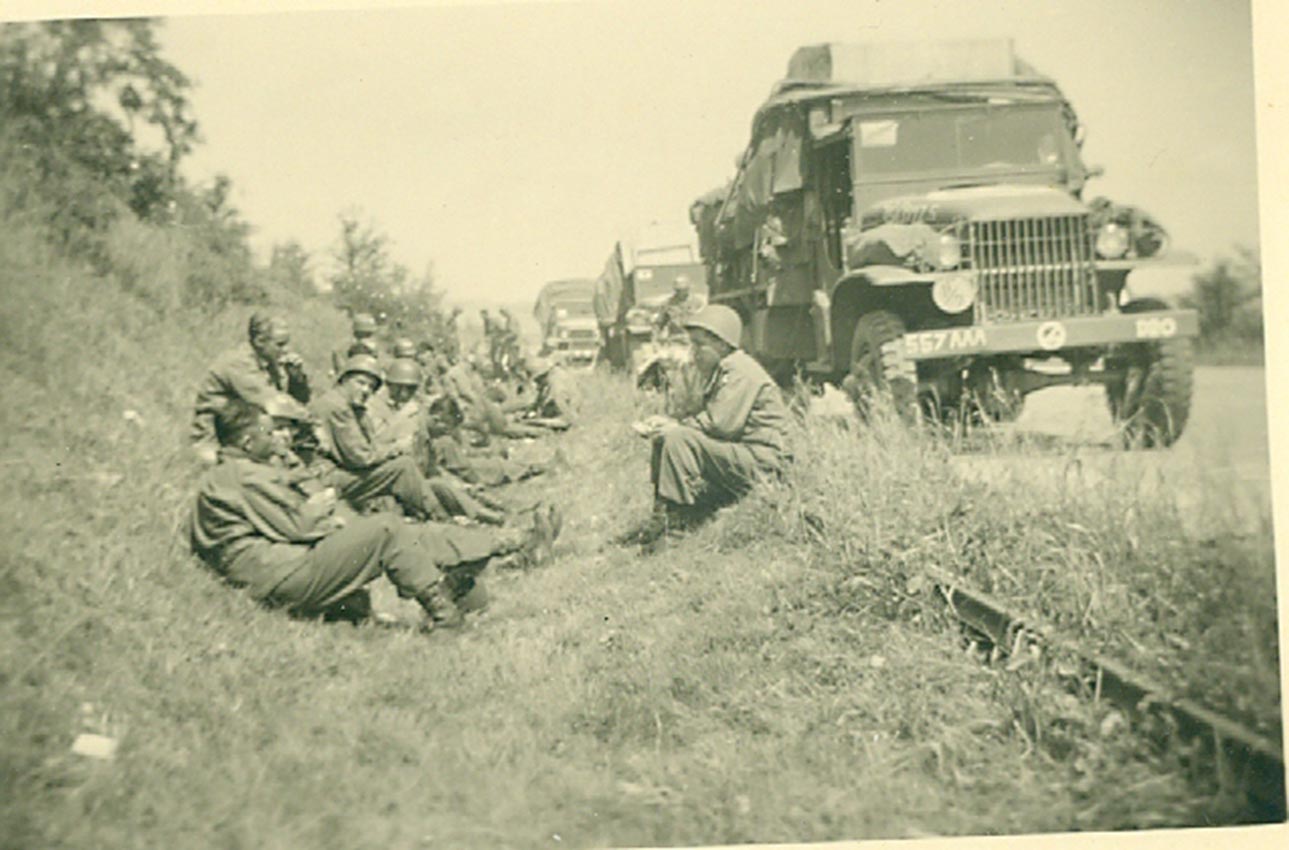
He Wrote Her Every Day by Gail Lindenberg is a true story that warms the heart. Barely married a year, Jim leaves his young wife, the love of his life, and ends up fighting in Europe during the final months of World War II. He experiences a lot of combat and is awarded a Silver Star when he risks his life leading a charge against a Nazi machine gun position.
James (Jim) William Hendrickson, Jr.
His brother Bill is in a prisoner of war camp somewhere in Germany, and Jim dreams of being the one who liberates him. You will need to read the book to find out what happened to Bill.
Jim also seldom missed a day to write a letter or add to one he was working on. Between being in the field chasing the enemy, on guard duty and/or in combat, he always finds time to write even when everyone else is trying to sleep—even when he is in a filthy, cramped foxhole in freezing winter weather.
somewhere in Germany 1944
I’ve never read a seamless story that grounded me in both the home front and a combat zone like this one did—especially after the war and the long months of waiting in Germany when Jim is anxious to return home but there is one delay after another. I kept turning the pages waiting for that moment when Jim finally made it back home to Arizona, and the conclusion brought a big smile to my face as I remembered the moment when I arrived home from another war.
Irene (Butch) – Jim’s wife and the love of his life
The author sent me a copy of the paperback for my honest review, and don’t miss the rest of the photos you will discover at He Wroter Her Every Day.com. This is a story that was lovingly researched and written by one of his daughters—a wonderful story that immortalizes a father who served his country with courage and honor.
_______________________
Lloyd Lofthouse is a former U.S. Marine and Vietnam Veteran.
His second novel is the award winning love story and suspense-thriller Running with the Enemy. Blamed for a crime he didn’t do while serving in Vietnam, his country considers him a traitor. Ethan Card is a loyal U.S. Marine desperate to prove his innocence or he will never go home again.
This is a love story that might cost the lovers everything—even their lives.
To follow this Blog via E-mail see upper left-hand column and click on “FOLLOW!”
While reading Last Plane Out of Saigon, an opinionated but accurate memoir by Richard Pena and John Hagan, I did a lot of reflection and here are some of my thoughts.
During a war, the U.S. government has the power to draft—against their will—recruits who might end up fighting in a just or unjust war. Then there are those Americans who join voluntarily to serve in the military. It’s been 49 years since I served as a volunteer in the U.S. Marine and fought in Vietnam, and for the last several decades, after a lot of research to understand what happened and why the U.S. started that war, I have concluded that the war in Vietnam was wrong and it was based on lies. I think the same about the Iraq War.
There is a big difference between volunteering versus being drafted and forced to serve, and two-thirds of the U.S. troops who served in Vietnam were volunteers and about 70% of those who were killed were also volunteers and 62% of the troops killed were age 21 or younger.
For me, a few weeks before I graduated from High school, I voluntarily surrendered the freedom most Americans take for granted and joined the U.S. Marines on a delayed deferment. In fact, once you join any of the branches of the U.S. military, you leave your free choice behind, and you don’t get it back until after you are honorably discharged. The military is another world with its own courts, hospitals and prisons, and the troops are trained to serve and obey without question. Disobey and a recruit might end up in prison or even executed for the crime of treason.
In the summer of 1965, I was in boot camp at MCRD in San Diego when we heard that the U.S. war in Vietnam was escalating and once we left boot camp every recruit was going to be on his way to fight. That scuttlebutt turned out to be true, and I arrived in Chu Lai, Vietnam, about 90 miles south of Da Nang on March 28, 1966.
About halfway through my combat tour, the first draftees started to arrive, and one was assigned to the communications platoon where I was a field radio operator. To me, and the other Marines in that platoon, it was considered wrong that anyone should be forced to serve in the U.S. Marines and fight in one of America’s wars, and we went out of our way to shelter that draftee.
In Richard Pena and John Hagan’s “Last Plane out of Saigon,” on page 100, Pena wrote something that I agree with: “I submit that the true American patriots are those who see the faults of our country and do not hide from them but instead attempt to rectify them.”
I didn’t always think that way. As a child, I grew up in a totally non-political family, and at the same time I was also being brainwashed by patriotic films disguised as adventures, thrillers and suspense out of Hollywood—for instance, most John Wayne movies. My parents never voted and the one time I asked my father why, he said all politicians were crooks, and it was a waste of time to vote because it wasn’t going to change anything. When I was in college on the GI Bill 1968 – 1973, I would become more aware and today I disagree with my father, because I think that when we don’t vote, the criminals in the White House and Congress get away with their crimes, but active, knowledgeable voters can change that.
To understand the dramatic attitude shift of the Vietnam War in the United States, in August 1965, when I reported to boot camp at MCRD, 62% of Americans agreed with the war. By the time I flew home from Vietnam near the end of December 1966, that number was down to about 52% and dropping. In 1968 when I was honorably discharged from active duty, support for the war was down to 37%, and by 1971, during my third year of college on the GI Bill, support was down to 28%.
“Last Plane Out of Saigon” is Richard Pena’s story, and it roughly captures the nation’s mood at the end of the war. Pena was drafted—forced to fight in a war that was clearly wrong. His book is a journal of what he felt, thought and did in Vietnam where he witnessed the horrors of war working in the operating room of Vietnam’s largest military hospital in Saigon.
I served in Vietnam in 1966 during the buildup. Soon after I left, U.S. troop strength reached about a half-million. But by the time Richard Pena arrived near the end of the war as a draftee in the fall of 1972, U.S. troop strength in Vietnam was down to about 100,000 and dropping.
I think many of American’s troops—both volunteers and draftees—served honorably for mostly honorable reasons, but many of the leaders of the United States who supported the war and sent the troops to fight justified their criminal actions based on lies and deceit.
That leads to a question I have no answer for. How does one serve honorably in a dishonorable war? As for the 5-stars I gave this book, how can I justify loving a book about a dishonorable war? I awarded the 5-stars based on the honesty of the book that revealed the reason why more than 70% of Americans were not allowing themselves to be fooled by the liars who started the war.
_______________________
Lloyd Lofthouse is a former U.S. Marine and Vietnam Veteran.
His latest novel is the award winning suspense-thriller Running with the Enemy. Blamed for a crime he did not commit while serving in Vietnam, his country considers him a traitor. Ethan Card is a loyal U.S. Marine desperate to prove his innocence or he will never go home again.
And the woman he loves and wants to save was fighting for the other side.
To follow this Blog via E-mail see upper left-hand column and click on “FOLLOW!”
I bought the DVD for The Patrol at Costco thinking it was about American special-forces troops in Afghanistan, but it wasn’t. It was about a British Army Patrol often under attack from an unseen enemy. The UK troops in the film return fire but have no way to know if they inflicted any casualties on the Taliban. I think we tend to forget that U.S. troops aren’t the only forces fighting in Afghanistan. To date, the UK has lost 453 troops in Afghanistan in addition to 2,116 wounded in action.
The Patrol takes place in 2006, in Helmand Province, as the British Army deploys into the Taliban heartland. In 2006, Britain led the International Security Assistance Force (ISAF) in Helmand province in the south of the country with a 3,300-strong force after fresh outbreaks of violence. At its peak, in Helmand alone there were 137 UK bases and around 9,500 UK troops.
The Patrol has been called, “The British answer to The Hurt Locker and is just as depressing for its sense of reality. As in all war, there is no glory, and with casualties, morale suffers. Hollywood, the news and novels are where war is glorified. Rooted in reality, this film is not your average Hollywood epic. If you are interested in the reality of war, I suggest you ignore the average star rating on Amazon from customer reviews.
War is not combat all the time. The average infantryman in the South Pacific during World War II saw about 40 days of combat in four years. The average infantryman in Vietnam saw about 240 days of combat in one year thanks to the mobility of the helicopter. Now research is revealing that our troops serving in Iraq and Afghanistan are experiencing over 310 days of combat—a day of combat is a day that you don’t know if you will live or die that day. – Our Warriors Today and “Combat Trauma”
The first-time, writer-director Tom Perch draws on his own life in the army to build a convincing low budget film of how troops lose faith in their leaders when they have lousy weapons and see no reason to keep risking their lives in combat that makes no sense.
What worked for me in this film was that the usual macho type heroes we see in most combat films were missing. There were no heroes here and no cowards either. Just troops doing the job they were trained to do—and obviously sent in to harm’s way by corrupt, bungling governments.
_______________________
Lloyd Lofthouse is a former U.S. Marine and Vietnam Veteran.
His latest novel is the award winning suspense-thriller Running with the Enemy. Blamed for a crime he did not commit while serving in Vietnam, his country considers him a traitor. Ethan Card is a loyal U.S. Marine desperate to prove his innocence or he will never go home again.
And the woman he loves and wants to save was fighting for the other side.
To follow this Blog via E-mail see upper left-hand column and click on “FOLLOW!”
There are some films and documentaries that should be required viewing the same as taxes and death. The Hornet’s Nest is one of those films that should be viewed not once, but at least three times or more, but, sad to say, average American values are on display when we compare two films that came out on the same weekend.
The Hornet’s Nest, a film my wife and I recently watched at home on a DVD, is a documentary shot by two journalists, a father and son, Carlos and Mike Boettcher, who were embedded with front-line U.S. combat troops in one of the most dangerous combat zones in Afghanistan.
The Hornet’s Nest is not based on a true story—it is a true story.
“The Hornet’s Nest is a groundbreaking and immersive feature film (documentary), using unprecedented real footage to tell the story of an elite group of U.S. troops sent on a dangerous mission deep inside one of Afghanistan’s most hostile valleys. The film culminates with what was planned as a single day strike turning into nine intense days of harrowing combat against an invisible, hostile enemy in the country’s complex terrain where no foreign troops have ever dared to go before. … What resulted is an intensely raw feature film experience that will give audiences a deeply emotional and authentic view of the heroism at the center of this gripping story.”
Yet, this film was never released to theaters outside of the United States and earned a total lifetime gross of $312.7 thousand. The same weekend that The Hornet’s Nest was released on May 9, 2014, Neighbors, a film I did NOT see and don’t plan to see, came out.
Neighbors grossed worldwide more than $268 million, and was released in 3,311-theaters compared to 57-theaters for The Hornet’s Nest.
I know that the corporate goal in the private sector is all about making profits almost any way possible, legally or illegally, but this is ridiculous—because if we lose the world-wide war against Islamic extremism, there may be no profits for corporate capitalists to earn, and consumers, those who are still alive and have converted to Islam to survive, may have few if any products to buy as they get out their prayer rugs at daybreak, noon, mid-afternoon, sunset and evening and turn toward Mecca to pray to the Prophet Muhammad’s tomb. Oh, and the prayers must be said in Arabic, no matter what the native tongue is.
The United States has been fighting the war in Afghanistan since 2001, and the Iraq and Afghan wars against Islamic terrorism have cost $4 to $6 Trillion (so far), in addition to thousands of deaths and hundreds of thousands of injured U.S. troops, and that isn’t counting the hundreds of thousands of deaths of civilians who lived in Iraq and Afghanistan and the millions who have fled to refugee camps to escape the horrors of war.
According to Hollywood Reporter, the average cost of a movie ticket is $7.96. That means 39,285 people may have seen The Hornet’s Nest documentary, compared to about 34-million viewers who watched Neighbors, a film about a couple with a newborn baby who end up having a loud, hard partying fraternity move in next door; a film with an R rating “for pervasive language, strong crude and sexual content, graphic nudity and drug use throughout. “
Rotten Tomatoes listed six media critics who reviewed The Hornet’s Nest and those six gave the film a 100-percent rating. Variety critic, Joe Leydon said, “This gripping documentary about soldiers in harm’s way during America’s longest war seems all the more relevant as we begin the countdown to troop withdrawals from that war-torn land.”
How about Neighbors?
Rotten Tomatoes reported that 44-critics reviewed the film with an average rating of 73-percent. One of the top critics, Christy Lemure, said, “I have been both of the people at the center of the conflict in “Neighbors.” I have been the drunken sorority girl who doesn’t want the party to end and I have been the perplexed new mom who’s desperate for some sleep. … If only the stakes were higher for all of these characters, it might even be possible to care about who wins.”
For those who care about the truth; the reality and quality of life, you may download the full film of The Hornet’s Nest for $3.99, and watch it starting with the next embedded video, or buy the DVD from Amazon by clicking the previous link.
As a combat veteran who fought in Vietnam, believe me when I say that you can’t hide from the harsh reality of life. Fantasies of sexy vampires, and visits to Disneyland and/or Magic Mountain will not protect you from that reality, because it will find you sooner or later, and it is a hard-wired fact that the United States has hundreds of thousands if not millions of enemies in the Middle East who want to destroy everything there is about America and the citizens who live here.
_______________________
Lloyd Lofthouse is a former U.S. Marine and Vietnam Veteran.
His latest novel is the award winning suspense-thriller Running with the Enemy. Blamed for a crime he did not commit while serving in Vietnam, his country considers him a traitor. Ethan Card is a loyal U.S. Marine desperate to prove his innocence or he will never go home again.
And the woman he loves and wants to save was fighting for the other side.
To follow this Blog via E-mail see upper left-hand column and click on “FOLLOW!”
There’s no fantasy, hero worship or fake humor in this TV series. Everyone is flawed and injured from the war—even Americans who never served in Vietnam or wore a uniform.
“China Beach” was a TV series from 1988 to 1991, and I didn’t view it until recently after I first heard about it and bought a copy of the series on DVD at Costco. I didn’t buy the complete series that comes with almost 60 hours of run time. I bought Seasons 1 + 2 with about 22 hours.
And I think I know why this excellent TV series was cancelled after four seasons—although the series has more than 249 reviews on Amazon with 4.8 of 5 stars, most Americans can’t deal with the harsh reality of war. After all, less than 7% of Americans are veterans and even fewer have served in combat.
“China Beach” is set in a combat hospital during the Vietnam War in the late 1960s. The title refers to My Khe beach in the city of Da Nang, which was nicknamed “China Beach” in English by American and Australian troops during the war.
The main character is first lieutenant Colleen McMurphy who is a triage nurse dealing with often severely wounded troops. The directors focused on reality and there were real combat nurses who were consultants. There’s a bonus DVD with this set where we get to meet some of the nurses who served in Vietnam.
The fictional nurse, McMurphy, takes her job saving lives seriously and when she loses wounded troops, she takes the loss personally and is emotionally injured. Her PTSD is visible from the beginning. At times the suffering and drama were so intense, my eyes filled with tears from my own memories.
If you want a close look at the reality of combat and the price the troops and civilians pay, I highly recommend this series. You’ll have a safe front row seat to watch these characters become friends, lovers and then suffer loses that would break most people and scar them for life as it must have scarred the real nurses who served there.
You may question my opinion of this series so it may help to know that I’m a Vietnam combat vet who was a field radio operator in the U.S. Marines. And I was fortunate to never have to be medevaced to a combat hospital although some of the Marines in my unit were.
Now I’m thinking about the seasons of “China Beach” I haven’t seen.
_______________________
Lloyd Lofthouse is a former U.S. Marine and Vietnam Veteran.
His latest novel is the award winning suspense-thriller Running with the Enemy. Blamed for a crime he did not commit while serving in Vietnam, his country considers him a traitor. Ethan Card is a loyal U.S. Marine desperate to prove his innocence or he will never go home again.
And the woman he loves and wants to save was fighting for the other side.
To follow this Blog via E-mail see upper left-hand column and click on “FOLLOW!”
I read the Daily Beast’s post and burst out laughing. The first thing I thought was the Pentagon is addicted to massive budgets. This is a ploy to stir up fear in Americans (again—it’s worked so well in the past. I’m thinking Vietnam and Iraq.) who’ll demand that Congress and the President increases the shrinking defense budget.
Let’s look at some numbers to see if Russia really wants to start a war with the United States and NATO.
First: The US has the third largest population in the world at 316.6 million, and 120 million are considered fit to serve in the military if we needed to call them up. There are 1.4 million active military with an active (trained) reserve of an addition 850+ thousand. In addition, the European Union (the EU is mostly made of NATO nations) has more than 1.5 million in its military and a total population of more than 500 million.
How about Russia? It has a total population of 145.5 million (Less than half of the US not counting the EU). Russia only has 46.8 million considered fit to serve; its active military numbers 766,000 with an active reserve of about 2.48 million (you can bet that they aren’t as well trained as the US reserves).
Compared to other countries, Russia only ranks 9th—a fraction of America’s manufacturing ability.
Carpe Diem also says, “American manufacturing is alive and well and poised for even greater growth in the future. Flush with record-level profits, the manufacturing sector has never been financially healthier than it is today and the future of American manufacturing has never looked brighter.” In fact, jobs are starting to come back from foreign countries.
Third: the US has ten active nuclear powered Nimitz-class super carriers. No other country in the world has even one carrier with the capability of any one of these ten. In addition, the US is building three Ford class super carriers that will be even more advanced and lethal. The US has a naval fleet of 473 ships. In addition, the European Union has 543 more naval ships.
What about Russia? It has one active aircraft carrier that’s about half the size of a Nimitz and it isn’t nuclear powered. Russia has 352 ships in its naval fleet.
According to Global Fire Power, the US has 13,683 total military aircraft and 6,012 helicopters. In addition, the EU adds another 2,037 fighter aircraft.
What about Russia? Total military aircraft of 3,082 in addition to 973 choppers.
What about tanks? The US has 8,325 tanks (several thousand are already in Europe). The European Union has another 6,510 tanks. Russia has 15,500 but only 1,667+ are its latest main battle tank—most are outdated (see embedded video). All of America’s tanks are the latest version.
The stupidest thing Putin could do is to pick a war with the European Union and the United States. Of course national leaders aren’t known to think rationally, but I’d place my money on the fact that Putin is bluffing, Obama may have blinked, and the US Pentagon is using this as an excuse to drum up support for bigger budgets.
Why is Putin bluffing? Because Americans are war weary after more than a decade of fighting in Iraq and Afghanistan. He’s gambling that public opinion in the US will hold back NATO, Obama and Congress from acting boldly to push Russia back with a show of force that Russia couldn’t match in its wildest dreams.
_______________________
Lloyd Lofthouse is a former U.S. Marine and Vietnam Veteran.
His latest novel is the award winning suspense-thriller Running with the Enemy. Blamed for a crime he did not commit while serving in Vietnam, his country considers him a traitor. Ethan Card is a loyal U.S. Marine desperate to prove his innocence or he will never go home again.
And the woman he loves and wants to save was fighting for the other side.
To follow this Blog via E-mail see upper left-hand column and click on “FOLLOW!”
Who do you think would win a war between Russia and the United States if it were fought between army choirs?
Russian Army Choir singing at the 2014 Winter Olympics
Of course, the second video with the MADtvMarine Choir was for fun. Now, in all seriousness, here’s the U.S. Army Choir
It’s only fair that we compare the Russian Army Choir to the U.S. Army Choir, in the 3rd video.
In addition, the 4th video is from The Vocal Majority – [US] Armed Forces medley.
Next time we fight a war, let military choirs compete on a battle field filled with the sound of music. Maybe through song, we might find peace. Do you think the Taliban or al Qaeda might have a choir?
_______________________
Lloyd Lofthouse is a former U.S. Marine and Vietnam Veteran.
His latest novel is the award winning suspense-thriller Running with the Enemy. Blamed for a crime he did not commit while serving in Vietnam, his country considers him a traitor. Ethan Card is a loyal U.S. Marine desperate to prove his innocence or he will never go home again.
And the woman he loves and wants to save was fighting for the other side.
To follow this Blog via E-mail see upper left-hand column and click on “FOLLOW!”
Are we all crazy? Does PTSD ever go away? I’m sure that most members of the US military have a much better understanding of PTSD than the general public.
There are currently about 1.4 million active troops serving in the U.S. military and 21.5 million military veterans. But the U.S. population has more than 317 million people. That means 0.44% are serving in the active military and 6.7% are veterans leaving 93.15% of the population mostly clueless.
So, where does the general population acquire its perception of PTSD?
To answer that, we must ask how many Hollywood movies have painted a positive picture of combat veterans compared to movies that show veterans as angry, violent, dangerous drug users and/or alcoholics (mostly brought on by PTSD).
Three Vietnam Veterans have run for President of the United States—all three lost. One was a Republican and two were Democrats.
Al Gore served in Vietnam as a reporter/journalist for five months. He was stationed with the 20th Engineer Brigade in Bien Hoa and was a journalist with The Castle Courier. He received an honorable discharge from the Army in May 1971.
Gore said, “I don’t pretend that my own military experience matches in any way what others here have been through … I didn’t do the most, or run the gravest danger. But I was proud to wear my country’s uniform. And my own experiences gave me strong beliefs about America’s obligation to keep our national defenses strong.”
John Kerry reported for duty at Coastal Squadron 1 in Cam Ranh Bay in South Vietnam on November 17, 1968. In his role as an officer in charge of swift boats, Kerry led five-man crews on a number of patrols into enemy-controlled areas.
John McCain requested a combat assignment, and was assigned to the aircraft carrier USS Forrestal flying A-4 Skyhawks. His combat duty began when he was thirty, in mid-1967.
John McCain became a prisoner of war on October 26, 1967. He was flying his 23rd bombing mission over North Vietnam when his aircraft was shot down by a missile over Hanoi.
What is your opinion about the public image of combat veterans? Do you think these three men lost the White House because of that image?
Lloyd Lofthouse is a former U.S. Marine and Vietnam Veteran.
His latest novel is the award winning suspense-thriller Running with the Enemy. Blamed for a crime he did not commit while serving in Vietnam, his country considers him a traitor. Ethan Card is a loyal U.S. Marine desperate to prove his innocence or he will never go home again.
And the woman he loves and wants to save was fighting for the other side.
To follow this Blog via E-mail see upper left-hand column and click on “FOLLOW!”
Walking the mile-and-a-half home, both films stirred emotions and made for conversation. I admit that I didn’t think The Wolf of Wall Street was about a real man. It was so outrageous, so amoral, and so greedy—you name it—that I thought it was the product of a very active imagination.
When I Googled the film, I discovered it was based on a real story and was surprised that anyone could be this rotten other than a serial killer who loves murdering innocent people—the real Wolf of Wall Street, Jordan Belfort, was as depraved and greedy as they come. The film is worth seeing. DiCaprio does a great job playing Belfort, a man who is often unfaithful to his wives, and in the end has no loyalty to anyone when it comes to his own survival.
Belfort and his employees lead a lifestyle of total debauchery with lavish parties, sex and drugs both in the workplace and in their personal lives.
Belfort was indicted in 1998 for securities fraud and money laundering, but he only served 22 months in a federal prison designed for white collar criminals. This prison, as depicted in the film, was more of a country club with tennis courts—but still a prison you can’t leave until you’ve served your time. It seems that today, Belfort is worth millions again (although nowhere close to the amount—about $200 million—he took from his victims); hasn’t paid back what the court ordered; lives in Manhattan Beach, California and is engaged again.
Lone Survivor is about a team of SEALS in Afghanistan and is also based on a true story. The film starts out with SEAL boot camp and in short order shows how tough it is to earn the right to be a SEAL. These are tough guys who value loyalty, patriotism and honor above all else and they are more than willing to die for what they believe.
Mark Wahlberg plays the lone survivor, Marcus Luttrell. Three of the four SEALS in his team are killed in combat with a vicious enemy, the Taliban, who once ruled most of Afghanistan while supporting Al Qaeda.
While I was disgusted at Belfort’s debauchery and greed, I was angry at what happened to the SEALS in Lone Survivor. Not long after they were dropped off in the Afghan mountains to carry out their mission, they discover that the intel was bad. Instead of a few Taliban, they were up against hundreds and they lost radio contact. When the help arrives, it’s without the proper support because there are not enough Apache gunships to support all of the ground operations in Afghanistan. The result, one of the troop carrying choppers is shot down with everyone aboard killed aborting the rescue attempt.
Why was I angry? Because when I served in Vietnam—several times while in the field—I lost radio contact—once on a deep recon where four of us were dozens of miles in front of our own lines. We even drove our World War II vintage jeeps—with no armor I might add—through an abandoned village where the cooking fires were still smoldering and there was a Vietcong flag flying from a radio antenna sticking out of the top of a tree. Several decades later, and Congress should have done something about fixing it so no ground troops would ever be out of radio contact, and I blame the lack of enough air support on Congress and President G. W. Bush for not making sure the troops had all the support they needed to succeed and come home.
Then there are the rules of combat that limit our troop’s ability to fight a war. We had them in Vietnam and they sucked. Noncombatants should not be allowed to make rules for combat. Most Americans—who live in a real fantasy world—do not understand war.
The challenge is how do we measure who Americans might admire most?
For The Wolf of Wall Street, the film—with a $100 million budget—opened in December in 2,537 theaters and has earned $90.8 million as of January 10, 2014.
Lone Survivor opened wide in 2,875 theaters on January 10; had a production budget of $40 million and has earned $14.782 million (the film started in 2 theaters on December 25, 2013 and went wide on January 10) compared to The Wolf of Wall Street that made $18.5 million its first weekend.
Who do you admire most and why: Belfort’s and his mob or Marcus Luttrell and the SEALS?
_______________________
Lloyd Lofthouse is a former U.S. Marine and Vietnam Veteran.
His latest novel is the award winning suspense-thriller Running with the Enemy. Blamed for a crime he did not commit while serving in Vietnam, his country considers him a traitor. Ethan Card is a loyal U.S. Marine desperate to prove his innocence or he will never go home again.
And the woman he loves and wants to save was fighting for the other side.
To follow this Blog via E-mail see upper left-hand column and click on “FOLLOW!”
Sometime in 1966, for a few days, some Marines from my battalion, including me, were sent to a hill on the perimeter at Chu Lai to watch over an infantry company’s equipment while they were in the hills chasing North Vietnamese ghosts—intelligence said a regiment of NVA had slipped into South Vietnam.
There weren’t many of us—just enough for two Marines to man each of the small bunkers near the base of the hill that was surrounded by coiled barbed wire and then rice paddies.
As daylight faded, the hum of a billion mosquitoes greeted our ears warning us of what was to come as we waged war with the bloodsuckers and lost.
Looking for a way to escape, several Marines scrambled into the largest bunker at the top of the hill—it stood two stories tall with a thick slab of cast iron for a roof offering protection from Vietcong mortar rounds.
Those Marines thought they would be able to escape the bloodsuckers by moving inside the bunker. But as fast as they went in, they came out—screaming like schoolgirls. The bunker was full of rats and when the first Marine’s boots landed on the dirt floor, the rats climbed his legs in a frenzy.
I watched the few who had gone in come shooting out like rockets—eyes wide with shock; faces pale. These were all men who had fought in combat without showing fear when confronted by an enemy who wanted to kill them. Before the cast iron hatch at the top was slammed shut, one Marine tossed a fragmentation grenade in the bunker and it went off with a muffled blast.
Hours later, during my watch between midnight and four, I heard a rustling noise near the wire. There would be long stretches of silence (if you didn’t count the sound of distant firefights and the glare of flares along the division perimeter), then another rustling as if someone were crawling up the hill. I couldn’t see anything and thought it might be a small animal.
When my watch ended, I visited the only latrine that was close to the top of the hill. It was a screened, plywood box with a four-hole plywood bench. Inside, it was black as ink and smelled of urine. Under the bench were four half-empty, fifty-five gallon metal drums with several inches of diesel fuel in each one. In the mornings, the drums would be dragged out from under the plywood bench and set on fire. When it wasn’t raining, hundreds of columns of black smoke could be seen drifting into the morning sky over Chu Lai as the shit was burned.
I had stomach cramps—probably from the twenty-one-year-old canned rations I’d had for my evening meal. Or maybe from the water we drank that had a strong taste of chlorine to it.
I leaned my weapon just out of reach against the three-foot high plywood wall in front of me and sat. Above the plywood was a screened in open space that allowed air to flow through while keeping the mosquitoes out.
There was a tin roof and the shitter was probably the only place to escape the mosquitoes. If it hadn’t been for the stink, I’d have slept there. On both sides of the shitter was a line of tents where the grunts (infantry) kept their gear and slept when they weren’t in the field.
That’s when the grenades started to go off. I glanced to the left and saw a shadowy figure running fast along the line of tents tossing a grenade through each opening. I reached for my weapon but a wave of cramps doubled me over as the diarrhea gushed out.
For an instant, I thought I was going to be dead when a grenade was tossed in the shitter. But from the outside, it must have looked empty and I was spared that fate.
No one died or was wounded on that hill that night. The tents were empty because the grunts were in the hills hunting an elusive enemy, and most of us were in the smaller bunkers near the concertina wire. I was closer than anyone to the lone killer who had slipped inside the wire.
That was just one night out of hundreds during my combat tour in Vietnam.
_______________________
Lloyd Lofthouse is a former U.S. Marine and Vietnam Veteran.
His latest novel is the award winning suspense-thriller Running with the Enemy. Blamed for a crime he did not commit while serving in Vietnam, his country considers him a traitor. Ethan Card is a loyal U.S. Marine desperate to prove his innocence or he will never go home again.
And the woman he loves and wants to save was fighting for the other side.
To follow this Blog via E-mail see upper left-hand column and click on “FOLLOW!”

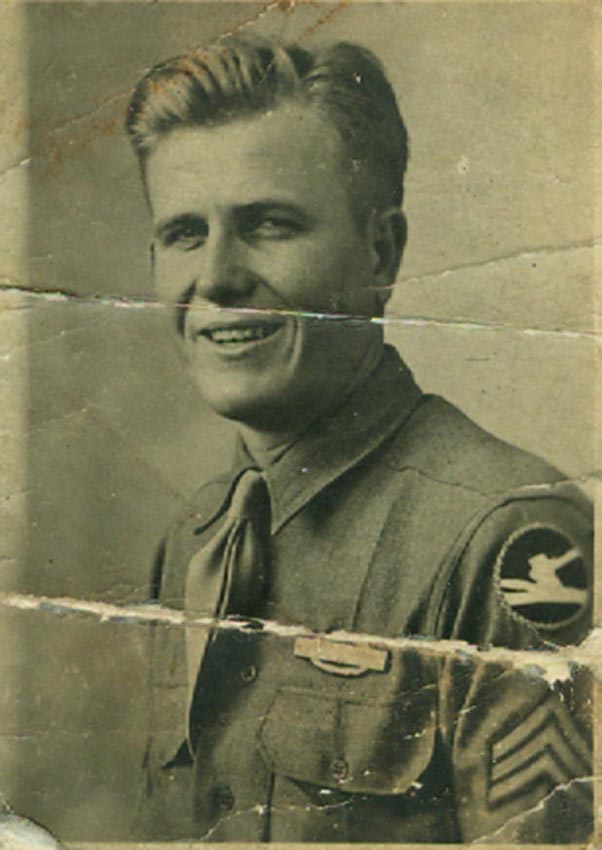 James (Jim) William Hendrickson, Jr.