Powerful scans measure how some of the brain’s regions are altered/damaged in the vicious cycle that is PTSD, where patients feel as if they are reliving a trauma instead of understanding that it’s just a memory.
With these scans, doctors may see how the brain has been changed in veterans with post-traumatic stress disorder.”
In fact, Brain Facts.org reported that “Long-term or high levels of cortisol (brought on by PTSD) can also have damaging effects, causing toxicity and shrinkage of brain regions such as the hippocampus, a structure involved in memory formation.… an especially traumatic event can cause post-traumatic stress disorder (PTSD), which occurs when the stress system fails to recover from the event. This results in recurring flashbacks that can disrupt everyday life.”
However, Neergaard reports that these changes to the brain need not be permanent and may change with treatment.
One such treatment is canine therapy. In May 2010, the US Congress introduced the Veterans Dog Training Therapy Act through H.R. 3885, which required the Department of Veterans Affairs (VA) to establish a pilot program through which veterans diagnosed with PTSD or other mental health conditions would train service doges for use by disabled veterans. The pilot program would operate in three to five medical centers over a five-year period.
Next, in July 2011, VA.gov’s VAntage Point reported in Finding Solace in Companion Dogs that this new pilot program authorized by Congress was launched at the Marion VA Medical Center in Illinois. The focus has moved beyond the idea that dogs are only for guide purposes (example: the blind). The focus has shifted to their companionship
and therapeutic potential.
In addition, Palo Alto Online News reported that at the VA in Palo Alto: “Melissa Puckett, recreational therapist and PTSD supervisor in the men’s and women’s trauma-recovery program, said many vets deal with emotional numbness as part of PTSD. The dogs help them to receive touch and spontaneous affection and to express love — ‘things they thought they would never have again,’ she said.”
Then The New York Times reported in For the Battle-Scarred, Comfort at Leash’s End that “Veterans rely on their dogs to gauge the safety of their surroundings, allowing them to venture into public places without constantly scanning for snipers, hidden bombs and other dangers lurking in the minds of those with the disorder.”
His latest novel is Running with the Enemy. Blamed for a crime he did not commit while serving in Vietnam, his country considers him a traitor. Ethan Card is a loyal U.S. Marine desperate to prove his innocence or he will never go home again.
And the woman he loves and wants to save was trained to hate and kill Americans.
To follow this Blog via E-mail see upper right-hand column and click on “Sign me up!”
If you hear someone laughing very loud and out of control that may be me. I just read how the brother of al Qaeda‘s second-in-command, who was killed in a U.S. drone strike recently, said Washington’s use of the remote-controlled weapons is inhumane and makes a nonsense of its claims to champion human rights. Source: Yahoo News.com
Al Qaeda’s surviving leaders must be pissed that the US doesn’t have the same rules of engagement we had to obey in Vietnam—a war the US lost after fighting there with overwhelming fire power for more than a decade.
I’m sure that Sun Tzu would scoff at anyone that applied rules to war and combat. In Vietnam we were told not to return fire when fired upon unless we saw who was shooting at us. If you haven’t been in combat in a jungle or on a river being shot at from a jungle, you may have no idea that it is impossible to see who is shooting at you.
In addition, no one sees the IED (Improvised Explosive Devices) buried under the ground that kill or wound our troops and many times innocent civilians including children.
In my opinion, I find it absurd that anyone willing to blow up people (mostly noncombatants) by using human bombs would even mention human rights violations and complain about U.S. drone strikes.
All is fair in love and war, which means we kill them before they kill us any way possible and if a few innocent people die, well, General Sherman knew what he was talking about at the end of the Civil War when he said “War is hell!”
If you want to win at war you must have the stomach for what that “hell” means—otherwise, hell will eventually visit its wrath on those that champion human rights in a time of war. For example, if President Lincoln had not sent General Sherman on his famous scorched earth march to the sea across the Confederate States where all kinds of human rights were violated, the Confederacy might still have slavery and the United States would be minus thirteen stars on its flag.
His latest novel is Running with the Enemy. Blamed for a crime he did not commit while serving in Vietnam, his country considers him a traitor. Ethan Card is a loyal U.S. Marine desperate to prove his innocence or he will never go home again.
And the woman he loves and wants to save was trained to hate and kill Americans.
To follow this Blog via E-mail see upper right-hand column and click on “Sign me up!”
An e-mail arrived this morning from the “Marine Corps Vietnam Tankers Historical Foundation”. I signed up for this news feed because I served in the First Tank Battalion, First Marine Division in Okinawa and then Vietnam in 1965-1966.
The title of the e-mail speaks volumes about America’s political priorities when measured between health of the environment and the individual and corporate profits.
The title of the e-mail was “Dow & Monsanto Join Forces to Poison America’s Heartland”. Source: Truth Out.org by Richard Schiffman
About Monsanto Company—it is the world’s largest provider of patented genetically modified seeds for crops such as corn, soybeans, and cotton, bringing in $10.5 billion this past year.
In fact, anything that makes food more expensive benefits Monsanto, which is why this corporation encourages the use of genetically engineered crops.
Schiffman says, “In a match that some would say was made in hell, the nation’s two leading producers of agrochemicals have joined forces in a partnership to reintroduce the use of the herbicide 2,4-D, one half of the infamous defoliant Agent Orange, which was used by American forces to clear jungle during the Vietnam War. These two biotech giants have developed a weed management program that, if successful, would go a long way toward a predicted doubling of harmful herbicide use in America’s corn belt during the next decade.”
Note from Blog host: Because I served in Vietnam and was exposed to Agent Orange, I am on the VA’s Agent Orange list. The VA (The United States Department of Veterans Affairs) lists these diseases on the VA Website as Veteran’s Diseases Associated with Agent Orange.
Schiffman says, “The problem for corn farmers is that “superweeds” have been developing resistance to America’s best-selling herbicide Roundup, which is being sprayed on millions of acres in the Midwest and elsewhere. Dow Agrosciences has developed a strain of corn that it says will solve the problem. The new genetically modified variety can tolerate 2,4-D, which will kill off the Roundup-resistant weeds, but leave the corn standing. Farmers who opt into this system will be required to double-dose their fields with a deadly cocktail of Roundup plus 2,4-D, both of which are manufactured by Monsanto.”
Note from Blog host: This actual article is much longer than what I’ve posted in this comment. You may find the rest at Truth Out.org
His latest novel is Running with the Enemy. Blamed for a crime he did not commit while serving in Vietnam, his country considers him a traitor. Ethan Card is a loyal U.S. Marine desperate to prove his innocence or he will never go home again.
And the woman he loves and wants to save was trained to hate and kill Americans.
To follow this Blog via E-mail see upper right-hand column and click on “Sign me up!”
For those fifteen years, I didn’t talk about the war. During the day, I didn’t think about it either. However, at night, every sound was the enemy coming for my family and me. I’d wake sweating and grab the eight-inch knife I slept with, and there was a loaded revolver under the bed. Then in 1981, I was working toward a MFA in writing and proposed an individual graduate project where I would write about my experiences from Vietnam.
It took six months to get beyond page forty in that manuscript, which was my first day in Vietnam. The Ph.D. with the major in English literature finally gave me an ultimatum, and I opened up. On page 41, I scrambled down a net and boarded a landing craft that carried me to the beach in Chu Lai.
Did that breakthrough help me sleep through the night? No. I still wake up listening to every sound.
If the crickets around the house stop chirping, I open my eyes and listen. You see, the crickets have become my first line of defense—my trip flare. Before bedtime, I check all the doors and windows to make sure they are locked. I still keep an eight-inch knife close and a twelve-gauge pump shotgun one-step from where I struggle to sleep. I’ve lived with this combat in my head for forty-four years so far.
When my VA shrink told me a few years ago that I had to lock my weapons up so no one would get hurt, I stopped going to counseling. Even in the US, the odds of becoming a victim of violent crime are one in four according to statistics and the last piece I read said the odds are getting worse. When the real beast comes, I have to be ready, because we live in a combat zone.
His latest novel is Running with the Enemy. Blamed for a crime he did not commit while serving in Vietnam, his country considers him a traitor. Ethan Card is a loyal U.S. Marine desperate to prove his innocence or he will never go home again.
And the woman he loves and wants to save was trained to hate and kill Americans.
To follow this Blog via E-mail see upper right-hand column and click on “Sign me up!”
In Vogt’s piece, one soldier says, “When you come back to here and you go to a combat stress from somebody who has a Ph.D. and whatnot and had never set foot in harm’s way, he’s only giving you textbook criteria or a pill to help you sleep better at night.”
The shrink says, “This is the kind of thing I hear a lot. Avoidance is typical. Each soldier’s timeline is different. There’s no predicting when a soldier will be ready to open up.”
It’s true. We all have different timelines, which may be unpredictable bombs ready to explode without warning. From 1966 until 1981, I didn’t even know my flashbacks, drinking and anger were from the combat I carried in my head.
The beasts come out at night and wake me to a nightmare world of combat where I hear the sniper round that touched my left ear—an inch to the right and I would have been dead or the time we were escorting a supply column north and one truck hit a landmine and we found only the foot (still in the boot) of the guy who was riding in that truck—he had two weeks left before he would have gone home.
His latest novel is Running with the Enemy. Blamed for a crime he did not commit while serving in Vietnam, his country considers him a traitor. Ethan Card is a loyal U.S. Marine desperate to prove his innocence or he will never go home again.
And the woman he loves and wants to save was trained to hate and kill Americans.
To follow this Blog via E-mail see upper right-hand column and click on “Sign me up!”
Associated Press writer Heidi Vogt wrote “Casualties of the Mind”, and I read her piece in the Bay Area News Group about the trauma of combat in Iraq and Afghanistan. The copy I found on-line was from the Fresno Bee and had a different title, Dying faces, body bags: How trauma hits a US unit (you may read the whole piece here). I checked. It’s all there.
Vogt writes that 20% of the 1.6 million troops who have returned from Iraq and Afghanistan have reported symptoms of post-traumatic stress (PTSD). I’m sure the numbers are higher. After all, many do not report the symptoms. Even if it were 20%, that’s still 320 thousand Causalities of the Mind, and the casualties from Vietnam, my war, may be higher.
Each troop interviewed by Vogt relates symptoms that are connected to the combat they experienced. For me, it was the long nights waiting for the enemy to infiltrate or hit our hill one more time or the night patrols and ambushes outside the wire moving through rice paddies on hyper alert in inky darkness because the enemy could be anywhere and hit at any time. The enemy could even be buried in the dirt we walked on waiting to blow off our legs if we stepped on one.
Then there were the field operations—one time I was part of a five or six man team on a recon thirty miles in front of our lines. We drove through a village where we saw no one but a radio antenna sticking from the top of a tree with a Vietcong flag flying from it.
His latest novel is Running with the Enemy. Blamed for a crime he did not commit while serving in Vietnam, his country considers him a traitor. Ethan Card is a loyal U.S. Marine desperate to prove his innocence or he will never go home again.
And the woman he loves and wants to save was trained to hate and kill Americans.
To follow this Blog via E-mail see upper right-hand column and click on “Sign me up!”
I’m sure that all governments do it—manipulate public opinion to support war. It doesn’t matter if the country has an autocratic government ruled by a dictator or a democracy ruled by elected public officials—the people must be convinced that the enemy is evil and war necessary.
If we follow public support for America’s largest wars, we discover the US government’s learning curve to use the media to drum up support of wars. This manipulation of public opinion may be explained by Abraham Lincoln who said, “You can fool all of the people some of the time, and some of the people all of the time, but you cannot fool all the people all the time.”
The idea is to fool enough people to start a war. After that, it’s easier to keep a war going even when public support turns against it—for a while anyway.
That learning curve started with the American Revolution. For example, many think that the American Revolutionary War (1774 – 1783) was a war fought with the unanimous support of the people for independence from Great Britain.
But in North America, the colonists generally considered themselves loyal British citizens, asserting rightful constitutional claims that had been previously established through their colonial charters or contracts. … Many colonists (and eventually foreign nations) had to be persuaded to join in this revolution. Source: GilderLehrman.org
Then “as the colonists discovered how difficult and dangerous military service could be, enthusiasm waned. Many men preferred to remain home, in the safety of what Gen. George Washington described as their Chimney Corner.”
In fact, Washington predicted that “after the first emotions are over,” those who were willing to serve from a belief in the “goodness of the cause” would amount to little more than “a drop in the Ocean.” And he was correct. Source: Smithsonian Magazine
But how did the colonial government drum up public support?
“American printers played a vital role in swaying public opinion in the years leading up to the American Revolution. A heavy use of propaganda, or the spreading of information and rumors, was used. American printers wrote a great deal against the British which helped to raise morale within the American colonies.” Source: VoicesYahoo.com
And what would have happened to America’s Founding Fathers if the Revolution had been lost? Well, pretty much what’s happening to Edward Snowden but worse. Snowden is a traitor for spilling American secrets, and if the U.S. catches him, he may spend the rest of his life in prison. In the 18th century, the Founding Fathers would have been hanged. Now you may understand why that propaganda and those rumors was so important to these future leaders of a fledgling country.
The contrast between the War of 1812, and the Mexican-American War demonstrates the important use of the media to manipulate public opinion—something America’s leaders were still learning.
The War of 1812 to March 1815 was also known as the Second War of Independence
The United States entered the war with confused objectives and divided loyalties and made peace without settling any of the issues that had induced the nation to go to war. Source: history.army.mil
Why? Because the prosecution of the war was marred by considerable bungling and mismanagement. This was partly due to the nature of the republic. The nation was too young and immature—and its government too feeble and inexperienced—to prosecute a major war efficiently. Politics also played a part. Federalists vigorously opposed the conflict, and so too did some Republicans. Even those who supported the war feuded among themselves and never displayed the sort of patriotic enthusiasm that has been so evident in other American wars.
It is this lack of success that may best explain why the war is so little remembered. Americans have characteristically judged their wars on the basis of their success. The best-known wars—the Revolution, the Civil War, and World War II—were all clear-cut successes. Source: pbs.org
Then we have the Mexican American War (1846 – 1848) where public opinion was divided at first. Many accused President Polk of provoking a war. … The Mexican War was not popular among certain people, especially in the north. They thought it was meant to expand the territory of slavery. … In the end—thrilled by sensationalized newspaper accounts of American victories— the public embraced the war. Source: archives.nbclearn.com
As you can see, the government needs the media to popularize a war. It also helps if the war is short. Long wars tend to lose public support.
The American Civil War (1861 – 1865) “was absolutely an important moment in the history of the press,” says Penn State’s Risley. “The practices, technological development you begin to see during the war—the importance of the telegraph, the use of illustrations, for example—and the growth in demand for newspapers, so many of these things came together during this remarkable and tragic event.”
The demand for newspapers in both the North and South soared during the Civil War, says Risley, whose book is Civil War Journalism(Praeger, 2012).
This demand for information continued after the war and pushed more newspapers to broaden their readership. “America really became a nation of newspaper readers during the war.” The Civil War also showed officials how powerful the press could be in shaping public opinion, and government officials often struggled finding an even-handed approach in their handling of the press.
“Abraham Lincoln recognized that the press played a role in public opinion and he used the press effectively,” says Risley. “But, he wasn’t afraid to shut down newspapers, something that would not have been acceptable today.” Source: futurity.org
Perhaps more importantly, newspapers were responsible for editorializing the war. They were the propaganda machines of the day. Though not universally true, many newspapers published biased accounts of events, “factual” testimonials of enemy atrocities, articles proselytizing for specific political and military goals, and emotionally charged letters from citizens affected by the conflict. A quiet war for public support was waged both in the North and the South with the newspapers serving on the front lines. Issues like conscription, use of slaves as soldiers, and the validity of total war were hotly debated in the papers. The newspapers controlled the ebb and flow of public opinion and a particularly popular circulation could determine the outcomes of city or state politics. … Some newspapers were known to falsely report casualty rates or results of battle to bolster public morale. Source: OregonState.edu
But if the Civil War taught the government about the importance of the media, The Spanish-American War (1898) may have been the first true “media war”.
Today, historians point to the Spanish-American War as the first press-driven war. Although it may be an exaggeration to claim that Hearst and the other yellow journalists started the war, it is fair to say that the press fueled the public’s passion for war.Without sensational headlines and stories about Cuban affairs, the mood for Cuban intervention may have been very different. Source: pbs.org
World War One (1917 – 1918) was deeply unpopular. “once public opinion polling did start appearing in the 1930’s, early surveys on World War Oneshowed only 28% of the country thought entering the war was a good idea, while 64% opposed it.”
In the years after World War I Americans quickly reached the conclusion that their country’s participation in that war had been a disastrous mistake, one which should never be repeated again. During the 1920s and 1930s, therefore, they pursued a number of strategies aimed at preventing war. Source: neh.gov
And Support for World War II (1941 – 1945) was also not widely popular. Even as public opinion in favor of war increased after France fell to Nazi Germany during World War Two, only 42% of the country thought entry into the war was a good idea, while 39% of the country still considered it a mistake.
In fact, entering this war was unpopular until Japanese aircraft attacked Pearl Harbor on December 7, 1941. Then it was clear that the US couldn’t stay out of the Second World War.
Once the war began in earnest, America increased the flood of propaganda, utilizing especially the radio and visual media, most specifically posters. … Since American leaders realized that the best hope of winning the war was through increased production and labor, many posters were circulated urging increased labor and production as well as conservation of materials for the war effort.… During World War II, America produced some of the most successful propaganda campaigns in history. The pushes for increased production, labor, and conservation may well have won the war for America. Source: thinkquest.org
Next, the Korean War (1950 – 1953): When Americans were first asked (by Gallup), in August 1950, if deciding to defend South Korea was a mistake, only 20% thought it was, while 65% said it was not a mistake.
But by the following January, opinion had shifted dramatically, and 49% thought the decision was a mistake, while 38% said it was not—13% had no opinion.
Over several months, as Gallup asked the public if “going into war in Korea” was a mistake, opinion remained relatively stable, with more Americans saying it was than saying it was not. Six months later, as truce talks were being conducted at Kaesong, Americans were feeling more positive—42% felt the war was a mistake, while 47% said it wasn’t. But the numbers shifted again six months later in February 1952, when a majority said the war was a mistake for the United States, soon after a POW exchange proposal by the United Nations was rejected, and riots in the United Nations’ overcrowded Koje-do prison camp resulted in the deaths of many North Korean prisoners.
Soon after Eisenhower was elected president in 1953 and truce talks began again, the American opinion shifted yet again, with half of Americans saying the war was not a mistake, while a low of 36% said it was a mistake.
For Vietnam (1953 – 1975): In 1965—soon after the so-called Tonkin Gulf Incident (the Vietnam War’s Pearl Harbor that was the propaganda to drum up support for war)—only 25% thought the war was a mistake. Source: DailyKos.com
In fact, Anup Shah writing for Global Issues, says it required massive propaganda to create the belief that U.S. involvement in Vietnam was because non-communist South Vietnam was invaded by communist North Vietnam and that the regime in the South was democratic—but there never was a democracy in South Vietnam.
This was all untrue. In addition, many think that the Vietnam War was lost due to the media revealing atrocities but this was also untrue. Noam Chomsky says the American elite typically regarded Vietnam as a “mistake” or tragedy.
Television news in particular was said to have helped America “lose” the war. Yet, television news coverage was arguably poor, and full of news-bites, rather than detailed documentaries. … The Vietnam experience highlights a multitude of factors that contributed to what can only be termed as propaganda for Cold War ideological battles: a mixture of ideological goals, geopolitical and military goals, and issues to do with the nature of reporting and the structure of the media and how it worked, combined with cultural norms, all impacted the way that things were reported, not reported, portrayed, or misrepresented, and this ultimately provided legitimacy for a war that saw millions killed. Source: Global Issues.org
Gallup reported that in 1965, soon after the so-called Tonkin Gulf Incident, 61% of American’s polled said that sending U.S. troops to fight in Vietnam was not a mistake. But by 1971, 70% would say yes—it was a mistake—to the same question.
Again, we hear the echo of President Abraham Lincoln’s words: “You can fool all of the people some of the time, and some of the people all of the time, but you cannot fool all the people all the time.” In 1965, the majority of the American people were fooled but by 1971, only a few were still fools.
For the Gulf War—also known as Operation Desert Storm (August 1990 – February 1991)—we learn that under the first President Bush short wars with decisive victories provide less time for the public to change its mind. … In addition, President George H. W. Bush (1989 – 1993), remembering the lessons of Vietnam, sought public support … and he got it. The vast majority of Americans and a narrow majority of the Congress supported the President’s actions. Source: Source: US History.org
But the 43rd President of the United States, George W. Bush, had his Pearl Harbor on 9/11, and he squandered the public support by relying on false reports of Weapons of Mass Destruction to declare war on Iraq. But this false propaganda succeeded leading to Operation Iraqi Freedom (2003 – 2011).
“Being able to exploit the national anguish and anger over 9/11 was a critical ingredient, of course. But the success of the war-selling campaign was testimony to what a determined use of the opinion-molding capabilities of the government of the day, including the bully pulpit of the presidency, can accomplish.” Source: The National Interest
After Powell’s speech at the UN about WMDs in Iraq, a Gallup poll concluded that 79% of Americans thought the war was justified. However, by 2007, 65% would disapprove of the Iraq War thinking it was not worth fighting, and in March 2013, another survey found that 51.9% of the American public felt that the Iraq War had been a mistake—after all, you cannot fool all of the people, all of the time.
Operation Enduring Freedom in Afghanistan (2001 to present): In 2001, Gallup reported that eight of ten Americans (80%) supported a ground war in Afghanistan. But by March 2012—more than a decade later—sixty-nine percent of Americans thought that the United States should not be at war in Afghanistan.
His latest novel is the award winning suspense-thriller Running with the Enemy. Blamed for a crime he did not commit while serving in Vietnam, his country considers him a traitor. Ethan Card is a loyal U.S. Marine desperate to prove his innocence or he will never go home again.
And the woman he loves and wants to save was fighting for the other side.
To follow this Blog via E-mail see upper left-hand column and click on “FOLLOW!”
Fear can be like a bone chewing pit-bull full of worry that will not let go. For LBJ, after he was out of the White House, I believe his fear came from guilt. Years ago, I read a review about a book written by one of the Secret Service agents that guarded LBJ on his ranch after he left the White House. This agent wrote that LBJ had a chapel on the ranch where the 36th President went daily to pray. The agent reported that LBJ talked a lot about dying. I think LBJ wanted to die—his way to escape the people he gifted with death, those that haunted him.
Waiting for something to happen is worse than when it happens. During the first Gulf War when the older Bush was President, most Americans, through the media, had an up-close view of war at its best and that image was misleading.
Wars seldom work as well as that one did—with so few causalities and so many quick kills and victories leading to the gates of Bagdad where GWB’s dad knew when to stop. This morning, I read a great piece written by Christopher Torchia, an Associated Press reporter. In “Afghanistan battle shows war rarely fought to plan“, Torchia captured the atmosphere of warriors waiting.
It reminded me that when a night patrol, an ambush or a field operation came along, most of us wanted to get outside the safety of the barbed wire so bad, we drew straws hoping to get the short one—the one that would put us in harm’s way.
His latest novel is Running with the Enemy. Blamed for a crime he did not commit while serving in Vietnam, his country considers him a traitor. Ethan Card is a loyal U.S. Marine desperate to prove his innocence or he will never go home again.
And the woman he loves and wants to save was trained to hate and kill Americans.
To follow this Blog via E-mail see upper right-hand column and click on “Sign me up!”
That was me in 1966, a trained killer. That was what I was trained to do at MCRD—to kill the enemy and not fight him—but to destroy him or her.
When I read the title,The Threat From Within, Some soldiers become murderers by Jim Frederick, Time Magazine, February 22, 2010; my first thought was that this issue was more complicated than that.
I read the piece, and then looked up theauthor’s bio. I saw no mention that Frederick served in the military or in a combat zone as a member of the military. No matter how many military men he interviewed or how much research he did, Frederick will never understand what it is like to be the hunter or hunted in a combat zone and what it does to that person.
The Threat From Within never mentions PTSD (Post Traumatic Stress Disorder). I have a PTSD VA rated disability from serving in combat in Vietnam in 1966. When I was in Vietnam, I knew men who did horrible things probably driven by PTSD. Current research shows that PTSD causes permanent brain damage. I’m sure that the reason the military handles incidents that would appear to be crimes in a civilian world the way they do, is because the officers know the horrible blood price that comes with winning a war and many people like Jim Frederick do not.
Frederick indicates that the military should find a way to root out these potentially dangerous individuals so these types of killings do not take place. It’s bad enough that our soldiers are put in harm’s way with rules that do not allow them to shoot unless they see the shooter with weapon in hand. They did that to us in Vietnam and America lost that war.
After years of war in Iraq and Afghanistan and a military stretched to the breaking point, if every solider damaged by PTSD were pulled from combat, there wouldn’t be enough troops left to accomplish winning a war America cannot afford to lose. Consider that Al-Qaida and their allies have sworn the utter and total destruction of our entire civilization.
In war, the military has a job to do. If that means sending partially damage troops into combat still capable of fighting and killing, that’s what’s done.
From history, we learned that great military minds like Alexander the Great understood that war is hell and must be fought as if the battlefield is hell itself. America fought like that in World War II and won. In a war zone, there are no innocent people no matter what the media prints or says and only ignorant people and fools support putting limits on our troops doing their job. Even in the Korean conflict, the harsh reality of war existed.
If the rules that our troops fight under today existed during World War II, America would have lost and eventually been split between Japan and Germany. If you lived in the West, the flag to salute would have a rising sun and in the east a swastika.
In my opinion—Jim Frederick and people that think like him are ignorant fools. Let them have their say and politely ignore them.
Lloyd Lofthouse is a former U.S. Marine and Vietnam Veteran.
His latest novel is the award winning suspense-thriller Running with the Enemy. Blamed for a crime he did not commit while serving in Vietnam, his country considers him a traitor. Ethan Card is a loyal U.S. Marine desperate to prove his innocence or he will never go home again.
And the woman he loves and wants to save was fighting for the other side.
To follow this Blog via E-mail see upper left-hand column and click on “FOLLOW!”
It’s difficult to write when I’m gasping for air and blowing my top. When I was still teaching, walking into a classroom in the morning made me sick—and no, I wasn’t allergic to my students, but I should have been.
Then I retired and for five years, I have been free of wheezy lungs and sinus infections that always arrived with the start of each school year when I worked in those old buildings at the high school where I taught. Have you heard ofsick building syndrome? I lived it.
This new, peaceful world changed several weeks ago. Workers came with power tools and mud-caked boots. I should have fled, but I stayed at my computer as a stupid, stubborn, former United States Marine would.
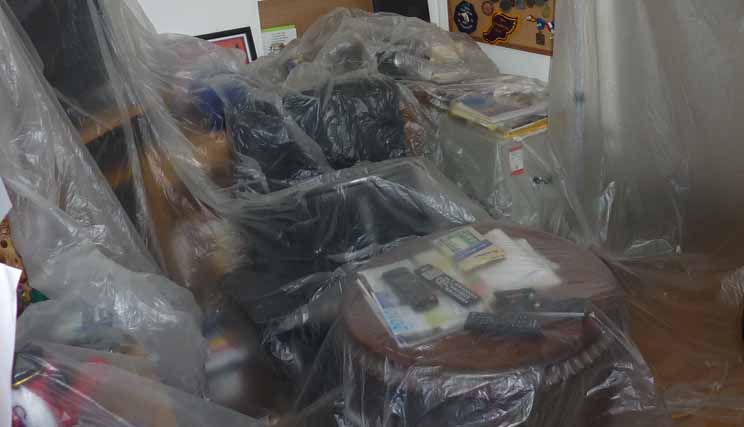
My office has three doors. One that leads toward the other rooms and one that opens to the outside. Then there is the door that opens to the space under the second story and the foundation. That crew drilled, pounded, cut and tracked dirt from room to room—always in my office. I had trouble concentrating. I suffered from memory loss. Plastic tarps covered most of the furniture, and I couldn’t find things. When I left the office to find a moment of peace, I covered the computer and printers with a bed sheet. The noise reminded me of combat but worse, because I was nineteen and then twenty when I was in Vietnam—noise did not bother me as it does now.
covered office furniture
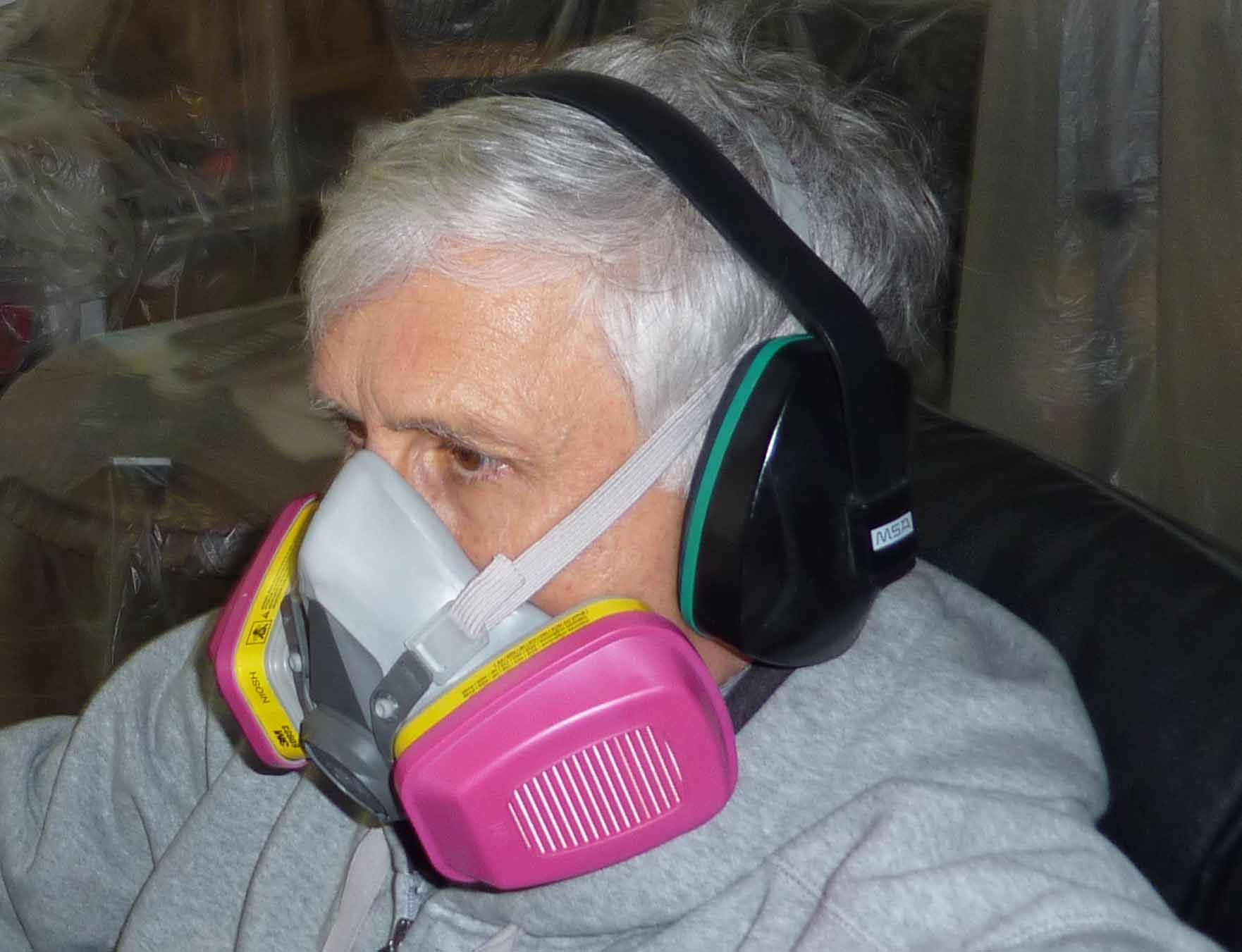
Concrete dust floated through the air and my sinuses and lungs rebelled, so I put on a 3M mask with two pink HEPA filters attached. The last time I wore a mask like this was when I was teaching. I searched the garage and found the noise suppresser to help mute the pounding and drilling. I looked like an explorer to Mars or a survivor of trench warfare struggling to write while the frigid air froze my fingers.
The crew had arrived to bolster the foundation against future earthquakes that might never arrive. Even if a hard tumbler did visit, I doubt that all that work would hold our sixty-year old hillside house together. It still might slide down the hill into the middle of the street blocking traffic.
I could have moved, but I didn’t want to disconnect all the cables and cart the equipment to another room for a few days to escape the dust and noise—something (I soon discovered) that would have been impossible without checking into a hotel.
Even with a noise suppresser covering my ears, muted sounds intruded and the last place I wanted to be was in this chair writing about China, the Vietnam War or being a teacher in the tortured American public schools. I stuck with it for days as my suppressed anger fueled by PTSD started to simmer and fume.
It was a relief when the workers finished. I thought I was going to have the tranquility back where the only noise would be the click of the keys as my warmed hands flew across the keyboard meeting my Blogging goals.
But the workers left something behind.
I started sneezing. My sinuses ran hundred mile marathons. I went to the doctor and he prescribed medications that didn’t work. The sneezing went volcanic—like Mt. Saint Helena blowing its top. One time, I sneezed so bad, I blew the 3M mask off my face—so much for a mask that’s supposed to protect you from every gas and plague Islamic terrorists can brew. Upstairs or outside, I was fine. But in my office, I was a goner. “Blam, blam, balm,” my nose exploded like rapid shots from a fifty-caliber submachine gun.
I could have opened windows, but it’s been raining for weeks. The sky has been overcast. The air breezy and cold. Then today, the sun came out and I finally let the outside in and the sneezing stopped—I’m crossing my fingers and knocking on wood. I’m afraid to close the windows, but night will come and with it lower temperatures. I fear that whatever industrial poison is haunting my once tranquil office space might return.
His latest novel is Running with the Enemy. Blamed for a crime he did not commit while serving in Vietnam, his country considers him a traitor. Ethan Card is a loyal U.S. Marine desperate to prove his innocence or he will never go home again.
And the woman he loves and wants to save was trained to hate and kill Americans.
To follow this Blog via E-mail see upper right-hand column and click on “Sign me up!”


 The Soulful Veteran's Blog