Censored but not Silenced: Part 3/5

The “Blood for Oil” theory that some claim was the main reason for the Iraq War was not the only reason behind the war, and I pointed this out to Ms. Lenarz in the allegedly censored comment.

There are at least two other major factors that have nothing to do with oil.

First, President G. W. Bush’s White House was dominated by neoconservatives who had (and still have) an agenda to export American style democracy by using the U.S. military—better known as building democracies using America’s bullets and bombs to force countries to become democracies.

A post written by Jacob Heilbrunn and published by The National Interest says, “It seems, in other words, that neocons in the administration (of G. W. Bush) were arguing that what the CIA was warning about was a bunch of hooey. They had their own pet cause—nailing Saddam Hussein, creating a democracy in Iraq …”

Second, on Jan. 17, 1961, President Dwight Eisenhower gave the nation a dire warning about what he described as a threat to democratic government. He called it the military-industrial complex, a formidable union of defense contractors and the armed forces. Source: NPR.org

And today, the military-industrial complex in the United States is a growth industry that depends on war to thrive and continue to make profits. In the allegedly censored comment, I pointed out to Ms. Lenarz that the United States Defense budget is the largest in the world. Without war, there is no excuse for this huge expense. Total global defense spending is $1.738 Trillion and America’s share of that is $711 Billion or almost 41% of the global total.

In addition, I wrote that the private sector weapons industry in the United States is the largest in the world.  This sector sells weapons to other countries and/or political organization—including brutal dictators—and controls 41% of the global market.  Second place goes to China with 8.2% of the weapons market, and Russia is in third place with 4.1% of sales. The United Kingdom, France and Germany combined have 10% of the global weapons market.

Therefore, I pointed out to Ms. Lenarz, there are three different private sector/political organizations that may have lobbied for a war in Iraq:

1. The oil industry

2. neoconservatives (with many working in the G.W. Bush White House) wanting to build democracies with America’s troops, bullets and bombs

3. the weapons industry

In the next post, I want to focus on the The Institute for Middle Eastern Democracy.

Continued on March 6, 2013 in Censored but not Silenced: Part 4 or return to Part 2

_______________________

Lloyd Lofthouse, a former U.S. Marine and Vietnam Veteran, is the award winning author of The Concubine Saga.

His latest novel is Running with the Enemy, a suspense thriller. Blamed for a crime he did not commit while serving in Vietnam, his country considers him a traitor. Ethan Card is a loyal U.S. Marine desperate to prove his innocence or he will never go home again.

And the woman he loves and wants to save was trained to hate and kill Americans.

To follow this Blog via E-mail see upper right-hand column and click on “Follow”.

Censored but not Silenced: Part 2/5

What is it that I allege was censored by Julie Lenarz?

The comment I’m talking about was a response that Ms. Lenarz made to a comment made by pabilos30 who said (February 21, 2013 at 7:35 am) : “Are you blind, the only (main) reason the US went into Iraq in the first place was to get leverage on the most valuable energy resource on this planet – Crude Oil. Sure Halliburton who CEO from 1995 – 2001 was none other than Dick Cheney. Halliburton oil services are now the main facilitator of Iraqi crude, of the 2.9 mbl/d total production over 70% of this is now exported to the US….. Now tell me the Bush didn’t go in for the oil!!!”

Julie replied to pabilos30 (February 21, 2013 at 12:56 pm): “Drop the ad hominem and people might start taking you seriously. Also, the “blood for oil” conspiracy is dead. http://instmed.org/2013/01/06/iraq-the-blood-for-oil-conspiracy-is-dead-2/

My allegedly censored comment pointed out that pabilos30 did not use an “ad hominem” when he or she said “Are you blind”. My thinking is that “Are you blind” is a question/interrogative and not a logical fallacy/ad hominem, a personal attack on Ms. Lenarz.

In fact, I do disagree with some of pabilos30’s claims. After all, I don’t think Ms. Lenarz is blind. I just think she is wrong. If I were to say, “You are so wrong”, before I offered my evidence, would she accuse me of an ad hominem attack?

I then suggested that Ms. Lenarz did not understand what a logical fallacy was and referred her to three books and a Website to learn.

  • The Structure of Argument by Rottenberg
  • Informal Logic by Walton
  • A Concise Introduction to Logic by Hurley
  • Professor Kevin deLaplante’s Critical Thinker Academy

Second, I focused on Ms. Lenarz’s “blood for oil” conspiracy is dead defense and pointed out that the support she offered for this claim was written by her and posted on the Website/Blog of the The Institute for Middle Eastern Democracy where she is a fellow.

Lenarz’s argument in that IMED post was that “invading Iraq was an extremely expensive undertaking for the US-led coalition with no guarantee or prospect of considerable profitability.”

I pointed out that the cost of the Iraq War was not paid for by any oil companies. I said that there is no tax in the United States to fund its wars. Wars are fought with mostly borrowed money that ends up growing the National Debt and that debt—if it is ever paid off—will be paid by U.S. tax payers and not by oil companies.

And the American government is not in the business of making a profit, but oil companies are, and the oil reserves in Iraq are a known commodity. It isn’t a question of if they are there but that they are there proving that the Iraq War that the US tax payers will eventually pay for will benefit oil companies in the long run.

After all, oil reserves in Iraq will be the largest in the world according to recent geological surveys and seismic data. The Iraqi government has stated that new exploration showed Iraq has the world’s largest proven oil reserves, with more than 350 billion barrels. Officially confirmed reserves rank Iraq as third largest in the world at approximately 143 billion barrels. Henry Thompson at Aubrn.edu says “Selling this oil at an average profit of $75 per barrel for the next 100 years will generate $15,000 trillion income.”

And the Iraq War Cost the United States about one trillion dollars. There is a HUGE difference between one trillion and $15,000 trillion.

Continued on March 5, 2013 in Censored but not Silenced: Part 3 or return to Part 1

_______________________

Lloyd Lofthouse, a former U.S. Marine and Vietnam Veteran, is the award winning author of The Concubine Saga.

His latest novel is Running with the Enemy, a suspense thriller. Blamed for a crime he did not commit while serving in Vietnam, his country considers him a traitor. Ethan Card is a loyal U.S. Marine desperate to prove his innocence or he will never go home again.

And the woman he loves and wants to save was trained to hate and kill Americans.

To follow this Blog via E-mail see upper right-hand column and click on “Follow”.

Censored but not Silenced: Part 1/5

I think I have been a victim of censorship. Am I wrong?

As much as we may claim to value the freedom to express our opinions, censorship in Western democracies does exist in one form or another. For example, it exists in the private/corporate sector; it exists in the public schools, and it exists among citizens who host Websites and Blogs, etc.

Reporters Without Borders’ Press Freedom Index 2011/2012 ranked Finland as number one for freedom of expression compared to 179 countries.

The United States, billed by many of its citizens as the land-of-the-free and a country that prides its freedom of expression while criticizing other countries such as China, is ranked 47th, and the U.S. has more people in prison than any country on the planet. In some parts of the United States, you can actually go to prison for life if you only steal a piece of candy or swipe a slice of pizza.

Reporters Without Borders says, “The United States (47th) also owed its fall of 27 places to the many arrests of journalist covering Occupy Wall Street protests.”

In fact, there is a long history of censorship in the United States. For one example of several, Civil Liberties says that in 1798, President John Adams made it illegal to criticize a government official without backing up one’s criticisms in court. Twenty-five people were arrested under that law.

Civil Liberties says, “The right to free speech is a longstanding U.S. tradition, but actually respecting the right to free speech is not.”

“A recent report from Google indicates that even western democracies have been trying to censor politically conflicting websites. Countries like Spain, Poland and even Canada have all submitted requests for the removal of content from the search engine.” Source: Business Insider

Back to the comment where I alleged that I was censored on another Blog that has a link to a nonprofit political organization with an alleged hidden political agenda.

I can only guess that I may have been allegedly censored because my position on the issue being discussed was stronger than the host’s opinion. Julie Lenarz, the host, specializes in Foreign and Security Policy and holds a BA in European Politics and an MA in Conflict Studies from the London School of Economics.

She is also an adviser on Foreign and Security Policy, a fellow at The Institute for Middle Eastern Democracy and current affairs blogger.

The Commentator.com says: “Julia Lenarz is author of the popular blog, Julie’s Think Tank.”

Of course, the claim that Julie’s Think Tank is a popular Blog is questionable, because its Alexa rank was almost 5.5 million with only 38 sites linked in (on February 22, 2013).  There was no data for traffic rank in the UK or US.

But what is popular to one individual may not be popular to another and everyone has a right to an opinion even if he or she may be wrong.

This we do know—there is big benefit to censor the opposition, because then you control the conversation and may advance your own political agenda.

In the post in question on Julie’s Think Tank, Lenarz’s position on the Iraq War was clear: She supported the war in the beginning and still feels it was moral and just to oust Saddam and his brutal regime. I left several comments for this post, and then wrote about this issue in a three-part series on one of my Blogs in a post titled The Noble Nightmare.

Before I share my reasons why I think Lenarz allegedly censored one of my comments, I want to focus on what it means to be a fellow in a political, nonprofit organization.

A fellow can be a participant in a professional development program run by a nonprofit. This type of fellowship is usually a short-term work opportunity (1–2 years) for professionals who already possess some level of academic or professional expertise that will serve the nonprofit’s mission. Fellows are often given a stipend as well as professional experience and leadership training.

A key phrase to remember from that description is: “that will serve the nonprofit’s mission”, and after some research, I now question what the real mission is for the Institute for Middle Eastern Democracy, but more on that later.

Continued on March 4, 2013 in Censored but not Silenced: Part 2

_______________________

Lloyd Lofthouse, a former U.S. Marine and Vietnam Veteran, is the award winning author of The Concubine Saga.

His latest novel is Running with the Enemy, a suspense thriller. Blamed for a crime he did not commit while serving in Vietnam, his country considers him a traitor. Ethan Card is a loyal U.S. Marine desperate to prove his innocence or he will never go home again.

And the woman he loves and wants to save was trained to hate and kill Americans.

To follow this Blog via E-mail see upper right-hand column and click on “Follow”.

The Noble Nightmare: Part 3/3

Imagine the cost in lives and dollars if the United States were to rule over 1.9 billion people in other countries for a few centuries until future freedom fighters drove the U.S. out after centuries of revolution.

For example, Vietnam was occupied by China for more than 1000 years from 221 B.C. until 938 A.D. when the Vietnamese resistance was finally successful and drove the Chinese out. Once the Chinese were gone, what form of government replaced them? Was it democratic?  No!

But then it would not have mattered, because a few centuries later the French arrived and occupied Vietnam, Cambodia and Laos for almost a century before they too were driven out by a popular resistance that eventually became another oppressive regime. Then the United States moved in and fought a war in Vietnam—based on another lie—for almost twenty years, leaving millions dead before it too pulled out. And during this time, South Vietnam was never ruled by a democratically elected government. Instead, the noble United States supported one dictator after another in South Vietnam.

The Government of Vietnam or Republic of Vietnam (South Vietnam) was originally led by Ngo Dinh Diem until his assassination in 1963. Afterwards, a series of “revolving door” leaders emerged, including Nguyen Cao Ky, General Khanh, Duong Van Minh, and Nguyen Van Thieu.

During the Vietnam War, the US dropped more than three times the number of bombs on Vietnam, Cambodia and Laos than it dropped on Germany, Italy and Japan during World War II. Were those bombs only dropped on military targets? No!


carpet bombing spares no one

It is estimated that the civilian death toll in Southeast Asia from America’s war (1955 – 1975) was 465,000 to 2.5 million. When we include military deaths that number is 1.1 to almost 3.9 million.

If we are unable to learn from history, we are guaranteed to repeat the same mistakes made by others.

Then of course, there is this incomplete history that many in the U.S. would rather never hear:

1. In 1953, the United States overthrew a democratic government in Iran and installed a dictator, the Shah of Iran, who ruled with American support until 1979.

2. In 1954, the United States overthrew a democratic government in Guatemala and installed a military dictator, and with American support brutal military dictators dominated Guatemala until the late 1980s.

3. In 1964, the United States overthrew a democratic government in Brazil and installed a military dictator, and with American support military dictators dominated Brazil until the late 1970s.

4. In 1965, the United States overthrew a democratic government in Indonesia and installed a military dictator, Suharto, who then with American help killed over 500,000 people–the people who supported the old democratic government. Suharto to this day continues to receive American economic, political, and military support.

5. In 1965, the United States helped install the brutal dictator, Mobuto, in Zaire, who killed tens of thousands of people and looted his country of over 8 billion dollars. The United States continued to support the brutal dictator Mobuto until just the last few years, when we are now calling him “a relic of the Cold War.” If he is a relic, he is the United States’ relic!

6. In 1973, after America had withdrawn from Vietnam, the United States overthrew a democratic government in Chile and installed a brutal dictator, Pinochet, who killed tens of thousands of people–people who supported the old democratic government. With American economic, political, and military support, the brutal dictator Pinochet dominated Chile until the late 1980s.

For a more complete list, see Dictators Supported by the United States and/or America’s Other Most Embarrassing Allies.

Now tell me how noble America’s government is.

One lesson we should learn from all this history is that one man’s noble cause often turns out to be a nightmare for millions.

Return to The Noble Nightmare: Part 2 or start with Part 1

_______________________

Lloyd Lofthouse, a former U.S. Marine and Vietnam Veteran, is the award winning author of The Concubine Saga.

His latest novel is Running with the Enemy, a suspense thriller. Blamed for a crime he did not commit while serving in Vietnam, his country considers him a traitor. Ethan Card is a loyal U.S. Marine desperate to prove his innocence or he will never go home again.

And the woman he loves and wants to save was trained to hate and kill Americans.

To follow this Blog via E-mail see upper right-hand column and click on “Follow”.

The Noble Nightmare: Part 2/3

Foreign Policy Magazine lists The Worst of the Worst and says, “There are at least 40 dictators around the world today, and approximately 1.9 billion people live under the grip of the 23 autocrats on this list alone.”

The Foreign Policy piece is worth reading because it reveals how some of these dictators were seen as freedom fighters until they won their revolution. Foreign Policy says, “Although all dictators are bad in their own way, there’s one insidious aspect of despotism that is most infuriating and galling to me: the disturbing frequency with which many despots, as in Kyrgyzstan, began their careers as erstwhile freedom fighters who were supposed to have liberated their people. ”

I think it is hypocrisy for any Americans to support the war in Iraq based on moral grounds without supporting wars against all of the other brutal, autocratic, and oppressive regimes across the globe. To do that, the U.S. would have to mobilize as it did to fight Japan, Italy and Germany in World War II by enacting the draft and raising a military force of more than sixteen million to fight a global war of this scale.

In fact, the use of nuclear weapons might also be an option to end this war as it did in World War II when two nuclear bombs were dropped on cities in Japan killing almost 200,000 innocent civilians including children.

Then after that global war on oppressive regimes,—that is if it was successful—to maintain the peace, the United States would have to occupy all of those countries by keeping a military presence as we have in Japan, Germany and South Korea. The last question would be, if the United States did do this and fought wars in these countries that have a population of about 1.9 billion people, how would the United States guarantee that a dictator would never rule these people again?

The answer is simple: The U.S. would have to rule over these countries no matter how the people felt and to achieve this, order would be maintained by a permanent U.S. military force.

Continued on February 26, 2013 in The Noble Nightmare: Part 3 or return to Part 1

_______________________

Lloyd Lofthouse, a former U.S. Marine and Vietnam Veteran, is the award winning author of The Concubine Saga.

His latest novel is Running with the Enemy, a suspense thriller. Blamed for a crime he did not commit while serving in Vietnam, his country considers him a traitor. Ethan Card is a loyal U.S. Marine desperate to prove his innocence or he will never go home again.

And the woman he loves and wants to save was trained to hate and kill Americans.

To follow this Blog via E-mail see upper right-hand column and click on “Follow”.

The Noble Nightmare: Part 1/3

After reading a post on the Iraq War by an individual who thinks the war was moral and just, I left a comment on that Blog, and then decided to continue the discussion here.

The author of that post is an advisor on Foreign and Security Policy and a fellow at The Institute for Middle Eastern Democracy. Julie holds a BA in European Politics and an MSc in Conflict Studies (Comparative Politics) from the London School of Economics. Source: Julie’s Think Tank.com

Julie says, “It is important to learn the right lessons from Iraq.”

But I say, “Why do we have to learn from the Iraq experience when we have thousands of years of history to learn from?”

Julie clearly says that she “strongly supported the invasion of Iraq in 2003 and still maintains the same position.”

And I’m one of those people that changed his mind after the truth about WMDs came out revealing that it was another fabrication used as an excuse to start what many in America still consider to be a just and noble war.

Of course going to war to remove a dictator considered a monster such as Saddam could be seen as a moral and just cause, but why do so many Americans see the United States as the global force to do that and then not continue this in other countries that were listed by The Atlantic Wire as ruled by dictators?

Continued on February 25, 2013 in The Noble Nightmare: Part 2

_______________________

Lloyd Lofthouse, a former U.S. Marine and Vietnam Veteran, is the award winning author of The Concubine Saga.

His latest novel is Running with the Enemy, a suspense thriller. Blamed for a crime he did not commit while serving in Vietnam, his country considers him a traitor. Ethan Card is a loyal U.S. Marine desperate to prove his innocence or he will never go home again.

And the woman he loves and wants to save was trained to hate and kill Americans.

To follow this Blog via E-mail see upper right-hand column and click on “Follow”.

Unwanted Heroes – Part 4/4

 3:  The Daily Grind

AHHHH!

The scream is loud and piercing.

I am in the storeroom in the back and immediately run to the front of the coffee shop, where San Francisco Financial District’s finest are packed around tables steamy cups in hand. Passing the big freezer, I rip open the door and grab a blue ice block fearing burning coffee is hideously scarring someone’s unblemished skin. With great concern for my customers and an inevitable impending lawsuit, I think, Not on my bloody shift!

“Fuck man! You’ve spilled your coffee on my papers. You clumsy asshole! I’ve gotta submit this today. My professor will kill me!”

Oh no. A law student!

“I’m so sorry. I tripped on the strap of her Timbuk2 bag,” the middle-aged businessman replies, pointing to the adjacent table. “At least it missed your laptop.”

Oh no, an optimist!

“If you’d spilled it on my laptop, I’d have sued your ass.”

Assault with a deadly drink … graduating this fall; no doubt plotting to make partner next year!

“Well, I’m glad it missed … oh, wow, is that the new MacBook?”

This man clearly has attention issues.

“Yes, a spanking new one! Look, I’ve gotta finish these corrections.” She picks up the soggy pages. “Just move on.”

But the guy just can’t. Then his tone shifts. “Why did you print it out if you’re still editing? A waste of trees, don’t you think?”

“It’s easier to spot…” She glares, ready to pronounce the death penalty. “What the fuck do you care? I’m trying to…”

This is my cue. I am the barista: a master of the mocha, a connoisseur of the cappuccino. Well, that’s my pick-up line. With careful delivery, I believe it sounds sexy, like a hairstylist, a DJ or an open-heart surgeon. I know from experience—I brew coffee at the corner coffee shop on Mission Street isn’t likely to elicit the coveted phone number.

But for now, I play mediator. The law student accepts wet napkins to clean up the mess and the sympathy of Tabitha. I escort the man to a vacant table on the other side of the coffee shop as far as possible from the threat of litigation. Both receive complimentary drinks, and soon the buzz of many conversations restores normalcy.

The law student stops me when I pass her table. “You’re alright for a Brit, Scarecrow.”

Scarecrow is a nickname that seems to follow me. I am reasonably tall, five-nine I think, thin, and with hair that refuses to be subdued by even a highly disciplining gel. About five minutes after grooming, I am left with, on a good day, the controlled scarecrow effect. I automatically move my hand to flatten the offending spikes and she laughs.

“You look fine.” She giggles.

“And you’re alright too.” I mumble, flattered to get her attention. “At least for a law student.”

Our café borders the financial district and the Embarcadero as well as some law and business schools. This prime location attracts refugees from the intensely caffeinated work culture by day and draws an eclectic crowd in the early evening when The Daily Grind transforms into an intimate wine bar. We also serve tourists who have lost their way to the nearby Ferry Building and the attractions of the Embarcadero.

Like all coffee shops, our weekday has its ebbs and flows. The morning is a madhouse as no self-respecting San Franciscan can possibly begin the day without their caffeine fix. By seven in the morning the line snakes outside our shop. With regulars, I try to remember their usual orders; a good memory ensures that loose change finds its way into the tip jar. If I can’t recall what they drink, I make an educated guess and am rarely far off. Even then, I apologize and explain how I evidently confused them with an actor, singer, sportsman or politician. Compliments generate tips just as effectively as a good memory.

As the day wears on and eventually draws to a close, we place aromatic candles on the tables; vigorously air out the place to lessen the robust coffee aroma and turn on carefully placed spotlights to highlight the heavy, oak wine racks lining the walls. Polished wineglasses take prominence over coffee mugs while jazz plays softly in the background.

The crowd changes, at least in its intent. Tired businessmen and women seek a ritual to cleanse themselves of the workday stress. Couples huddle in the corners wondering over a deep-red Merlot if the person facing them might just be the one. Life is a Cabernet, my friend, and a soul mate is waiting to be found.

It’s a job, a good one, and it pays for my other life. You see, I’m not only a barista. I’m a writer. A well-worn book about famous writers who spent time in San Francisco sits by my bed. I’ve walked in their footsteps, frequented their coffeehouses and wine bars, and opened my Mac in search of the same inspiration.

One day soon, I’ll be a famous author. Someone once defined an author as a writer who never gave up. I’m far from famous, but I’m also far from giving up. Like others of my tribe, I’ve saved the rejection letters—evidence of the emotional scars that all wannabe authors bear.

Let me show you my world: the parallel realities of the barista and the writer, the highs and lows of an aspiring artist, the pitfalls that await a lonely young man with much to give. But first, let me introduce you to San Francisco, the greatest city in the world.

Yeah, I grew up in London with fog rolling off the Thames, but I do not recall locals stopping to admire it. Other cities share similar traits to San Francisco: Rome has hills; London has immigrants and culture, and Paris the artistic mystique. But San Francisco has all of this and it is not thrown in your face. It just is.

I lean over the rails on the Embarcadero and stare out at the looming Bay Bridge, gray and partially veiled by early-morning mist. Next to me stands a metal woman eighteen feet high—a creation welded from hundreds of recycled pieces of junk. She holds hands with a child about eight feet tall and together they stare out to sea.

The metal woman lacks the elegance of the Statue of Liberty. That is what makes San Francisco special. It works without pretentiousness. I am told that the metal mother and child stand at the annual Burning Man festival in the Black Rock desert. Fire courses through her body and out of her hand into the child.

We could do with a fire right now. I shiver as I watch wisps of cloud hover above the water. It is very early and I must open the coffee shop. Despite the cold, I love this hour of the day when the city slumbers but is not asleep. It is simply preparing for the onslaught.  In two hours, tens of thousands of people will spew out of the BART and MUNI public transport tunnels. Others will stubbornly drive in searching for elusive and pricey parking spaces. The more enlightened drivers have recruited passengers from the casual carpool pickup points scattered around the bay thereby paying less for the bridge tolls and utilizing the carpool lanes. The passengers, for their part, get a free ride into town.

Walking down Mission Street, I see Clarence, a huge African American dressed in a shiny black suit. I cannot tell if he is awake behind those big black sunglasses until he raises his saxophone to salute me. The shiny instrument gleams, even in our fog-filled streets, and Clarence lets rip a short riff to announce the barista has arrived!

Clarence customarily stakes his position in the early morning. There are more street musicians than ever these days and, with only a few prime spots, Clarence must claim his territory. But at this time of day, he plays only for me and I feel like a king. Clarence knows I do not have spare change to throw in his open sax case—perhaps he would feel insulted if I did.

Later, around 9.30, when the herd is safely corralled into their office cubicles and Clarence’s muscles are aching; he will come and rest in The Daily Grind. When I think Mr. Tzu, the owner, is not looking, I leave a cup of coffee on Clarence’s table. I used to mutter under my breath that some jerk had changed his order after I had already poured his cup and there is no point wasting it. After about the fortieth time, I figured Clarence had picked up on my ruse so I just place the steaming cup on his table without a word.

No thanks, but I know the gesture is appreciated just as I appreciate Clarence playing for me as I pass him in the early morning. He will sit for an hour or so then slowly move off. I know little of Clarence, but he is part of my life—another strand that weaves this urban tapestry called San Francisco.

Two weeks ago, a bunch of students entered The Daily Grind and their clothes were covered with ‘New Orleans’ insignia. They were excited and boisterous as they passed Clarence at his regular table. From the way Clarence eyed them, I thought that their intrusion annoyed him, but I was wrong.

“Hey! What’s with th’ shirts? What y’all doing with New Orleans?”

A young woman, blond, thin and tanned, excitedly explained how they’d just come back from a week helping rebuild houses damaged by Hurricane Katrina. “You should’ve seen the damage that hurricane did,” she said.

“Ain’t no hurricane did that, gal,” Clarence replied with a growl. “Weren’t no nat’ral disaster. Don’t let ’em bull ya’. The hurricane would’a done some damage, but if those levees had held, if those bastards had built ’em like they should, well, ain’t no one have died there. My grandma’s house waz swept away. Broke her, it did. Such a proud w’man.”

Clarence rose and moved heavily to the door but then turned. We all watched. He spoke now in a softer tone. “But I thank y’all for going down there t’help. It’s import’nt y’all show ya’ care, that some’n shows they care.”

We saw his tears as he walked out the door and left behind a heavy wake of silence. I could not stop myself. I nodded to Tabitha to cover for me and followed him out of the café.

He stood on the corner of Mission and Spear caressing his saxophone and let rip the most beautiful, soulful jazz I have ever heard. He was not playing for me that time; he was not even playing for San Francisco. I could almost see his tune rolling out of the bay along with the fog making its way to the Gulf Coast.

When he finished, I approached unsure what to say. We stared at each other.

“I’m so sorry,” I said. “I’m so sorry.”

I had spoken with Mr. Tzu, that day. I had an idea and from that week, every Friday at lunchtime, Clarence played in The Daily Grind to a packed audience. Big jars were scattered around the tables with labels: All Proceeds to New Orleans Relief Projects and as the music touched our customer’s souls, the jars filled, because San Francisco has a heart, and that heart was bleeding for a sister on the Gulf Coast.

Return to Unwanted Heroes – Part 3 or start with Part 1

____________________

You may buy Unwanted Heroes at Amazon.com

Growing up in London, Alon Shalev has been a political activist since his early teens. He strives through his writing to highlight social and political injustice and to inspire action for change.

Moving to Israel, he helped establish a kibbutz where he lived for 20 years and served in the Israeli army.

Shalev then moved to the San Francisco Bay area and fell hopelessly in love with this unique city. Being new to the US, however, he was shocked to see so many war veterans on the streets. He regularly volunteers at initiatives such as Project Homeless Connect and the San Francisco Food Bank where he meets and talks with war veterans.

To follow this Blog via E-mail see upper right-hand column and click on “Follow”.

Unwanted Heroes – Part 3/4

2:  The Letter

I stare at him in bewilderment as he strides out of the café. I cannot decide whether I admire or fear him and conclude that probably a bit of both is most prudent. Turning back to the counter, I see Tabitha watching me as she hands change to a customer. I feel a sharp wave of panic.

“So they’re onto me?” Her tone is flippant when it is just the two of us. “It’s the addiction, Will. Caffeine and a full moon. Such a fatal combination.” She raises her cup and flutters her eyelashes as she sips.

“Until Mr. Tzu shows up, we’ll have to rearrange the work roster,” I reply somberly. “I assume Ginny has been filling in for Mr. Tzu over the weekend, but you have more experience. You’re going to have to pull the shift opposite mine.”

“But then we won’t get to work together! Who’s going to train me, nurture my career, and bring out my full potential?” She does a credible job pouting like a spoiled child. Then stretching out her hands, she bows her head. “I’m still your humble apprentice, Will, my lord, my barista.”

I relax. “Be mindful of the Force, my young Padma,” I say in my best Yoda-ese, “and keep the fucking Beast clean. Remember, the coffee flows through the Beast.” If only my school counselor had let me pursue a career as a Jedi Knight. “Right now, you’re the only other person supremely qualified to run shifts,” I say, getting back to business.

“But what about the wines?” Tabitha asks.

“George and I will alternate,” I reply.

“Carrot Face?”

“You’re going to call him that to his face one day soon and I might not be around to protect you.”

We both laugh. The prospect of Carrot Face or George and I going a few rounds over Tabitha’s honor is amusing. George is a recent addition to our staff. He knows little about coffee but worked on a vineyard in Napa for a few years. He is skinny, spotty, awkward and … well you can probably guess his hair color.

“But you’re gonna work a lot of hours,” Tabitha says, concerned.

“It’ll only be for a few days. He’ll be back soon.” I hear the doubt in my voice.

I serve two businessmen, who take their drinks swiftly to a table—their discussion never stopping.

Tabitha shrugs. “I bet the bastard rented a sports car and is in Vegas denying his age. Men are jerks, you know.”

“How would I know that?” I roll my eyes.

“You’re a writer, Will. You must’ve noticed them. Jerks.” Tabitha manages a disdainful expression.

“I’m also a man—never mind. The other day when Mr. Tzu chewed you out, has that happened before?”

“No, I’m actually a wonderful asset to the business!” Tabitha replies, her voice feigning hurt, then she frowns. “Hey, Will, you’re worried, aren’t you? You’re not convinced he’ll be back in a day or so?”

“I don’t know,” I say. “I wonder what made him crack.”

Tabitha shuffles and stares down at her scuffed Doc Martin boots.

“Tzu’s always been kinda tight, y’ know. Not big on the conversation, but he’s not a screamer either. That day, though, he was really pissed and not just because I failed to clean the Beast to his standards. He later chewed out Carrot Face after George quipped that, though it was his brother’s birthday, he was ignoring it as they weren’t close.

“Tzu heaped him a nasty lecture about family and loyalty. It wasn’t a fatherly rebuke either. Tzu was really pissed. I figured maybe it’s an Asian thing. They’re very family oriented.”

Tabitha puts down a wineglass that she’s been polishing and sighs. “Look, I don’t know Tzu. I’ve always been a bit scared of him ’cause he never talks or anything, so I’ve kinda kept my distance. You never know what’s going on in his mind. It’s intimidating. I’m not a barista or a wine freak like you. I’m expendable. As a woman, too, I feel vulnerable around him. Asians are pretty patriarchal, y’know, and I’m at the bottom of the food chain.”

“Yeah.” I’m feeling increasingly uncomfortable. “Let’s get back to work.”

A few minutes later I see Tabitha hovering by Tzu’s desk in the back of the store. She’s holding a badly crumpled piece of paper and calls me over.

“Will, look. This letter appeared the morning Tzu wigged out on me and Carrot Face. It had been slipped under the door before we arrived to open the café. I picked it off the floor, but Tzu grabbed it from me and read it immediately. He had it in his hand or his back pocket all morning. Later, I saw him put it in his desk drawer.”

Hoping for a clue, I take the letter. It is dirty and creased, and I just stare at thick, black Chinese characters.

I return the letter to the drawer of Tzu’s desk. It will be here when he returns—probably tomorrow. But Tzu doesn’t return and as the week passes, the whole staff begins to worry for Mr. Tzu and our jobs.

Early Wednesday, an elderly Asian woman enters the café. She wears a thick heavy coat and a green-silk scarf covers her head probably to ward off the chill. I turn to serve her as she approaches.

“Will?” Her voice is unsteady and her English heavily accented.

“Mrs. Tzu?” I hazard a guess.

She nods. “Please, bring green tea and sit with me.” She shuffles over to an empty table. There is a heavy flow of customers. I don’t like the other staff members seeing me sit while they work, but this wasn’t presented as a request.

Mrs. Tzu sips the tea and stares at me. Her face looks tired and worn.

“I’m sorry about Mr. Tzu. I really am,” I say. “Is there anything I can do to help?”

“Husband will come back.” She nods as she says this but without conviction. “He says you are good boy. He says you can be trusted.”

“Thank you, Mrs. Tzu. That is high praise.” I am pleased to hear this. “I love my job and the coffee shop.”

“Good, good.” She nods. “You stay and run place. Mr. Tzu will soon return and give you reward. Okay?”

“Sure, Mrs. Tzu. Do you have any idea where he might be? Could he … could he have gone home to China?” Last night, I dreamed that he had returned there to die, but I don’t feel it prudent to share this.

“Mr. Tzu is American.” She shakes her head. “Left China as very small boy and feels no love for China. Love 49ers and Giants. For him, America is home.”

“What do your children think? Have you talked with other relatives?”

She again shakes her head. “I speak with children. Speak all the time. No brother or sister. This disappearance is very strange. He has gone before when very stressed. Has something in past, something from war.”

“So you don’t think he’s been kidnapped or anything? He doesn’t have any enemies, does he?”

She looks at me for a moment perhaps to see if I am joking. Then she leans forward, her expression serious. “Mr. Tzu is good man. Very fair. Many in city know him. All have high respect for him.”

“I’m sorry. Didn’t mean to imply—” I didn’t know what I didn’t mean to imply, and we both fall silent.

Then Mrs. Tzu leaned forward. “I am from China. Parents die during time of Long March, I think. Maybe later. China was chaos. Hard life then. I brought to US to stay with aunt. Meet Mr. Tzu in city. America is good but for me not home. Mr. Tzu is my home and so America is my home.”

She leans back and sighs. “49ers and Giants, they suck. Coffee not good either. Bad for Shen, for spirit. Green tea is good—keep you young.” She winks. Then she laughs, and I try to laugh with her.

I feel a wave of sympathy toward this brave woman who, like me, is far from her home. I swallow hard. “Mrs. Tzu. I don’t know where he is. I don’t really know him.” I’m getting repetitive perhaps feeling guilty that I haven’t tried to befriend him. “But maybe you could come into the café more and sit here to help look after the staff and customers?”

She flashes the briefest of smiles. “Thank you. Mr. Tzu is right. You are good boy. I go down to visit children in Ventura for few days. Help them not to worry.” She smiles and looks proud, so I think that they have invited her. Then she asks, “You good son to parents, yes?”

I’m a little bewildered by the change of direction but manage to say, “Despite the distance, I try. My father passed away about ten years ago, but I think they were always good to me. My mum’s still in England and I miss her—both of them, I guess.”

“Maybe you send mother flowers to show you think of her? Write letter. I come back and check, yes? After I return from Ventura.”

Write a letter—shit! The letter! I reach into my pocket but something stops me. Mrs. Tzu rises pushing down on the table as she straightens and shuffles out. I remain seated staring at her cup of still-steaming tea, which she hardly touched. Mrs. Tzu could probably have translated the letter her husband received on the day he flew at the staff, yet some strong impulse holds me back. I shrug. I can show her the letter another time.

I pick up her warm cup and hug it between my two palms. As I stare at the door she has just exited, I have a strong feeling that I am getting sucked into something that shouldn’t be part of my life yet unequivocally is. Shit! Maybe I should give up coffee for green tea. It’s bad for my Shen whatever that is.

Continued on February 20, 2013 in Unwanted Heroes – Part 4 or return to Part 2

____________________

Growing up in London, Alon Shalev has been a political activist since his early teens. He strives through his writing to highlight social and political injustice and to inspire action for change.

Moving to Israel, he helped establish a kibbutz where he lived for 20 years and served in the Israeli army.

Shalev then moved to the San Francisco Bay area and fell hopelessly in love with this unique city. Being new to the US, however, he was shocked to see so many war veterans on the streets. He regularly volunteers at initiatives such as Project Homeless Connect and the San Francisco Food Bank where he meets and talks with war veterans.

You may buy Unwanted Heroes at Amazon.com

To follow this Blog via E-mail see upper right-hand column and click on “Follow”.

Unwanted Heroes – Part 2/4

1:  The Disappearance of Mr. Tzu

Monday mornings are tough at the best of times. The Financial District of San Francisco swarms with people craving their caffeine turbo charged as they transition from weekend wildness to the cubical and office. The line for coffee snakes out of The Daily Grind onto Spear Street and I, the barista, marshal my staff to satisfy the needs of my newly adopted city.

Nothing can stop me as steam rises from the Beast, our espresso machine, which hisses and whistles as I concoct cappuccino, mochaccino, latte, espresso, nonfat, low fat, decaf, skinny. I am focused. Nothing can take me out of the groove as I serve the suits, the ripped jeans, the police uniforms.

Police Uniforms? One is a huge ruddy-faced officer while the other is smaller, mustached and maybe Hispanic. I’m still too new in the US to accurately place the myriad of people who make up the melting pot of San Francisco. But I do notice that the smaller officer wears wraparounds even inside our coffee shop.

“Are you the barista?”

“Yes sir. My name’s Will … Will Taylor. What can I get for you?” What are the customers thinking? What did he do? He made such a nice latte. Who would have thought?

“Good morning, Will. I’m Captain O’Connor and this is Sergeant Mendez. We’re SFPD.” Two badges flash against the fluorescent lights held in front of the midnight-blue uniforms. “We’d like to talk to you about your employer, Mr. Tzu.”

“Now?” I glance at the line then my watch. It is a few minutes to nine o’clock and the rush is almost over.

“Can we move this away from the counter, gentlemen, and maybe give me just five minutes here?” My tone is a mix of impatience and a fear of authority—especially in a land I am not used to. “Why don’t you sit over at that vacant table, and I’ll bring you coffee?”

As I continue to work our espresso machine, I recall a conversation on Saturday with Tabitha. Tabs was due to replace me for the afternoon shift but, as she often did, she came in early to hang out, as the weekends are pretty quiet.

Tabitha was my first true friend after I arrived in the US, and we have remained close since. She is young, thin and has a tendency to wear body-clinging clothes that appear to have shrunk several times over. Her mousey blond hair is straight and looks fashionably neglected. She has piercings everywhere. Tabitha can be dead cool or apple pie fresh; apparently, it is somehow related to the moon’s cycle.

“Hey Hemingway,” she said with a chirp.

When we first met, I made the mistake of trying to impress upon her my desire to become a famous writer with a Hemingway quote. I’m pretty sure she uses the nickname as a token of affection.

Tabitha is supposed to be an art student. She is enrolled at the nearby Academy of Art, although she seems to attend with varying degrees of intensity. She never likes to discuss her art or her studies and I have learned to avoid the topic.

Our relationship is purely platonic. She’s been to my apartment a few times for dinner and a movie. Twice she slept over as it was late; yet there was no suggestion of anything sexual. She could be my little sister—I always wanted a younger sibling to bully.

On Saturday, I had been cleaning the Beast, which our boss demands must sparkle and purr. Mr. Tzu was apparently one of the first to import such a fine espresso machine from Europe and was extremely proud of it.

“The Beast looks good,” Tabitha said, patting the metallic giant. “You take good care of …” Her voice had faded.

I stopped cleaning the machine and turned to her. “What’s up, Tabs?”

“Tzu chewed me out the other day.” Her voice quivered, and she played with a hanging lock of hair. “He was brutal.”

Though Mr. Tzu is my boss, I know little about him. When he saw that I could not only function as barista but also as shift manager, he had me running the opposite shifts to him.

An elderly Asian American, Mr. Tzu is nearing retirement. He’s prompt, quiet and formal. Although there is a high staff turnover, I’ve never heard of someone being yelled at or fired acrimoniously. Tzu provides health benefits, not a given in this line of work, and we enjoy the informal work environment and compensation.

“What did you do wrong?” I asked.

“Nothing really.” Her tone was sulky, bottom lip pouting. “I hadn’t cleaned the Beast properly in his eyes.”

“He is very protective of it,” I replied, trying a sympathetic approach.

“The coffee machine wasn’t the reason!” Tabitha snapped. “He was really pissed, Will. There’s something going on.”

I pause, puzzled by her response. “I’m sorry he got mad, but what do you mean?”

“Well, you know. He’s married and has kids somewhere. I’ve never had a meaningful conversation with him, but I sense something is eating at him—something serious.”

“Hmm.” I had nothing else to say.

I hadn’t given it any more thought. My shift finished and I spent the rest of the weekend writing vigorously on my laptop. In fact, this whole scene had slipped my mind until now when the police entered the coffee shop.
Low Res Finished Cover on November 14

“Again, I’m Captain O’Connor.” A thick hand is extended and soon crushes mine. “We’re here about Mr. Tzu.”

“Why? What’s happened?” I sip a glass of water I have with me.

“He’s disappeared, Will. No one has seen him since Thursday. What can you tell us about your boss?”

“Not a lot. I’m curious. A grown man disappears for a few days and the police are already involved?”

“Listen, kid,” replies Captain O’Connor, a big muscular fellow with an imposing mustache and balding head. “San Francisco might seem like a big city to an outsider like yourself—an Englishman no? But we still have neighborhoods, communities, and we still look out for each other. Mr. Tzu is known around these parts and there’s a history. Let’s just say that this isn’t the first time, okay? Now please, tell us what you know about your boss.”

I shrug. “Probably less than you. When he hired me, he was looking to reduce his hours. He’s getting old; probably thinking about slowing down. I’ve considerable experience as both a barista and sommelier, and I studied business for a while in college. I really don’t know him. Once he saw that I’m competent, he pretty much has had me working the opposite shift to him.”

I sip more water and try to think of something else. “There’s a Mrs. Tzu and kids, grown up I think, but I’m not sure how close the family is or where the kids live.” Both O’Connor and Mendez display bored expressions, and I say, “I’m not telling you anything new, am I?”

“No, you’re not,” replies O’Connor. “Think of something that might be relevant to his disappearance. How’s business? Any problems come to mind?”

“I think business is pretty steady,” I say. “But I don’t see the books, so I can’t be certain.”

“What else is sold here, kid?” The second cop, Mendez, leans in and speaks quietly, his voice a fair James Cagney. “Anything, you know, on the side?”

I stare at him for a few moments wondering if he’s joking, but he just stares back blankly awaiting my answer. Mendez, in contrast to his partner, is a small, dark man with jet-black, greased-back hair and sunglasses. We’re a month into a gray San Francisco winter and he’s still sporting sunglasses—indoors. His badge, on the other hand, is extremely shiny and glints when it catches the café’s ceiling lights.

“What do you mean?” It’s about all my brain can muster.

“Drugs, gambling, numbers, you know?” Mendez no doubt reels off such a list a few times a day.

“None of that stuff.” Is he joking?

The Hispanic cop wiggles his nose as if trying to pick up a scent. “You said that he has you working the opposite shifts to himself, correct? Ever thought he did this on purpose?” He stares at me over his steaming coffee cup. There is some froth on his dark mustache. “Perhaps he’s keeping you away from something?”

“Of course not,” I answer. “I told you he’s just slowing down and feels he can trust me.”

“Yes, you did.” He takes another calculated sip of coffee. More foam beds down in his moustache. “Any of the staff mentioned someone coming into the coffee shop and arguing with him? Or have any of them argued with him?”

I glance at Tabitha thinking about her argument with Mr. Tzu over the Beast but shake my head. “No, not that I know of.”

“Anyone fired recently?” Mendez is certainly persistent. “Perhaps someone left feeling like he screwed ’em?”

I’m really no help. “Maybe you should talk with the other employees,” I say. “I need to get back to work. Do you have any more questions?”

“Not for now.” O’Connor says handing over a business card. “If anything comes to mind, call us.”

As the captain walks out the door, his partner leans back in still holding his coffee cup. His James Cagney tone is little more than a whisper.

“Keep an eye on the girl.” His eyes flash toward Tabitha. “We know about their argument, and we know you didn’t tell us. It’s all about the espresso machine. If it ain’t treated right, we can tell.” He taps his nose with a thick, gold-ringed finger. “The customer always knows.”

Continued on February 19, 2013 in Unwanted Heroes – Part 3 or return to Part 1

____________________

Growing up in London, Alon Shalev has been a political activist since his early teens. He strives through his writing to highlight social and political injustice and to inspire action for change.

Moving to Israel, he helped establish a kibbutz where he lived for 20 years and served in the Israeli army.

Shalev then moved to the San Francisco Bay area and fell hopelessly in love with this unique city. Being new to the US, however, he was shocked to see so many war veterans on the streets. He regularly volunteers at initiatives such as Project Homeless Connect and the San Francisco Food Bank where he meets and talks with war veterans.

You may buy Unwanted Heroes at Amazon.com

To follow this Blog via E-mail see upper right-hand column and click on “Follow”.

Unwanted Heroes – Part 1/4

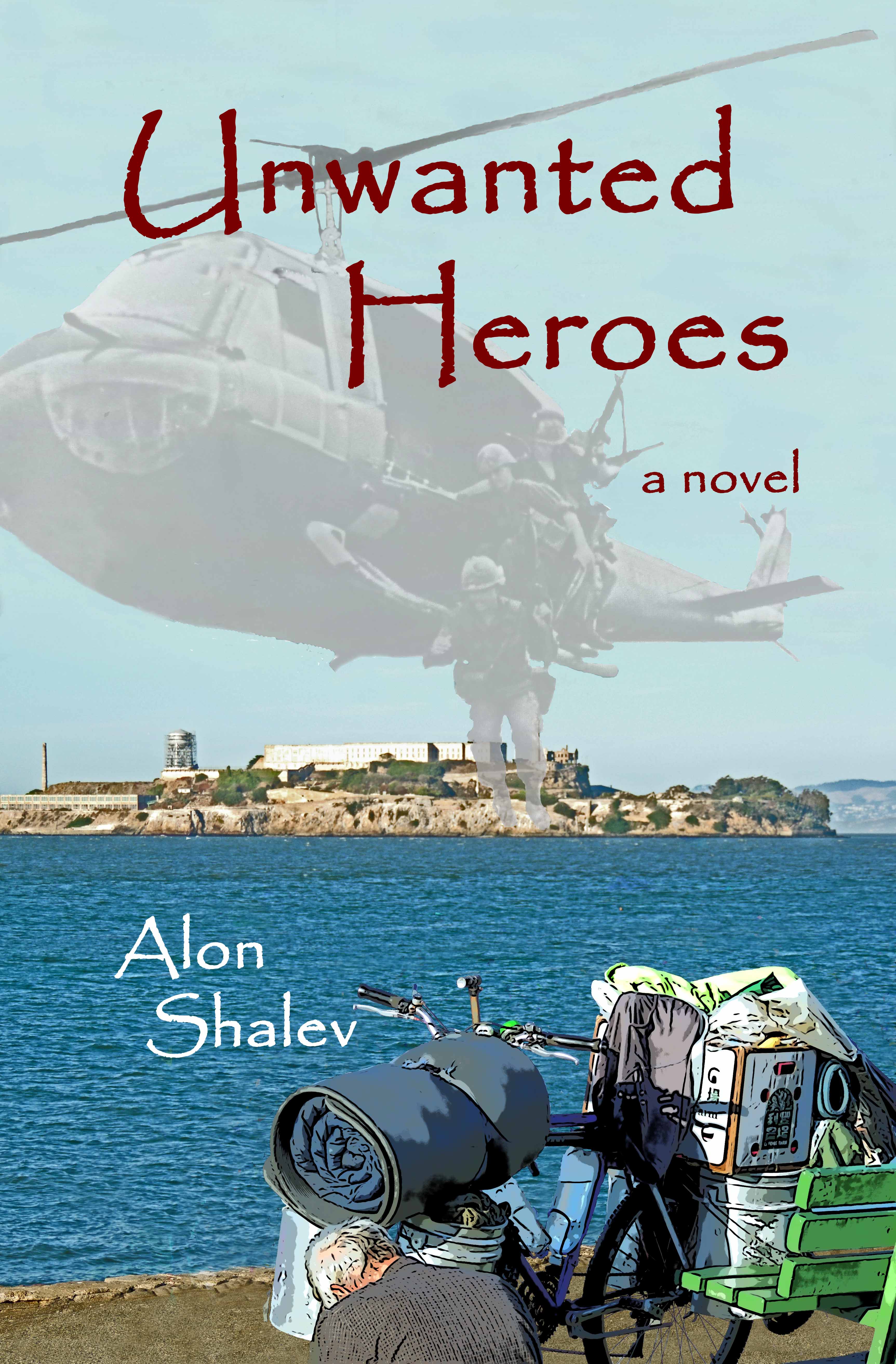
Disclaimer: Lloyd Lofthouse is the editor/publisher of Alon Shalev’s Unwanted Heroes, and for a few days, we will showcase the first three chapter of his novel about surviving with PTSD.

Unwanted Heroes brings together an elderly, battle weary Chinese American war vet and an idealistic and pretentious young Englishmen, who share a love for San Francisco, coffee and wine. They soon discover further common ground when repressed memories abruptly surface, cementing an unlikely relationship that just might release each from the tragic pasts that bind them.

When Will Taylor finds employment as a barista at The Daily Grind in the Financial District, he feels inspired to write his breakout novel. Walking the streets of Kerouac and Ginsberg, Taylor discovers the harsh side of America and an injustice he must try and help right before he loses his sanity and love.

When his boss suddenly disappears, Will needs all the help he can find. A homeless professor, precariously balanced between intellectual pinnacles and mental abyss, offers advice and contacts. Taylor’s Goth girlfriend initiates him into the West Coast counter culture, while her Nob Hill father digs up his own military nightmares to help another haunted soldier in desperate straits.

The unique culture of San Francisco lends itself to the comical aspects of the novel, offset in a rollercoaster of emotions as comic follows tragic. Will finds himself dining with his Goth girlfriend and her parent at their home on Nob Hill and teaching them how to toast in twelve languages. In the next scene, he is frantically searching a military graveyard at night, looking for his boss who has suddenly disappeared for a second time.

Unwanted Heroes confronts the issue of homelessness and, in particular, war vets who could never readjust into society. This novel is a tribute to a beautiful, unique and quirky city, its people, and those who sacrificed so much to keep it and America free.

Continued on February 18, 2013 in Unwanted Heroes – Part 2

____________________

Growing up in London, Alon Shalev has been a political activist since his early teens. He strives through his writing to highlight social and political injustice and to inspire action for change.

Moving to Israel, he helped establish a kibbutz where he lived for 20 years and served in the Israeli army.

Shalev then moved to the San Francisco Bay area and fell hopelessly in love with this unique city. Being new to the US, however, he was shocked to see so many war veterans on the streets. He regularly volunteers at initiatives such as Project Homeless Connect and the San Francisco Food Bank where he meets and talks with war veterans.

You may buy Unwanted Heroes at Amazon.com

To follow this Blog via E-mail see upper right-hand column and click on “Follow”.