There was a mess hall in Chu Lai, Vietnam inside the company area and, of course, I ate there but not often. That mess hall served three companies. Except for Thanksgiving, the food wasn’t that good. It was powdered eggs for breakfast and similar chow the rest of the day.
Most of the time, I ate C-Rations and heated them with a can of Sterno. If I didn’t have Sterno, I opened a can of crackers or chocolate, took out the contents and vented the bottom, stuffed the can with dirt and soaked the dirt with gasoline then lit a fire and heated the main course on that makeshift stove.
When I was in the field driving a radio Jeep, I’d pop the hood and set the can on the manifold until the food was bubbling. The engine was kept running to power the radio behind the front seats. My favorite C-ration was the ham and limas. Since few in my platoon liked that flavor, I usually ended with more than one can. The chocolate was horrible–not sweet by today’s standards.
Since GIs were eating that chocolate in World War II, there must have been a lot less sugar in candy then. I’ve seen movies where WWII GIs are rolling through towns in Europe or Japan handing out United States military chocolate to kids. That C-ration chocolate wouldn’t sell well today—American kids would throw it in the trash.
Today, the average American eats (156) one hundred and fifty-six pounds of sugar per person annually, that’s thirty-one, five-pound bags. The high school where I taught installed soda machines a few years before I left in 2005. I was told that two thousand sodas were being stocked in those school machines twice a week and there were only two thousand students. I read that in 1600, sugar consumption in the UK was seven pounds per person. In 1850, that was up to fifty-two pounds. In America, diabetes has jumped more than five hundred percent since the 1950s, and kids are getting adult diabetes. Need I say more?
The C-rations I ate in 1966 were stamped on the side of the box with 1945. Every box of C-rations came with four, free cigarettes. I smoked a few but didn’t like what it did to my taste buds, so I gave the cigarettes away. I imagine many young American men were hooked on cigarettes fighting America’s modern wars until the day came when tobacco was removed from military rations. At nineteen, I didn’t know a thing about nutrition. I’ll bet there wasn’t much health left in those cans after sitting for more than twenty years.
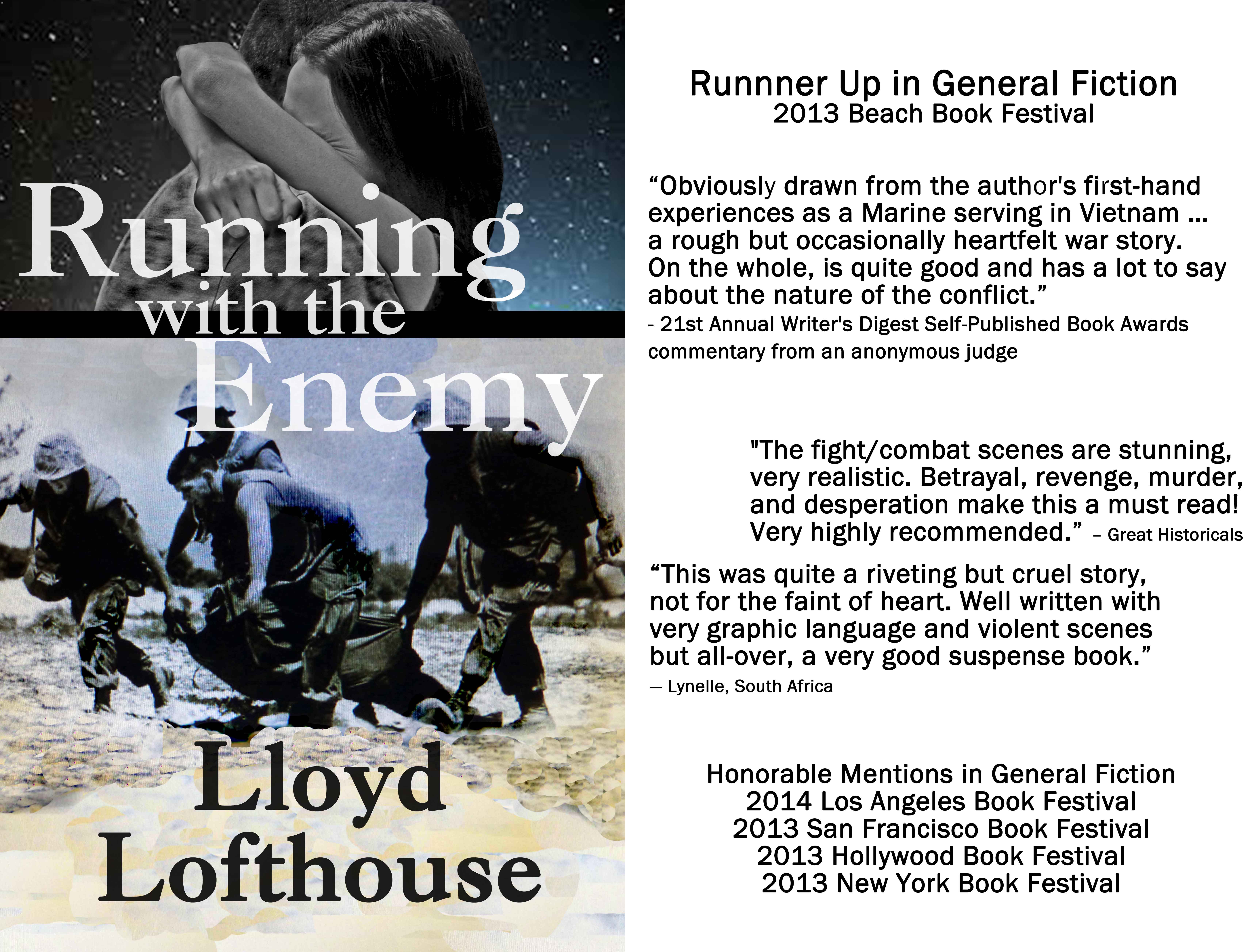
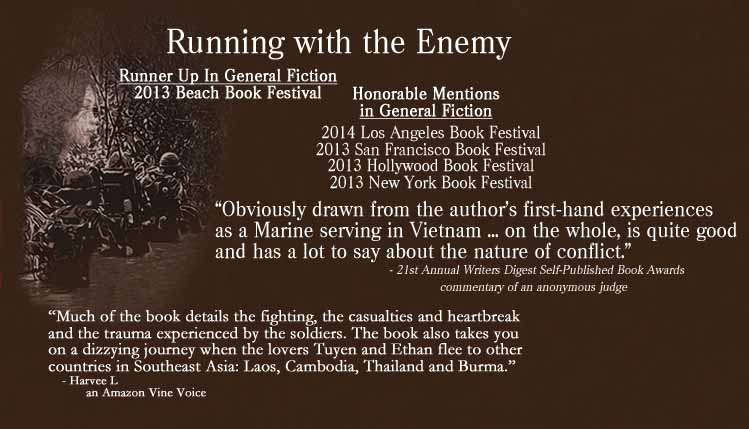
His latest novel is Running with the Enemy. Blamed for a crime he did not commit while serving in Vietnam, his country considers him a traitor. Ethan Card is a loyal U.S. Marine desperate to prove his innocence or he will never go home again.
And the woman he loves and wants to save was trained to hate and kill Americans.
To follow this Blog via E-mail see upper right-hand column and click on “Sign me up!”
The quiet was almost total this morning at 3:00 AM.
There were no crickets, and there was no sound of intruders. I lay in bed listening for a long time, maybe an hour before I drifted off again.
The familiar static was there that is the only sound when there is no noise outside my head. I’m not sure I’ve heard total silence since Vietnam.
During early morning moments such as this, I remember one night in Vietnam when I lost my sight and hearing.
In Chu Lai, Vietnam, I was a field radio operator in the 1st Tank Battalion, First Marine Division.
The M-48 Patton had a 90 mm cannon. The M-48 was separated into three compartments: the driver’s compartment, the fighting compartment where the gunner, loader, and tank commander [TC] fought, and the engine compartment.
Above the main gun was a 1 million candlepower Xenon searchlight. This light had both a white light and an infrared mode. It was bore sighted with the main gun and gun sights so that it could be used to illuminate a target at night.
Hearing those 90 mm cannons firing may have contributed to the static in my hearing today.
However, one night, a battery of M-109 (called the Paladin), 155 mm self-propelled howitzers gets the most credit for that static.
That battery fired a surprise mission.
At two AM, I was standing watch in a hillside bunker above the M-109s, and I was struggling to stay alert and awake.
Without warning, the battery fired.
What little hair I had on my head stood at attention, and the combined flashes left me blind for a moment with dancing spots staying longer, but the loud buzzing in my ears stayed for hours.
My head felt as if it had been stuffed with cotton. All sound was dampened for some time.
By the way, field radio operators did not ride in tanks. We had a jeep with a canvas top. A large radio filled the space behind the front seats.
When we weren’t driving around in old WWII vintage radio jeeps, we hoofed it with a radio strapped to our backs and our old batteries were often dead before we used them.
The radio we arrived with in Vietnam with was a PRC 10. There was no armor to protect field-radio operators in the field. Field-radio operators were usually the first to be shot in an ambush.
His latest novel is Running with the Enemy. Blamed for a crime he did not commit while serving in Vietnam, his country considers him a traitor. Ethan Card is a loyal U.S. Marine desperate to prove his innocence or he will never go home again.
And the woman he loves and wants to save was trained to hate and kill Americans.
To follow this Blog via E-mail see upper right-hand column and click on “Sign me up!”
It has been said that the world’s oldest profession is prostitution. That is wrong. The oldest profession is motherhood.
The second oldest profession belongs to warriors leaving home to fight in foreign lands. That may make prostitution the third oldest profession. It all comes down to what came first, the chicken or the egg.
When warriors leave home to fight in foreign lands, the hormonal drive to have sex does not go into hibernation. That has been true for thousands of years.
I am sure that Alexander the Great’s army did not become celibate all those years away from Greece while conquering so much of the known world.
Soldiers have two choices to take care of the sex drive: commit rape or turn to prostitutes. Celibacy is usually not the choice most young men in the military make.
The Vietnam War was no different. For each tour served, the troops were given five days of R & R. It was called rest and recuperation.
Most married men flew to Hawaii for their five days to spend time with the family. The rest went to places like Taiwan, Hong Kong, and Bangkok in Thailand.
Bangkok was the desired location for most Marines.
I spent my R & R in Hong Kong, and I did not rest.
Another Marine in the communications platoon I was in went to Bangkok and returned to Vietnam with more than one unwanted gift.
He had crabs, syphilis and gonorrhea. When he had to pee, two of us went with him to hold him up. The pain was so intense he passed out.
Another young Marine in the Communications platoon couldn’t wait for R & R. He found a woman while still in Vietnam. He swore that he paid her, but her father caught them naked in a rice paddy and the Marine was on top. She accused that Marine of rape, and he was court marital and sent to a military prison for twenty years.
Going to a foreign land to fight for his country changed his life drastically.
Years later, in 1981, I wrote a short story about one night in Vietnam that has to do with the need for sex and food.
For the next twenty-five years, I worked on that story. Eventually, A Night at the ‘Well of Purity’ was a finalist for the 2007 Chicago Literary Awards. The story is fiction but is based on fact. That night did happen, and I have never forgotten it.
I am sure the male sex drive had an impact on most of the young men that went to fight in America’s foreign wars.
In this post, I am writing for someone who has no voice.
George Sandefur was a smoker who died from an aggressive form of lung cancer in the 1980s, but I have not forgotten what he told me.
At the time, he taught math and I taught English at Giano Intermediate School in La Puente, California. He had the classroom next door. George told me his story a few years before the cancer took him.
Thirty years earlier, George served in the U.S. Army in Korea. He told me about one patrol on a cold day. The narrow trail they followed clung to the side of a steep mountain he didn’t know the name of.
George brought up the rear and from his vantage point saw several young Korean children coming their way. None of these kids could have been over ten. The rest of American patrol had gone around a fold in the mountain and couldn’t see the children.
George stopped. He sensed that something was wrong. When he saw the machine gun strapped to the back of a little girl, he knew that the other troops in his patrol were walking into a trap.
He was the only one who had a clear shot. If he didn’t take it, the other troops might be killed or wounded, so he pulled the trigger.
It turned out those kids were heavily armed with explosives and that machine gun. All that little girl had to do was bend over so the seven or eight-year-old boy behind her could pull the trigger to kill the US troops.
The rest of the patrol would have been surprised and didn’t stand a chance if George had not acted.
George took lives that day but also saved lives, and he was left with a mental scar that followed him the rest of his life.
That one defining moment changed who George was and how he saw the world.
I heard of this soulful experience at lunch one day. We can only imagine how this violent moment in time experience changed one man’s life. What did it feel like to kill several children who would have killed him without a thought?
Discover The Long March, another war, another place, and another time.
_______________________
Lloyd Lofthouse is a former U.S. Marine, Vietnam Veteran, journalist and award winning author.
His second novel is the award winning love story and suspense-thriller Running with the Enemy. Blamed for a crime he didn’t do while serving in Vietnam, his country considers him a traitor. Ethan Card is a loyal U.S. Marine desperate to prove his innocence or he will never go home again.
In this post, I have combined the ten-part series on Sun Tzu’s “The Art of War” in one post and added more content.
The reason for learning about Sun Tzu’s The Art of War has to do with a study by The Pew Research Center, which reported that one in three Iraq and Afghanistan veterans of the post-9/11 military see these wars as a waste.
And NPR’s Jackie Northam reported as the wars drag on, interest among Americans has dropped from 90 percent supporting the invasion of Iraq and Afghanistan before the war started to 25 percent today.
Northam quotes Andrew Kohut, president of the Pew Research Center. “The public soured on the decision to go to war in Iraq by 2004, when not only were there no weapons of mass destruction (WMD) found, but all of a sudden, the cost of that war began to increase, [and] casualties began to be rather substantial.”
In addition, Fair Game (2010), a movie of CIA operative Valerie Plame and her husband, who wrote a 2003 New York Times op-ed piece on the topic of WMD in Iraq, alleged that the Bush administration had manipulated intelligence about weapons of mass destruction to justify the invasion of Iraq—an accusation of fraud in the White House.
According to the wisdom of Sun Tzu, these three points are enough to indicate a “high” possibility of failure by the United States.
So, who better to turn to than Sun Tzu to see if the goals of these wars are possible to achieve.
It is time to reexamine the master that West Point cadets study. Sun Tzu dates to China’s Warring States Period (476 – 221 BC). Traditional accounts place him in the Spring and Autumn Period of China as a military general serving under King Helu of Wu (544-496 BC).
You have to be good to still be taken seriously about 2500 years after your death.
There are three key principals to The Art of War.
1. Know your enemy and know yourself — understanding your opponent is crucial to victory.
2. Sun Tzu prizes the general who can outwit instead of outfight his opponent — to subdue the enemy without fighting is the height of skill.
3. Avoid what is strong. Attack what is weak.
In the case of President George W. Bush, when he went to war in Iraq and Afghanistan, it is clear that he did not know his enemy (or much at all about the culture and politics of the Middle East and of Islam).
Bush also resorted to subduing his enemy with force instead of outwitting him—as if President Bush was capable of outwitting Al-Qaeda, since finding the weakness of an organization that is like smoke would be a challenge to any president.
As for Sun Tzu, around 500 BC, the King of Wu summons him, one of the greatest military minds in history, to save his kingdom from a more powerful enemy.
Sun Tzu was a warrior and a philosopher. He was important because he had a cohesive, holistic philosophy on strategy.
Sun Tzu tells the King of Wu he can defeat the enemy with a smaller army. Doubting him, the king challenges Sun Tzu to turn the palace concubines into a fighting force and Sun Tzu accepts.
Sun Tzu shows the concubines what to do, selects the best two students and puts them in charge of the others. When Sun Tzu orders the exercise to begin, the woman laugh.
He tries again but the concubines laugh again.
Sun Tzu says, “If instructions are not clear and commands not explicit, it is the fault of the general. But if the orders are clear, and my orders are clear, it is the fault of the subordinate officers.”
Without warning, Sun Tzu beheads the two concubines he had selected to lead the others. To Sun Tzu, war is a matter of life and death. This is the key principal of his teachings. Once understood, everyone from the general to the solider will be motivated to win.
However, in Vietnam, Iraq and Afghanistan, the United States fought wars with rules that hamper victory and ignore the fact that war is a matter of life and death.
Instead, politics and public opinion decide the rules of the battle field.
While the bodies of the first two concubines are still warm, Sun Tzu appoints two new concubines to lead the others. This time the concubines follow his orders without hesitation. The king of Wu is convinced and appoints Sun Tzu commander of the Wu army.
Sun Tzu now must train an army of 30 thousand troops to fight a force ten times larger.
The state of Wu has only 33,000 troops while Chu can field a force of 300 thousand.
Outnumbered ten to one, Sun Tzu could build his defenses and wait for the attack. However, he does the unexpected. He invades Chu.
He doesn’t attack Chu’s main army. Instead, he attacks outposts and weaker targets. When Chu sends an army to fight, Sun Tzu slips away emphasizing maneuver, surprise and deception.
After every battle, Sun Tzu learns more about his enemy.
During another war more than two thousand years later, Sun Tzu’s ultimate secret becomes more evident. In the mid 1960s, the world’s largest super power fought in Vietnam—a country smaller than the state of Montana.
The American general sees the battlefield like a chessboard where armies stand and fight. However, Vietnam has no clear objectives to attack and destroy.
The Communist general understands Sun Tzu and uses the Viet Cong in hit and run attacks against fixed US positions.
Sun Tzu said, “It is more important to outthink your enemy than outfight him. In war, numbers alone confer no advantage. Do not advance relying on sheer military power.”
The US commander breaks these rules.
Sun Tzu liked the enemy to maneuver and respond to his moves so he would be in charge of the battlefield.
A US report after the Vietnam War revealed that 80% of the time, it was the North Vietnamese and Vietcong who decided where and when to fight.
Sun Tzu said, “Once you know the enemy’s strengths and weaknesses, you can avoid the strengths and attack the weaknesses.” At the beginning of the war, almost 80% of Americans supported the.
As the Vietnam War continued with mounting US causalities, support at home shifted against the war, which achieved another of Sun Tzu’s rules, “The skillful leader subdues enemy’s troops without any fighting. One does not win wars by winning battles.”
Although the North Vietnamese and Vietcong did not win battles, they won the war by turning the American people against the war. To achieve this goal, the North Vietnamese commander was willing to lose ten men for every American killed.
In the end, the US lost 53 thousand troops and the North Vietnamese and Vietcong more than a million with several million more noncombatants killed as collateral damage to the American bombing—the U.S. dropped more bombs in Vietnam, Laos and Cambodia than it dropped in all of World War II.
Sun Tzu felt spies were important, and he devoted one chapter to spies. He said, “Use your spies for every kind of business,” and the North Vietnamese and Vietcong followed that advice.
Sun Tzu said, “An accurate knowledge of the enemy is worth ten divisions.”
He also said, “Let your plans be as dark as night – then strike like a thunderbolt.” The Tet Offensive in January of 1968 was that thunderbolt.
Sun Tzu said, “Keep plans as dark as night.”
The NVA (North Vietnamese Army) and Vietcong did this by moving supplies and troops through miles of tunnels built in the 1950 and 60s.
Deception was also one of Sun Tzu’s rules.
To achieve deception, the NVA and Vietcong announced they would honor a cease-fire on January 31, 1968, the Tet New-Year Holiday.
Sun Tzu said, “In battle use a direct attack to engage and an indirect attack to win,” meaning to deceive your enemy so you can win your real objective.
To achieve this goal, the NVA launched a surprise attack on Khe Sanh, a remote US base, one week before the Tet Offensive.
The South Vietnamese and American military were surprised when the NVA launches the Tet Offensive. At first, it looks like the Vietcong will win, but the NVA ignored one of Sun Tzu’s rules—moral influence.
Moral influence means a leader must have the people behind him to win.
During the early days of the Tet, the Vietcong rounded up and brutally assassinated several-thousand South Vietnamese government workers and killed many Catholic nuns losing the support of the people.
However, in America, watching the violence of the Tet Offensive on TV turned more Americans against the war.
Eight years later, in 1975, Saigon falls to the NVA and America loses the war even though the US had military superiority.
In China about 500 BC Sun Tzu’s hit-and-run campaign against the state of Chu worked. The Chu prime minister lost support and the moral of his troops dropped.
Throughout the countryside of Chu, the people feared where Sun Tzu will strike next. When the larger Chu army threatened one of Sun Tzu’s allies, Sun Tzu uses another rule of war, “To move your enemy, entice him with something he is certain to take.”
Then, when his own forces are surrounded, Sun Tzu says, “Put the army in the face of death where there is no escape and they will not flee or be afraid – there is nothing they cannot achieve.” Discover The Long March
What happened to Sun Tzu when his small army was surrounded also happened on June 6, 1944 when allied troops in World War II invaded Europe during D-day.
Sun Tzu says, “All warfare is deception. If you can deceive your enemy before battle, you are more likely to win.”
That’s what General Eisenhower did before the invasion of Normandy. To succeed, the allies used deception to convince the Germans the attack would not take place in Normandy.
Sun Tzu says, “It is essential to seek out enemy agents who have come to spy against you and bribe them to serve you.” In The Art of War, double agents are the most important spies.
That is what the Allies did in World War II before the Normandy Invasion of France. No one used double agents better than the British did.
Britain turned almost every spy Germany sent during the war. These double agents made the Germans believed the invasion would take place at Pas de Calais and not Normandy.
Sun Tzu says, “The way a wise general can achieve greatness beyond ordinary men is through foreknowledge.” The allies had foreknowledge because they broke the German code and knew what the Germans were thinking and planning.
Sun Tzu would have praised the allied preparation for the invasion and the use of deception but he would have condemned the actual assault.
Sun Tzu says, “When a falcon’s strike breaks the body of its prey, it is because of timing. When torrential water tosses boulders, it is because of momentum.”
Sun Tzu believes that the best attack can be ruined if momentum is lost, and he would have predicted the cost of lives during the Normandy invasion more than two-thousand years before it took place.
During the invasion of Normandy, the allies survived on death ground exactly as Sun Tzu predicted by fighting together and never giving up.
Sun Tzu meant when you put troops in a combat position where they must fight or die, there is no choice but to fight.
Another reason the Allies succeeded during D-day was another of Sun Tzu’s rules of war. He said, “It is essential for victory that generals are unconstrained by their [political] leaders.”
The allied command structure gave total authority to General Eisenhower as supreme commander.
However, Germany under Hitler did not have the same command structure.
Hitler had set up a confusing system of overlapping authority so no one had total control over the military leaving Hitler the only one who made final decisions.
Hitler’s command structure is a perfect example of what Sun Tzu says about “no interference from the leader”.
The allies in France are bogged down in difficult terrain. The combat losses are horrible and little progress is made.
The solution is found in Sun Tzu’s rules of war. “Make your enemy prepare on his left and he will be weak on his right.”
The allies will follow this rule.
Sun Tzu says you must behave like the snake. When your enemy attacks, you must be flexible.
Throughout the invasion of Normandy, France, Sun Tzu’s rules of war guided the Allies to victory. The Allies used deception, foreknowledge, and a superior command structure that motivated the army to fight as one.
Sun Tzu says, “The winning army realizes the conditions for victory first then fights. The losing army fights first then seeks victory.”
More than two thousand years before the Battle of Normandy, the battle between the kingdoms of Wu and Chu raged on.
Even with a smaller army, Sun Tzu is not worried. He has split his army. While the Chu army is surrounding his smaller force, the main part of his army is moving toward the unprotected Chu capital.
And once the Chu commander learns of this, he turns from the smaller Wu force under Sun Tzu’s command and rushes back to save the capital.
Sun Tzu says, “No nation has ever benefitted from prolonged war.” The American Civil War is Sun Tzu’s nightmare scenario. Possibly the wars in Iraq and Afghanistan are the same since so many of Sun Tzu’s rules of war have been ignored.
Sun Tzu says, “Those skilled in war bring the enemy to the field of battle. They are not brought by him.” This will happen to General Robert E. Lee in 1863.
Sun Tzu says if the orders are unclear, it is the fault of the commanding general.
General Lee told one of his generals to “Attack when you think it is practical.” That general decides it is not practical and does nothing.
At the Battle Gettysburg, Lee did not give clear orders.
Robert E. Lee made a tactical mistake when he did not follow Sun Tzu’s rule to “Move only when you see an advantage and there is something to gain. Only fight if a position is critical.”
Sun Tzu says, “When the enemy occupies high ground, do not confront him. If he attacks downhill, do not oppose him.” Robert E. Lee did not listen and decides to attack the Union positions on the high ground.
General Longstreet disagrees. He does not want to attack the high ground. Instead, he wants to go around the Union Army toward the North’s capital, Washington D.C.
Sun Tzu says, “There are some armies that should not be fought and some ground that should not be contested.”
After two days of horrible losses, Robert E. Lee orders what is left of his army to attack uphill a third time. General Longstreet urges Lee not to do this. Lee ignores him.
On the third day of Gettysburg during Picket’s charge up another hill, only 5,000 survived of 12,000 troops. Sun Tzu would have been horrified.
Sun Tzu says, “When troops flee, are insubordinate, collapse or are routed in battle, it is the fault of the general.”
Sun Tzu sees a commanding general as someone intelligent and cunning and never rash or arrogant, which is the opposite of the commander of the Chu army more than two thousand years ago.
Sun Tzu won the war against Chu, which had an army ten times larger than his. He did this through preparation, deception and indirect attacks.
After winning the war against Chu, Sun Tzu retires and writes The Art of War.
The first line of Sun Tzu’s rules of war says, “War is a matter of vital importance to the State. It is a matter of life and death, survival or ruin.
As I finished the series on Sun Tzu’s The Art of War, I thought of President Lyndon Johnson who invaded Vietnam (1950 to 1975)—a war where a super power lost to a third-world country as Chu did to Wu about twenty-five hundred years ago.
Nations that fought with the United States lost more than 300 thousand troops with almost 1.5 million wounded. North Vietnam and the Communists lost almost 1.2 million troops and more than 4 million civilian dead. Source: Vietnam War – Wiki
President G. W. Bush rushed into a war in Iraq and Afghanistan on faulty evidence, which may have been based on lies. For these wars, the casualties and losses continue.
Several American presidents have ignored Sun Tzu’s advice from The Art of War.
Since World War II, America has spent more than 23 trillion dollars fighting wars and in defense. The U.S. won the Cold War against Soviet Russia without fighting.
Too bad the citizen of the US, Presidents Johnson and G. W. Bush did not learn from Sun Tzu’s The Art of War.
Sun Tzu said, “Sometimes, the best way to win is not to fight.”
Lloyd Lofthouse is a former U.S. Marine and Vietnam Veteran.
His latest novel is the award winning suspense-thriller Running with the Enemy. Blamed for a crime he did not commit while serving in Vietnam, his country considers him a traitor. Ethan Card is a loyal U.S. Marine desperate to prove his innocence or he will never go home again.
And the woman he loves and wants to save was fighting for the other side.
To follow this Blog via E-mail see upper left-hand column and click on “FOLLOW!”
This is a short story based on a real event that took place in Vietnam in 1966.
This story was named a finalist in the 2007 Chicago Literary Awards.
_________________________
There wasn’t much that surprised Basarte, but the girl did. Her appearance was like magic. There was no other explanation he accepted. He was still alive after three tours in Vietnam because he heard or saw everything coming his way. Until that moment, nothing had surprised him. He swore that no one had been approaching their position. He was sure of it. His first response after he saw her was to look and see if anyone was pulling strings.
Basarte was exhausted from booze and whores and needed a week just to get his breath back after five days of R & R in Hong Kong. His platoon sergeant had accommodated him by assigning him guard duty at the ‘Well of Purity’ with a squad of strangers. Although he was twenty-four, he felt sixty. Donald Basarte didn’t know it yet, but he was about to learn how insidious the devil could be. When he could not corrupt you, he bruised your soul through the depravity of others.
“I fix everyone for one dollar each,” the child said with a voice that sounded as if it had been scuffed with sandpaper.
An armorer from Basarte’s battalion, a corporal like him, yelled at her with some Vietnamese tossed in, “Di di,go away! Jesus Fucking Christ, how can anyone call this place the ‘Well of Purity’ when filthy beggars show up looking for handouts?”
“Go easy on her, Colby,” Basarte said. “She’s a kid.”
She was barefoot, and her grimy toes curled and dug into the dirt. She had round eyes that were deep like the paddy water Basarte had spent a night in on an ambush, but her bone structure was delicate like a Vietnamese. She was an Amerasian, and countries like Vietnam had an invisible code that half-breeds were not welcome.
She looked down at the ground as if she didn’t know how to respond. She was about nine but could’ve been older. Her black blouse and baggy trousers were worn thin, and through the filthy cloth you could see patches of dirt stained skin. “Look, kid,” Basarte said, “come over here and get a bite to eat. You’re skinny as a stick.” He patted a spot on the log telephone pole beside him.
“She’s probably infested with lice and fleas,” Colby said. “Keep her away from me.”
Basarte shook his head in disgust.
“What’s with you?” Colby said.
“What I’m thinking is none of your fucking business.” Basarte replied. He kept his eyes on the girl. “Come on, honey. The food’s not that great, but it will take away the hunger.”
She didn’t move.
His hands kept working the sharp, inch long beak of the metal GI can opener as he cut through the tin lid of the ham and lima bean C-ration. The date on the box said 1945, and Basarte was sitting in December of 1967. The Marine Corps never wasted anything.
He looked up, and the little girl still hadn’t moved. The lid came off, and he held the can over the flame of the Sterno.
“You dinky dow, you crazy!” Colby said, sounding like a dog barking. “Get out! You number ten! You no good!”
“I give you number one blowjob,” she said, and her empty eyes stared at him.
Basarte stopped stirring his beans.
“What did she say?” Colby asked.
“She wants to suck your lizard,” Basarte said, surprised again. Colby burst out laughing and the crudeness of it soured Basarte’s stomach.
When Colby sputtered into silence, a dozen pairs of eyes were examining the shapeless child. The sun slipped away, and the sky went from pale blue to deep blue. When the sky turned black, it robbed them of the ability to see much beyond where they were sitting. The collective hum of the mosquito horde could be heard. They were on their way from the rice paddies to assault them. Further away there was the rumble of artillery firing a mission toward the jungles of the Central Highlands. Closer, on the other side of the hills south of them, a flare shot up and lit the landscape with an eerie light that hissed and sputtered as it drifted back to earth.
Basarte had shared a rice paddy with a cobra once. He felt as if he were in a similar situation now. He looked into the dusky shadows around the position imagining Vietcong slithering in on their bellies, just as he’d expected that snake to come and find him in that black rice paddy water. To offer a smaller target, he slid off the log to sit on the dirt. Picking up his M3A1 Grease Gun, he rested it across his lap.
They sat in a flat depression with hills threatening them on three sides. Prickly brush surrounded their perimeter, and every bush could hide sudden death.
“What did you say you charge?” Colby asked the little girl.
“You can’t be serious,” Basarte said. “We have to secure our position before it gets dark. Besides, she’s a kid.”
Colby dismissed Basarte with the flap of a hand.
“I give you number one blowjob for one American dollar.” She pulled back her shoulders, thrust her chest out and took a step closer. She had no shape and no breasts.
Colby examined her as if he were at a rummage sale. “You ain’t worth no dollar. You are worth two bits.” Colby put aside his can of food and stood. He was a tall, lean man with freckles scattered across a face that looked as if it had been squeezed into its thin, narrow shape by two slabs of rusty steel. Between the freckles his skin was sallow colored, and there were baggy shadows under his eyes. He ran a big, bony hand through his close-cropped red hair.
He grinned showing off a silver frame around one of his cigarette-stained teeth. “You can get more than one dollar, but you’re going to have to suck a lot of lizards. You will earn two bits each.”
“Don’t be a fool,” Basarte said.
“Who the hell are you to tell me what to do?” Colby said, and glared at him. Colby studied the name printed above Basarte’s left breast pocket. “I heard of you,” Colby said, and his eyes went to the automatic weapon on Basarte’s lap. “You were decorated—a Bronze Star and a Purple Heart with an Oak Leaf Cluster.”
Basarte wasn’t his actual name. When he’d joined, he used his mother’s maiden name instead of Casanova, his father’s name.
“You don’t know shit,” Basarte replied. His right hand sought the comfort of his submachine gun and stroked the barrel as if it were a woman’s leg. He’d been wounded twice. During his first tour, shrapnel from a mortar round had ripped into his right shoulder. The scar looked like a snowflake. The man next to him suffered a serious head wound, and Basarte carried what was left of him to the medic through heavy sniper fire. Compared to that Marine, Basarte’s wound was nothing. It took a dozen stitches to sew Basarte up after the jagged bit of metal was removed. The other Marine was a vegetable. His next wound arrived during his second tour. Sniper rounds were zipping by his ears when the right rear wheel of his radio jeep ran over a landmine. The jeep was blown off the road and rolled over. He was tossed from the vehicle and gained a concussion and a huge bruise on the left side of his forehead. That wound sent him to the division hospital for more than a week.
Colby’s eyes retreated from Basarte, and he looked at the girl.
She held out a hand for the money. Six of the men, including Colby, dropped coins into it. She slipped them into a palm-sized, cloth purse that looked like the color of old dried blood. She then moved toward the corporal and knelt in front of him.
“Not here,” Colby said. He turned to those who hadn’t paid. “Come on, Marines, chip in.” His eyes were on Basarte as if he were issuing a challenge.
“Leave me out of it,” Basarte said.
“Maybe you ain’t the man they think you are,” Colby said.
“Coming from you, I’ll take that as a compliment,“ Basarte said, and winked at him. Colby led the girl out beyond the telephone poles into the brush until only the top of his head was visible. He ducked out of sight. The others looked back and forth at one another. No one spoke.
One by one, those who had paid stood and walked into the gathering darkness. That left six sitting on the prone telephone poles.
A lance corporal from the Ontos battalion cleared his throat, and after he spit, said, “Shit, I’m growing calluses on my right hand. I’m going to watch and join in if it looks like fun.” Three more stood and followed him into the night.
Basarte remained with a typist from the tank battalion’s headquarters platoon. Acne scars cratered this man’s face, and his hair was the color of dead straw. His blue eyes darted in a panic toward the bushes. His hand went to a compact black book jammed into his left breast pocket as if he were seeking answers from it.
They should’ve had razor wire and a few Claymores. But out here in this parasite-infested crotch nestled between hills, there wasn’t much of anything that offered protection except one sloppily built bunker with a rusty tin roof. They were here to protect the fresh water well that three battalions depended on.
“What are we going to do?” The typist’s eyes were busy trying to see through the darkness. The book was in his hands now, and Basarte could see the gold lettering of the title. It was a Bible.
Basarte’s mother had more than twenty Bibles. She’d been a Holy Roller before he was born and a Catholic while he was in a parochial elementary school. Before he graduated from high school, she’d converted to become a Jehovah Witness. To her religions were like lottery tickets—you had to have more than one for a chance to win. When Basarte joined the Marines right after two years of college, she cried because she feared that if he were killed, she’d never see him in the next life.
“Is that book the reason you didn’t go with them?” Basarte said. He pointed at the Bible.
“It wasn’t right,” the typist said. “What about you?”
Basarte’s hunger had vanished into that Bible, so he pushed aside the last of his ham and limas, slipped the can opener into his top pocket and picked up his gear to move inside the bunker. “Never mind about me,” he said. “Come on. It’s not a good idea to be out here.”
The typist made a face. “I saw a rat in there,” he said.
“Don’t tell me you want to be stupid like them,” Basarte replied. “Look, I haven’t survived three tours in this place for nothing. Do you drink the free beer rations they hand out?”
The typist nodded yes.
“Well, I don’t, and I like beer. I stopped drinking inside the combat zone after my first wound. It doesn’t pay to be drugged out when someone comes to punch your ticket. You got that. Now get up.” Basarte walked into the bunker.
The typist followed.
“Sit with your back to mine,” Basarte said. He slipped his finger into the recess of the bolt of the M3A1 Grease Gun and pulled it back to cock it. Sensing that somehow God was going to come out of the typist’s mouth, Basarte said, “What’s your name?”
“Thompson.” The typist leaned his back against Basarte. There was a sharp metallic sound as Thompson chambered a round in his semiautomatic rifle.
“Aren’t you the radio operator?” Thompson asked, and pointed at the PRC Ten leaning against the sandbags. “You’re a corporal too. Why didn’t you stop Colby?”
“He’s been a corporal longer than me.”
“But you’ve been in the Marines longer,” he said.
“How did you know that?”
“I saw your name on your jacket. They say you signed up for a third tour before your second ended, and that you go on missions with ARVN rangers from their Thirty-Seventh Battalion and sometimes you go out alone. I was told to never wake you, because you sleep with a round in the chamber of a forty-five. Heck, most guys can’t wait to get out of this hole, but it doesn’t bother you.” He twisted around and looked over Basarte’s shoulder. “And what is that gun you got there?”
“Gun!” Basarte said, challenging him. “You must have been drafted.”
“Weapon,” Thompson corrected himself, shocked at his slip. In boot camp, it was drilled into Marine recruits that a gun was your cock. You used it for fun and killed with a weapon. Thompson’s M-14 was a weapon. Basarte’s M3A1 and Colt Forty-Five automatic pistol were weapons. His favorite was the KA-Bar with its seven-inch blade. It was silent and deadly.
“You talking about this?” Basarte asked, holding up the Grease Gun.Thompson nodded. “I’ve never seen one before.”
“This is a submachine gun. It fires .45 caliber rounds. Its rate of fire is about 450 rounds a minute. Each magazine holds thirty rounds. Once I pull the trigger, I can cut a man in two.”
“No shit,” the typist said with awe in his voice. “You a lifer or something?”
“Don’t insult me with a question like that,” Basarte said. “It took me five years to become a staff sergeant. I got busted last year when I went AWOL to Saigon and shacked up with this woman I knew. I don’t see myself as a lifer. Men like that love the Corps. I hate it. I have one year to go.”
“So, why stay?” he asked.
“I stay because combat is preferable to barracks life in the states. I don’t like the discipline. Once I’m out, I’m going to college on the GI Bill.” His younger brother Dion, who wrote regularly, married his high school sweetheart right after graduation and was making a good life for himself working for a Ford dealership as a mechanic and going to night school at the local community college. Dion wanted to be a schoolteacher. In his letters, he was urging Basarte to do the same.
“How did you get your Bronze Star?” Thompson asked.
“Don’t you have anything better to do than ask these dumb questions?”
“If I had a medal like that, I’d tell everyone. I’d be a hero. They might have a parade in my hometown when I get back.”
“You sound like you want to be John Wayne,” Basarte said. “That’s a sure way to own a slab of granite with your name on it. Killing isn’t something to brag about.”
“What about that woman in Saigon? Is she something to brag about?”
“No, I got stupid.”
“I got stupid because of love once too,” Thompson replied, “so I had intercourse with my female German shepherd.”
“What!” Basarte said, as if the typist were insane. “You fucked a dog?”
The typist’s voice went up an octave and became whiny. “Don’t tell anyone what I just said. I was still in high school. There was this cheerleader I liked, but she didn’t know my name. Heck, I was fourteen. A guy who is fourteen will have sex with almost anything.”
“Wait a minute,” Basarte said. “I didn’t do anything like that.”
“I don’t feel so good,” the typist said. “I think I might get sick. I’ve been here for three weeks and have never been outside the battalion perimeter before. Are we going to die? I just turned nineteen. I only did it with the shepherd once. I never did it again. I’m not bad.”
“Probably not,” Basarte said. “Even God said that the imagination of man’s heart is evil from his youth. You can’t be blamed. After all, you were fourteen.”
“God said that?”
“Genesis 8:21.”
“What are the women in Saigon like? I’ll bet they are sexy. Was your woman a prostitute?”
“You talk too much. Take a breath before you pass out.”
“I’m sorry.”
“No reason to be sorry. Just shut up and breathe.”
“Can you call for help on that radio?” the typist asked.
Basarte didn’t have the heart to tell him that the battery in the radio was as old as the food and was probably dead. “The woman I shacked up with in Saigon was no whore,” he said. “She was a nurse I met the second time I was wounded. She transferred to Saigon. I missed her, so I went.”
“You going to see her again?”
“No, it’s over. She rotated back to the states and is with her husband now.”
“Bummer,” he said. “You like married women?”
“I’ll never do it again.” Basarte noticed the weapons that had been left behind when the rest of the squad had gone off with the girl into the abyss. Their brains had dissolved into their pricks. Their weapons were leaning against the telephone poles next to the uneaten rations. Flies were spiraling in and out of the open cans.
Basarte recalled another, similar time when some of the others in the communication platoon had slipped out of the base camp and had gone into a nearby village to eat some of the local food. Eating something mysterious and strange was more important than life to them. Basarte went along but refused to eat. His job was to keep the flies off the food and to kill every Vietnamese in sight if any of his people died of food poisoning, ate razor blades or swallowed ground glass as they had been warned.
Basarte twitched when Colby’s broken laughter came out of the night.
“Your fucking cock is too big for that little bitch’s mouth,” a voice said.
“I’m getting my fucking money’s worth,” Colby said. “Come on, suck it back in!” The girl choked. “This fucking blowjob ain’t worth two bits! It ain’t worth a nickel. You ain’t going to cheat me!”
She screamed.
“Bend over and give me that little ass!”
The scream turned into a shriek and then faded to a whimper.
“What are you going to do?” Thompson said.
Basarte’s finger slipped to the trigger of his M3A1, and then he stopped. “If I shoot these bastards, can I count on you to back me up?”
“What do you mean by back you up?” The typist’s voice sounded nervous.
“It means that you have to shoot them too.”
“They’re Marines. I can’t do that.”
“I didn’t think so,” Basarte replied. “If I shoot them with this weapon, I’ll probably hit the girl, which will defeat the purpose of trying to save her. There isn’t much we can do.”
“I feel bad doing nothing,” the typist said.
“Then go over there and stop them. The odds are good. There are ten of them and one of you. You can easily kick all their asses, can’t you?”
“You don’t have to bite my head off,” the typist said. “I’m not over there with them.”
“That’s one good thing. Look, I don’t like what’s going on any better than you do. That little girl is traveling one hard road through life. If you can think of something we can do to help that won’t get us killed or sent to prison, you let me know.”
Basarte’s mother had traveled a hard road. In the few letters she’d written, she shared things with him that she’d never talked about. She’d written about the white KKK cloak and hood she’d found in the bottom of her father’s trunk. At fourteen, she ran away from the Black Hills of South Dakota and crossed half the country to support herself as a waitress in a town south of Seattle. Basarte wrote back and said it wasn’t her fault, but she didn’t see it that way. She carried guilt around like a two-gallon bucket full of wet concrete.
“We could introduce her to God,” Thompson said, and then kissed his Bible. “I love God with all my heart and soul.”
“Which god?” Basarte asked. “The Jewish one, or the Catholic one, or the Islamic one, or how about the Mormons or the Jehovah Witnesses. I don’t have any use for religions.” He didn’t give the typist a chance to talk. “God is not going to help.” He took his finger away from the trigger and arranged his grenades in a row in the dirt next to his right leg. Talking about religion or God made him thirsty so he unscrewed the cap on his canteen and drank half the tepid water.
“If you visit Saigon again, can I go with you?”
“No.”
It must’ve been almost an hour before the first Marine returned like a pale wraith floating in out of the dark. Basarte almost shot him. The wraith sat on one of the telephone poles, relit his can of Sterno and started to reheat his C-rations. A few minutes later the others straggled in.
Colby came last. Flies coated the ground like black sticky pitch. As he walked through them, they swarmed around his legs and then settled back down after he passed. Once inside the perimeter, he stopped to fasten the buttons on the trousers of his jungle fatigues. He smiled and then picked at his teeth with a fingernail. When he glanced into the bunker, a frown wrinkled his face. “What the hell are you pussies doing in there?”
“Speak for yourself, asshole,” Basarte said.
“What is your problem?” Colby said. Then he looked startled as if he’d frightened himself. His eyes darted to where Basarte’s weapon was waiting on his lap. The muscles in his face quivered. Then he turned his back on Basarte, waved the flies away, took up his C-rations and started to eat without reheating the food. The others stared at their food.
“She was the tightest pussy I ever fucked,” Colby said, and the laugh that followed annoyed Basarte. “That proves there ain’t no pussy I can’t stick it to,” he continued. “Look, I got her wallet.” He held up his stained trophy, the little cloth purse.
“If she returns, you give it back to her. You hear?” Basarte said.
Colby torqued himself around to glare at Basarte. “And what are you going to do if I don’t,” he replied. Basarte thought of the brig time he’d spent after he’d been busted in rank for going AWOL the previous year.
“You are one stupid asshole,” Basarte said, and pointed a finger at him. “Don’t say another word.” Colby stiffened but didn’t speak. His eyes wavered, and he turned back to his food.
While the others slept inside the second skin of their green ponchos, Basarte stood guard. Occasionally there was the sound of someone slapping at a mosquito or the pungent scent of government issue bug spray. The glowing dial of his gold Hamilton self-winding watch said it was a little past midnight.
Franklin, one of the wiremen, had gone into the village a few months back and had bought some time with a whore. When he went into the hut, he’d been an E5 sergeant. The MP’s arrived, and the other Marines retreated out the back and escaped. But not Frank. He kept cranking out his swamp juice refusing to get off the whore. She was screeching like one of those scrawny village chickens before it ended sizzling in a wok.
That girl was going to become a whore if she lived long enough. Sometimes Basarte wished he could put his brain in a freezer and leave it there.
It took five MP’s to pull Frank off the whore. The colonel busted him all the way back to a private. Frank should’ve known better. The local whores were off limits because of the black syphilis. It could not be cured and swelled a man’s gonads so big that they’d look like an old milk cow’s sagging tits.
As much as Basarte didn’t want to think about that little girl, she was twisted inside his head like a piece of razor wire. His thoughts kept coming back to her dark, bottomless eyes and black purse.
A sudden, harsh wailing sound shattered the silence. Alarmed, Basarte sat up straighter. It was like some animal had walked into a trap and was chewing its leg off to escape. He glanced over his shoulder at the green mounds that showed where everyone slept. No one moved—not even Thompson. It looked as if they were dead and mold had grown over them.
To hear better Basarte left the bunker and crawled to a position behind one of the prone telephone poles. He took out his KA-Bar and stuck it in the dirt beside him. Phantom clouds were racing across the sky in a hurry to get somewhere and were breaking up the light from the full moon. With this broken light as a backdrop, the hills were blurred. Eventually, he saw the figure on a hill about half-a-mile from their position. He was sure it was the girl by her silhouette. He saw her long hair cascading down over her scrawny neck and shoulders. Her nose was pointed at the moon as if she were seeking sympathy from the only thing that might care.
Colby cursed and came out in his bare feet with his forty-five pistol clutched in his right hand. “Shut up! Shut up!” he shouted. He lunged into the darkness and fired a few rounds in her direction. He turned toward Basarte. “I ain’t got the range. Use your weapon and blow the little slut away.”
“Go fuck yourself,” Basarte relied. The noise she was making escalated.
The features of Colby’s face froze and his eyes stared at the barrel of Basarte’s weapon. It was pointed at him. “Get that out of my face,” he said.
“Imagine what thirty .45 caliber slugs can do to a body.” Basarte smiled, and Colby’s sallow complexion turned pasty-faced.
“This is your lucky day,” Basarte said. “I’m going to let you go back to sleep.”
Colby scuttled to his sleeping bag like a dung beetle on its way to bury itself in shit. Thompson was on his knees inside the bunker. He had taken off his jungle fatigues and was dressed in a white T-shirt and boxer shorts. The moon lit him as if he were a torch. He made an easy target. Basarte wondered why Thompson hadn’t dyed his underwear green. The typist’s hands were in a praying position and between them he clutched the Bible. His eyes were squeezed shut. His lips were moving in a prayer.
Colby sat up and stared at Thompson. “Damned Jesus freak. I’ll never understand you assholes. My mother was a born again Christian, and she beat the Gospel into me every chance she got.” Looking disgusted, he wrapped his poncho around him until he was just another mound.
Then the clouds, like a flock of silent black crows, blanketed the bright face of the moon and Thompson‘s glowing image vanished. Basarte heard him say, “Jesus died for our sins. Repent and you will be forgiven.”
Basarte’s mother was a gentle woman. She never beat him. Maybe it would have been better if she had. When he was relieved from duty, he rolled himself inside his poncho in an attempt to escape the mosquitoes.
Like a stealthy invader, the sun’s light crept over the horizon about five. The Marines left the bunker one at a time to piss or take a dump. With Sterno cans lit, they heated twenty-year-old rations.
Before Basarte or anyone else had a chance to start eating, there was a buzzing noise like an angry hornet’s nest coming from the direction of Highway One and the invisible village out there.
He recognized the girl as she came into sight. She was running and was pumping her legs hard and her mouth had formed a shocked oval. A mob of Vietnamese women with sticks and hoes were chasing her and the women were yelling.
The girl reached the perimeter and ran past Basarte straight to Colby. She stood behind him and hung onto his pant legs with her little hands. The top of her head was level with the Marine’s web belt.
The women, who looked like bitter, scrawny vultures, hesitated. They looked at the Marines as if they might eat them. Then they slowly crept closer. When Basarte could see their blackened, beetle nut-stained teeth, Colby pulled out his forty-five and cocked it. The women stopped and shouted what must have been insults in Vietnamese at the girl, who, penniless, had crept into the village to steal a bowl of rice.
Then they shifted into pidgin English and threw words at the Marines like grenades. “You number ten.” The boldest woman stepped past the telephone poles and pointed at her knee. “Fucky, fucky for one dollar, or maybe you like horny water buffalo.”
“Get the hell gone, you ugly God damned bitches!” Colby said, and jabbed his forty-five at them like a spear.
The women backed up but continued to fling insults. After the Marines drove them off, Basarte looked at the little girl. Without making a sound, she was crying—her frail chest heaving. Her small fists struggled to erase the tears streaking her dirt-stained cheeks.
He glared at Colby.
“What are you looking at?” Colby said.
Basarte shook his head. “You don’t learn do you? You’re about as stupid as a wet fart. What are you going to do to make things right?”
“You have no call to insult me,” Colby said. “She ain’t nothing.” They got into a staring match, but Colby couldn’t break Basarte. Colby’s eyes moved first. “I remember more about you now,” Colby continued. “You are one crazy bastard. I heard you ate a live snake for a twenty-dollar bet. When the guy wouldn’t pay, you bit his ear off. You don’t scare me.”
“This is your second lucky break,” Basarte replied. “I was drunk then, and I’m sober now. If I were drunk, you would be dead. You had better do something to make this right.”
The fight in Colby’s eyes fled and he bent over and looked at the dust where he shuffled his booted feet as if he were rubbing something out he didn’t like. After a moment, the expression on his face brightened. He straightened, reached in a pocket, removed the girl’s purse and offered it to her. She grabbed it. He found a few dollars in his pockets and gave them to her too. “Come on, jarheads. Everyone makes a donation.” He looked pleased with himself.
“This doesn’t make you a hero,” Basarte said.
Colby swallowed hard forcing the words he wanted to spit at Basarte down his throat. Basarte gave the girl all the money he had. It wasn’t enough.
Colby made her sit next to him while he heated rations. When the food was bubbling in the cans, he handed one to her. Occasionally his eyes glanced at Basarte, but Basarte ignored him. Colby was nothing but a blood sucking mosquito—one that should be smashed.
The girl ate with her mouth open and smacked her lips. Some brownish-yellow sauce escaped from the corner of her mouth, but she caught it with her pink tongue. Her rice paddy eyes had a spark of life in them now. After the Marines finished eating and started to police the area, she followed Colby around like she was a stray kitten hoping to be adopted.
The first of the deuce-and-a-half ton trucks, towing empty water tanks from the Ontos, artillery and tank battalions, rolled in and choked the Marines with dust from their wheels.
When the Marines started their walk toward the battalions in the hills, Basarte was last. He looked back. The little girl stood and watched as the Marines filed out onto the dirt road. She was sucking on a dirty thumb. A pile of donated C-rations sat at her feet. Her other hand clutched the cloth purse.
Basarte agreed with the World War II general and Thirty-Fourth President Dwight D. Eisenhower, who said, “I hate war as only a soldier who has lived it can, only as one who has seen its brutality, its futility, its stupidity.”
Soon after that night, Colby was caught selling weapons to the Vietcong. He was court-martialed and sentenced to twenty years of hard labor in a military prison. Thompson earned a Purple Heart when both of his legs were blown off below the knees. He didn’t get his parade, but he did become a pastor in a church near his hometown.
A week after guard duty at the ‘Well of Purity’ Basarte asked an officer he knew from the Thirty-Seventh ARVN Ranger Battalion for help. They found the girl. Her name was Tran Bian, and she didn’t know how old she was. In English, Bian translates to hiddenorsecret. She didn’t know her father, and her mother had abandoned her. Basarte had friends, who owned a bar in Shanghai, and he paid them to take care of her.
During the Tet Offensive in 1968, Basarte received another wound and earned a Silver Star when he stopped a dozen Vietcong from infiltrating his battalion headquarters base camp. He killed half of them with one burst from his submachine gun and held the rest off until reinforcements arrived. During hand-to-hand combat, he had a knife stuck in his leg. He used the same knife to kill the man that stabbed him. When he was in the hospital in Saigon recovering, his colonel helped him get a visa for Bian. Basarte’s younger brother and his wife met her when she landed at Los Angeles International Airport.
Basarte returned to the states a few years later and changed her name to Nguyet, which means ‘moon’.
Lloyd Lofthouse is a former U.S. Marine and Vietnam Veteran.
His latest novel is the award winning suspense-thriller Running with the Enemy. Blamed for a crime he did not commit while serving in Vietnam, his country considers him a traitor. Ethan Card is a loyal U.S. Marine desperate to prove his innocence or he will never go home again.
And the woman he loves and wants to save was fighting for the other side.
To follow this Blog via E-mail see upper left-hand column and click on “FOLLOW!”


 The Soulful Veteran's Blog