
Tag Archives: Vietnam Veteran
Like Frankie McGrath, I wasn’t a baby killer
My review of this realistic, historical action suspense thriller will join hundreds of thousands already on Amazon and Goodreads. Still, how many of those ratings and reviews were written by Vietnam combat vets who were there?
Soon after this novel was released, The Women was mentioned in my VA PTSD support group that meets every Wednesday morning. This support group may differ from many since half are women that served in the Air Force, the Navy, with one a Marine, who served in the Middle East. In combat!
Later that day, I saw The Women at Costco and bought a hardcover.
The main character in this novel is a young Army nurse, and the first half of this brutal combat story mostly takes place in Vietnam. Although Frankie McGrath was an Army nurse saving lives in a field medical unit beyond the front lines, and not behind them, she didn’t fight in combat. Yet she was in combat, every moment, awake or asleep. I’m going to explain what I mean soon.
For me, reading this historical fiction became a triggered journey back in time. And I started losing sleep, waking at the slightest sound. Alert, ready to fight.
Remembering!
And by the time I finished reading, I was angry.
My DD214, a form we get when we leave the military and return to civilian life, had one entry that said I’d gone on one major military operation for a few days during 1966. Yet I was in combat almost daily after climbing down that net (like the kind used on D-Day during World War II) on the side of a Navy transport ship, jumping the last few feet into a landing craft that took us Marines ashore. As we landed, fighting was taking place not that far from our location on the beach. And a few hours later, the first night we were there, my company was hit before we’d finished setting up our base camp. We had no wire surrounding us yet, and none of the bunkers had been completed.
All of Southern Vietnam was a war zone. It didn’t matter if you were inside the wire, in a bunker, we were always in the war. No place was safe. We didn’t have to go out on a major field operation to find the war. It found us almost nightly and sometimes in daylight.
Frankie McGraths’ medical unit was inside the wire, protected by bunkers, almost all the time, yet her unit was also under attack, as VC or North Vietnamese mortar rounds dropped in without warning, looking for random kills.
Like me, McGrath has some close calls inside the bunkers and wire. Like me, she lost friends. Like me, she came home to protestors calling her a baby killer. And she shot no one. Instead, she saved lives, even Vietnamese citizens, including children. She was a nurse. Not a US Marine rifleman. Not a grunt like me.
Some protestor in the story spit on her once she returned to the States. I’d heard about that when I came home in December 1966, but being spit on didn’t happen to me.
McGrath suffered from PTSD as I did, and we still do. Yet when she went to the VA for help, she was told no women served in Vietnam and she couldn’t have PTSD. They sent her back home. When she returned to the VA later, after a traumatic episode of PTSD, and tried to join a group of combat vets to share her trauma with, the men told her she couldn’t stay because she couldn’t be a combat vet. No women served in Vietnam. She left again, with no support.
And yet thousands of military women served in Vietnam.
Maybe what happened to McGrath is like what happened to me.
Her being told women didn’t serve in Vietnam reminded me of something someone working in VA-mental health care said to me after 2005. I don’t remember the exact wording but it was something like, Your PTSD can’t be that bad, since you only went on one military operation.
WTF!
Like McGrath, VC mortar shells dropped into my base camp without warning to kill at random. One time, in daylight, a sniper almost took me out. The round grazing my left ear. An inch further to the right, my body might have been shipped home with a Purple Heart my parents could hang on a wall in the same case the folded US flag arrived in.
Then, unlike McGrath, there were the night patrols and ambushes outside the wire that were not part of a major military operation, that were not mentioned on my DD214.
Or that mad dash with sniper rounds snapping past us while we drove at top speed through the jungle, me in an unarmored jeep with no doors on a one lane dirt road to reach a forward artillery base outside the division perimeter that had been hit hard and needed to be resupplied before they got hit again. While I was there, they got hit again, a rain of mortar shells and rockets, when one Marine lost his life, decapitated by a rocket.
I recommend reading The Women for the reality it paints and when you finish the story, read the author’s notes, to learn that about 10,000 women served in Vietnam, many just like McGrath.
Lloyd Lofthouse is the author of military action suspense thrillers: The Patriot Oath, Never for Glory, and Running with the Enemy, a novel placed in Southeast Asia during the Vietnam War.
The Noble Nightmare: Part 2/3
Foreign Policy Magazine lists The Worst of the Worst and says, “There are at least 40 dictators around the world today, and approximately 1.9 billion people live under the grip of the 23 autocrats on this list alone.”
The Foreign Policy piece is worth reading because it reveals how some of these dictators were seen as freedom fighters until they won their revolution. Foreign Policy says, “Although all dictators are bad in their own way, there’s one insidious aspect of despotism that is most infuriating and galling to me: the disturbing frequency with which many despots, as in Kyrgyzstan, began their careers as erstwhile freedom fighters who were supposed to have liberated their people. ”
I think it is hypocrisy for any Americans to support the war in Iraq based on moral grounds without supporting wars against all of the other brutal, autocratic, and oppressive regimes across the globe. To do that, the U.S. would have to mobilize as it did to fight Japan, Italy and Germany in World War II by enacting the draft and raising a military force of more than sixteen million to fight a global war of this scale.
In fact, the use of nuclear weapons might also be an option to end this war as it did in World War II when two nuclear bombs were dropped on cities in Japan killing almost 200,000 innocent civilians including children.
Then after that global war on oppressive regimes,—that is if it was successful—to maintain the peace, the United States would have to occupy all of those countries by keeping a military presence as we have in Japan, Germany and South Korea. The last question would be, if the United States did do this and fought wars in these countries that have a population of about 1.9 billion people, how would the United States guarantee that a dictator would never rule these people again?
The answer is simple: The U.S. would have to rule over these countries no matter how the people felt and to achieve this, order would be maintained by a permanent U.S. military force.
Continued on February 26, 2013 in The Noble Nightmare: Part 3 or return to Part 1
_______________________
Lloyd Lofthouse, a former U.S. Marine and Vietnam Veteran, is the award winning author of The Concubine Saga.
His latest novel is Running with the Enemy, a suspense thriller. Blamed for a crime he did not commit while serving in Vietnam, his country considers him a traitor. Ethan Card is a loyal U.S. Marine desperate to prove his innocence or he will never go home again.
And the woman he loves and wants to save was trained to hate and kill Americans.
To follow this Blog via E-mail see upper right-hand column and click on “Follow”.
The Dark Side of Humanity
Sarah McCoy wrote a post for the Huffington Book Blog about “Men of War are Conflicted Characters“. After I read her post, I wanted to leave a comment but couldn’t because that section was closed, so I’m writing it here.
You may want to read McCoy’s post. It’s well written and deals with an author’s dilemma when she has to crawl inside the skin of someone most of the world considers a monster, because he fought for Hitler during World War II and was tagged with the term Nazi.
However, it was McCoy’s conclusion that I wanted to leave a comment for. She said, “I’ll be honest, it was an onerous task to write under the psychological hood of war. I struggled but knew it was essential to the story and my attempt to unearth a truth. War asks us to give up our humanity, but if we do, aren’t we losing what we’re fighting for in the first place?”
I say no. War does not ask us to give up our humanity. It asks us to reveal the horror of our humanity—to let the dark side we spend a lifetime struggling to suppress out of its bloody bag. Inside our skin lives both demons and angels. When an individual fails to keep the lid on his or her demons, we end up with people like Luis Garavito of Colombia who may have murdered more than 400 people. He was a serial killer known as The Beast.
These killers, who cannot control the dogs of war, live all over the world. Instead of listing them, you may want to visit this page on Wiki and see for yourself what happens when the lid comes off on its own and stays off.
In war, troops are trained to open that door and let the beast out. Then they are expected to stuff it back in the box when we come home.
We can’t pretend it isn’t there, because just like night and day, sunrise and sunset, each person has a bright and dark side and it is the dark that we struggle to keep under control.
Carl Gustav Jung (1875 – 1961), the founder of analytical psychology, called it the shadow: The shadow is an unconscious complex that is defined as the repressed and suppressed aspects of the conscious self.
There are constructive and destructive types of shadow.
On the destructive side, it often represents everything that the conscious person does not wish to acknowledge within themselves. For instance, someone who identifies as being kind has a shadow that is harsh or unkind. Conversely, an individual who is brutal has a kind shadow. The shadow of persons who are convinced that they are ugly appears to be beautiful. Source: Psychologist Anywhere Anytime.com
Some men that wear uniforms might go to war conflicted, but I think to most trained warriors, it’s just a job. Ethan Card, the main character in my novel, Running with the Enemy, is an example of what I’m talking about. To succeed and survive, he must trust the beast from the dark side of humanity to help him get the job done.
It is the only way to win a war. If you disagree, show me a war that was won by fighting with a set of rules based on modern, humanitarian principals that did not exist a few decades ago.
What do you think was going through the mind of the pilot of the Enola Gay as he dropped “Little Boy” on the city of Hiroshima and killed 80,000 people in one nuclear flash? Next was Nagasaki with another 40,000 killed instantly. Some children had been evacuated out of the city, for fear of bombing, but many remained. “1,653 primary school children and 74 of their teachers died in Nagasaki.” Source: Ban the Bomb.org
Discover Children as Weapons of Death
_______________________
Lloyd Lofthouse, a former U.S. Marine and Vietnam Veteran, is the award winning author of The Concubine Saga.
His latest novel is Running with the Enemy. Blamed for a crime he did not commit while serving in Vietnam, his country considers him a traitor. Ethan Card is a loyal U.S. Marine desperate to prove his innocence or he will never go home again.
And the woman he loves and wants to save was trained to hate and kill Americans.
To follow this Blog via E-mail see upper right-hand column and click on “FOLLOW”.
A U.S. Marine Deals with his PTSD through Ballet
I faced my PTSD when I started to write about it. Here’s a Marine that did the same thing but with Ballet.
After serving at Fallujah, choreographer Roman Baca channeled his military experience into provocative dance performances.
This post is in addition to a post I reblogged from “Off the Base” — A Marine’s Voice Being Heard from the Dance Stage
“Roman Baca is a Marine Iraq War Veteran and the Artistic Director of Exit 12 Dance Company in NYC. After a career in dance, Mr. Baca served as a US Marine and was deployed to Fallujah, Iraq from ‘05-’06.” Source: Exit 12 Dance Company
_______________________
Lloyd Lofthouse, a former U.S. Marine and Vietnam Veteran, is the award winning author of The Concubine Saga.
His latest novel is Running with the Enemy. Blamed for a crime he did not commit while serving in Vietnam, his country considers him a traitor. Ethan Card is a loyal U.S. Marine desperate to prove his innocence or he will never go home again.
And the woman he loves and wants to save was trained to hate and kill Americans.
To follow this Blog via E-mail see upper right-hand column and click on “Sign me up!”
Kill Anything That Moves: Part 3/3
Jennings’s review was posted the day after Turse’s book, Kill Anything That Moves: The Real American War in Vietnam, was released on January 16. I seriously question Jenning’s claim that he read this book and wrote his long criticism in such a short period of time. I suspect that he may have skimmed the book and then wrote what is obviously a biased review. In fact, he did buy the book, but the odds say he posted the review before the book reached him through the mail.
Of the fifteen, five-star reviews, five were verified Amazon purchases and four of those were posted seven to twelve days after the release, and a sixth was from a Vine Reviewer that was posted the day the book was released, which may mean he or she got the book free through the Amazon Vine program—advanced review copies are available through Amazon Vine. I know this because I am an Amazon Vine reviewer.
One of the five-star reviews—not a verified Amazon purchase—posted on January 17 copied and pasted an interview with Turse at Democracy Now. I doubt if HCI read the book.
Five of the one-star reviews appeared on the same day, January 21. Three appeared on January 22. I think this was an organized posting by a group—that did not read the book—with a goal to discredit and hurt the book’s sales. None of these reviews came from verified Amazon purchases.
My reading list is rather long so it may take several weeks/months to read and review Kill Anything that Moves.
In conclusion, I suspect that most of the civilian deaths in Vietnam were caused by bombs dropped by American aircraft and atrocities by American ground troop did take place but were not common as Turse claims—the anti war crowd has a loud voice and always will.
Return to Kill Anything That Moves: Part 2 or start with Part 1
_______________________
Lloyd Lofthouse, a former U.S. Marine and Vietnam Veteran, is the award winning author of The Concubine Saga.
His latest novel is Running with the Enemy. Blamed for a crime he did not commit while serving in Vietnam, his country considers him a traitor. Ethan Card is a loyal U.S. Marine desperate to prove his innocence or he will never go home again.
And the woman he loves and wants to save was trained to hate and kill Americans.
To follow this Blog via E-mail see upper right-hand column and click on “Sign me up!”
Unwanted Heroes
Many unwanted heroes defend our nation and fight its wars—right or wrong. When America’s leaders declare wars based on lies (for example: Vietnam and Iraq) or the truth (World War I, II, Afghanistan and Korea), unwanted heroes do the fighting and pay the price.
On the side of a bus at the VA medical clinic that I go to, it says, “All gave some; some gave all.” I have a credit card sized VA Department of Veterans Affairs ID card. It says below my photo: “Service Connected.” That means I have a disability connected to my service in Vietnam in 1966 when I was serving in the US Marines.
What is the price many unwanted heroes pay for trusting their leaders?
This post has the same title of a novel that was recently released, and I had the privilege of editing Unwanted Heroes by Alon Shalev.
In Unwanted Heroes, Shalev brings together a long suffering, battle weary Chinese American Vietnam veteran suffering from the trauma of PTSD and an idealistic and somewhat pretentious young Englishmen, who both share a love for San Francisco, coffee and wine.
Alon Shalev, the author, grew up in London, and has been a political activist since his early teens. He strives through his writing to highlight social and political injustice and to inspire action for change.
Moving to Israel, he helped establish a kibbutz where he lived for 20 years and served in the Israeli army.
Shalev then moved to the San Francisco Bay area and fell hopelessly in love with this unique city. Being new to the US, however, he was shocked to see so many war veterans on the streets. He regularly volunteers at initiatives such as Project Homeless Connect and the San Francisco Food Bank where he meets and talks with war veterans. These experiences lend authenticity to the novel.
In fact, according to NIH (the National Institute of Health) Medline Plus, “PTSD affects about 7.7 million American adults” … and “members of the military exposed to war/combat and other groups at high risk for trauma exposure are at risk for developing PTSD.
“Among veterans returning from the current wars in Iraq and Afghanistan, PTSD and mild to moderate traumatic brain injury (TBI) are often linked and their symptoms may overlap. Blast waves from explosions can cause TBI, rattling the brain inside the skull.
“The U.S. Department of Veterans Affairs estimates that PTSD afflicts almost 31% of Vietnam veterans; as many as 10% of Gulf War (Desert Storm) veterans; 11% of veterans of the war in Afghanistan, and 20% of Iraqi war veterans.”
NIH says, “PTSD is often accompanied by depression, substance abuse, or other anxiety disorders.”
In addition, “between 529,000 and 840,000 veterans are homeless at some time during the year, and on any given night, more than 300,000 veterans are living on the streets or in shelters in the US. … About 33% of homeless males in the US are veterans and veterans are twice as likely as other Americans to become chronically homeless. One of the primary causes of homelessness among veterans is combat-related mental health issues and disability.
The incident of PTSD and suicide rates among veterans is also climbing and 45% of homeless veterans suffer from mental illness including PTSD. Source: Veterans Inc.org
The New York Times reported, “Suicide rates of military personnel and combat veterans have risen sharply since 2005, as the wars in Iraq and Afghanistan intensified. Recently, the Pentagon established a Defense Suicide Prevention Office.”
“The CDC Vietnam Experience Study Mortality Assessment showed that during the first 5 years after discharge, deaths from suicide were 1.7 times more likely among Vietnam veterans than non-Vietnam veterans. …
Why? “The average infantryman in the South Pacific during World War II saw about 40 days of combat in four years. The average infantryman in Vietnam saw about 240 days of combat in one year thanks to the mobility of the helicopter.” Source: History.com – Statistics about the Vietnam War
I did not seek help for my PTSD for thirty-eight years, because I did not know the VA offered counseling.
Discover A Prisoner of War for Life
__________________________
Follow this Blog via Email — sign in near the top-right corner of this screen and click “Follow”
PTSD and Homeless Veterans
In the Marines, we learned to never leave the wounded or dead behind.
I have lived with the symptoms of PTSD for forty-six years. I was fortunate. I was capable of holding down a job. I haven’t forgotten the homeless veteran I met in an alley early one early morning in Pasadena, California. I wrote about it in A Prisoner of War for Life.
The key is to learn how to cope. If you have PTSD, you will never get rid of it as if it were a cold or the flu. PTSD stays with you for life.
USA Today reported, “War might be making young bodies old. … The tragic signs of post-traumatic stress disorder or battlefield concussion are all too evident. Even more alarming for researchers is emerging evidence that these newest American combat veterans — former GIs and Marines in their 20s and 30s — appear to be growing old before their time. Scientists see early signs of heart disease and diabetes, slowed metabolisms and obesity — maladies more common to middle age or later.”
Some veterans are so damaged from combat experience, that they become homeless.
The population of the United States is more than 314 million people. The US Armed Forces that protects America’s civilians numbers 1.458 million—less than one-half-of-one-percent of the total US population. In addition, there are about 860 thousand military reservists.
In fact, the number of military veterans in the United States in 2012 was 21.8 million—6.94% of the total US population.
It doesn’t matter the reason a US citizen joins the military—patriotism or a financial need—and fights in one of America’s foreign wars. The fact that he or she served and put his or her life on the line or risked serious injury in combat, I think that the ninety-three percent of the population that never served and risked life and limb owes those veterans an obligation.
That also means supporting homeless veterans with jobs and shelter.
The National Alliance to End Homelessness says, “The nation’s homeless population … went from 643,067 in 2009 to 636,017 in 2011. … The only increase was among those unsheltered.”
However, “The national rate of homelessness was 21 homeless people per 10,000 people in the general population. The rate for veterans was 31 homeless veterans per 10,000 veterans in the general population.”
PBS Documentary on Homeless Veterans – WORTH WATCHING if you have the time.
The Veterans Administration is the only federal agency that provides substantial hand-on assistance directly to Veterans who are homeless or at risk of homelessness.
Veteran homelessness is a problem of national importance. According to a count on a January night in 2011, there were 67,495 homeless Veterans. And an estimated 144,842 Veterans spent at least one night in an emergency shelter or transitional housing program in a recent year. Because of this, in 2009, President Obama and U.S. Department of Veterans Affairs Secretary Eric K. Shinseki announced the federal government’s goal to end Veteran homelessness by 2015.
An estimated 144,842 Veterans spent at least one night in an emergency shelter or transitional housing program in one recent year.
Many other Veterans are considered at risk of homelessness because of poverty, lack of support from family and friends, substance use or mental health issues, and precarious living conditions.
The VA has a hot line to support veterans who are homeless or at risk of becoming homeless. That number is: 1-877-4AID-VET (1-877-4243-838) Source: VA.gov/Homeless
In recent months, I have been editing a novel about PTSD and homeless veterans. It isn’t my work. It was written by Alon Shalev, the author of The Accidental Activist and A Gardener’s Tale. His next novel is titled, Unwanted Heroes (to be published soon). It’s a story about healing and/or the failure to heal from PTSD. A love story is part of the mix too.
_______________________
Lloyd Lofthouse is a former U.S. Marine and Vietnam Veteran.
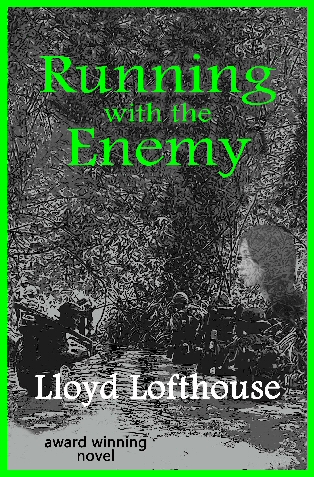 His latest novel is the award winning suspense-thriller Running with the Enemy. Blamed for a crime he did not commit while serving in Vietnam, his country considers him a traitor. Ethan Card is a loyal U.S. Marine desperate to prove his innocence or he will never go home again.
And the woman he loves and wants to save was fighting for the other side.
To follow this Blog via E-mail see upper left-hand column and click on “FOLLOW!”
One Never Forgets
It has been forty-six years since I fought in Vietnam, and watching two movies rebooted my PTSD interrupting my sleep pattern. For years, I usually wake at least once a night and listen. However, since watching the movies, I wake every hour and listen to the night sounds.
In Brothers, one of the two brothers, a captain in the US Marines, goes to Afghanistan on his fourth tour of duty and becomes a tortured and abused POW. After he is liberated and his captors killed, he returns home suffering from severe PTSD trauma. Tobey Maguire plays Marine Captain Sam Cahill and does a convincing job playing a veteran that is severely damaged by PTSD symptoms.
Watching Maguire act his part reminded me of my first decade back from Vietnam when I drank too much and often woke once or twice and carried a loaded weapon around the house checking the doors and windows. More than once, when overwhelmed by a burst of anger, I punched holes in walls with fists.
The anger comes fast—one moment you are calm as a rusty doorknob and an instant later an exploding fragmentation grenade.
In the Valley of Elah, Tommy Lee Jones plays a father, who was also a Vietnam combat veteran, searching for answers to explain his son’s death soon after returning from Iraq. In this film, we see how war strips young men of their humanity—that thin veneer that comes with so-called civilization.
From Brothers, I was reminded of the homeless Vietnam veteran I met in an alley in Pasadena, California one early morning. He had been a prisoner of war and similar to the character Tobey Maguire plays, was severely traumatized with PTSD symptoms.
The VA rated the homeless vet I met in that Pasadena alley as 100% disabled by PTSD possibly explaining why he was homeless—not because he could not afford an apartment. The disability from the VA was more than enough to support him. However, most of that money went for drugs and booze for him and his homeless buddies.
Then there was another vivid image of a Vietcong POW being tortured by South Korean troops during a field operation I was on. The South Koreans hung that Vietnamese POW by his heels from a tree limb and pealed the skin off his body while he lived.
In the Valley of Elah reminded me of an ambush where a team of Marines I was a member of went out in a heavy rain at sunset and after an hour or so of slogging through the gloomy downpour, we stopped in a rice paddy with water to our necks and stayed there for more than an hour waiting for complete darkness before moving into position. We shared that rice paddy with a very large king cobra.
In the Marines, one does not question orders—we do or die—so we stayed in that paddy knowing a king cobra was in the water with us.
Both of these films are dramatic examples of what war does to young men and their families.
Some combat veterans avoid seeing films such as these two. However, I do not. I do not want to return to that time where I avoided talking and thinking of my part in the Vietnam War, because at night when we struggle to sleep there is no escape. We cannot hide from the monster that came home with us living inside our skin as if it were an unwanted parasite.
Discover A Prisoner of War for Life
_______________________
Lloyd Lofthouse, a former U.S. Marine and Vietnam Veteran, is the award winning author of The Concubine Saga.
His latest novel is Running with the Enemy. Blamed for a crime he did not commit while serving in Vietnam, his country considers him a traitor. Ethan Card is a loyal U.S. Marine desperate to prove his innocence or he will never go home again.
And the woman he loves and wants to save was trained to hate and kill Americans.
To follow this Blog via E-mail see upper right-hand column and click on “Sign me up!”
The PTSD Connection – help from friends, family, loved ones and maybe marijuana
On the walk home from the theater after seeing the film Savages (Oliver Stone directed the film), I thought of one of the characters played by Taylor Kitsch—Chon is a former Navy Seal that served combat tours in Iraq and then Afghanistan.
Near the beginning of the film, it is obvious that Chon has PTSD but by the end Ophelia and Ben will have it too. What these characters experience in the film was traumatic in the worst way without joining the military and serving in a war.
If you see the movie or read the novel by Don Winslow, pay attention to how Chon deals with danger. There is one film scene in a restaurant where a server drops a tray of dishes and Chon, in a flash, is under the table with pistol in hand. He also handles dangerous situations ruthlessly.
In the movie, Chon and Ben produce high-quality marijuana and sell it legally and illegally, and all three of the main characters smoke their own product, which may be explained away by a study conducted at Haifa University in Israel that found rats with PTSD treated with marijuana within 24 hours of a traumatic experience successfully avoided any PTSD symptoms (maybe the US military should include some marijuana in the rations of all combat troops in Afghanistan).
However, that would not have helped me. I’m allergic to marijuana smoke and cannot be in the same room where someone else is smoking weed.
Winslow, the author of Savages, was once a private detective in New York City. His career as an investigator would repeatedly bring him to California to look into arson cases, so maybe he has some PTSD from that experience.
It is a fact that anyone can have PTSD—it isn’t exclusive to combat veterans. After all, Ophelia and Ben never served in the military and were not combat veterans from Vietnam, Iraq or Afghanistan, but by the end of the movie the odds are they both will have PTSD.
It doesn’t hurt that Oliver Stone, the film’s director, enlisted in the United States Army, fought in Vietnam with the 25th Infantry Division, then with the First Calvary Division, earning a Bronze Star with Combat V, an Army Commendation Medal and a Purple Heart with Oak Leaf Cluster before his discharge.
After Stone’s experience in Vietnam, PTSD may have followed him home adding authenticity to the film.
However, if you have PTSD or you know someone with PTSD and you have severe allergic reactions to smoking marijuana, as I do, then you may have to look for support from family, loved ones and friends.
That brings us to Charlene Rubush’s Blog—Win Over PTSD.
This video has nothing to do with Rubush’s Blog but does focus on PTSD.
Rubush’s experience as a former wife of a Vietnam veteran with Post-Traumatic Stress Disorder led to years of research on the subject, and she recently published a guest post by Ryan Rivera on How to Be the Partner of Someone with PTSD.
Rivera says, “One of the most important recovery tools for someone living with PTSD is social support. The more they know that they have real, true friends behind them, the better the outcome of their PTSD treatments. The problem is that PTSD can be hard to understand, and those in a relationship with someone living with PTSD often find that they are struggling with how to keep the relationship together.”
In Savages, Chon’s true friends are Ophelia and Ben. He knows he can count on them accepting him as he is, PTSD included—they are a family.
If you try the marijuana therapy, make sure to do it legally and if you don’t do it legally, don’t get caught. A term in prison may make the PTSD worse—a lot worse.
Discover Booze, the Veteran and coming home
_______________________
Lloyd Lofthouse, a former U.S. Marine and Vietnam Veteran, is the award winning author of The Concubine Saga.
His latest novel is Running with the Enemy. Blamed for a crime he did not commit while serving in Vietnam, his country considers him a traitor. Ethan Card is a loyal U.S. Marine desperate to prove his innocence or he will never go home again.
And the woman he loves and wants to save was trained to hate and kill Americans.
To follow this Blog via E-mail see upper right-hand column and click on “Sign me up!”
 The Soulful Veteran's Blog