Manipulating public opinion to wage war: Part 5/5

For Vietnam (1953 – 1975):  In 1965—soon after the so-called Tonkin Gulf Incident (the Vietnam War’s Pearl Harbor that was the propaganda to drum up support for war)—only 25% thought the war was a mistake. Source: DailyKos.com

In fact, Anup Shah writing for Global Issues, says it required massive propaganda to create the belief that U.S. involvement in Vietnam was because non-communist South Vietnam was invaded by communist North Vietnam and that the regime in the South was democratic—but there never was a democracy in South Vietnam.

This was all untrue. In addition, many think that the Vietnam War was lost due to the media revealing atrocities but this was also untrue.  Noam Chomsky says the American elite typically regarded Vietnam as a “mistake” or tragedy.

Television news in particular was said to have helped America “lose” the war. Yet, television news coverage was arguably poor, and full of news-bites, rather than detailed documentaries. … The Vietnam experience highlights a multitude of factors that contributed to what can only be termed as propaganda for Cold War ideological battles: a mixture of ideological goals, geopolitical and military goals, and issues to do with the nature of reporting and the structure of the media and how it worked, combined with cultural norms, all impacted the way that things were reported, not reported, portrayed, or misrepresented, and this ultimately provided legitimacy for a war that saw millions killed. Source: Global Issues.org

Gallup reported that in 1965, soon after the so-called Tonkin Gulf Incident, 61% of American’s polled said that sending U.S. troops to fight in Vietnam was not a mistake. But by 1971, 70% would say yes—it was a mistake—to the same question.

Again, we hear the echo of President Abraham Lincoln’s words: “You can fool all of the people some of the time, and some of the people all of the time, but you cannot fool all the people all the time.” In 1965, the majority of the American people were fooled but by 1971, only a few were still fools.

For the Gulf War—also known as Operation Desert Storm (August 1990 – February 1991)—we learn under the first President Bush that short wars with decisive victories provide less time for the public to change its mind. … In addition, President George H. W. Bush (1989 – 1993), remembering the lessons of Vietnam, sought public support … and he got it.  The vast majority of Americans and a narrow majority of the Congress supported the President’s actions. Source: US History.org

But the 43rd President of the United States, George W. Bush, had his Pearl Harbor on 9/11, and he squandered the public support by relying on false reports of Weapons of Mass Destruction to declare war on Iraq. But this false propaganda succeeded leading to Operation Iraqi Freedom (2003 – 2011).

“Being able to exploit the national anguish and anger over 9/11 was a critical ingredient, of course. But the success of the war-selling campaign was testimony to what a determined use of the opinion-molding capabilities of the government of the day, including the bully pulpit of the presidency, can accomplish.” Source: The National Interest

After Powell’s speech at the UN about WMDs in Iraq, a Gallup poll concluded that 79% of Americans thought the war was justified. However, by 2007, 65% would disapprove of the Iraq War thinking it was not worth fighting, and in March 2013, another survey found that 51.9% of the American public felt that the Iraq War had been a mistake—after all, you cannot fool all of the people, all of the time.

Operation Enduring Freedom in Afghanistan (2001 to present): In 2001, Gallup reported that eight of ten Americans (80%) supported a ground war in Afghanistan. But by March 2012—more than a decade later—sixty-nine percent of Americans thought that the United States should not be at war in Afghanistan.

Return to Manipulating public opinion to wage wars: Part 4 or start with Part 1

View as Single Page

_______________________

Lloyd Lofthouse is a former U.S. Marine and Vietnam Veteran.

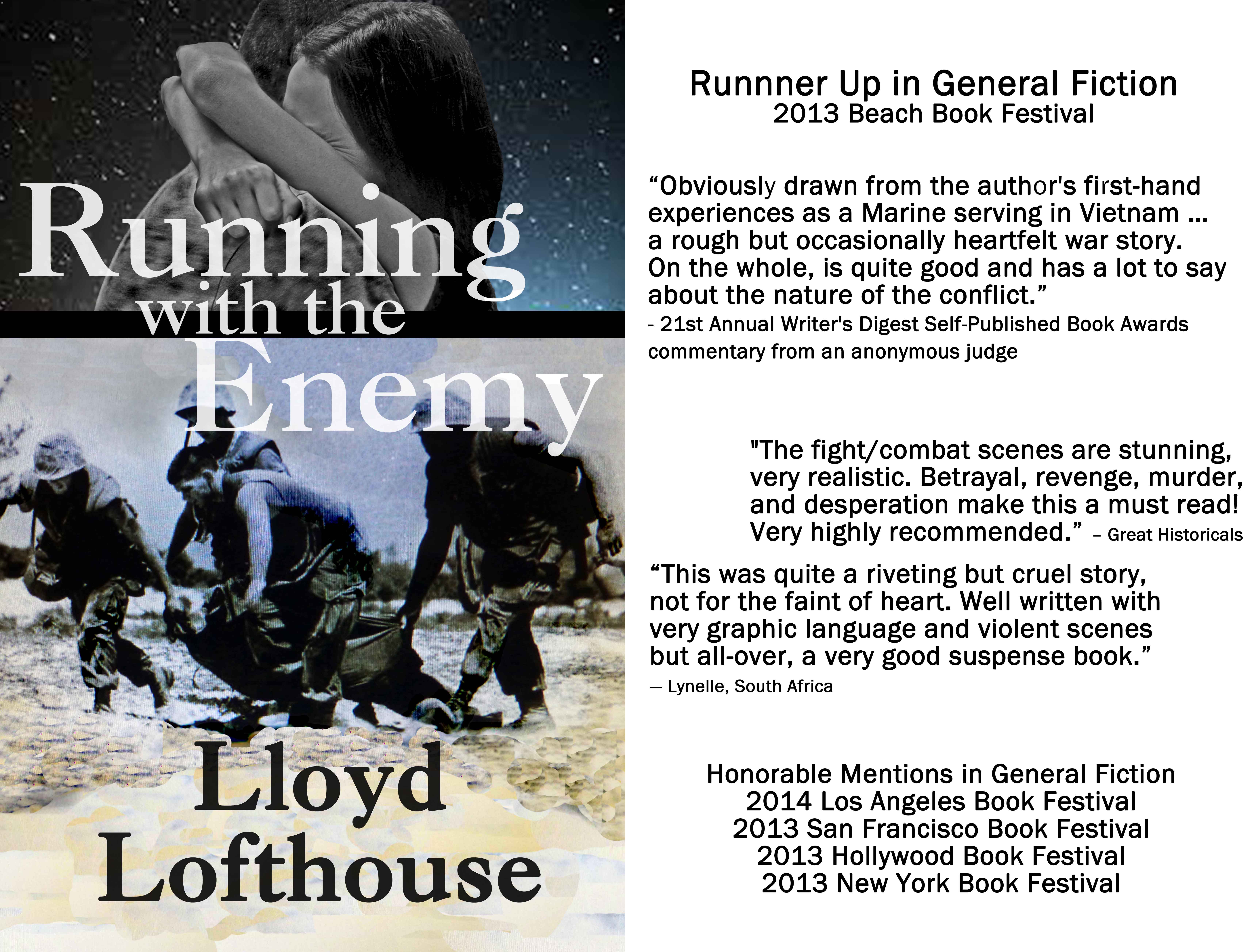
His latest novel is the award winning suspense-thriller Running with the Enemy. Blamed for a crime he did not commit while serving in Vietnam, his country considers him a traitor. Ethan Card is a loyal U.S. Marine desperate to prove his innocence or he will never go home again.

And the woman he loves and wants to save was fighting for the other side.

To follow this Blog via E-mail see upper left-hand column and click on “FOLLOW!”
Manipulating public opinion to wage war: Part 4/5

World War One (1917 – 1918) was deeply unpopular. “once public opinion polling did start appearing in the 1930’s, early surveys on World War One showed only 28% of the country thought entering the war was a good idea, while 64% opposed it.”

In the years after World War I Americans quickly reached the conclusion that their country’s participation in that war had been a disastrous mistake, one which should never be repeated again. During the 1920s and 1930s, therefore, they pursued a number of strategies aimed at preventing war. Source: neh.gov

And Support for World War II (1941 – 1945) was also not widely popular. Even as public opinion in favor of war increased after France fell to Nazi Germany during World War Two, only 42% of the country thought entry into the war was a good idea, while 39% of the country still considered it a mistake.

In fact, entering this war was unpopular until Japanese aircraft attacked Pearl Harbor on December 7, 1941. Then it was clear that the US couldn’t stay out of the Second World War.

Once the war began in earnest, America increased the flood of propaganda, utilizing especially the radio and visual media, most specifically posters. … Since American leaders realized that the best hope of winning the war was through increased production and labor, many posters were circulated urging increased labor and production as well as conservation of materials for the war effort.… During World War II, America produced some of the most successful propaganda campaigns in history. The pushes for increased production, labor, and conservation may well have won the war for America. Source: thinkquest.org

Next, the Korean War (1950 – 1953): When Americans were first asked (by Gallup), in August 1950, if deciding to defend South Korea was a mistake, only 20% thought it was, while 65% said it was not a mistake.

But by the following January, opinion had shifted dramatically, and 49% thought the decision was a mistake, while 38% said it was not—13% had no opinion.

Over several months, as Gallup asked the public if “going into war in Korea” was a mistake, opinion remained relatively stable, with more Americans saying it was than saying it was not. Six months later, as truce talks were being conducted at Kaesong, Americans were feeling more positive—42% felt the war was a mistake, while 47% said it wasn’t. But the numbers shifted again six months later in February 1952, when a majority said the war was a mistake for the United States, soon after a POW exchange proposal by the United Nations was rejected, and riots in the United Nations’ overcrowded Koje-do prison camp resulted in the deaths of many North Korean prisoners.

Soon after Eisenhower was elected president in 1953 and truce talks began again, the American opinion shifted yet again, with half of Americans saying the war was not a mistake, while a low of 36% said it was a mistake.

Continued on July 12, 2013 in Manipulating public opinion to wage wars: Part 5 or return to Part 3

View as Single Page

_______________________

 Lloyd Lofthouse is a former U.S. Marine and Vietnam Veteran.

His latest novel is the award winning suspense-thriller Running with the Enemy. Blamed for a crime he did not commit while serving in Vietnam, his country considers him a traitor. Ethan Card is a loyal U.S. Marine desperate to prove his innocence or he will never go home again.

And the woman he loves and wants to save was fighting for the other side.

To follow this Blog via E-mail see upper left-hand column and click on “FOLLOW!”

Manipulating public opinion to wage war: Part 3/5

The American Civil War (1861 – 1865) “was absolutely an important moment in the history of the press,” says Penn State’s Risley. “The practices, technological development you begin to see during the war—the importance of the telegraph, the use of illustrations, for example—and the growth in demand for newspapers, so many of these things came together during this remarkable and tragic event.”

The demand for newspapers in both the North and South soared during the Civil War, says Risley, whose book is Civil War Journalism (Praeger, 2012).

This demand for information continued after the war and pushed more newspapers to broaden their readership. “America really became a nation of newspaper readers during the war.” The Civil War also showed officials how powerful the press could be in shaping public opinion, and government officials often struggled finding an even-handed approach in their handling of the press.

“Abraham Lincoln recognized that the press played a role in public opinion and he used the press effectively,” says Risley. “But, he wasn’t afraid to shut down newspapers, something that would not have been acceptable today.” Source: futurity.org

Perhaps more importantly, newspapers were responsible for editorializing the war.  They were the propaganda machines of the day. Though not universally true, many newspapers published biased accounts of events, “factual” testimonials of enemy atrocities, articles proselytizing for specific political and military goals, and emotionally charged letters from citizens affected by the conflict. A quiet war for public support was waged both in the North and the South with the newspapers serving on the front lines. Issues like conscription, use of slaves as soldiers, and the validity of total war were hotly debated in the papers. The newspapers controlled the ebb and flow of public opinion and a particularly popular circulation could determine the outcomes of city or state politics.Some newspapers were known to falsely report casualty rates or results of battle to bolster public morale. Source: OregonState.edu

But if the Civil War taught the government about the importance of the media, The Spanish-American War (1898) may have been the first true “media war”.

Today, historians point to the Spanish-American War as the first press-driven war. Although it may be an exaggeration to claim that Hearst and the other yellow journalists started the war, it is fair to say that the press fueled the public’s passion for war. Without sensational headlines and stories about Cuban affairs, the mood for Cuban intervention may have been very different. Source: pbs.org

Continued on July 11, 2013 in Manipulating public opinion to wage wars: Part 4 or return to Part 2

View as Single Page

_______________________

 Lloyd Lofthouse is a former U.S. Marine and Vietnam Veteran.

His latest novel is the award winning suspense-thriller Running with the Enemy. Blamed for a crime he did not commit while serving in Vietnam, his country considers him a traitor. Ethan Card is a loyal U.S. Marine desperate to prove his innocence or he will never go home again.

And the woman he loves and wants to save was fighting for the other side.

To follow this Blog via E-mail see upper left-hand column and click on “FOLLOW!”

Manipulating public opinion to wage war: Part 2/5

The contrast between the War of 1812, and the Mexican-American War demonstrates the important use of the media to manipulate public opinion—something America’s leaders were still learning.

The War of 1812 to March 1815 was also known as the Second War of Independence

The United States entered the war with confused objectives and divided loyalties and made peace without settling any of the issues that had induced the nation to go to war. Source: history.army.mil

Why? Because the prosecution of the war was marred by considerable bungling and mismanagement.  This was partly due to the nature of the republic.  The nation was too young and immature—and its government too feeble and inexperienced—to prosecute a major war efficiently.  Politics also played a part.  Federalists vigorously opposed the conflict, and so too did some Republicans.  Even those who supported the war feuded among themselves and never displayed the sort of patriotic enthusiasm that has been so evident in other American wars.

It is this lack of success that may best explain why the war is so little remembered.  Americans have characteristically judged their wars on the basis of their success.  The best-known wars—the Revolution, the Civil War, and World War II—were all clear-cut successes. Source: pbs.org

Then we have the Mexican American War (1846 – 1848) where public opinion was divided at first. Many accused President Polk of provoking a war. … The Mexican War was not popular among certain people, especially in the north. They thought it was meant to expand the territory of slavery. … In the end—thrilled by sensationalized newspaper accounts of American victories— the public embraced the war. Source: archives.nbclearn.com

As you can see, the government needs the media to popularize a war.  It also helps if the war is short. Long wars tend to lose public support.

Continued on July 10, 2013 in Manipulating public opinion to wage wars: Part 3 or return to Part 1

View as Single Page

_______________________

 Lloyd Lofthouse is a former U.S. Marine and Vietnam Veteran.

His latest novel is the award winning suspense-thriller Running with the Enemy. Blamed for a crime he did not commit while serving in Vietnam, his country considers him a traitor. Ethan Card is a loyal U.S. Marine desperate to prove his innocence or he will never go home again.

And the woman he loves and wants to save was fighting for the other side.

To follow this Blog via E-mail see upper left-hand column and click on “FOLLOW!”

Manipulating public opinion to wage war: Part 1/5

I’m sure that all governments do it—manipulate public opinion to support war. It doesn’t matter if the country has an autocratic government ruled by a dictator or a democracy ruled by elected public officials—the people must be convinced that the enemy is evil and war necessary.

If we follow public support for America’s largest wars, we discover the US government’s learning curve to use the media to drum up support of wars. This manipulation of public opinion may be explained by Abraham Lincoln who said, “You can fool all of the people some of the time, and some of the people all of the time, but you cannot fool all the people all the time.”

The idea is to fool enough people to start a war. After that, it’s easier to keep a war going even when public support turns against it—for a while anyway.

That learning curve started with the American Revolution. For example, many think that the American Revolutionary War (1774 – 1783) was a war fought with the unanimous support of the people for independence from Great Britain.

But in North America, the colonists generally considered themselves loyal British citizens, asserting rightful constitutional claims that had been previously established through their colonial charters or contracts. … Many colonists (and eventually foreign nations) had to be persuaded to join in this revolution. Source: GilderLehrman.org

Then “as the colonists discovered how difficult and dangerous military service could be, enthusiasm waned. Many men preferred to remain home, in the safety of what Gen. George Washington described as their Chimney Corner.”

In fact, Washington predicted that “after the first emotions are over,” those who were willing to serve from a belief in the “goodness of the cause” would amount to little more than “a drop in the Ocean.” And he was correct. Source: Smithsonian Magazine

But how did the colonial government drum up public support?

American printers played a vital role in swaying public opinion in the years leading up to the American Revolution. A heavy use of propaganda, or the spreading of information and rumors, was used. American printers wrote a great deal against the British which helped to raise morale within the American colonies.”  Source: VoicesYahoo.com

And what would have happened to America’s Founding Fathers if the Revolution had been lost? Well, pretty much what’s happening to Edward Snowden but worse. Snowden is a traitor for spilling American secrets, and if the U.S. catches him, he may spend the rest of his life in prison. In the 18th century, the Founding Fathers would have been hanged. Now you may understand why that propaganda and those rumors was so important to these future leaders of a fledgling country.

Continued on July 9, 2013 in Manipulating public opinion to wage wars: Part 2

View as Single Page

_______________________

 Lloyd Lofthouse is a former U.S. Marine and Vietnam Veteran.

His latest novel is the award winning suspense-thriller Running with the Enemy. Blamed for a crime he did not commit while serving in Vietnam, his country considers him a traitor. Ethan Card is a loyal U.S. Marine desperate to prove his innocence or he will never go home again.

And the woman he loves and wants to save was fighting for the other side.

To follow this Blog via E-mail see upper left-hand column and click on “FOLLOW!”

Okinawa’s Sitting Bull

I want to warn you that if you are a member of the uber-sensitive politically-correct mob—some of these people even want to censure literature and rewrite history to fit their politically correct sensitivities—and you are often offended at the use of vulgar/racist words, don’t read this post.

To history buffs, this post is not about the famous Hunkpapa Lakota Sioux holy man (1831-1890) who led his people as a tribal chief during years of warfare with the United States government.

This post is about an Okinawan whore in early 1966, who made a lot of money servicing dozens of American Marines nightly. Some of her paying customers were addicted to having sex with her and were willing to wait for an hour or more outside of her small house in Ken village across the street from Camp Hanson in Okinawa.

Maybe the U.S. Marines who were her customers and fans called her Sitting Bull because she sort of resembled the famous Sioux chief at a younger age.

The one time I saw her, she was wearing a knee length bath robe; had frizzy hair sticking out in all directions and was so overwhelmed from the dozen or more orgasms she’d already experienced that night, she had trouble walking as she came out of the bedroom to call in the next customer in line.

I think she was called Sitting Bull because her fiancé—a U.S. Marine—was a full-blooded Lakota Sioux. I don’t know his name but I know he was a Sioux and his job as a Marine was to drive one of the M48 Patton medium tanks in the 1st Marine Division tank battalion we were both members of.

While Sitting Bull, the whore, was conducting business in one end of her small house, her fiancé was watching TV with Sitting Bull’s mother and children at the other end of the house. She must have been one hell of a fuck, but I never found out. The only reason I stood in that line was out of curiosity. Once I saw her, I left and went to a local bar to get drunk.

Before we shipped out to Vietnam a few weeks later, Sitting Bull’s fiancé went a little crazy—no, really very crazy.  He wanted to marry her and take her home but his request was denied by the U.S. Military after a background check of his fiancé.

The Sioux tank driver got drunk and attempted to drive a tank off base so he could be with his woman. The base commander talked him out of his drunken urge and sent him to the brig instead.

In 1969, at the height of the U.S. War in Vietnam, the Okinawan police estimated that 7,362 Okinawan women were working in prostitution though others estimated this number to be 10,000 or more.  Today, some 7,000 Filipinas … are prostituted women—on entertainment visas—for U.S. military personnel in Okinawa. Source: GenuineSecurity.org

What is going to happen to the world’s prostitutes once the United States stops playing at being a global empire and brings the troops home from more than 611 foreign military bases (According to The Washington Post)?

Discover Kill Anything that Moves

_______________________

Lloyd Lofthouse is a former U.S. Marine and Vietnam Veteran.

His latest novel is the award winning suspense-thriller Running with the Enemy. Blamed for a crime he did not commit while serving in Vietnam, his country considers him a traitor. Ethan Card is a loyal U.S. Marine desperate to prove his innocence or he will never go home again.

And the woman he loves and wants to save was fighting for the other side.

To follow this Blog via E-mail see upper left-hand column and click on “FOLLOW!”

Shell Shock in 1915 becomes Combat Fatigue by World War II and PTSD in 1980

In World War I, PTSD—known as shell shock then—was such a problem that ‘forward psychiatry’ was begun by French doctors in 1915. Some British doctors tried general anesthesia as a treatment (ether and chloroform), while others preferred application of electricity.

Imagine suffering from PTSD and being strapped down to a table with electrodes attaches followed by jolts of electricity to shock you healthy.

In 1917, four British ‘forward psychiatric units’ were set up. Hospitals for shell-shocked soldiers were also established in Britain, including (for officers) Craiglockhart War Hospital in Edinburgh.

Patients diagnosed to have more serious psychiatric conditions were transferred to the Royal Edinburgh Asylum.

Near the end of 1918, the use of anesthetic and electrical treatments to treat shell shock was gradually replaced with modified Freudian psychodynamic intervention. The efficacy of ‘forward psychiatry’ was controversial.

Psychodynamic therapy focuses on unconscious processes as they are manifested in a person’s present behavior. The goals of psychodynamic therapy are a client’s self-awareness and understanding of the influence of the past on present behavior.

In 1922 the British War Office produced a report on shell shock with recommendations for prevention of war neurosis. However, when World War II broke out in 1939, this seems to have been ignored.

Then during World War II, the term ‘combat fatigue’ was introduced as breakdown rates became alarming, and the value of pre-selection was recognized.

At the Maudsley Hospital in London in 1940, barbiturate abreaction (an emotional release resulting from mentally reliving through the process of catharsis, a long-repressed, painful experience) was advocated for quick relief from severe anxiety and hysteria, using i.v. anesthetics: Somnifaine, paraldehyde, Sodium Amytal. ‘Pentothal narcosis’ and ‘narco-analysis’ were adopted by British and American military psychiatrists.

However, by 1945 medical thinking gradually settled on the same approaches that had seemed to be effective in 1918.

The term PTSD was introduced in 1980.

In the UK the National Institute for Health and Clinical Excellence (NICE) guidelines for management (2005) recommend trauma-focused Cognitive Behavioral Therapy and consideration of antidepressants. Source: Pub Med.gov

Discover The public image of PTSD and the Vietnam Veteran

_______________________

Lloyd Lofthouse is a former U.S. Marine, Vietnam Veteran, journalist and award winning author.

His second novel is the award winning love story and suspense-thriller Running with the Enemy. Blamed for a crime he didn’t do while serving in Vietnam, his country considers him a traitor. Ethan Card is a loyal U.S. Marine desperate to prove his innocence or he will never go home again.

Promo Image with Cover Awards

Where to Buy

To follow this Blog via E-mail see upper left-hand column and click on “FOLLOW!”

US Troops and the Prostitutes that Service Them: Part 3/3

View as Single Page

Before I shipped out to Vietnam, I never received any classes, lectures, inservices or workshops on Southeast Asian culture and at that age—without a college education—I wasn’t curious or interested.

We were US Marines trained to kill. We weren’t there to understand the culture. The only workshop I remember was one about how to avoid getting an STD and how dangerous one strain of syphilis/gonorrhea was in Vietnam.

We were told that if we were careless with a Vietnamese woman, it could be a very painful death sentence from a viral form of an STD that no drugs could cure.

In fact, I didn’t know anyone in my unit who expressed the slightest bit of interest in Vietnam’s culture or history. When we went on five days of R&R during our tour of combat—for example to Hong Kong, Thailand, Okinawa, Japan, or the Philippians—most of us were interested in only one thing: getting drunk and getting laid.

And the hundreds of thousands of US troops who felt the same way were not alone in history.

“According to Beth Bailey and David Farber, during the Second World War a large number of prostitutes in Hawaii, each servicing upward of 100 men a day, made a fiscal “killing.” “Shackjobs,” or long-term, paid relationships with women of Hawaiian or Filipino descent were also common among military personnel stationed in Hawaii (as they were later in Vietnam). …”

And “during the war in Indochina, U.S. Senator J. William Fulbright and Sunday Times of London correspondent Murray Sayle maintained, independently of one another, that U.S. forces in South Vietnam had turned Saigon into a “brothel”—a reference to the estimated 500,000 Vietnamese prostitutes who served an approximately equal number of GI’s. … Source: John Brown University


In fact, “There were 20,000 prostitutes in Thailand in 1957; by 1964, after the United States established seven bases in the country, that number had skyrocketed to 400,000.” Source: Prostitution in Thailand and Southeast Asia

In addition, “At the height of the US presence in the Philippines, for example, more than 60,000 women and children were employed in bars, night clubs and massage parlors around the Subic Bay and Clark Naval bases alone. Estimates of the total numbers of Filipina women and girls engaged in prostitution and other sex-based industries range between 300,000 and 600,000.” Source: PeaceNews.info – Command and control: the economies of militarized prostitution

And if you think times have changed, read this: “As recently as 2002, a brothel in Australia closed their doors when a group of 5,500 U.S. Sailors coming back from a war zone stopped off in Australia. From the article: Mary-Anne Kenworthy said she was forced to close the doors of her famous Langtrees brothel for only the third time ever yesterday because her prostitutes were so worn out they could no longer provide a quality service.” Source: Cause of Liberty – Prostitution

Do you condemn those who sinned—if it was a sin—or is it wrong to send a young virgin off to possibly die for his country while denying him the pleasure of a woman even if a prostitute was his only choice? What do you think?

Return to US Troops and the Prostitutes Who Service Them: Part 2 or start with Part 1

View as Single Page

_______________________

Lloyd Lofthouse is a former U.S. Marine and Vietnam Veteran.

image

Buy Now

And the woman he loves and wants to save was fighting for the other side.

To follow this Blog via E-mail see upper left-hand column and click on “FOLLOW!”

US Troops and the Prostitutes Who Service Them: Part 2/3

View as Single Page

When I joined the US Marines, I was a high school graduate and an avid reader of science fiction and fantasy. I was not an intellectual—instead, I was a walking libido filled to overflowing with testosterone like so many of my fellow Marines.

I turned twenty-one in Vietnam, and up to that time Vietnam veterans were the best educated force the United States has ever sent into combat—79% had a high school education or better. Two-thirds of the men who served in Vietnam were volunteers, and eighty-six percent of those who died in Vietnam were Caucasians, 12.5% were black, and 1.2% were from other ethnic/racial groups.

If I had gone straight to Vietnam instead of spending a few weeks in Okinawa for additional training, I could have died a virgin—having never known what it was like to be sexually intimate with a woman.

And that reminds me of a film called Mrs. Henderson Presents staring Judi Dench as Mrs. Laura Henderson who opens a theater in London during World War Two with an all-nude female review for the allied troops, because her son had died a virgin in combat and she didn’t want these young men to die without having at least seen a young, nude woman at least once.

Continued on June 28, 2013 in US Troops and the Prostitutes Who Service Them: Part 3 or return to Part 1

View as Single Page

_______________________

Lloyd Lofthouse is a former U.S. Marine and Vietnam Veteran.

image

Buy or Read Now

To follow this Blog via E-mail see upper left-hand column and click on “FOLLOW!”

US Troops and the Prostitutes Who Service Them: Part 1/3

“The sin we condemn — the sinner … we try to understand.”
– Adam Michnik (1946 – )

View as Single Page

The subject of this series of posts is about US troops and prostitution. It has been said that prostitution is the world’s oldest profession.

For example, in 2400 B.C., the Sumerians listed prostitution in one the earliest lists of professions, and the practice of prostitution in ancient Rome was both legal and licensed, and even Roman men of the highest social status were free to engage prostitutes of either sex without incurring moral disapproval. In fact, rent from a brothel was considered a legitimate source of income in the Roman Empire.

In addition, Hammurabi’s Code (1780 B.C.) specifically mentioned the rights of a prostitute or the child of a prostitute.

And in China—600 B.C.—brothels were legal, while in Greece (594 BC) state brothels were founded and a prostitute’s earnings were taxed. Source: Historical Timeline – Prostitution


In fact, historically, “where there are soldiers, there are women who exist for them. … In some ways, military prostitution (prostitution catering to, and sometimes organized by, the military) has been so commonplace that people rarely stop to think about how and why it is created, sustained, and incorporated into military life and warfare.” Source: The Asia Pacific Journal

That leads to when I was a US Marine age twenty in Okinawa on my way to fight in one of America’s wars, and I arrived a virgin who desperately didn’t want to be one. And when I left Okinawa for Vietnam, I had achieved a goal that hundreds-of-thousand—and maybe millions—in the US military have achieved both during peace time and war.

Continued on June 26, 2013 in US Troops and the Prostitutes Who Service Them: Part 2

View as Single Page

_______________________

Lloyd Lofthouse is a former U.S. Marine and Vietnam Veteran.

image

Buy or Read Now

To follow this Blog via E-mail see upper left-hand column and click on “FOLLOW!”