Unwanted Heroes

Many unwanted heroes defend our nation and fight its wars—right or wrong. When America’s leaders declare wars based on lies (for example: Vietnam and Iraq) or the truth (World War I, II, Afghanistan and Korea), unwanted heroes do the fighting and pay the price.

On the side of a bus at the VA medical clinic that I go to, it says, “All gave some; some gave all.” I have a credit card sized VA Department of Veterans Affairs ID card.  It says below my photo: “Service Connected.” That means I have a disability connected to my service in Vietnam in 1966 when I was serving in the US Marines.

What is the price many unwanted heroes pay for trusting their leaders?

This post has the same title of a novel that was recently released, and I had the privilege of editing Unwanted Heroes by Alon Shalev.

In Unwanted Heroes, Shalev brings together a long suffering, battle weary Chinese American Vietnam veteran suffering from the trauma of PTSD and an idealistic and somewhat pretentious young Englishmen, who both share a love for San Francisco, coffee and wine.

Alon Shalev, the author, grew up in London, and has been a political activist since his early teens. He strives through his writing to highlight social and political injustice and to inspire action for change.

Moving to Israel, he helped establish a kibbutz where he lived for 20 years and served in the Israeli army.

Shalev then moved to the San Francisco Bay area and fell hopelessly in love with this unique city. Being new to the US, however, he was shocked to see so many war veterans on the streets. He regularly volunteers at initiatives such as Project Homeless Connect and the San Francisco Food Bank where he meets and talks with war veterans. These experiences lend authenticity to the novel.

In fact, according to NIH (the National Institute of Health) Medline Plus, “PTSD affects about 7.7 million American adults” … and “members of the military exposed to war/combat and other groups at high risk for trauma exposure are at risk for developing PTSD.

“Among veterans returning from the current wars in Iraq and Afghanistan, PTSD and mild to moderate traumatic brain injury (TBI) are often linked and their symptoms may overlap. Blast waves from explosions can cause TBI, rattling the brain inside the skull.

“The U.S. Department of Veterans Affairs estimates that PTSD afflicts almost 31% of Vietnam veterans; as many as 10% of Gulf War (Desert Storm) veterans; 11% of veterans of the war in Afghanistan, and 20% of Iraqi war veterans.”

NIH says, “PTSD is often accompanied by depression, substance abuse, or other anxiety disorders.”

In addition, “between 529,000 and 840,000 veterans are homeless at some time during the year, and on any given night, more than 300,000 veterans are living on the streets or in shelters in the US. … About 33% of homeless males in the US are veterans and veterans are twice as likely as other Americans to become chronically homeless. One of the primary causes of homelessness among veterans is combat-related mental health issues and disability.

The incident of PTSD and suicide rates among veterans is also climbing and 45% of homeless veterans suffer from mental illness including PTSD. Source: Veterans Inc.org

The New York Times reported, “Suicide rates of military personnel and combat veterans have risen sharply since 2005, as the wars in Iraq and Afghanistan intensified. Recently, the Pentagon established a Defense Suicide Prevention Office.”

“The CDC Vietnam Experience Study Mortality Assessment showed that during the first 5 years after discharge, deaths from suicide were 1.7 times more likely among Vietnam veterans than non-Vietnam veterans. …

Why? “The average infantryman in the South Pacific during World War II saw about 40 days of combat in four years. The average infantryman in Vietnam saw about 240 days of combat in one year thanks to the mobility of the helicopter.” Source: History.com – Statistics about the Vietnam War

I did not seek help for my PTSD for thirty-eight years, because I did not know the VA offered counseling.

Discover A Prisoner of War for Life

__________________________

Follow this Blog via Email — sign in near the top-right corner of this screen and click “Follow”
PTSD and Homeless Veterans

In the Marines, we learned to never leave the wounded or dead behind.

I have lived with the symptoms of PTSD for forty-six years. I was fortunate. I was capable of holding down a job. I haven’t forgotten the homeless veteran I met in an alley early one early morning in Pasadena, California. I wrote about it in A Prisoner of War for Life.

The key is to learn how to cope. If you have PTSD, you will never get rid of it as if it were a cold or the flu. PTSD stays with you for life.

USA Today reported, “War might be making young bodies old. … The tragic signs of post-traumatic stress disorder or battlefield concussion are all too evident. Even more alarming for researchers is emerging evidence that these newest American combat veterans — former GIs and Marines in their 20s and 30s — appear to be growing old before their time. Scientists see early signs of heart disease and diabetes, slowed metabolisms and obesity — maladies more common to middle age or later.”

Some veterans are so damaged from combat experience, that they become homeless.

The population of the United States is more than 314 million people. The US Armed Forces that protects America’s civilians numbers 1.458 million—less than one-half-of-one-percent of the total US population. In addition, there are about 860 thousand military reservists.

In fact, the number of military veterans in the United States in 2012 was 21.8 million—6.94% of the total US population.

It doesn’t matter the reason a US citizen joins the military—patriotism or a financial need—and fights in one of America’s foreign wars. The fact that he or she served and put his or her life on the line or risked serious injury in combat,  I think that the ninety-three percent of the population that never served and risked life and limb owes those veterans an obligation.

That also means supporting homeless veterans with jobs and shelter.

The National Alliance to End Homelessness says, “The nation’s homeless population … went from 643,067 in 2009 to 636,017 in 2011. … The only increase was among those unsheltered.”

However, “The national rate of homelessness was 21 homeless people per 10,000 people in the general population. The rate for veterans was 31 homeless veterans per 10,000 veterans in the general population.”


PBS Documentary on Homeless Veterans – WORTH WATCHING if you have the time.

The Veterans Administration is the only federal agency that provides substantial hand-on assistance directly to Veterans who are homeless or at risk of homelessness.

Veteran homelessness is a problem of national importance. According to a count on a January night in 2011, there were 67,495 homeless Veterans. And an estimated 144,842 Veterans spent at least one night in an emergency shelter or transitional housing program in a recent year. Because of this, in 2009, President Obama and U.S. Department of Veterans Affairs Secretary Eric K. Shinseki announced the federal government’s goal to end Veteran homelessness by 2015.

An estimated 144,842 Veterans spent at least one night in an emergency shelter or transitional housing program in one recent year.

Many other Veterans are considered at risk of homelessness because of poverty, lack of support from family and friends, substance use or mental health issues, and precarious living conditions.

The VA has a hot line to support veterans who are homeless or at risk of becoming homeless. That number is: 1-877-4AID-VET (1-877-4243-838) Source: VA.gov/Homeless

In recent months, I have been editing a novel about PTSD and homeless veterans.  It isn’t my work. It was written by Alon Shalev, the author of  The Accidental Activist and A Gardener’s Tale.  His next novel is titled, Unwanted Heroes (to be published soon). It’s a story about healing and/or the failure to heal from PTSD. A love story is part of the mix too.

_______________________
Lloyd Lofthouse is a former U.S. Marine and Vietnam Veteran.

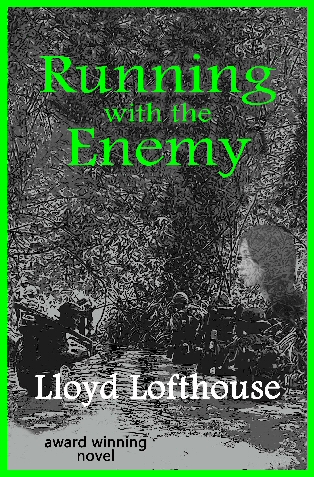
Low-Def Kindle Cover December 11His latest novel is the award winning suspense-thriller Running with the Enemy. Blamed for a crime he did not commit while serving in Vietnam, his country considers him a traitor. Ethan Card is a loyal U.S. Marine desperate to prove his innocence or he will never go home again.

And the woman he loves and wants to save was fighting for the other side.

To follow this Blog via E-mail see upper left-hand column and click on “FOLLOW!”

Missing John Wayne

I was not there when John Wayne dropped by the Battalion CP of the 1st Marine Division’s Tank Battalion in 1966 at Chu Lai, Vietnam. Instead, I was in the field. I don’t remember what I was doing in the field. I was on a night patrol, a recon, an ambush or a field operation but I wasn’t there.

I was in the field getting shot at—a walking target with a radio on my back or driving a radio jeep with no armor.  The jeep I drove in Vietnam was more than twenty years old and had a canvas top with open sides (no doors). Today, it would be unthinkable to send our troops into combat in one of those.

I was told Wayne drove in by himself in a 1945 Willys Jeep and walked around talking to Marines, drank a few warm beers with enlisted men then ate with the officers in their mess tent.

Years later, I wondered if Wayne really visited US troops in Vietnam and discovered, thanks to Google, that he did.

 “Once again, John Wayne found himself in the midst of a heated political controversy. It started in June 1966, when Wayne visited Vietnam to cheer American troops on the front and wounded soldiers in hospitals. The mission of the tour was twofold: It was a good-will trip, and at the same time provided him the opportunity to gather first-hand material for a film.

“It is unclear whether the idea to make a film on Vietnam originated before or during the trip. Before he left for the three-week tour, sponsored by the Department of Defense, Wayne said he was “going around the hinterlands to give the boys something to break the monotony.” “I can’t sing or dance,” he said, but “I can sure shake a lot of hands.” Source: Emanuel Levy Cinema 24/7

If anyone instilled a sense of patriotism in me for the US (not its political leaders), it was growing up watching John Wayne movies.

As a child, I knew nothing of politics but too much, thanks to my mother, of God and the Bible.

My father didn’t believe in God, didn’t vote and didn’t belong to any political party. He deeply distrusted politicians and said they were all liars and couldn’t be trusted. Today, I suspect that what he believed came from having survived the Great Depression (1929 to mid 1940s). At fourteen, he dropped out of school to find a job to survive. He would work for forty-six years before he retired on a union pension.

It doesn’t matter if I agree with Wayne’s conservative, hawkish, right-wing politics, because his screen image did more to instill my sense of patriotism than anything else did. In fact, he may have agreed with my father’s political beliefs.

Wayne’s attitude toward politics was at best ambivalent, considering it a necessary evil. “I hate politics and most politicians,” he repeatedly declared, and “I am not a political figure.” At the same time, he conceded that, “When things get rough and people are saying things that aren’t true, I sometimes open my mouth and eventually get in trouble.”

“About the only thing you have to guide you,” he said, “is your conscience.” One should not let “social groups or petty ambitions or political parties or any institution tempt you to sacrifice your moral standards,” but he conceded that, “It takes a long time to develop a philosophy that enables you to do that.” Integrity and self-respect were his most cherished values, “If you lose your self-respect, you’ve lost everything.” Source: Emanuel Levy Cinema 24/7


Good for Wayne. I respect him for being true to what he believed and standing up for it. To this day, I wished I’d been there at my base camp in 1966 the day he drove in to visit the troops, so I could shake his hand and listen to what he had to say.  Two years later, his movie, Green Berets, came out the same year as the Tet Offensive—considered by many to be the turning point in the war that led to the defeat of US goals.

What does patriotism mean to you?

_______________________

Lloyd Lofthouse, a former U.S. Marine and Vietnam Veteran, is the award winning author of The Concubine Saga.

His latest novel is Running with the Enemy. Blamed for a crime he did not commit while serving in Vietnam, his country considers him a traitor. Ethan Card is a loyal U.S. Marine desperate to prove his innocence or he will never go home again.

And the woman he loves and wants to save was trained to hate and kill Americans.

To follow this Blog via E-mail see upper right-hand column and click on “Sign me up!”

One Never Forgets

It has been forty-six years since I fought in Vietnam, and watching two movies rebooted my PTSD interrupting my sleep pattern. For years, I usually wake at least once a night and listen. However, since watching the movies, I wake every hour and listen to the night sounds.

In Brothers, one of the two brothers, a captain in the US Marines, goes to Afghanistan on his fourth tour of duty and becomes a tortured and abused POW.  After he is liberated and his captors killed, he returns home suffering from severe PTSD trauma. Tobey Maguire plays Marine Captain Sam Cahill and does a convincing job playing a veteran that is severely damaged by PTSD symptoms.

Watching Maguire act his part reminded me of my first decade back from Vietnam when I drank too much and often woke once or twice and carried a loaded weapon around the house checking the doors and windows.  More than once, when overwhelmed by a burst of anger, I punched holes in walls with fists.

The anger comes fast—one moment you are calm as a rusty doorknob and an instant later an exploding fragmentation grenade.

In the Valley of Elah, Tommy Lee Jones plays a father, who was also a Vietnam combat veteran, searching for answers to explain his son’s death soon after returning from Iraq. In this film, we see how war strips young men of their humanity—that thin veneer that comes with so-called civilization.

From Brothers, I was reminded of the homeless Vietnam veteran I met in an alley in Pasadena, California one early morning. He had been a prisoner of war and similar to the character Tobey Maguire plays, was severely traumatized with PTSD symptoms.

The VA rated the homeless vet I met in that Pasadena alley as 100% disabled by PTSD possibly explaining why he was homeless—not because he could not afford an apartment.  The disability from the VA was more than enough to support him.  However, most of that money went for drugs and booze for him and his homeless buddies.

Then there was another vivid image of a Vietcong POW being tortured by South Korean troops during a field operation I was on.  The South Koreans hung that Vietnamese POW by his heels from a tree limb and pealed the skin off his body while he lived.

In the Valley of Elah reminded me of an ambush where a team of Marines I was a member of went out in a heavy rain at sunset and after an hour or so of slogging through the gloomy downpour, we stopped in a rice paddy with water to our necks and stayed there for more than an hour waiting for complete darkness before moving into position. We shared that rice paddy with a very large king cobra.

In the Marines, one does not question orders—we do or die—so we stayed in that paddy knowing a king cobra was in the water with us.

Both of these films are dramatic examples of what war does to young men and their families.

Some combat veterans avoid seeing films such as these two. However, I do not. I do not want to return to that time where I avoided talking and thinking of my part in the Vietnam War, because at night when we struggle to sleep there is no escape. We cannot hide from the monster that came home with us living inside our skin as if it were an unwanted parasite.

Discover A Prisoner of War for Life

_______________________

Lloyd Lofthouse, a former U.S. Marine and Vietnam Veteran, is the award winning author of The Concubine Saga.

His latest novel is Running with the Enemy. Blamed for a crime he did not commit while serving in Vietnam, his country considers him a traitor. Ethan Card is a loyal U.S. Marine desperate to prove his innocence or he will never go home again.

And the woman he loves and wants to save was trained to hate and kill Americans.

To follow this Blog via E-mail see upper right-hand column and click on “Sign me up!”

The Blood Price – Part 4/4

Granted, World Wars I and II, and the Korean Conflict were unavoidable, and it could be argued that the War in Afghanistan was justified. However, we did not need to send American troops to Vietnam or Iraq and both of these wars were based on lies.

One reason for these needless wars may be linked to corporate profits while keeping unemployment down.

The Great Depression originated in the U.S. and had its start around September 4, 1929 and became worldwide news with the stock market crash of October 29, 1929 (known as Black Tuesday).

The Great Depression devastated countries around the globe. In the United States, industrial production dropped by 46%; foreign trade dropped 70% and unemployment reached 25%—in some countries it was as high as 33%.

The wartime economic boom during World War II caused a dramatic increase in employment, which paralleled the expansion of industrial production. In 1944, unemployment dipped to 1.2 percent of the civilian labor force, a record low in American economic history.

In 1954, after the Korean Conflict unemployment in the United States went up to about 6%. Then the economy turned down in the summer of 1957 and reached a low point in the spring of 1958. Industrial production fell 14%, corporate profits dropped 25% and unemployment reached 7.5%

The US needed another war to stimulate the economy. The US had already unofficially been in Vietnam since 1953 and in 1964 the war became official with the Gulf of Tonkin Resolution.

In 1960, unemployment in the US was 6.1%, but by 1964, unemployment dropped to 4.8% and then 3.4% by 1968. However, a year after the Vietnam War, unemployment was up again to 7.2%—a 212% increase since 1968.

It is now obvious that war is another option to keep Americans employed. Since the end of the Korean Conflict in 1953, the United States has been involved in thirty-two wars/conflicts. Source: List of wars involving the United States

I started to add up all the months and years US troops have been fighting somewhere in the world since 1953 and gave up—just Vietnam, Iraq and Afghanistan (three of the thirty-two conflicts) add up to more than forty years of combat.

In fact, before World War II, the allocation of resources to military purposes was typically no more than 1 percent of GNP, except during actual warfare, which occurred infrequently. Wartime and peacetime were distinct, and during peacetime—that is, almost all the time—the societal opportunity cost of “guns” was nearly nil.

However, following the Korean Conflict, military purchases reached an unprecedented level for “peacetime” and, despite some fluctuations, remained at or above this elevated level permanently. During 1948-86, military purchases cumulated to $6.316 Trillion, averaging about $162 billion per year, or 7.6 percent of GNP. Source: Cato Institute

In conclusion, after the Korean Conflict, the US capitalist consumer economy added war to its financial formula, and the price has been decades of spilled blood all over the world. The last question is, “Who benefits the most?”

Return to The The Blood Price – Part 3 or start with Part 1

_______________________

Lloyd Lofthouse, a former U.S. Marine and Vietnam Veteran, is the award winning author of The Concubine Saga.

His latest novel is Running with the Enemy. Blamed for a crime he did not commit while serving in Vietnam, his country considers him a traitor. Ethan Card is a loyal U.S. Marine desperate to prove his innocence or he will never go home again.

And the woman he loves and wants to save was trained to hate and kill Americans.

To follow this Blog via E-mail see upper right-hand column and click on “Sign me up!”

The Blood Price – Part 3/4

The excuse for the wars in Southeast Asia was to protect Western democracy from the possible spread of Communism. To do this, the United States dropped over 7 million tons of bombs in Vietnam. In Laos, the US dropped 270 million cluster bombs and more than 20,000 Laotians have been killed by these bombs since the war.

In Cambodia, the US dropped 2.75 million tons of bombs.

For a comparison, in World War II a total of just over 2 million tons of bombs were dropped.

The Vietnam War lasted 19 years, 5 months, 4 weeks and 1 day. The number of military dead numbered in the millions. There is no way to count the number of civilian dead.

It is estimated that in Vietnam 411,000 – 2,000,000 civilians were killed; 20,000 – 200,000 in Laos, and 200,000 – 300,000 in Cambodia.


The United States is a peace loving nation!

What about government and religion in Vietnam, Laos and Cambodia?

Vietnam has a Communist government. According to the CIA Factbook, 80.8% of the population belongs to no religion; 9.3% are Buddhists and 6.7% are Catholic (that’s almost seven times the ratio of Christians in Japan and we won that war).

In addition, Laos is still a Communist state. The predominant religion is Theravada Buddhism (67%). Animism is common among the mountain tribes. Buddhism and spirit worship coexist easily. There also are small numbers of Christians and Muslims—only 1.5% of the population is Christian.

Cambodia, however, is a multiparty democracy under a constitutional monarchy. It is no longer a Communist/Socialist state, and 96.4% of its population is Buddhist while 2.1% is Muslim. Despite the French colonization in the 19th century, Christianity made little impact in the country. There are around 20,000 Catholics in Cambodia which represents 0.15% of the total population and less than 2,000 Protestants.

If we use the result of America’s wars in Southeast Asia as an example of what is to come, what will the Middle East look like fifty years after the war in Afghanistan ends?

Continued on August 4, 2012 in The Blood Price – Part 4 or return to Part 2

_______________________

Lloyd Lofthouse, a former U.S. Marine and Vietnam Veteran, is the award winning author of The Concubine Saga.

His latest novel is Running with the Enemy. Blamed for a crime he did not commit while serving in Vietnam, his country considers him a traitor. Ethan Card is a loyal U.S. Marine desperate to prove his innocence or he will never go home again.

And the woman he loves and wants to save was trained to hate and kill Americans.

To follow this Blog via E-mail see upper right-hand column and click on “Sign me up!”

The Blood Price – Part 2/4

For the United States to defeat Japan, the Japanese suffered tremendous loss of life. Before the two atomic bombs were dropped that ended the war in the Pacific, Osaka was hit hard suffering more than 10,000 civilian casualties in March, June, July and August 1945.

Total dead on both sides of World War II is estimated to be more than 73 million. The majority of deaths took place in the Soviet Union and China (about 85%). Japan lost more than two million troops and 500,000 – 1,000,000 civilians.

In comparison, the United States only lost 1,700 civilians.

The result today: The government of Japan is a constitutional monarchy where the power of the Emperor is limited, a ceremonial figurehead—a symbol of the state and the unity of the people. Power is held mostly by the Prime Minister of Japan and other elected members of the Diet (Japan’s parliament).  The Diet is made up of two legislative houses.

How about religion in Japan? Shinto (practiced by 83% of the population) and Buddhism (92 million Japanese identify themselves as Buddhists) are Japan’s two major religions. The Muslim population is about 115,000 – 125,000 and there are about 5,000 Hindus in the country along with 2,000 Jews.

About one to two million Japanese are Christians (1% of Japan’s population) and many live in Western Japan where Christian missionaries were active during the 16th century.

Then there is Vietnam, Cambodia and Laos where the United States failed to achieve its goals—maybe!

Continued on August 3, 2012 in The Blood Price – Part 3 or return to Part 1

_______________________

Lloyd Lofthouse, a former U.S. Marine and Vietnam Veteran, is the award winning author of The Concubine Saga.

His latest novel is Running with the Enemy. Blamed for a crime he did not commit while serving in Vietnam, his country considers him a traitor. Ethan Card is a loyal U.S. Marine desperate to prove his innocence or he will never go home again.

And the woman he loves and wants to save was trained to hate and kill Americans.

To follow this Blog via E-mail see upper right-hand column and click on “Sign me up!”

It is Time – Relief for Victims of Lone-Wolf Killers such as James Holmes

What happened in that theater outside Denver, Colorado on July 25, 2012 or, for example, the terrorist bomb attack on the Alfred P. Murray Federal Building in Downtown Oklahoma City on April 19, 1995, were acts of terrorism and/or combat no different from what happened on 9/11 or in America’s foreign wars such as Vietnam, Iraq and Afghanistan.

In fact, twelve days after 9/11, the US Congress enacted the September 11th Victim Compensation fund of 2001. This $6 billion program was intended to compensate any individual (or the personal representative of a deceased individual) who was physically injured or killed as a result of the terrorist attacks on September 11, 2011. Source: Homeland Security: 9/11 Victim Relief Funds

We already know what happens to America’s combat veterans in similar situations—and US troops are trained, armed and ready.

In July 2010, PBS News Hour reported, “Of the more than two million men and women who served in Afghanistan and Iraq, it’s estimated one in five will come home with post-traumatic stress disorder or PTSD,” said health correspondent Betty Ann Bowser.

Bowser quoted U. S. President Barack Obama, who said, “I don’t think our troops on the battlefield should have to keep notes just in case they need to apply for a claim. And I have met enough veterans to know that you don’t have to engage in a firefight to endure the trauma of war.”

Before President Obama, the rules required veterans to document events like firefights or bomb explosions that could have caused PTSD. Such documentation was often time-consuming and difficult, and sometimes was impossible. … Under the new rules a veteran need show only that he or she served in a war and performed a job during which events could have happened that could cause the disorder.

But what about the innocent victims of combat in the United States?

I’m not talking about the homicide rate (which is in decline) or riots (which most people may avoid by staying away from the location of the riot). I’m talking about the victims of lone-wolf mass killings such as what happened recently near Denver, Colorado.


What Motivates “Lone-Wolf” Shooters – there are thousands hiding in public!

According to The Arizona Republic, “There has been no corresponding decline in mass murder—these sudden, stunning eruptions of violence with multiple victims, often perpetrated by gunmen who researchers refer to as ‘pseudo-commandos.’ Such a killer, clad in body armor and with a small arsenal of firearms, struck Friday in Aurora, Colo., leaving a dozen dead, 58 wounded and a nation horrified. …

“The United States experienced 645 mass-murder events—killings with at least four victims—from 1976 to 2010, according to Northeastern University criminologist James Alan Fox. When graphed, these incidents show no obvious trend. The numbers go up and down and up again. The total body count: 2,949.”

The total number killed in the terrorist attack in New York City on September 11, 2001 was 2,819.

If what happened in that Colorado Theater does not qualify as a home grown terrorist attack by a ‘pseudo-commando’, what does?

Lone-wolf acts of violence in the United States must be considered the same as any disaster and be included under the Robert T. Stafford Disaster Relief and Emergency Assistance Act of 1988. Under this act, the Federal share of the costs of such efforts is to be no less than 75 percent of the eligible costs. Total assistance under this Act for one emergency is to be limited to no more than $5,000,000, except when the President determines additional funds are needed. If additional funds are needed, the President must report to Congress on the extent of the additional need.

If what happened in Colorado is not covered under the Stafford Act, we need a new law that will. After all, it is the government’s responsibility to safeguard innocent, law abiding US citizens and in acts of lone-wolf violence, the government has failed 645 times since 1976.

It’s time to take care of our own in situations such as a lone-wolf mass-murder events. If the US Federal government can spend $49 billion for foreign aid in 2012, it must help the victims of acts of violence similar to what happened in Colorado in that Century Theater—the victims in such acts of violence should be treated the same as if they were 9/11 victims, wounded in combat or came home with PTSD from Vietnam, Iraq or Afghanistan.

Discover The Creative Writing Class at war with the Vietnam Vet

_______________________

Lloyd Lofthouse, a former U.S. Marine and Vietnam Veteran, is the award winning author of The Concubine Saga.

His latest novel is Running with the Enemy. Blamed for a crime he did not commit while serving in Vietnam, his country considers him a traitor. Ethan Card is a loyal U.S. Marine desperate to prove his innocence or he will never go home again.

And the woman he loves and wants to save was trained to hate and kill Americans.

To follow this Blog via E-mail see upper right-hand column and click on “Sign me up!”

The PTSD Connection – help from friends, family, loved ones and maybe marijuana

On the walk home from the theater after seeing the film Savages (Oliver Stone directed the film), I thought of one of the characters played by Taylor Kitsch—Chon is a former Navy Seal that served combat tours in Iraq and then Afghanistan.

Near the beginning of the film, it is obvious that Chon has PTSD but by the end Ophelia and Ben will have it too. What these characters experience in the film was traumatic in the worst way without joining the military and serving in a war.

If you see the movie or read the novel by Don Winslow, pay attention to how Chon deals with danger. There is one film scene in a restaurant where a server drops a tray of dishes and Chon, in a flash, is under the table with pistol in hand. He also handles dangerous situations ruthlessly.

In the movie, Chon and Ben produce high-quality marijuana and sell it legally and illegally, and all three of the main characters smoke their own product, which may be explained away by a study conducted at Haifa University in Israel that found rats with PTSD treated with marijuana within 24 hours of a traumatic experience successfully avoided any PTSD symptoms (maybe the US military should include some marijuana in the rations of all combat troops in Afghanistan).

However, that would not have helped me. I’m allergic to marijuana smoke and cannot be in the same room where someone else is smoking weed.

Winslow, the author of Savages, was once a private detective in New York City. His career as an investigator would repeatedly bring him to California to look into arson cases, so maybe he has some PTSD from that experience.

It is a fact that anyone can have PTSD—it isn’t exclusive to combat veterans. After all, Ophelia and Ben never served in the military and were not combat veterans from Vietnam, Iraq or Afghanistan, but by the end of the movie the odds are they both will have PTSD.

It doesn’t hurt that Oliver Stone, the film’s director, enlisted in the United States Army, fought in Vietnam with the 25th Infantry Division, then with the First Calvary Division, earning a Bronze Star with Combat V, an Army Commendation Medal and a Purple Heart with Oak Leaf Cluster before his discharge.

After Stone’s experience in Vietnam, PTSD may have followed him home adding authenticity to the film.

However, if you have PTSD or you know someone with PTSD and you have severe allergic reactions to smoking marijuana, as I do, then you may have to look for support from family, loved ones and friends.

That brings us to Charlene Rubush’s Blog—Win Over PTSD.


This video has nothing to do with Rubush’s Blog but does focus on PTSD.

Rubush’s experience as a former wife of a Vietnam veteran with Post-Traumatic Stress Disorder led to years of research on the subject, and she recently published a guest post by Ryan Rivera on How to Be the Partner of Someone with PTSD.

Rivera says, “One of the most important recovery tools for someone living with PTSD is social support. The more they know that they have real, true friends behind them, the better the outcome of their PTSD treatments. The problem is that PTSD can be hard to understand, and those in a relationship with someone living with PTSD often find that they are struggling with how to keep the relationship together.”

In Savages, Chon’s true friends are Ophelia and Ben. He knows he can count on them accepting him as he is, PTSD included—they are a family.

If you try the marijuana therapy, make sure to do it legally and if you don’t do it legally, don’t get caught. A term in prison may make the PTSD worse—a lot worse.

Discover Booze, the Veteran and coming home

_______________________

Lloyd Lofthouse, a former U.S. Marine and Vietnam Veteran, is the award winning author of The Concubine Saga.

His latest novel is Running with the Enemy. Blamed for a crime he did not commit while serving in Vietnam, his country considers him a traitor. Ethan Card is a loyal U.S. Marine desperate to prove his innocence or he will never go home again.

And the woman he loves and wants to save was trained to hate and kill Americans.

To follow this Blog via E-mail see upper right-hand column and click on “Sign me up!”

From Memoir to Novel – the metamorphosis of a manuscript about war as hell – Part 3/3

According to Vietnam: Looking Back at the Facts: “About 5,000 men assigned to Vietnam deserted and just 249 of those deserted while in Vietnam.”

Then there were crimes other than rape. Near the end of my 1996 combat tour, the armorer of our gun company was caught selling weapons on the black market in Vietnam—weapons that ended in the hands of the Viet Cong soldiers that ambushed a Marine patrol—The Marines won that fight, and that’s how they discovered the weapons that led back to our armorer.

The armorer was sentenced twenty years to life in a federal prison.

“Fragging” and “Combat Refusals” in Vietnam were not unknown and some of these incidents have been documented. I recall one fragging in my unit. A lieutenant, considered an asshole by many, was taking his shower at night when his quarters were fragged. He survived because he wasn’t in the tent. The next day, he was a different person—a reformed asshole turned nice guy.

The question of crimes such as ‘fragging’, ‘combat refusals’, desertion and AWOL within the Vietnam conflict is one which brings emotions to the fore. Many veterans deny that ‘fragging’ or ‘combat refusals’ occurred, whilst others feel desertion and AWOL was merely a means of resisting what was felt to be an unjust and illegal conflict.” Source: http://home.mweb.co.za/re/redcap/vietcrim.htm

Then there is the CIA’s role in moving drugs from the Golden Triangle to America where they were sold to fund illegal operations that the US Congress did not approve. To this day, the CIA denies doing this.

However, “The KMT exported their opium harvests usually by mule train across the mountains or by unmarked American C-47 transportation planes to Thailand for processing. Some was flown on to Taiwan. In 1950 the CIA purchased bankrupt Civil Air Transport (CAT) for $950,000 and used their fleet of planes to run weapons to KMT General Li Mi in Shan province, and the planes returned to Bangkok filled with opium.” Source: Dark Politricks.com

In addition, “Bob Kirkconnell, a retired Air Force chief master sergeant spent 27 years on active duty, and was involved in an investigation of heroin smuggling into the US using killed-in-action human remains out of Vietnam.” Source: http://www.wanttoknow.info/militarysmuggledheroin

For more information on drug smuggled into the US during the Vietnam War, I recommend reading The Cadaver Connection from History Net.

Then there was the Marine I met on the flight to Hong Kong from Vietnam. He asked me to share a hotel room with him—to double up because he was on his third tour in the combat zone (I was into my fifth month by then), and he had to have a white, round-eyed face wake him in the morning before any strange Asian, almond shaped eyed face (like the women or men that cleaned the hotel rooms in Hong Kong), came into the room while he was sleeping.

Note: the French left Vietnam in 1956, which is when the US sent advisers into Vietnam to start working with and training the South Vietnamese military. The National Liberation Front, known by us as the Viet Cong, wouldn’t be formed until 1960. The U.S. started using Agent Orange in 1962 and the Declaration of War by Congress would not become official until 1964.

The first time I crossed from my bed to his and shook his shoulder, he quickly rolled over, pulled a Colt forty-five from under his pillow, and centered the barrel between my eyes as he clicked off the safety.  He blinked to clear his vision and stared at me before he lowered the weapon.

He had a Chinese girlfriend in Hong Kong, and they had a child together.

After that first morning in Hong Kong, I didn’t see him for a while since he was staying with his Chinese girlfriend and child—that is until she got angry with him and threw him out.

At the time, no one had put a clinical, psychological name on PTSD and it wasn’t officially studied.  That wouldn’t happen for more than twenty years.  What’s ironic is that I now sleep with a .38 caliber loaded with hollow points and the first thing I do when I wake up each morning is to listen for any out of the ordinary sounds in the house before I get up and sweep the house to see if any of the windows and/or doors have been forced.  Once I’m satisfied the house is secure, I store my weapon in a safe place—not for me but for my family.

When my novel was completed to Miller’s satisfaction, she contacted a reputable agent to represent it. Several of the writers in the workshop were published thanks to Miller’s support. However, the agent for my work, which was originally called “Better a Dead Hero“, could not sell it. The publishers responded that the Vietnam War as a topic was not selling and they were not interested.  That was in the late 1980s.

The manuscript that is now  “Running With the Enemy” sat gathering dust for more than twenty-two years before I found it on a shelf in the garage, renamed it  and ran it through several edits and revisions. I expect the novel will be released in the next few months hopefully before the end of September 2012.

Return to From Memoir to Novel – the metamorphosis of a manuscript about war as hell – Part 2 or start with  Part 1

_______________________

Lloyd Lofthouse, a former U.S. Marine and Vietnam Veteran, is the award winning author of The Concubine Saga.

His latest novel is Running with the Enemy. Blamed for a crime he did not commit while serving in Vietnam, his country considers him a traitor. Ethan Card is a loyal U.S. Marine desperate to prove his innocence or he will never go home again.

And the woman he loves and wants to save was trained to hate and kill Americans.

To follow this Blog via E-mail see upper right-hand column and click on “Sign me up!”