If you hear someone laughing very loud and out of control that may be me. I just read how the brother of al Qaeda‘s second-in-command, who was killed in a U.S. drone strike recently, said Washington’s use of the remote-controlled weapons is inhumane and makes a nonsense of its claims to champion human rights. Source: Yahoo News.com
Al Qaeda’s surviving leaders must be pissed that the US doesn’t have the same rules of engagement we had to obey in Vietnam—a war the US lost after fighting there with overwhelming fire power for more than a decade.
I’m sure that Sun Tzu would scoff at anyone that applied rules to war and combat. In Vietnam we were told not to return fire when fired upon unless we saw who was shooting at us. If you haven’t been in combat in a jungle or on a river being shot at from a jungle, you may have no idea that it is impossible to see who is shooting at you.
In addition, no one sees the IED (Improvised Explosive Devices) buried under the ground that kill or wound our troops and many times innocent civilians including children.
In my opinion, I find it absurd that anyone willing to blow up people (mostly noncombatants) by using human bombs would even mention human rights violations and complain about U.S. drone strikes.
All is fair in love and war, which means we kill them before they kill us any way possible and if a few innocent people die, well, General Sherman knew what he was talking about at the end of the Civil War when he said “War is hell!”
If you want to win at war you must have the stomach for what that “hell” means—otherwise, hell will eventually visit its wrath on those that champion human rights in a time of war. For example, if President Lincoln had not sent General Sherman on his famous scorched earth march to the sea across the Confederate States where all kinds of human rights were violated, the Confederacy might still have slavery and the United States would be minus thirteen stars on its flag.
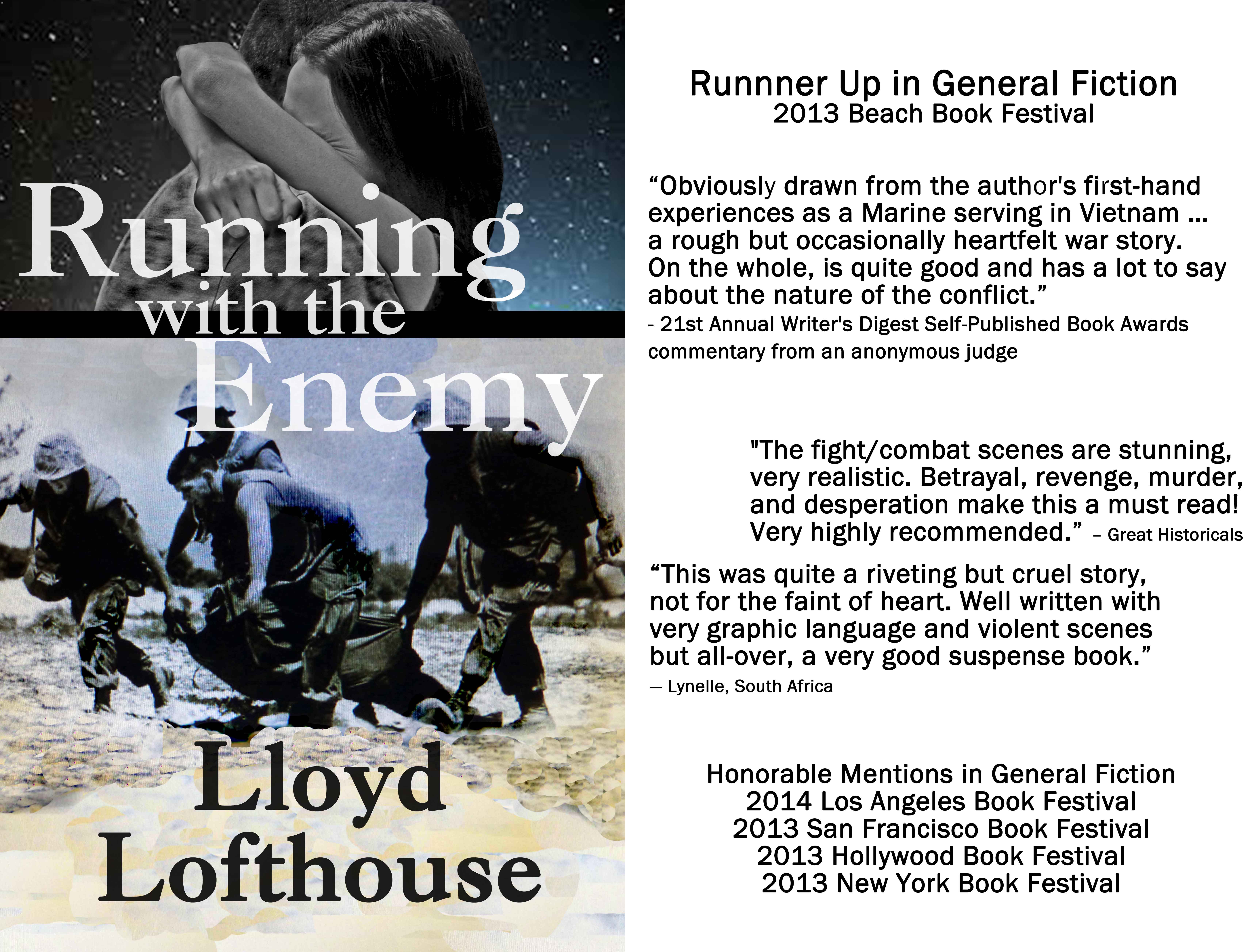
His latest novel is Running with the Enemy. Blamed for a crime he did not commit while serving in Vietnam, his country considers him a traitor. Ethan Card is a loyal U.S. Marine desperate to prove his innocence or he will never go home again.
And the woman he loves and wants to save was trained to hate and kill Americans.
To follow this Blog via E-mail see upper right-hand column and click on “Sign me up!”
For those fifteen years, I didn’t talk about the war. During the day, I didn’t think about it either. However, at night, every sound was the enemy coming for my family and me. I’d wake sweating and grab the eight-inch knife I slept with, and there was a loaded revolver under the bed. Then in 1981, I was working toward a MFA in writing and proposed an individual graduate project where I would write about my experiences from Vietnam.
It took six months to get beyond page forty in that manuscript, which was my first day in Vietnam. The Ph.D. with the major in English literature finally gave me an ultimatum, and I opened up. On page 41, I scrambled down a net and boarded a landing craft that carried me to the beach in Chu Lai.
Did that breakthrough help me sleep through the night? No. I still wake up listening to every sound.
If the crickets around the house stop chirping, I open my eyes and listen. You see, the crickets have become my first line of defense—my trip flare. Before bedtime, I check all the doors and windows to make sure they are locked. I still keep an eight-inch knife close and a twelve-gauge pump shotgun one-step from where I struggle to sleep. I’ve lived with this combat in my head for forty-four years so far.
When my VA shrink told me a few years ago that I had to lock my weapons up so no one would get hurt, I stopped going to counseling. Even in the US, the odds of becoming a victim of violent crime are one in four according to statistics and the last piece I read said the odds are getting worse. When the real beast comes, I have to be ready, because we live in a combat zone.
His latest novel is Running with the Enemy. Blamed for a crime he did not commit while serving in Vietnam, his country considers him a traitor. Ethan Card is a loyal U.S. Marine desperate to prove his innocence or he will never go home again.
And the woman he loves and wants to save was trained to hate and kill Americans.
To follow this Blog via E-mail see upper right-hand column and click on “Sign me up!”
I’m sure that all governments do it—manipulate public opinion to support war. It doesn’t matter if the country has an autocratic government ruled by a dictator or a democracy ruled by elected public officials—the people must be convinced that the enemy is evil and war necessary.
If we follow public support for America’s largest wars, we discover the US government’s learning curve to use the media to drum up support of wars. This manipulation of public opinion may be explained by Abraham Lincoln who said, “You can fool all of the people some of the time, and some of the people all of the time, but you cannot fool all the people all the time.”
The idea is to fool enough people to start a war. After that, it’s easier to keep a war going even when public support turns against it—for a while anyway.
That learning curve started with the American Revolution. For example, many think that the American Revolutionary War (1774 – 1783) was a war fought with the unanimous support of the people for independence from Great Britain.
But in North America, the colonists generally considered themselves loyal British citizens, asserting rightful constitutional claims that had been previously established through their colonial charters or contracts. … Many colonists (and eventually foreign nations) had to be persuaded to join in this revolution. Source: GilderLehrman.org
Then “as the colonists discovered how difficult and dangerous military service could be, enthusiasm waned. Many men preferred to remain home, in the safety of what Gen. George Washington described as their Chimney Corner.”
In fact, Washington predicted that “after the first emotions are over,” those who were willing to serve from a belief in the “goodness of the cause” would amount to little more than “a drop in the Ocean.” And he was correct. Source: Smithsonian Magazine
But how did the colonial government drum up public support?
“American printers played a vital role in swaying public opinion in the years leading up to the American Revolution. A heavy use of propaganda, or the spreading of information and rumors, was used. American printers wrote a great deal against the British which helped to raise morale within the American colonies.” Source: VoicesYahoo.com
And what would have happened to America’s Founding Fathers if the Revolution had been lost? Well, pretty much what’s happening to Edward Snowden but worse. Snowden is a traitor for spilling American secrets, and if the U.S. catches him, he may spend the rest of his life in prison. In the 18th century, the Founding Fathers would have been hanged. Now you may understand why that propaganda and those rumors was so important to these future leaders of a fledgling country.
The contrast between the War of 1812, and the Mexican-American War demonstrates the important use of the media to manipulate public opinion—something America’s leaders were still learning.
The War of 1812 to March 1815 was also known as the Second War of Independence
The United States entered the war with confused objectives and divided loyalties and made peace without settling any of the issues that had induced the nation to go to war. Source: history.army.mil
Why? Because the prosecution of the war was marred by considerable bungling and mismanagement. This was partly due to the nature of the republic. The nation was too young and immature—and its government too feeble and inexperienced—to prosecute a major war efficiently. Politics also played a part. Federalists vigorously opposed the conflict, and so too did some Republicans. Even those who supported the war feuded among themselves and never displayed the sort of patriotic enthusiasm that has been so evident in other American wars.
It is this lack of success that may best explain why the war is so little remembered. Americans have characteristically judged their wars on the basis of their success. The best-known wars—the Revolution, the Civil War, and World War II—were all clear-cut successes. Source: pbs.org
Then we have the Mexican American War (1846 – 1848) where public opinion was divided at first. Many accused President Polk of provoking a war. … The Mexican War was not popular among certain people, especially in the north. They thought it was meant to expand the territory of slavery. … In the end—thrilled by sensationalized newspaper accounts of American victories— the public embraced the war. Source: archives.nbclearn.com
As you can see, the government needs the media to popularize a war. It also helps if the war is short. Long wars tend to lose public support.
The American Civil War (1861 – 1865) “was absolutely an important moment in the history of the press,” says Penn State’s Risley. “The practices, technological development you begin to see during the war—the importance of the telegraph, the use of illustrations, for example—and the growth in demand for newspapers, so many of these things came together during this remarkable and tragic event.”
The demand for newspapers in both the North and South soared during the Civil War, says Risley, whose book is Civil War Journalism(Praeger, 2012).
This demand for information continued after the war and pushed more newspapers to broaden their readership. “America really became a nation of newspaper readers during the war.” The Civil War also showed officials how powerful the press could be in shaping public opinion, and government officials often struggled finding an even-handed approach in their handling of the press.
“Abraham Lincoln recognized that the press played a role in public opinion and he used the press effectively,” says Risley. “But, he wasn’t afraid to shut down newspapers, something that would not have been acceptable today.” Source: futurity.org
Perhaps more importantly, newspapers were responsible for editorializing the war. They were the propaganda machines of the day. Though not universally true, many newspapers published biased accounts of events, “factual” testimonials of enemy atrocities, articles proselytizing for specific political and military goals, and emotionally charged letters from citizens affected by the conflict. A quiet war for public support was waged both in the North and the South with the newspapers serving on the front lines. Issues like conscription, use of slaves as soldiers, and the validity of total war were hotly debated in the papers. The newspapers controlled the ebb and flow of public opinion and a particularly popular circulation could determine the outcomes of city or state politics. … Some newspapers were known to falsely report casualty rates or results of battle to bolster public morale. Source: OregonState.edu
But if the Civil War taught the government about the importance of the media, The Spanish-American War (1898) may have been the first true “media war”.
Today, historians point to the Spanish-American War as the first press-driven war. Although it may be an exaggeration to claim that Hearst and the other yellow journalists started the war, it is fair to say that the press fueled the public’s passion for war.Without sensational headlines and stories about Cuban affairs, the mood for Cuban intervention may have been very different. Source: pbs.org
World War One (1917 – 1918) was deeply unpopular. “once public opinion polling did start appearing in the 1930’s, early surveys on World War Oneshowed only 28% of the country thought entering the war was a good idea, while 64% opposed it.”
In the years after World War I Americans quickly reached the conclusion that their country’s participation in that war had been a disastrous mistake, one which should never be repeated again. During the 1920s and 1930s, therefore, they pursued a number of strategies aimed at preventing war. Source: neh.gov
And Support for World War II (1941 – 1945) was also not widely popular. Even as public opinion in favor of war increased after France fell to Nazi Germany during World War Two, only 42% of the country thought entry into the war was a good idea, while 39% of the country still considered it a mistake.
In fact, entering this war was unpopular until Japanese aircraft attacked Pearl Harbor on December 7, 1941. Then it was clear that the US couldn’t stay out of the Second World War.
Once the war began in earnest, America increased the flood of propaganda, utilizing especially the radio and visual media, most specifically posters. … Since American leaders realized that the best hope of winning the war was through increased production and labor, many posters were circulated urging increased labor and production as well as conservation of materials for the war effort.… During World War II, America produced some of the most successful propaganda campaigns in history. The pushes for increased production, labor, and conservation may well have won the war for America. Source: thinkquest.org
Next, the Korean War (1950 – 1953): When Americans were first asked (by Gallup), in August 1950, if deciding to defend South Korea was a mistake, only 20% thought it was, while 65% said it was not a mistake.
But by the following January, opinion had shifted dramatically, and 49% thought the decision was a mistake, while 38% said it was not—13% had no opinion.
Over several months, as Gallup asked the public if “going into war in Korea” was a mistake, opinion remained relatively stable, with more Americans saying it was than saying it was not. Six months later, as truce talks were being conducted at Kaesong, Americans were feeling more positive—42% felt the war was a mistake, while 47% said it wasn’t. But the numbers shifted again six months later in February 1952, when a majority said the war was a mistake for the United States, soon after a POW exchange proposal by the United Nations was rejected, and riots in the United Nations’ overcrowded Koje-do prison camp resulted in the deaths of many North Korean prisoners.
Soon after Eisenhower was elected president in 1953 and truce talks began again, the American opinion shifted yet again, with half of Americans saying the war was not a mistake, while a low of 36% said it was a mistake.
For Vietnam (1953 – 1975): In 1965—soon after the so-called Tonkin Gulf Incident (the Vietnam War’s Pearl Harbor that was the propaganda to drum up support for war)—only 25% thought the war was a mistake. Source: DailyKos.com
In fact, Anup Shah writing for Global Issues, says it required massive propaganda to create the belief that U.S. involvement in Vietnam was because non-communist South Vietnam was invaded by communist North Vietnam and that the regime in the South was democratic—but there never was a democracy in South Vietnam.
This was all untrue. In addition, many think that the Vietnam War was lost due to the media revealing atrocities but this was also untrue. Noam Chomsky says the American elite typically regarded Vietnam as a “mistake” or tragedy.
Television news in particular was said to have helped America “lose” the war. Yet, television news coverage was arguably poor, and full of news-bites, rather than detailed documentaries. … The Vietnam experience highlights a multitude of factors that contributed to what can only be termed as propaganda for Cold War ideological battles: a mixture of ideological goals, geopolitical and military goals, and issues to do with the nature of reporting and the structure of the media and how it worked, combined with cultural norms, all impacted the way that things were reported, not reported, portrayed, or misrepresented, and this ultimately provided legitimacy for a war that saw millions killed. Source: Global Issues.org
Gallup reported that in 1965, soon after the so-called Tonkin Gulf Incident, 61% of American’s polled said that sending U.S. troops to fight in Vietnam was not a mistake. But by 1971, 70% would say yes—it was a mistake—to the same question.
Again, we hear the echo of President Abraham Lincoln’s words: “You can fool all of the people some of the time, and some of the people all of the time, but you cannot fool all the people all the time.” In 1965, the majority of the American people were fooled but by 1971, only a few were still fools.
For the Gulf War—also known as Operation Desert Storm (August 1990 – February 1991)—we learn that under the first President Bush short wars with decisive victories provide less time for the public to change its mind. … In addition, President George H. W. Bush (1989 – 1993), remembering the lessons of Vietnam, sought public support … and he got it. The vast majority of Americans and a narrow majority of the Congress supported the President’s actions. Source: Source: US History.org
But the 43rd President of the United States, George W. Bush, had his Pearl Harbor on 9/11, and he squandered the public support by relying on false reports of Weapons of Mass Destruction to declare war on Iraq. But this false propaganda succeeded leading to Operation Iraqi Freedom (2003 – 2011).
“Being able to exploit the national anguish and anger over 9/11 was a critical ingredient, of course. But the success of the war-selling campaign was testimony to what a determined use of the opinion-molding capabilities of the government of the day, including the bully pulpit of the presidency, can accomplish.” Source: The National Interest
After Powell’s speech at the UN about WMDs in Iraq, a Gallup poll concluded that 79% of Americans thought the war was justified. However, by 2007, 65% would disapprove of the Iraq War thinking it was not worth fighting, and in March 2013, another survey found that 51.9% of the American public felt that the Iraq War had been a mistake—after all, you cannot fool all of the people, all of the time.
Operation Enduring Freedom in Afghanistan (2001 to present): In 2001, Gallup reported that eight of ten Americans (80%) supported a ground war in Afghanistan. But by March 2012—more than a decade later—sixty-nine percent of Americans thought that the United States should not be at war in Afghanistan.
His latest novel is the award winning suspense-thriller Running with the Enemy. Blamed for a crime he did not commit while serving in Vietnam, his country considers him a traitor. Ethan Card is a loyal U.S. Marine desperate to prove his innocence or he will never go home again.
And the woman he loves and wants to save was fighting for the other side.
To follow this Blog via E-mail see upper left-hand column and click on “FOLLOW!”
That was me in 1966, a trained killer. That was what I was trained to do at MCRD—to kill the enemy and not fight him—but to destroy him or her.
When I read the title,The Threat From Within, Some soldiers become murderers by Jim Frederick, Time Magazine, February 22, 2010; my first thought was that this issue was more complicated than that.
I read the piece, and then looked up theauthor’s bio. I saw no mention that Frederick served in the military or in a combat zone as a member of the military. No matter how many military men he interviewed or how much research he did, Frederick will never understand what it is like to be the hunter or hunted in a combat zone and what it does to that person.
The Threat From Within never mentions PTSD (Post Traumatic Stress Disorder). I have a PTSD VA rated disability from serving in combat in Vietnam in 1966. When I was in Vietnam, I knew men who did horrible things probably driven by PTSD. Current research shows that PTSD causes permanent brain damage. I’m sure that the reason the military handles incidents that would appear to be crimes in a civilian world the way they do, is because the officers know the horrible blood price that comes with winning a war and many people like Jim Frederick do not.
Frederick indicates that the military should find a way to root out these potentially dangerous individuals so these types of killings do not take place. It’s bad enough that our soldiers are put in harm’s way with rules that do not allow them to shoot unless they see the shooter with weapon in hand. They did that to us in Vietnam and America lost that war.
After years of war in Iraq and Afghanistan and a military stretched to the breaking point, if every solider damaged by PTSD were pulled from combat, there wouldn’t be enough troops left to accomplish winning a war America cannot afford to lose. Consider that Al-Qaida and their allies have sworn the utter and total destruction of our entire civilization.
In war, the military has a job to do. If that means sending partially damage troops into combat still capable of fighting and killing, that’s what’s done.
From history, we learned that great military minds like Alexander the Great understood that war is hell and must be fought as if the battlefield is hell itself. America fought like that in World War II and won. In a war zone, there are no innocent people no matter what the media prints or says and only ignorant people and fools support putting limits on our troops doing their job. Even in the Korean conflict, the harsh reality of war existed.
If the rules that our troops fight under today existed during World War II, America would have lost and eventually been split between Japan and Germany. If you lived in the West, the flag to salute would have a rising sun and in the east a swastika.
In my opinion—Jim Frederick and people that think like him are ignorant fools. Let them have their say and politely ignore them.
Lloyd Lofthouse is a former U.S. Marine and Vietnam Veteran.
His latest novel is the award winning suspense-thriller Running with the Enemy. Blamed for a crime he did not commit while serving in Vietnam, his country considers him a traitor. Ethan Card is a loyal U.S. Marine desperate to prove his innocence or he will never go home again.
And the woman he loves and wants to save was fighting for the other side.
To follow this Blog via E-mail see upper left-hand column and click on “FOLLOW!”
I was one of four Marines in two jeeps. We were Marines but we were not Recon Marines. Two of the four were officers. One was a staff sergeant, and I was the radio operator with equipment so old that the three spare batteries had a better chance of being dead before me. Heck, they were feeding us twenty-year old C-rations. The sides of the boxes were stamped 1945 and it was 1966. Proof that the Marines don’t waste anything.
What was more dangerous? The food we were eating or the Vietcong. It’s good to be stupid and nineteen—not knowing about botulism. Besides, I liked the ham and limas.
The 1st Marine tank battalion was involved in a field operation with a South Korean unit—the kind of soldiers you want on your side. The US Marines and the Koreans, along with an ARVN unit, were forming a box to trap a regiment of North Koreans.
We drove ahead of our troops to check the depth of the rice paddies making sure our tanks wouldn’t be bogged down. Every mile or so, we would stop and the officers, a major and a lieutenant, would take a long pole and poke a paddy.
Once we were fifteen to twenty miles ahead of our lines, I lost contact with our people. I switched batteries until I’d tried them all. Then we rolled through a recently deserted village where I saw the Vietcong flag and radio antennas sticking from the top of a tree. Food was still cooking on open flames inside empty huts.
I pointed them out, and the staff sergeant said, “Don’t tell the officers. They don’t need the worry.”
Thirty miles in front of the lines, the officers were busy poking a rice paddy when I spied a line of muscular men in peasant clothing coming toward us. I was squatting behind the second jeep watching our rear holding a fifty-caliber Ingram submachine gun. I was dressed in camouflage, the jeep was olive green, and I was squatting in shadows. These guys were approaching from the rear and the staff sergeant and officers didn’t know.
I felt like an orphan about to be molested.
When that line of men reached the dirt road and climbed from the rice paddy, I stood so they could see my weapon and me, the skinny Marine who had gained twenty pounds in boot camp and was no longer invisible if he turned sideways.
A fifty caliber Ingram submachine gun with a fifty-round clip will cut small trees and men in half. Once you pull the bolt and let go, the entire clip empties. There was another clip taped to the first one. It’s a quick change. You aim to the left of the target and the recoil swings the weapon in an arc to the right.
They saw me and, still walking military fashion, crossed the road, went down the other side into the next rice paddy and kept going. No one shot at us on that recon, but this kind of memory causes you to wake sweaty at three in the morning listening. I remember thinking that maybe my hands were too slick with sweat to pull the bolt and fire.
His latest novel is Running with the Enemy. Blamed for a crime he did not commit while serving in Vietnam, his country considers him a traitor. Ethan Card is a loyal U.S. Marine desperate to prove his innocence or he will never go home again.
And the woman he loves and wants to save was trained to hate and kill Americans.
To follow this Blog via E-mail see upper right-hand column and click on “Sign me up!”
Here we are fighting a war with an enemy that wants to destroy America and everyone in it, and the Republicans are putting obstacles in the way of America’s safety net that is supposed to protect America against terrorists while blaming the democrats for what happened on that Northwest flight.
Let’s not forget that Americans are dying in Iraq and Afghanistan and many come home missing parts or with PTSD.
In Vietnam, I remember congress passing rules of engagement. We weren’t supposed to shoot until we saw who was shooting at us so we wouldn’t hit noncombatants leading to bad press in the media.
Try that in the jungle when you cannot see anyone and someone is shooting at you.
Near the end of my tour, we had a young lieutenant just out of West Point who drummed it into us that we weren’t supposed to shoot unless we saw who was shooting at us. Then he was pinned down on a patrol and he was shouting at us to lay down covering fire.
Yea, right!
No one fired. Then a voice, “We can’t see who is shooting at you.”
What are we supposed to say to the enemy who wants to kill us? “Hold your fire! Hold your fire! You aren’t playing by the rules. This isn’t’ fair. You are a cheater. I’m going to tell your mommy what you are doing.”
What does congress and the media think war is, a game of Risk (that board game kids sometimes play)? Hey guys, we aren’t made of plastic here. We bleed and even if we walk away, we leave damaged.
What do you think? Maybe we should shoot the politicians and the reporters instead.
His latest novel is Running with the Enemy. Blamed for a crime he did not commit while serving in Vietnam, his country considers him a traitor. Ethan Card is a loyal U.S. Marine desperate to prove his innocence or he will never go home again.
And the woman he loves and wants to save was trained to hate and kill Americans.
To follow this Blog via E-mail see upper right-hand column and click on “Sign me up!”
I woke up this morning and wanted to hit something. In the 1960s and 70s, I would have smashed a hole in the nearest drywall.
This is what set me off: “In the past six weeks, you’ve had the Fort Hood attack, the D.C. Five and now the attempted attack on the plane in Detroit … and they all underscored the clear philosophical difference between the administration and us,” said Rep. Pete Hiekstra (R-Mich.), the ranking Republican on the House Intelligence Committee.
The Republican spin machine is trying to score points blaming Obama for what almost happened last week on Northwest Flight 253.
Why did I get angry? Because I immediately flashed back to an incident in Vietnam.
We’d been out for hours on a night patrol slipping silently through the rice paddies that surrounded our hill, and we were returning as dawn arrived—tired but alert as we straggled along the dirt road that climbed into the hills where our Battalion CP was located.
A washed out blue sky was spreading from the east and it was still dark in the west. Then the ground trembled as if an earthquake were taking place. The sound of the explosion blew over us. We stopped and turned to see flames and a thick spire of black smoke rising into the sky from where the airstrip was located. One of the jobs the 1st Marine Division at Chu Lai had in 1966 was to protect that airstrip and the jet fighters that used it.
One Vietcong had slipped past an entire Marine division and made it to the airstrip where he managed to blow up a large portion of the stored jet fuel. That Vietcong didn’t just slip past one defensive line, but several.
I “hate” dirty politics—the same kind that started wars like Vietnam and Iraq so young men as I was then, in our patriotic zeal, would fly off to war believing we were serving a just cause when in the truth, we had been lied to.
It is almost impossible to stop an individual from doing something like what happened on that airplane a few days ago just as an entire Marine division couldn’t stop that Vietcong from infiltrating our lines.
There were 300 people on Northwest Flight 253. For sure, someone will suffer some PTSD symptoms and have trouble sleeping as they relieve the moment they thought they might die. Some may never fly again.
If you agree with Rep. Pete Hiekstra, then George W. Bush is responsible for what happened on September 11, 2001.
Instead of pointing fingers of blame looking for a “scapegoat”, Republicans and Democrats should be looking for ways to do a better job than the Homeland Security our current president inherited.
His latest novel is Running with the Enemy. Blamed for a crime he did not commit while serving in Vietnam, his country considers him a traitor. Ethan Card is a loyal U.S. Marine desperate to prove his innocence or he will never go home again.
And the woman he loves and wants to save was trained to hate and kill Americans.
To follow this Blog via E-mail see upper right-hand column and click on “Sign me up!”
The history of PTSD http://www.psychiatric-disorders.com/articles/ptsd/causes-and-history/index.php says that this disorder wasn’t recognized until 1980. Although this means we have recognized PTSD for about thirty years now, that doesn’t mean we have reached a total understanding of what causes it and how to deal with it. Scientists and doctors are still learning. Compare PTSD to some cancers that modern medicine has dealt with for much longer and they still have no cure–just better ways to identify the cancer early and deal with it. The earlier the discovery, the better chance for recovery and to live a life considered normal. Current evidence about PTSD is saying the same thing. If you have symptoms of cancer and ignore it, the odds are it won’t vanish. The same thing goes for PTSD.
I have read about research for other illnesses that show the longer a physical or psychologically health related problem is “not” treated, the less chance there is to overcome the damage caused.
One thing I’ve learned while living with PTSD for more than forty years is that a healthy lifestyle without booze helps me handle the trauma better. Before I stopped drinking and eating an unhealthy diet, my PTSD symptoms were worse than they are now. I still sleep with weapons and I still wake up at every sound and have trouble sleeping. If I get four hours of sleep in one stretch, that’s good.
Before I sleep, I always do an inside perimeter check to make sure the windows and doors are locked. When I’m out in public, I’m alert to everything around me as if I were going to be attacked at any moment. I still have an unpredictable temper to watch over and there are times it escapes. Double that or triple it before I stopped drinking. The worse thing to do is be in denial and “not” to talk or write about it. The first step to dealing with PTSD is to admit it is there and stop visiting the liquor store.
Imagine what life was like for people with PTSD before 1980. How did WWI, WWII, and Korean War veterans deal with PTSD when they came home? I read recently that the average Vietnam veteran’s lifespan is in the fifty age bracket. Why do you think that is so?
His latest novel is Running with the Enemy. Blamed for a crime he did not commit while serving in Vietnam, his country considers him a traitor. Ethan Card is a loyal U.S. Marine desperate to prove his innocence or he will never go home again.
And the woman he loves and wants to save was trained to hate and kill Americans.
To follow this Blog via E-mail see upper right-hand column and click on “Sign me up!”
For a few days, some of the Marines in my company, including me, were sent to a hill on the perimeter at Chu Lai to watch over an infantry company’s equipment while they were in the hills chasing North Vietnamese ghosts.
There weren’t many of us–just enough for two Marines to man each of the smaller bunkers near the foot of the hill.
Rice paddies surrounded the hill. When night came, the hum of mosquitoes sounded like waves of alien flying saucers, then the rest of the night was a battle against the bloodsuckers.
Several Marines scrambled into the largest bunker at the top of the hill—a two-story model with iron boiler plate for a roof. They thought they would be able to escape the bloodsuckers in there. But as fast as they went in, they came out screaming. The bunker was full of rats and as the first Marine put his boots on the floor, the rats started climbing his legs.
During my watch between midnight and four, I heard a rustling noise near the wire. There would be long stretches of silence (if you don’t count the sound of distant firefights and flares), then another rustling as if someone were crawling up the hill. I couldn’t see anything and thought it might be a small animal.
When my watch ended, I had to visit the latrine. It was a screened, plywood box with a four-hole plywood bench inside. It was black as ink in there. Under the bench were four half-empty, fifty-five gallon metal drums with several inches of diesel fuel in each one. In the mornings, the drums would be dragged out from under the plywood bench and set on fire. When day came, hundreds of columns of black smoke would drift lazily into the morning sky over Chu Lai.
I had cramps—what I call green apple trot. I leaned my weapon just out of reach against the three-foot high plywood wall in front of me and sat. Above the plywood was a screened in open space that allowed air to flow through. There was a tin roof. On both sides was a line of tents where the grunts (infantry) kept their gear and slept.
That’s when the grenades started to go off. I glanced to the left to see a shadowy figure running along the line of tents tossing a grenade through each opening. I reached for my weapon as a wave of cramps doubled me over. I thought I was dead.
No one died on that hill that night. The tents were empty because the grunts were in the hills and we were in the smaller bunkers near the concertina wire. I was closer than anyone in my unit but was fortunate the latrine was ignored.
How many events like this does it take to acquire Post Traumatic Stress? What happened to you? What do you remember?
His latest novel is Running with the Enemy. Blamed for a crime he did not commit while serving in Vietnam, his country considers him a traitor. Ethan Card is a loyal U.S. Marine desperate to prove his innocence or he will never go home again.
And the woman he loves and wants to save was trained to hate and kill Americans.
To follow this Blog via E-mail see upper right-hand column and click on “Sign me up!”
How many Hollywood movies have painted a positive picture of Vietnam Veterans compared to movies that show Vietnam veterans as angry, violent, dangerous drug users and/or alcholics (mostly brought on by PTSD)?
Three Vietnam Veterans that I know of have run for President of the United States. All three lost.
Al Gore served in Vietnam as a reporter/journalist for five months. He Gore was stationed with the 20th Engineer Brigade in Bien Hoa and was a journalist with The Castle Courier. He received an honorable discharge from the Army in May 1971.
Of his time in the Army, Gore later stated, “I don’t pretend that my own military experience matches in any way what others here have been through […] I didn’t do the most, or run the gravest danger. But I was proud to wear my country’s uniform. And my own experiences gave me strong beliefs about America’s obligation to keep our national defenses strong.” He also later stated that his experience in Vietnam “didn’t change my conclusions about the war being a terrible mistake, but it struck me that opponents to the war, including myself, really did not take into account the fact that there were an awful lot of South Vietnamese who desperately wanted to hang on to what they called freedom. Coming face to face with those sentiments expressed by people who did the laundry and ran the restaurants and worked in the fields was something I was naively unprepared for.”
John Kerry reported for duty at Coastal Squadron 1 in Cam Ranh Bay in South Vietnam on November 17, 1968. In his role as an officer in charge of Swift boats, Kerry led five-man crews on a number of patrols into enemy-controlled areas. His first command was Swift boat PCF-44, from December 6, 1968 to January 21, 1969, when the crew was disbanded. They were based at Coastal Division 13 at Cat Lo from December 13, 1968 to January 6, 1969. Otherwise, they were stationed at Coastal Division 11 at An Thoi. On January 30, 1969, Kerry took charge of PCF-94 and its crew, which he led until he departed An Thoi on March 26, 1969, and subsequently the crew was disbanded.
On January 22, 1969, Kerry and several other officers had a meeting in Saigon with Admiral Elmo Zumwalt, the commander of U.S. Naval forces in Vietnam, and U.S. Army General Creighton Abrams, the overall commander of U.S. forces in Vietnam. Kerry and the other officers reported that the “free-fire zone” policy was alienating the Vietnamese and that the Swift boats’ actions were not accomplishing their ostensible goal of interdicting Viet Cong supply lines.
John McCain requested a combat assignment, and was assigned to the aircraft carrier USS Forrestal flying A-4 Skyhawks. His combat duty began when he was 30 years old, in mid-1967, during the Vietnam War. McCain and his fellow pilots became frustrated by micromanagement from Washington, and he would later write that “In all candor, we thought our civilian commanders were complete idiots who didn’t have the least notion of what it took to win the war.”
John McCain became a prisnor of war on October 26, 1967.
He was flying his 23rd bombing mission over North Vietnam when his aircraft was shot down by a missile over Hanoi. McCain fractured both arms and a leg ejecting from the aircraft. Although McCain was badly wounded, his captors refused to treat his injuries, beating and interrogating him to get information; he was given medical care only when the North Vietnamese discovered that his father was a top admiral.
Lloyd Lofthouseis a former U.S. Marine, Vietnam Veteran, journalist and award winning author.
His second novel is the award winning love story and suspense-thrillerRunning with the Enemy. Blamed for a crime he didn’t do while serving in Vietnam, his country considers him a traitor. Ethan Card is a loyal U.S. Marine desperate to prove his innocence or he will never go home again.

 The Soulful Veteran's Blog