What happened to the America that …

On January 3, 2013, Mark Hosenball writing for Reuters reported that the Senate Intelligence Committee’s chairwoman expressed outrage over scenes in the film “Zero Dark Thirty” that imply “enhanced interrogations” of CIA detainees.

Hosenball wrote, “Some of Obama’s liberal supporters are attacking the film and officials who cooperated with its creators for allegedly promoting the effectiveness of torture.”

As I read this piece , I started to think of the brutality of war and what it means to lose and then had a few questions:

During the Vietnam War, what happened to the America that dropped 250,000 cluster bombs on Cambodia?

What happened to the America that firebombed civilians in Germany & Japan in World War II?

PBS reported that in Germany, “The casualty figures reported by German fire and police services ranged between 25,000 and 35,000 dead. However, thousands more were missing, and there were many unidentified refugees in the city. It is probable that the death total approached the 45,000 killed in the bombing of Hamburg in July-August 1943. Some careless historians, encouraged by Soviet and East German propaganda, promulgated figures as high as 250,000. Although David Irving later recanted his claim of 135,000 dead, one can still find that number cited in many history books.”

In Japan, PBS said that in Tokyo, “Before the firestorm ignited by Operation MEETINGHOUSE had burned itself out, between 90,000 and 100,000 people had been killed. Another million were rendered homeless. Sixteen square miles were incinerated, and the glow of the flames was visible 150 miles away. Victims died horribly as intense fires consumed the oxygen, boiled water in canals, and sent liquid glass rolling down streets.”

What happened to the America that dropped A-bombs on two cities in Japan to end World War II?

“Unlike many other bombing raids, the goal for this raid had not been a military installation but rather an entire city. The atomic bomb that exploded over Hiroshima killed civilian women and children in addition to soldiers. Hiroshima’s population has been estimated at 350,000; approximately 70,000 died immediately from the explosion and another 70,000 died from radiation within five years.”

“Approximately 40 percent of Nagasaki was destroyed. Luckily for many civilians living in Nagasaki, though this atomic bomb was considered much stronger than the one exploded over Hiroshima, the terrain of Nagasaki prevented the bomb from doing as much damage. Yet the decimation was still great. With a population of 270,000, approximately 70,000 people died by the end of the year.” Source: About.com

What happened to the America that sprayed Vietnam with Agent Orange?

What happened to the America that dropped more bombs on northeastern Laos during the Vietnam War than it dropped in all of World War II?

“As part of its efforts during the Vietnam War, the United States began a nine-year bombing campaign in Laos in 1964 that ultimately dropped 260 million cluster bombs on the country — the most heavily bombed country in history. That’s more than 2.5 million tons of munitions — more than what the U.S. dropped in World War II on Germany and Japan combined. … Of the 75 million bombs that failed to detonate, less than 1 percent have been cleared. At least 25,000 people have been killed or injured by these bombs in the 35 years following the end of the bombing campaign. Today, an average of 300 Lao people are injured or killed every year by these weapons.” Source: Huffington Post

What happens to the citizens of the United States if America loses the war on terror?

Discover A Night at the “Well of Purity”

_______________________

Lloyd Lofthouse, a former U.S. Marine and Vietnam Veteran, is the award winning author of The Concubine Saga.

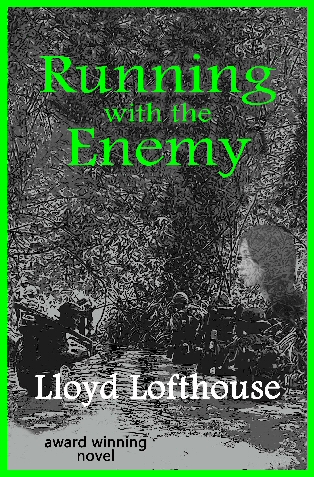
His latest novel is Running with the Enemy. Blamed for a crime he did not commit while serving in Vietnam, his country considers him a traitor. Ethan Card is a loyal U.S. Marine desperate to prove his innocence or he will never go home again.

And the woman he loves and wants to save was trained to hate and kill Americans.

To follow this Blog via E-mail see upper right-hand column and click on “Sign me up!”

Rebuilding Lives

I bought an audio version of The Street of a Thousand Blossoms to listen to while driving (I am an avid reader and listener of books).

Gail Tsukiyama’s novel starts before World War II and concludes years after the war ends. The story is about the violent rebirth of a nation and its people through war and defeat told mostly through the eyes and emotions of two brothers.

Because I served in Vietnam in the US Marines as a field radio operator, my focus has been on what combat does to soldiers—not noncombatants. However, after reading Tsukiyama’s novel, it is easy to see that civilians that experience the horror of war may also suffer from the trauma of PTSD.

To get an idea of the destruction and suffering, more people may have been killed or injured in the firebombing of Tokyo than from the atomic bombs dropped on Hiroshima or Nagasaki near the end of the war.

The Tokyo Metropolitan Police Department reported that almost a 100,000 were killed in addition to a million injured with 286,358 buildings and homes destroyed. There were a million left homeless.

In comparison, it is estimated that 150,000 – 246,000 were killed from the atomic bombs, and if Japan hadn’t surrendered when it did, the US would have had seven more atomic bombs ready to drop on Japan’s cities before October 1945.

What led to the war in the Pacific?

Some of Japan’s leaders wanted to rule over East Asia, including China, and that quest for power cost Japan dearly and the nations it invaded.

However, in defeat, between 500,000 and 1,000,000 Japanese civilians were killed in addition to 2.12 million military. In comparison, in all of World War II, the US lost 1,700 civilians and 416,800 military. At Pearl Harbor, the US lost 2,402 military and 57 civilians.

What is not well known is that the decision to attack the United States was not unanimous in Japan’s government or military.

“Military control in prewar Japan was exercised by the War and Navy Ministers and the General Staffs of the Army and Navy, not by the civil government.” Source: ibiblio.org

In fact, “Higher Navy officials in Japan were against bombing Pearl Harbor, but the fleet commander, Yamamoto, threatened to resign unless given permission to launch the strike and the Navy staff reluctantly permitted it.” Source: Thornley.net

“To the conservative admirals of Japan’s Naval General Staff, a direct confrontation in the central Pacific Ocean between their navy and the Unites States Navy was unthinkable.” Source: Pacific War.org

In addition, Emperor “Hirohito said he was powerless to stop the militarists because any dissent on his part would have led to his assassination.” Source: Net Places.com

Then Japan’s Prime Minister Prince Fumimaro Konoe attempted to avoid war with the United States, and when he failed, he resigned from office on October 16, 1941 – six weeks before Japan attacked Pearl Harbor.”  Source: Wikipedia.org

Hiroshi and Kenji are the main characters in The Street of a Thousand Blossoms, and what they experience during the war is often worse than that of soldiers in combat. The sense of helplessness is acute because the characters in the novel cannot fight back as bombs are dropped on them or as Japanese police force them to comply with harsh wartime regulations.

Hiroshi dreams of becoming a sumotori (a Japanese form of wrestling) while his younger brother, Kenji, is obsessed with the craft of carving wood masks worn by the actors of Noh Theater, a classical Japanese theatrical form—one of the world’s oldest.

Before the war, the brothers’ parents drowned in a boating accident, and they are raised by their grandparents in the Yanaka district of northeastern Tokyo.

The war interferes with the boys’ dreams and rationing leads to hunger and the struggle to survive.

Because we are either with Hiroshi or Kenji during the horrific fire-bombing of Tokyo, and they also experience the iron fist of the city’s police to control the people while Japan is losing the war, we discover what it must be like to live in a nation that is being defeated.

The bombing of Hiroshima and Nagasaki ends the war, but the emotional wounds are slow to heal. However, Hiroshi and Kenji renew their passions and through them we see the healing of a defeated nation. It is a bitter sweet story that I highly recommend—a story of resilience and rebirth.


Gail Tsukiyama was born in San Francisco, California to a Chinese mother from Hong Kong and a Japanese father from Hawaii. She attended San Francisco State University where she received both her Bachelor of Arts Degree and a Master of Arts Degree in English with the emphasis in Creative Writing.

Discover Stanford Study shows effect of PTSD trauma on brain

_______________________

Lloyd Lofthouse, a former U.S. Marine and Vietnam Veteran, is the award winning author of The Concubine Saga.

His latest novel is Running with the Enemy. Blamed for a crime he did not commit while serving in Vietnam, his country considers him a traitor. Ethan Card is a loyal U.S. Marine desperate to prove his innocence or he will never go home again.

And the woman he loves and wants to save was trained to hate and kill Americans.

To follow this Blog via E-mail see upper right-hand column and click on “Sign me up!”

Unwanted Heroes

Many unwanted heroes defend our nation and fight its wars—right or wrong. When America’s leaders declare wars based on lies (for example: Vietnam and Iraq) or the truth (World War I, II, Afghanistan and Korea), unwanted heroes do the fighting and pay the price.

On the side of a bus at the VA medical clinic that I go to, it says, “All gave some; some gave all.” I have a credit card sized VA Department of Veterans Affairs ID card.  It says below my photo: “Service Connected.” That means I have a disability connected to my service in Vietnam in 1966 when I was serving in the US Marines.

What is the price many unwanted heroes pay for trusting their leaders?

This post has the same title of a novel that was recently released, and I had the privilege of editing Unwanted Heroes by Alon Shalev.

In Unwanted Heroes, Shalev brings together a long suffering, battle weary Chinese American Vietnam veteran suffering from the trauma of PTSD and an idealistic and somewhat pretentious young Englishmen, who both share a love for San Francisco, coffee and wine.

Alon Shalev, the author, grew up in London, and has been a political activist since his early teens. He strives through his writing to highlight social and political injustice and to inspire action for change.

Moving to Israel, he helped establish a kibbutz where he lived for 20 years and served in the Israeli army.

Shalev then moved to the San Francisco Bay area and fell hopelessly in love with this unique city. Being new to the US, however, he was shocked to see so many war veterans on the streets. He regularly volunteers at initiatives such as Project Homeless Connect and the San Francisco Food Bank where he meets and talks with war veterans. These experiences lend authenticity to the novel.

In fact, according to NIH (the National Institute of Health) Medline Plus, “PTSD affects about 7.7 million American adults” … and “members of the military exposed to war/combat and other groups at high risk for trauma exposure are at risk for developing PTSD.

“Among veterans returning from the current wars in Iraq and Afghanistan, PTSD and mild to moderate traumatic brain injury (TBI) are often linked and their symptoms may overlap. Blast waves from explosions can cause TBI, rattling the brain inside the skull.

“The U.S. Department of Veterans Affairs estimates that PTSD afflicts almost 31% of Vietnam veterans; as many as 10% of Gulf War (Desert Storm) veterans; 11% of veterans of the war in Afghanistan, and 20% of Iraqi war veterans.”

NIH says, “PTSD is often accompanied by depression, substance abuse, or other anxiety disorders.”

In addition, “between 529,000 and 840,000 veterans are homeless at some time during the year, and on any given night, more than 300,000 veterans are living on the streets or in shelters in the US. … About 33% of homeless males in the US are veterans and veterans are twice as likely as other Americans to become chronically homeless. One of the primary causes of homelessness among veterans is combat-related mental health issues and disability.

The incident of PTSD and suicide rates among veterans is also climbing and 45% of homeless veterans suffer from mental illness including PTSD. Source: Veterans Inc.org

The New York Times reported, “Suicide rates of military personnel and combat veterans have risen sharply since 2005, as the wars in Iraq and Afghanistan intensified. Recently, the Pentagon established a Defense Suicide Prevention Office.”

“The CDC Vietnam Experience Study Mortality Assessment showed that during the first 5 years after discharge, deaths from suicide were 1.7 times more likely among Vietnam veterans than non-Vietnam veterans. …

Why? “The average infantryman in the South Pacific during World War II saw about 40 days of combat in four years. The average infantryman in Vietnam saw about 240 days of combat in one year thanks to the mobility of the helicopter.” Source: History.com – Statistics about the Vietnam War

I did not seek help for my PTSD for thirty-eight years, because I did not know the VA offered counseling.

Discover A Prisoner of War for Life

__________________________

Follow this Blog via Email — sign in near the top-right corner of this screen and click “Follow”

My PTSD may be responsible for me being an unlikable guy—at least for some people that do not think as I think. This reblogged essay is worth reading–important nutrition for thought. If you regularly read one of my blogs where the posts often run more than a few hundred words and are not written for a fifth-grade reading level (the average person in America reads at this level), I suspect you are a thinker and are in a minority in the United States when it comes to thinking.

Lloyd Lofthouse's avatarLloyd's Anything Blog

All it takes is nine minutes of your time to watch this video as a way to understand why we need healthcare reform in the US.  We cannot return to the way things were in 2007-2008 as Mitt Romney says he will do if elected president. Romney has pledged he will repeal Obamacare if elected.  What does that mean?

“The percentage of people without health insurance in America in 2008 was not statistically different from 2007 at 15.4 percent. The number of uninsured increased to 46.3 million in 2008, from 45.7 million in 2007.

“The number of people with health insurance increased to 255.1 million in 2008—up from 253.4 million in 2007. The number of people covered by private health insurance decreased to 201.0 million in 2008—down from 202.0 million in 2007. The number of people covered by government health insurance increased to 87.4 million—up from 83.0 million in 2007

View original post 557 more words

Destroying an Enemy at the Speed of Light

The US Navy announced it is two years away from active laser weapons on its warships.

 ABC News reported, “The weapons are designed to track and fire on threats to a warship that could include anything from armed drones and small ‘swarm’ boats to incoming missiles and aircraft.”

A directed-energy weapon, such as a laser, shoots energy in an aimed direction without using a projectile such as a missile or a round fired from a cannon.

Laser weapons usually generate brief high-energy pulses. A one megajoule laser pulse delivers roughly the same energy as 200 grams of high explosive, and has the same basic effect on a target. The primary damage mechanism is mechanical shear, caused by reaction when the surface of the target is explosively evaporated

In May 2012, Scientific American.com said, “In a grainy, black-and-white video that looks like a home movie of a UFO attack a sleek aircraft streaks through the sky one minute, only to burst into flames the next and plummet into the sea.  … The Phalanx—a rapid-fire, computer-controlled, radar-guided gun system—used electro-optical tracking and radio frequency sensors to provide range data to the LaWS, which is made up of six solid-state lasers with an output of 32 kilowatts that simultaneously focus on a target.”

This weapon, of course, will make China’s aircraft carrier killer missile obsolete only a few years after China developed it. On December 27, 2010, Washington Times.com reported, “China’s military is deploying a new anti-ship ballistic missile that can sink U.S. aircraft carriers.”

The country with the most advanced weapons usually rules the battle field. The Chinese, for example, did it for centuries with rockets, napalm and the simple stirrup for riding horses. Once China’s northern enemies, the Mongolians, had these weapons too, China was conquered and Kublai Khan founded the Yuan Dynasty that ruled China 1279 – 1368 AD.

Discover War – the Waiting

_______________________

Lloyd Lofthouse, a former U.S. Marine and Vietnam Veteran, is the award winning author of The Concubine Saga.

His latest novel is Running with the Enemy. Blamed for a crime he did not commit while serving in Vietnam, his country considers him a traitor. Ethan Card is a loyal U.S. Marine desperate to prove his innocence or he will never go home again.

And the woman he loves and wants to save was trained to hate and kill Americans.

To follow this Blog via E-mail see upper right-hand column and click on “Sign me up!”

Lloyd Lofthouse's avatarLloyd's Anything Blog

The word that is the title for this post sums up most of Mitt Romney’s campaign for president of the US. And Vice President Joe Biden, if you didn’t notice, used the term in his debate with Ryan three times.

Vera H-C Chan writing for The Ticket explained the loaded message behind Biden’s use of ‘malarkey’.

Chan wrote, “‘Malarkey,’ as Merriam-Webster defines it, is ‘insincere or foolish talk.’ It’s a dismissive word to use, with avuncular overtones, and you’d use it to deem something as silliness, bunkum, hogwash—verging on nonsense, you (and a thesaurus) might even say.”

I read that many viewers of the debate turned to the Internet to discover what ‘malarkey’ meant, but I didn’t have to turn to the Internet thanks to my Irish heritage through my father. Lofthouse is a common name in England and Ireland—not Germany as many may think when first…

View original post 991 more words

I often see a bumper sticker on the back bumpers of cars on US streets that say “COEXIST”—a dream of many idealistic and ignorant Americans. I suspect this dream that we “all get along” will never materialize without much bloodshed.

To achieve coexistence, mankind would have to kill off every violent person on the planet: every bully, every sociopath, every narcissist, and every violent idealist such as American neoconservatives, white supremacists and every American ever convicted or suspected of a violent crime, etc.

There would have to be a blanket death sentence for all people that fit that description. Either that or we would have to lobotomize them all. As long as one violent person lives and walks free on the Earth we can never have a peaceful coexistence.

Wayne K. Spear's avatarJournalism, Essays, Broadcasting, Books

Malala Yousafzai

THERE ARE no words of sufficient force to summarize this week’s attempted murder of fourteen year-old Malala Yousafzai, in the northwest Pakistan city of Mingora. Yet as shocking as this savagery is, there is nothing new about it either: depravity is the business of the Taliban franchise. There are however some lessons to be drawn from the years during which the Tehrik-i-Taliban Pakistan (abbreviated as TTP and known also as the Pakistani Taliban) terrorized the Swat valley and Mingora specifically.

The rise of the Pakistani Taliban coincided with, but was not an outcome of, the American and British entrance into the Northern Alliance battle against the Afghani Taliban. Here I should remind the reader that the Taliban of Afghanistan and Pakistan share a name and a list of enemies but little else. In structure, interests and objectives they differ, and excepting a short-lived declaration of common purpose — to…

View original post 477 more words

PTSD and Homeless Veterans

In the Marines, we learned to never leave the wounded or dead behind.

I have lived with the symptoms of PTSD for forty-six years. I was fortunate. I was capable of holding down a job. I haven’t forgotten the homeless veteran I met in an alley early one early morning in Pasadena, California. I wrote about it in A Prisoner of War for Life.

The key is to learn how to cope. If you have PTSD, you will never get rid of it as if it were a cold or the flu. PTSD stays with you for life.

USA Today reported, “War might be making young bodies old. … The tragic signs of post-traumatic stress disorder or battlefield concussion are all too evident. Even more alarming for researchers is emerging evidence that these newest American combat veterans — former GIs and Marines in their 20s and 30s — appear to be growing old before their time. Scientists see early signs of heart disease and diabetes, slowed metabolisms and obesity — maladies more common to middle age or later.”

Some veterans are so damaged from combat experience, that they become homeless.

The population of the United States is more than 314 million people. The US Armed Forces that protects America’s civilians numbers 1.458 million—less than one-half-of-one-percent of the total US population. In addition, there are about 860 thousand military reservists.

In fact, the number of military veterans in the United States in 2012 was 21.8 million—6.94% of the total US population.

It doesn’t matter the reason a US citizen joins the military—patriotism or a financial need—and fights in one of America’s foreign wars. The fact that he or she served and put his or her life on the line or risked serious injury in combat,  I think that the ninety-three percent of the population that never served and risked life and limb owes those veterans an obligation.

That also means supporting homeless veterans with jobs and shelter.

The National Alliance to End Homelessness says, “The nation’s homeless population … went from 643,067 in 2009 to 636,017 in 2011. … The only increase was among those unsheltered.”

However, “The national rate of homelessness was 21 homeless people per 10,000 people in the general population. The rate for veterans was 31 homeless veterans per 10,000 veterans in the general population.”


PBS Documentary on Homeless Veterans – WORTH WATCHING if you have the time.

The Veterans Administration is the only federal agency that provides substantial hand-on assistance directly to Veterans who are homeless or at risk of homelessness.

Veteran homelessness is a problem of national importance. According to a count on a January night in 2011, there were 67,495 homeless Veterans. And an estimated 144,842 Veterans spent at least one night in an emergency shelter or transitional housing program in a recent year. Because of this, in 2009, President Obama and U.S. Department of Veterans Affairs Secretary Eric K. Shinseki announced the federal government’s goal to end Veteran homelessness by 2015.

An estimated 144,842 Veterans spent at least one night in an emergency shelter or transitional housing program in one recent year.

Many other Veterans are considered at risk of homelessness because of poverty, lack of support from family and friends, substance use or mental health issues, and precarious living conditions.

The VA has a hot line to support veterans who are homeless or at risk of becoming homeless. That number is: 1-877-4AID-VET (1-877-4243-838) Source: VA.gov/Homeless

In recent months, I have been editing a novel about PTSD and homeless veterans.  It isn’t my work. It was written by Alon Shalev, the author of  The Accidental Activist and A Gardener’s Tale.  His next novel is titled, Unwanted Heroes (to be published soon). It’s a story about healing and/or the failure to heal from PTSD. A love story is part of the mix too.

_______________________
Lloyd Lofthouse is a former U.S. Marine and Vietnam Veteran.

Low-Def Kindle Cover December 11His latest novel is the award winning suspense-thriller Running with the Enemy. Blamed for a crime he did not commit while serving in Vietnam, his country considers him a traitor. Ethan Card is a loyal U.S. Marine desperate to prove his innocence or he will never go home again.

And the woman he loves and wants to save was fighting for the other side.

To follow this Blog via E-mail see upper left-hand column and click on “FOLLOW!”