In September 2009 , I found the 1966 Vietnam letters I wrote home that my mother had saved. Sitting on the floor sorting them, I noticed that my dad had written a lot while I was overseas. My dad was a man of few words, and the number of letters told me how much he cared.
My dad has been dead for twenty years and my mother for ten. These letters had been in a box for more than forty years. They showed that people now dead cared when I was in harm’s way as our troops are in harm’s way in Iraq and Afghanistan. Sitting on the floor with those letters scattered around me, I started to cry. After the tears dried, I read some more.
One of the letters was from Linda Grey, my dad’s best friend’s oldest daughter. By the way, when I was a kid, my family and friends called me Skip.
Hi Skip,
How are you doing over there, Skip? Your mother is teaching me how to cook for you, so when you get back I will cook a dinner for you, okay. That Tim just loves to tease me all the time. And it makes me mad! I hope you like the candy I made. We all miss you very much, and that is why we call Tim, Skip.
I’m sorry I haven’t been writing to you, but I have been working a lot this summer. Skip, have you met any beautiful girls over there? Skip, for my summer vacation I went to Yosemite National Park with my grandmother, my cousin, my sister and I went horseback riding for four hours. When we got through going horseback riding, we went bicycle riding for one hour. Skip, could you find out how much does a culture pearl cost? Well, I will say good-by for now.
Love,
Miss Linda Grey.
Sitting on top of that bunker in Vietnam in 1966, I stared at the word “Love,” and wondered what she met and was afraid of my own imagination.
What if those thoughts were wrong?
It was a sunny, clear day with a deep-blue sky. That’s when the sniper fired. I felt and heard the round as it snapped by my ear brushing the skin but not breaking it. One more inch to the left, and I would have been dead.
Instantly, I rolled off the back of the bunker, grabbed my M-14 on the way down, hit the ground, flipped off the safety, rolled to the right into the open and searched for a target. There was no one beyond the concertina wire at the base of the hill. The rice paddies were empty—the trees a smudge in the distance.
A few weeks later, another letter arrived from my mother and she told me to write Linda and tell her that that I was too old for her. Linda was a teenager then—about four or five years younger than me. I turned twenty-one soon after arriving in Vietnam.
For the next month, my depression was deep. As a child growing up, I’d known Linda for years, and she was a great kid to have as a friend. She also grew up to be a real beauty. I know now—decades later—that after she graduated from high school, she married the wrong guy, who abused her horribly, and her life was a mess for some time before she divorced him and eventually found love again.
After that narrow escape from death in Vietnam—one of several while I was there—I didn’t read letters on top of bunkers again. I also never forget the letters that the adolescent Miss Linda Grey wrote that ended with the word “Love“.
Are there any special letters or e-mails that you remember—ones that will still be in your thoughts decades later?
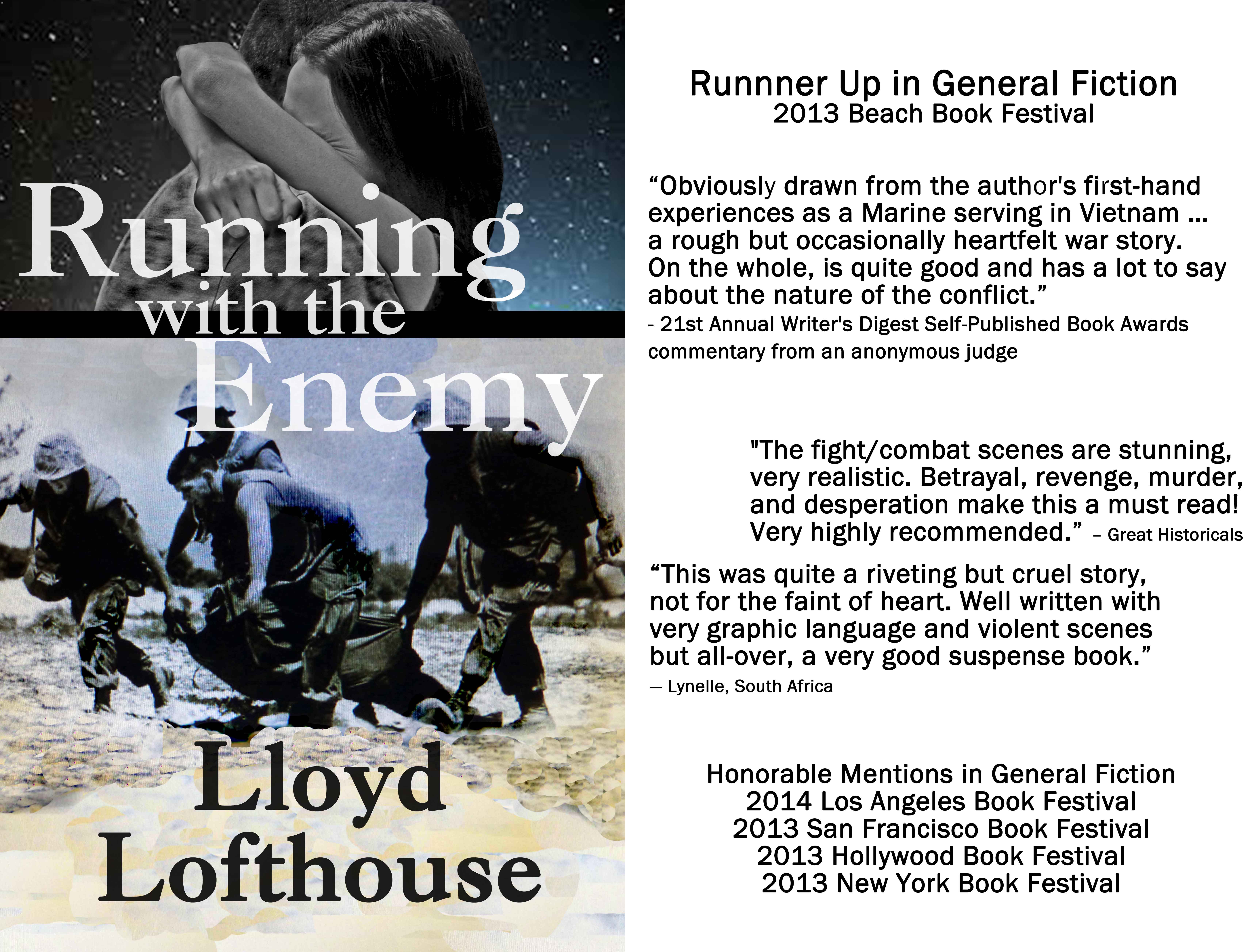
His latest novel is Running with the Enemy. Blamed for a crime he did not commit while serving in Vietnam, his country considers him a traitor. Ethan Card is a loyal U.S. Marine desperate to prove his innocence or he will never go home again.
And the woman he loves and wants to save was trained to hate and kill Americans.
To follow this Blog via E-mail see upper right-hand column and click on “Sign me up!”
The GI Bill helped pay my way through college. In 1971, I was in my third year; attending my third college. My third college wasFresno State. I was in a creative writing class when a debate about the war in Vietnam started after a young girl read her short story about ‘evil’ American pilots dropping bombs on North Vietnamese children.
I was the onlyVietnam veteran in the class. I struggled to explain to the obviously brainwashed kids that American pilots dropping bombs over North Vietnam were thousands of feet above the targets and did not see the carnage. They were gone by the time the bombs exploded, and they were following orders. In the military, you followed orders or faced a court martial.
“How could someone sleep at night knowing they had dropped bombs killing innocent children and women,” one girl said. Others joined in, and the discussion turned into an argument. It was them against me. It was frustrating. The consensus was that any American in Vietnam was a baby killer. To them, the American pilots had to know what they were doing and were evil.
Eventually, the professor put a stop to the argument.
My first night in Vietnam, I relayed an order that killed a dozen Vietcong. I never saw the bodies. I never saw them die. I was in the radio tent a hundred yards from the action when a call came from one of the tank commanders saying there was noise in a ravine that led to the top of the hill. During the day, wires had been strung in that ravine with tin cans tied to them and there were rocks in the cans.
The tankers heard the rattle of rocks and called asking for permission to fire napalm into that gully. The officer on watch said yes, and I relayed the order. The tankers lit their flame and fired. The next morning, twelve blackened, burned bodies were found in the ravine. They all had weapons. They were coming to kill United States Marines.
Our colonel had devised a plan, and it succeeded. He had given no orders to build bunkers or spread concertina wire along the perimeter to protect us on our first night in country. The platoon of flame tanks had been left aboard the Navy ship until dark when they were brought ashore and guided to the hill where the platoon of tanks was positioned to protect against an attack.
In Europe during WWII, American bombers firebombed cities nightly during the closing months of the war against Hitler’s Germany. In one night, in one city, forty thousand civilians including women and children hadnapalm dropped on them. In Japan,firebombs dropped on Tokyo burned a hundred thousand in one day. There were no attempts to avoid hitting civilians to bring Hitler’s Germany and Japan to their knees. It was understood that war was ‘hell,’ and we fought to win. What has changed?
Lloyd Lofthouse is a former U.S. Marine and Vietnam Veteran.
His latest novel is the award winning suspense-thriller Running with the Enemy. Blamed for a crime he did not commit while serving in Vietnam, his country considers him a traitor. Ethan Card is a loyal U.S. Marine desperate to prove his innocence or he will never go home again.
And the woman he loves and wants to save was fighting for the other side.
To follow this Blog via E-mail see upper left-hand column and click on “FOLLOW!”
John Wayne movies molded my young brain, and fired my imagination. As a child, I dreamed of being a hero. Then at nineteen, I went to war and my thinking changed drastically. Narrow escapes from death ended my hero dreams, and I was fortunate to arrive home from Vietnam without aPurple Heart.
They say close only counts in horseshoes. I say it also counts in war. This morning, I awoke thinking about John Kerry and how his reputation was smeared during his presidential campaign.
John Kerry fought in Vietnam. He was wounded three times. They were not serious wounds, but they drew blood. Even flesh wounds earn Purple Hearts. One wireman in my communications platoon was awarded a Purple Heart. While in the field sleeping in his shelter half, his unit came under attack. Mortar rounds dropped in like hail. Half asleep, he scrambled out, tripped on one of the lines that held his shelter half up, fell and hit his head on something. He needed stitches. His sergeant put him in for a Purple Heart.
One of the tankers in that action was scrambling to get into his tank. In his rush to get inside the protection the tank offered, he slammed the turret hatch on one of his hands and crushed all the bones in it. He was also awarded a Purple Heart. He earned a ticket home too, and was discharged from the Marines with aVA disability for the crushed hand.
Bob, a history teacher I taught with, was in the Navy and served inSwift Boats like Kerry. Bob was the mechanic that kept the twin engines running. He told me once that the safest place in that swift boat was between the twin engines. On the water, the swift boat was an easy target and the metal hull was thin.
Those of us that did not bleed during combat and never earned Purple Hearts were still changed by narrow escapes from death. I had several and came home with a case of PTSD that still haunts me decades later.
John Kerry’s flesh wounds show that he came close to death. Yet, during his campaign for president, Swift Boat Veterans for Truth cast doubt on his courage, andGeorge W. Bush, the man who used family influence to get into the National Guard and avoid combat, somehow became a hero, walked into the White House and served as president for eight years starting two wars. I have no idea what kind of president John Kerry would have been. I wonder if he would have used bogus evidence for WMDs and invaded Iraq.
Abraham Lincoln said “You may fool all the people some of the time, you can even fool some of the people all of the time, but you cannot fool all of the people all the time.”
His latest novel is Running with the Enemy. Blamed for a crime he did not commit while serving in Vietnam, his country considers him a traitor. Ethan Card is a loyal U.S. Marine desperate to prove his innocence or he will never go home again.
And the woman he loves and wants to save was trained to hate and kill Americans.
To follow this Blog via E-mail see upper right-hand column and click on “Sign me up!”
I went to sleep at 11:00 p.m. and woke to dark listening to the crickets, noisy sentries that say all was well. It wasn’t raining and there was no thunder or lightning. However, staring at the glowing red numbers on the clock radio reminded of the rainy days I spent on O.P. 39 in 1966. There’s a picture on my Website. It’s about two-thirds of the way down the page. The thirty-nine meant the elevation above sea level.
I have no idea what triggered that particular memory. No one shot at me. No mortar rounds or rockets hit the hill. The fighting was taking place miles away. Maybe it was those red numbers on the clock radio. On the other hand, O.P. 39 offered a lesson on how fragile life was. Such lessons taught most of us veterans not to take life for granted.
There were two of us from the 1st Tank Battalionthere. We were working a radio relay during a major offensive north of Chu-Lai. It rained most of the time. There were other units involved in that operation so there were other radio operators. The radios were on folding tables in a tent near my shelter half. There was also an artillery unit that fired support for the grunts fighting in the hills.
Outside that tent was a metal-lattice tower with a bunch of antennas on top. My watch started around six. I woke early when I rolled off the air mattress to flounder in several inches of water. It had rained hard all night and flooded the spot where I had pitched my shelter-half. I’d picked a spot surrounded by boulders that offered protection from incoming fire. That spot may have been safer than most, but it was in a slight depression.
After I stripped off the soaked clothing, changed into something dry, then slipped into my poncho, I heated up a can of C-Rations, ate, and afterwards brushed my teeth. While this was going on, thunder rumbled and lightning strikes blossomed around the hill. Soon, I was on my way to the radio tent to stand watch. I was going to start early.
If I had been ten minutes earlier, I would have been killed. The Marine I was replacing died moments before I arrived. Lightning hit the antenna array, went into his body through the headset and cooked him. The medics were carrying his corpse out of the tent when I arrived.
There was no time to be shocked or ponder why him and not me. Regardless of the fact that the rain, thunder and lightning were still around, I had a job to do. I powered up my radio jeep and used the set behind the front seats. I grounded the radio, turned the speaker loud and did not use the headset.
His latest novel is Running with the Enemy. Blamed for a crime he did not commit while serving in Vietnam, his country considers him a traitor. Ethan Card is a loyal U.S. Marine desperate to prove his innocence or he will never go home again.
And the woman he loves and wants to save was trained to hate and kill Americans.
To follow this Blog via E-mail see upper right-hand column and click on “Sign me up!”
There was a mess hall in Chu Lai, Vietnam inside the company area and, of course, I ate there but not often. That mess hall served three companies. Except for Thanksgiving, the food wasn’t that good. It was powdered eggs for breakfast and similar chow the rest of the day.
Most of the time, I ate C-Rations and heated them with a can of Sterno. If I didn’t have Sterno, I opened a can of crackers or chocolate, took out the contents and vented the bottom, stuffed the can with dirt and soaked the dirt with gasoline then lit a fire and heated the main course on that makeshift stove.
When I was in the field driving a radio Jeep, I’d pop the hood and set the can on the manifold until the food was bubbling. The engine was kept running to power the radio behind the front seats. My favorite C-ration was the ham and limas. Since few in my platoon liked that flavor, I usually ended with more than one can. The chocolate was horrible–not sweet by today’s standards.
Since GIs were eating that chocolate in World War II, there must have been a lot less sugar in candy then. I’ve seen movies where WWII GIs are rolling through towns in Europe or Japan handing out United States military chocolate to kids. That C-ration chocolate wouldn’t sell well today—American kids would throw it in the trash.
Today, the average American eats (156) one hundred and fifty-six pounds of sugar per person annually, that’s thirty-one, five-pound bags. The high school where I taught installed soda machines a few years before I left in 2005. I was told that two thousand sodas were being stocked in those school machines twice a week and there were only two thousand students. I read that in 1600, sugar consumption in the UK was seven pounds per person. In 1850, that was up to fifty-two pounds. In America, diabetes has jumped more than five hundred percent since the 1950s, and kids are getting adult diabetes. Need I say more?
The C-rations I ate in 1966 were stamped on the side of the box with 1945. Every box of C-rations came with four, free cigarettes. I smoked a few but didn’t like what it did to my taste buds, so I gave the cigarettes away. I imagine many young American men were hooked on cigarettes fighting America’s modern wars until the day came when tobacco was removed from military rations. At nineteen, I didn’t know a thing about nutrition. I’ll bet there wasn’t much health left in those cans after sitting for more than twenty years.
His latest novel is Running with the Enemy. Blamed for a crime he did not commit while serving in Vietnam, his country considers him a traitor. Ethan Card is a loyal U.S. Marine desperate to prove his innocence or he will never go home again.
And the woman he loves and wants to save was trained to hate and kill Americans.
To follow this Blog via E-mail see upper right-hand column and click on “Sign me up!”
The quiet was almost total this morning at 3:00 AM.
There were no crickets, and there was no sound of intruders. I lay in bed listening for a long time, maybe an hour before I drifted off again.
The familiar static was there that is the only sound when there is no noise outside my head. I’m not sure I’ve heard total silence since Vietnam.
During early morning moments such as this, I remember one night in Vietnam when I lost my sight and hearing.
In Chu Lai, Vietnam, I was a field radio operator in the 1st Tank Battalion, First Marine Division.
The M-48 Patton had a 90 mm cannon. The M-48 was separated into three compartments: the driver’s compartment, the fighting compartment where the gunner, loader, and tank commander [TC] fought, and the engine compartment.
Above the main gun was a 1 million candlepower Xenon searchlight. This light had both a white light and an infrared mode. It was bore sighted with the main gun and gun sights so that it could be used to illuminate a target at night.
Hearing those 90 mm cannons firing may have contributed to the static in my hearing today.
However, one night, a battery of M-109 (called the Paladin), 155 mm self-propelled howitzers gets the most credit for that static.
That battery fired a surprise mission.
At two AM, I was standing watch in a hillside bunker above the M-109s, and I was struggling to stay alert and awake.
Without warning, the battery fired.
What little hair I had on my head stood at attention, and the combined flashes left me blind for a moment with dancing spots staying longer, but the loud buzzing in my ears stayed for hours.
My head felt as if it had been stuffed with cotton. All sound was dampened for some time.
By the way, field radio operators did not ride in tanks. We had a jeep with a canvas top. A large radio filled the space behind the front seats.
When we weren’t driving around in old WWII vintage radio jeeps, we hoofed it with a radio strapped to our backs and our old batteries were often dead before we used them.
The radio we arrived with in Vietnam with was a PRC 10. There was no armor to protect field-radio operators in the field. Field-radio operators were usually the first to be shot in an ambush.
His latest novel is Running with the Enemy. Blamed for a crime he did not commit while serving in Vietnam, his country considers him a traitor. Ethan Card is a loyal U.S. Marine desperate to prove his innocence or he will never go home again.
And the woman he loves and wants to save was trained to hate and kill Americans.
To follow this Blog via E-mail see upper right-hand column and click on “Sign me up!”
I do not read newspapers or watch the daily news. The news in America is too violent.
When I read or hear news that reminds me of the statistics that say one out of three Americans will be the victims of violent crime during their lives, that flips the PTSD switch in my head, and I go on uber-alert.
For readers that don’t know, PTSD is Post Traumatic Stress Disorder.
Studies show that people from three professions can suffer from PTSD: veterans, teachers and flight controllers.
Since I served in Vietnam in the Marines, then went into the classroom for thirty years teaching in gang-infested schools surrounded by graffiti slimed neighborhoods, I qualify.
The thing is, I don’t have nightmares from the classroom. None of my tough students tried to kill me.
My flashbacks come from the rice paddies where I fought mostly on night patrols and ambushes.
Before I go to bed, I reach for the hidden Ka-Bar (Marine Corps knife) to make sure it was still there. I’d keep a pistol or riot gun close, but I don’t want to wake in the dark and shoot my wife or daughter before I have time to think, so I keep those weapons out of easy reach.
That brings me to what has kept me awake this week.
My teenage daughter broke up with her boyfriend for the fifth time. I hope this is the last time with this boy.
You see, I learned in Vietnam that every human is capable of extreme violence, and strong, negative emotions bring out that violence. When I feel there is any possible threat to my family, I don’t sleep well.
When I’m on high alert, I’m lucky to sleep an hour in one night. Sometimes, I don’t sleep at all. Every noise wakes me.
Before going to bed, I make my rounds. I check every door, every lock. I check all the windows to make sure they are latched. After I get in bed, I make sure that Ka-Bar is still there. Touching the handle of that deadly seven-inch blade reassures me. I also know where the shotguns are, my thirty-eight caliber revolver and the automatic with the ten-round clip. I have weapons salted all over the house hidden and out of sight but easy to reach.
It may sound strange, but I can watch violent movies like Alien or The Terminator and they do not set me off, because I know they are fiction.
However, the TV news is based on real stories, and that keeps me awake nights. I wish my daughter would find guys to go out with who aren’t so dysfunctional.
His latest novel is Running with the Enemy. Blamed for a crime he did not commit while serving in Vietnam, his country considers him a traitor. Ethan Card is a loyal U.S. Marine desperate to prove his innocence or he will never go home again.
And the woman he loves and wants to save was trained to hate and kill Americans.
To follow this Blog via E-mail see upper right-hand column and click on “Sign me up!”
It has been said that the world’s oldest profession is prostitution. That is wrong. The oldest profession is motherhood.
The second oldest profession belongs to warriors leaving home to fight in foreign lands. That may make prostitution the third oldest profession. It all comes down to what came first, the chicken or the egg.
When warriors leave home to fight in foreign lands, the hormonal drive to have sex does not go into hibernation. That has been true for thousands of years.
I am sure that Alexander the Great’s army did not become celibate all those years away from Greece while conquering so much of the known world.
Soldiers have two choices to take care of the sex drive: commit rape or turn to prostitutes. Celibacy is usually not the choice most young men in the military make.
The Vietnam War was no different. For each tour served, the troops were given five days of R & R. It was called rest and recuperation.
Most married men flew to Hawaii for their five days to spend time with the family. The rest went to places like Taiwan, Hong Kong, and Bangkok in Thailand.
Bangkok was the desired location for most Marines.
I spent my R & R in Hong Kong, and I did not rest.
Another Marine in the communications platoon I was in went to Bangkok and returned to Vietnam with more than one unwanted gift.
He had crabs, syphilis and gonorrhea. When he had to pee, two of us went with him to hold him up. The pain was so intense he passed out.
Another young Marine in the Communications platoon couldn’t wait for R & R. He found a woman while still in Vietnam. He swore that he paid her, but her father caught them naked in a rice paddy and the Marine was on top. She accused that Marine of rape, and he was court marital and sent to a military prison for twenty years.
Going to a foreign land to fight for his country changed his life drastically.
Years later, in 1981, I wrote a short story about one night in Vietnam that has to do with the need for sex and food.
For the next twenty-five years, I worked on that story. Eventually, A Night at the ‘Well of Purity’ was a finalist for the 2007 Chicago Literary Awards. The story is fiction but is based on fact. That night did happen, and I have never forgotten it.
I am sure the male sex drive had an impact on most of the young men that went to fight in America’s foreign wars.
In this post, I am writing for someone who has no voice.
George Sandefur was a smoker who died from an aggressive form of lung cancer in the 1980s, but I have not forgotten what he told me.
At the time, he taught math and I taught English at Giano Intermediate School in La Puente, California. He had the classroom next door. George told me his story a few years before the cancer took him.
Thirty years earlier, George served in the U.S. Army in Korea. He told me about one patrol on a cold day. The narrow trail they followed clung to the side of a steep mountain he didn’t know the name of.
George brought up the rear and from his vantage point saw several young Korean children coming their way. None of these kids could have been over ten. The rest of American patrol had gone around a fold in the mountain and couldn’t see the children.
George stopped. He sensed that something was wrong. When he saw the machine gun strapped to the back of a little girl, he knew that the other troops in his patrol were walking into a trap.
He was the only one who had a clear shot. If he didn’t take it, the other troops might be killed or wounded, so he pulled the trigger.
It turned out those kids were heavily armed with explosives and that machine gun. All that little girl had to do was bend over so the seven or eight-year-old boy behind her could pull the trigger to kill the US troops.
The rest of the patrol would have been surprised and didn’t stand a chance if George had not acted.
George took lives that day but also saved lives, and he was left with a mental scar that followed him the rest of his life.
That one defining moment changed who George was and how he saw the world.
I heard of this soulful experience at lunch one day. We can only imagine how this violent moment in time experience changed one man’s life. What did it feel like to kill several children who would have killed him without a thought?
Discover The Long March, another war, another place, and another time.
_______________________
Lloyd Lofthouse is a former U.S. Marine, Vietnam Veteran, journalist and award winning author.
His second novel is the award winning love story and suspense-thriller Running with the Enemy. Blamed for a crime he didn’t do while serving in Vietnam, his country considers him a traitor. Ethan Card is a loyal U.S. Marine desperate to prove his innocence or he will never go home again.
In this post, I have combined the ten-part series on Sun Tzu’s “The Art of War” in one post and added more content.
The reason for learning about Sun Tzu’s The Art of War has to do with a study by The Pew Research Center, which reported that one in three Iraq and Afghanistan veterans of the post-9/11 military see these wars as a waste.
And NPR’s Jackie Northam reported as the wars drag on, interest among Americans has dropped from 90 percent supporting the invasion of Iraq and Afghanistan before the war started to 25 percent today.
Northam quotes Andrew Kohut, president of the Pew Research Center. “The public soured on the decision to go to war in Iraq by 2004, when not only were there no weapons of mass destruction (WMD) found, but all of a sudden, the cost of that war began to increase, [and] casualties began to be rather substantial.”
In addition, Fair Game (2010), a movie of CIA operative Valerie Plame and her husband, who wrote a 2003 New York Times op-ed piece on the topic of WMD in Iraq, alleged that the Bush administration had manipulated intelligence about weapons of mass destruction to justify the invasion of Iraq—an accusation of fraud in the White House.
According to the wisdom of Sun Tzu, these three points are enough to indicate a “high” possibility of failure by the United States.
So, who better to turn to than Sun Tzu to see if the goals of these wars are possible to achieve.
It is time to reexamine the master that West Point cadets study. Sun Tzu dates to China’s Warring States Period (476 – 221 BC). Traditional accounts place him in the Spring and Autumn Period of China as a military general serving under King Helu of Wu (544-496 BC).
You have to be good to still be taken seriously about 2500 years after your death.
There are three key principals to The Art of War.
1. Know your enemy and know yourself — understanding your opponent is crucial to victory.
2. Sun Tzu prizes the general who can outwit instead of outfight his opponent — to subdue the enemy without fighting is the height of skill.
3. Avoid what is strong. Attack what is weak.
In the case of President George W. Bush, when he went to war in Iraq and Afghanistan, it is clear that he did not know his enemy (or much at all about the culture and politics of the Middle East and of Islam).
Bush also resorted to subduing his enemy with force instead of outwitting him—as if President Bush was capable of outwitting Al-Qaeda, since finding the weakness of an organization that is like smoke would be a challenge to any president.
As for Sun Tzu, around 500 BC, the King of Wu summons him, one of the greatest military minds in history, to save his kingdom from a more powerful enemy.
Sun Tzu was a warrior and a philosopher. He was important because he had a cohesive, holistic philosophy on strategy.
Sun Tzu tells the King of Wu he can defeat the enemy with a smaller army. Doubting him, the king challenges Sun Tzu to turn the palace concubines into a fighting force and Sun Tzu accepts.
Sun Tzu shows the concubines what to do, selects the best two students and puts them in charge of the others. When Sun Tzu orders the exercise to begin, the woman laugh.
He tries again but the concubines laugh again.
Sun Tzu says, “If instructions are not clear and commands not explicit, it is the fault of the general. But if the orders are clear, and my orders are clear, it is the fault of the subordinate officers.”
Without warning, Sun Tzu beheads the two concubines he had selected to lead the others. To Sun Tzu, war is a matter of life and death. This is the key principal of his teachings. Once understood, everyone from the general to the solider will be motivated to win.
However, in Vietnam, Iraq and Afghanistan, the United States fought wars with rules that hamper victory and ignore the fact that war is a matter of life and death.
Instead, politics and public opinion decide the rules of the battle field.
While the bodies of the first two concubines are still warm, Sun Tzu appoints two new concubines to lead the others. This time the concubines follow his orders without hesitation. The king of Wu is convinced and appoints Sun Tzu commander of the Wu army.
Sun Tzu now must train an army of 30 thousand troops to fight a force ten times larger.
The state of Wu has only 33,000 troops while Chu can field a force of 300 thousand.
Outnumbered ten to one, Sun Tzu could build his defenses and wait for the attack. However, he does the unexpected. He invades Chu.
He doesn’t attack Chu’s main army. Instead, he attacks outposts and weaker targets. When Chu sends an army to fight, Sun Tzu slips away emphasizing maneuver, surprise and deception.
After every battle, Sun Tzu learns more about his enemy.
During another war more than two thousand years later, Sun Tzu’s ultimate secret becomes more evident. In the mid 1960s, the world’s largest super power fought in Vietnam—a country smaller than the state of Montana.
The American general sees the battlefield like a chessboard where armies stand and fight. However, Vietnam has no clear objectives to attack and destroy.
The Communist general understands Sun Tzu and uses the Viet Cong in hit and run attacks against fixed US positions.
Sun Tzu said, “It is more important to outthink your enemy than outfight him. In war, numbers alone confer no advantage. Do not advance relying on sheer military power.”
The US commander breaks these rules.
Sun Tzu liked the enemy to maneuver and respond to his moves so he would be in charge of the battlefield.
A US report after the Vietnam War revealed that 80% of the time, it was the North Vietnamese and Vietcong who decided where and when to fight.
Sun Tzu said, “Once you know the enemy’s strengths and weaknesses, you can avoid the strengths and attack the weaknesses.” At the beginning of the war, almost 80% of Americans supported the.
As the Vietnam War continued with mounting US causalities, support at home shifted against the war, which achieved another of Sun Tzu’s rules, “The skillful leader subdues enemy’s troops without any fighting. One does not win wars by winning battles.”
Although the North Vietnamese and Vietcong did not win battles, they won the war by turning the American people against the war. To achieve this goal, the North Vietnamese commander was willing to lose ten men for every American killed.
In the end, the US lost 53 thousand troops and the North Vietnamese and Vietcong more than a million with several million more noncombatants killed as collateral damage to the American bombing—the U.S. dropped more bombs in Vietnam, Laos and Cambodia than it dropped in all of World War II.
Sun Tzu felt spies were important, and he devoted one chapter to spies. He said, “Use your spies for every kind of business,” and the North Vietnamese and Vietcong followed that advice.
Sun Tzu said, “An accurate knowledge of the enemy is worth ten divisions.”
He also said, “Let your plans be as dark as night – then strike like a thunderbolt.” The Tet Offensive in January of 1968 was that thunderbolt.
Sun Tzu said, “Keep plans as dark as night.”
The NVA (North Vietnamese Army) and Vietcong did this by moving supplies and troops through miles of tunnels built in the 1950 and 60s.
Deception was also one of Sun Tzu’s rules.
To achieve deception, the NVA and Vietcong announced they would honor a cease-fire on January 31, 1968, the Tet New-Year Holiday.
Sun Tzu said, “In battle use a direct attack to engage and an indirect attack to win,” meaning to deceive your enemy so you can win your real objective.
To achieve this goal, the NVA launched a surprise attack on Khe Sanh, a remote US base, one week before the Tet Offensive.
The South Vietnamese and American military were surprised when the NVA launches the Tet Offensive. At first, it looks like the Vietcong will win, but the NVA ignored one of Sun Tzu’s rules—moral influence.
Moral influence means a leader must have the people behind him to win.
During the early days of the Tet, the Vietcong rounded up and brutally assassinated several-thousand South Vietnamese government workers and killed many Catholic nuns losing the support of the people.
However, in America, watching the violence of the Tet Offensive on TV turned more Americans against the war.
Eight years later, in 1975, Saigon falls to the NVA and America loses the war even though the US had military superiority.
In China about 500 BC Sun Tzu’s hit-and-run campaign against the state of Chu worked. The Chu prime minister lost support and the moral of his troops dropped.
Throughout the countryside of Chu, the people feared where Sun Tzu will strike next. When the larger Chu army threatened one of Sun Tzu’s allies, Sun Tzu uses another rule of war, “To move your enemy, entice him with something he is certain to take.”
Then, when his own forces are surrounded, Sun Tzu says, “Put the army in the face of death where there is no escape and they will not flee or be afraid – there is nothing they cannot achieve.” Discover The Long March
What happened to Sun Tzu when his small army was surrounded also happened on June 6, 1944 when allied troops in World War II invaded Europe during D-day.
Sun Tzu says, “All warfare is deception. If you can deceive your enemy before battle, you are more likely to win.”
That’s what General Eisenhower did before the invasion of Normandy. To succeed, the allies used deception to convince the Germans the attack would not take place in Normandy.
Sun Tzu says, “It is essential to seek out enemy agents who have come to spy against you and bribe them to serve you.” In The Art of War, double agents are the most important spies.
That is what the Allies did in World War II before the Normandy Invasion of France. No one used double agents better than the British did.
Britain turned almost every spy Germany sent during the war. These double agents made the Germans believed the invasion would take place at Pas de Calais and not Normandy.
Sun Tzu says, “The way a wise general can achieve greatness beyond ordinary men is through foreknowledge.” The allies had foreknowledge because they broke the German code and knew what the Germans were thinking and planning.
Sun Tzu would have praised the allied preparation for the invasion and the use of deception but he would have condemned the actual assault.
Sun Tzu says, “When a falcon’s strike breaks the body of its prey, it is because of timing. When torrential water tosses boulders, it is because of momentum.”
Sun Tzu believes that the best attack can be ruined if momentum is lost, and he would have predicted the cost of lives during the Normandy invasion more than two-thousand years before it took place.
During the invasion of Normandy, the allies survived on death ground exactly as Sun Tzu predicted by fighting together and never giving up.
Sun Tzu meant when you put troops in a combat position where they must fight or die, there is no choice but to fight.
Another reason the Allies succeeded during D-day was another of Sun Tzu’s rules of war. He said, “It is essential for victory that generals are unconstrained by their [political] leaders.”
The allied command structure gave total authority to General Eisenhower as supreme commander.
However, Germany under Hitler did not have the same command structure.
Hitler had set up a confusing system of overlapping authority so no one had total control over the military leaving Hitler the only one who made final decisions.
Hitler’s command structure is a perfect example of what Sun Tzu says about “no interference from the leader”.
The allies in France are bogged down in difficult terrain. The combat losses are horrible and little progress is made.
The solution is found in Sun Tzu’s rules of war. “Make your enemy prepare on his left and he will be weak on his right.”
The allies will follow this rule.
Sun Tzu says you must behave like the snake. When your enemy attacks, you must be flexible.
Throughout the invasion of Normandy, France, Sun Tzu’s rules of war guided the Allies to victory. The Allies used deception, foreknowledge, and a superior command structure that motivated the army to fight as one.
Sun Tzu says, “The winning army realizes the conditions for victory first then fights. The losing army fights first then seeks victory.”
More than two thousand years before the Battle of Normandy, the battle between the kingdoms of Wu and Chu raged on.
Even with a smaller army, Sun Tzu is not worried. He has split his army. While the Chu army is surrounding his smaller force, the main part of his army is moving toward the unprotected Chu capital.
And once the Chu commander learns of this, he turns from the smaller Wu force under Sun Tzu’s command and rushes back to save the capital.
Sun Tzu says, “No nation has ever benefitted from prolonged war.” The American Civil War is Sun Tzu’s nightmare scenario. Possibly the wars in Iraq and Afghanistan are the same since so many of Sun Tzu’s rules of war have been ignored.
Sun Tzu says, “Those skilled in war bring the enemy to the field of battle. They are not brought by him.” This will happen to General Robert E. Lee in 1863.
Sun Tzu says if the orders are unclear, it is the fault of the commanding general.
General Lee told one of his generals to “Attack when you think it is practical.” That general decides it is not practical and does nothing.
At the Battle Gettysburg, Lee did not give clear orders.
Robert E. Lee made a tactical mistake when he did not follow Sun Tzu’s rule to “Move only when you see an advantage and there is something to gain. Only fight if a position is critical.”
Sun Tzu says, “When the enemy occupies high ground, do not confront him. If he attacks downhill, do not oppose him.” Robert E. Lee did not listen and decides to attack the Union positions on the high ground.
General Longstreet disagrees. He does not want to attack the high ground. Instead, he wants to go around the Union Army toward the North’s capital, Washington D.C.
Sun Tzu says, “There are some armies that should not be fought and some ground that should not be contested.”
After two days of horrible losses, Robert E. Lee orders what is left of his army to attack uphill a third time. General Longstreet urges Lee not to do this. Lee ignores him.
On the third day of Gettysburg during Picket’s charge up another hill, only 5,000 survived of 12,000 troops. Sun Tzu would have been horrified.
Sun Tzu says, “When troops flee, are insubordinate, collapse or are routed in battle, it is the fault of the general.”
Sun Tzu sees a commanding general as someone intelligent and cunning and never rash or arrogant, which is the opposite of the commander of the Chu army more than two thousand years ago.
Sun Tzu won the war against Chu, which had an army ten times larger than his. He did this through preparation, deception and indirect attacks.
After winning the war against Chu, Sun Tzu retires and writes The Art of War.
The first line of Sun Tzu’s rules of war says, “War is a matter of vital importance to the State. It is a matter of life and death, survival or ruin.
As I finished the series on Sun Tzu’s The Art of War, I thought of President Lyndon Johnson who invaded Vietnam (1950 to 1975)—a war where a super power lost to a third-world country as Chu did to Wu about twenty-five hundred years ago.
Nations that fought with the United States lost more than 300 thousand troops with almost 1.5 million wounded. North Vietnam and the Communists lost almost 1.2 million troops and more than 4 million civilian dead. Source: Vietnam War – Wiki
President G. W. Bush rushed into a war in Iraq and Afghanistan on faulty evidence, which may have been based on lies. For these wars, the casualties and losses continue.
Several American presidents have ignored Sun Tzu’s advice from The Art of War.
Since World War II, America has spent more than 23 trillion dollars fighting wars and in defense. The U.S. won the Cold War against Soviet Russia without fighting.
Too bad the citizen of the US, Presidents Johnson and G. W. Bush did not learn from Sun Tzu’s The Art of War.
Sun Tzu said, “Sometimes, the best way to win is not to fight.”
Lloyd Lofthouse is a former U.S. Marine and Vietnam Veteran.
His latest novel is the award winning suspense-thriller Running with the Enemy. Blamed for a crime he did not commit while serving in Vietnam, his country considers him a traitor. Ethan Card is a loyal U.S. Marine desperate to prove his innocence or he will never go home again.
And the woman he loves and wants to save was fighting for the other side.
To follow this Blog via E-mail see upper left-hand column and click on “FOLLOW!”


 The Soulful Veteran's Blog