I read a powerful piece this week written by David Lamb in the June 2009 Smithsonian about Amerasians, The Children of the Dust. Another piece in TIME from May 13, 2002 also shows a chapter from the story about these children. Then there is the 1991 Broadway musical, Miss Saigon. I’ve seen this musical twice and I’ve always felt the tears.
When Americans fled Vietnam at the end of that war, they left behind a tragedy—thousands of children born from romance, passion and lust. They also left behind a horrible legacy from the Agent Orange sprayed on the rainforests. Many of these children suffered a cruel fate at the hands of prejudice and hate.
A decade before Miss Saigon and all the rest, I wrote about one child of the dust—that one night became one chapter in an early memoir about my tour in Vietnam. Decades later, that chapter became a short story and was a finalist for the 2007 Chicago Literary Awards.
The fate these children faced was the result of a country without honor running from unfinished business. Don’t let that happen in Iraq and Afghanistan.
His latest novel is Running with the Enemy. Blamed for a crime he did not commit while serving in Vietnam, his country considers him a traitor. Ethan Card is a loyal U.S. Marine desperate to prove his innocence or he will never go home again.
And the woman he loves and wants to save was trained to hate and kill Americans.
To follow this Blog via E-mail see upper right-hand column and click on “Sign me up!”
That was me in 1966, a trained killer. That was what I was trained to do at MCRD—to kill the enemy and not fight him—but to destroy him or her.
When I read the title,The Threat From Within, Some soldiers become murderers by Jim Frederick, Time Magazine, February 22, 2010; my first thought was that this issue was more complicated than that.
I read the piece, and then looked up theauthor’s bio. I saw no mention that Frederick served in the military or in a combat zone as a member of the military. No matter how many military men he interviewed or how much research he did, Frederick will never understand what it is like to be the hunter or hunted in a combat zone and what it does to that person.
The Threat From Within never mentions PTSD (Post Traumatic Stress Disorder). I have a PTSD VA rated disability from serving in combat in Vietnam in 1966. When I was in Vietnam, I knew men who did horrible things probably driven by PTSD. Current research shows that PTSD causes permanent brain damage. I’m sure that the reason the military handles incidents that would appear to be crimes in a civilian world the way they do, is because the officers know the horrible blood price that comes with winning a war and many people like Jim Frederick do not.
Frederick indicates that the military should find a way to root out these potentially dangerous individuals so these types of killings do not take place. It’s bad enough that our soldiers are put in harm’s way with rules that do not allow them to shoot unless they see the shooter with weapon in hand. They did that to us in Vietnam and America lost that war.
After years of war in Iraq and Afghanistan and a military stretched to the breaking point, if every solider damaged by PTSD were pulled from combat, there wouldn’t be enough troops left to accomplish winning a war America cannot afford to lose. Consider that Al-Qaida and their allies have sworn the utter and total destruction of our entire civilization.
In war, the military has a job to do. If that means sending partially damage troops into combat still capable of fighting and killing, that’s what’s done.
From history, we learned that great military minds like Alexander the Great understood that war is hell and must be fought as if the battlefield is hell itself. America fought like that in World War II and won. In a war zone, there are no innocent people no matter what the media prints or says and only ignorant people and fools support putting limits on our troops doing their job. Even in the Korean conflict, the harsh reality of war existed.
If the rules that our troops fight under today existed during World War II, America would have lost and eventually been split between Japan and Germany. If you lived in the West, the flag to salute would have a rising sun and in the east a swastika.
In my opinion—Jim Frederick and people that think like him are ignorant fools. Let them have their say and politely ignore them.
Lloyd Lofthouse is a former U.S. Marine and Vietnam Veteran.
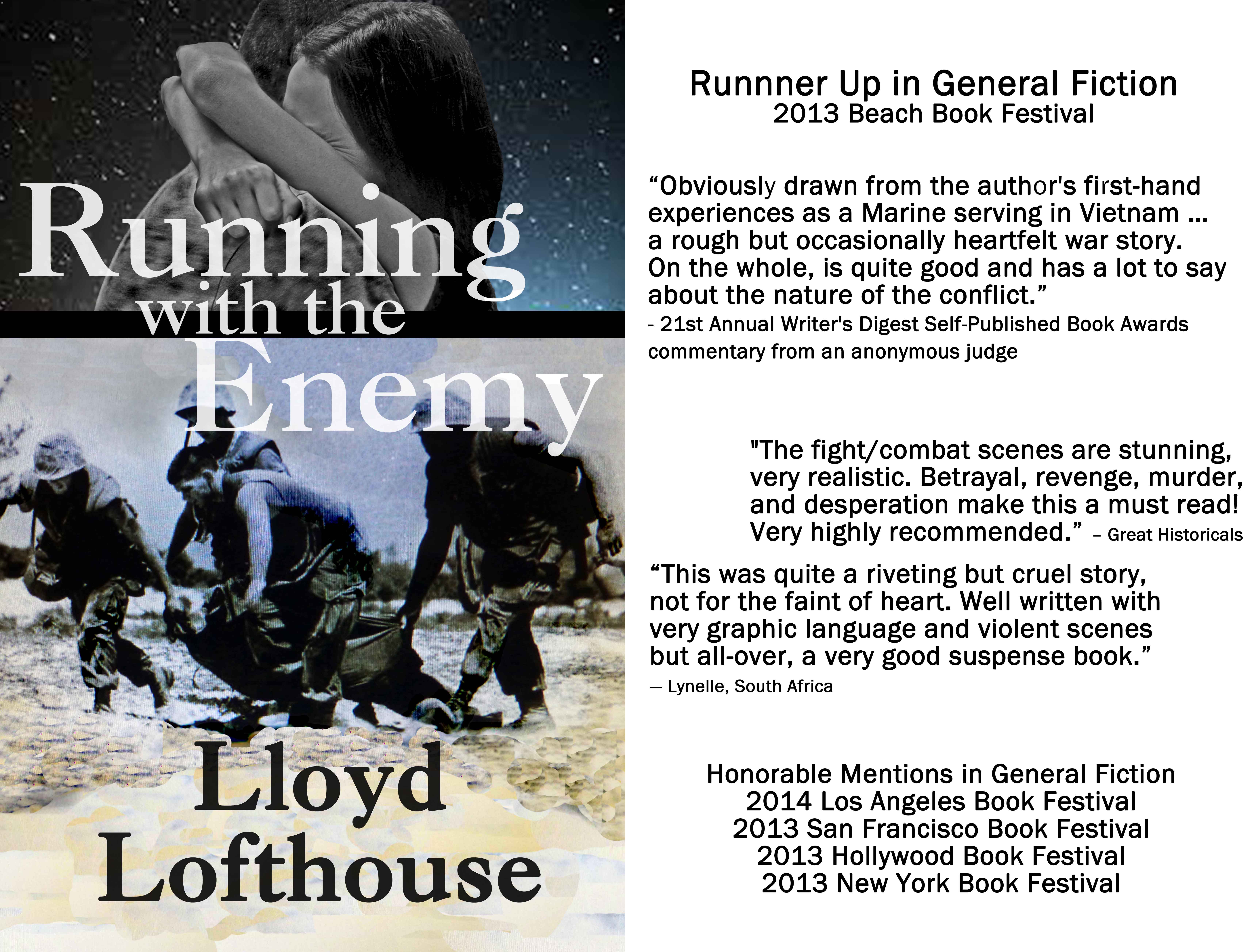
His latest novel is the award winning suspense-thriller Running with the Enemy. Blamed for a crime he did not commit while serving in Vietnam, his country considers him a traitor. Ethan Card is a loyal U.S. Marine desperate to prove his innocence or he will never go home again.
And the woman he loves and wants to save was fighting for the other side.
To follow this Blog via E-mail see upper left-hand column and click on “FOLLOW!”
I read a blog post from The UX of Social Media Blog, and the author wrote, “The suffering of others is also the staple of millions of viewers who tune in from squalid rooms and palaces alike to watch someone besides themselves become the latest humiliated outcast.”
The Reality of Reality TV
After reading the rest of the post, I thought of a letter I received in Vietnam that said, Dear Skip. Then I thought of the millions who have nothing more constructive to do but tune in and watch others suffer and be humiliated. This same ship of fools may also have enjoyed my suffering then, but I’m also sure they would not want to have what I brought home from Vietnam—the beast that lives inside my head.
I have no desire to watch reality TV, and I’m sure America would be a better place if the misguided people that watch this junk had a dose of Vietnam as I did. Maybe then, Americans would be less combative and judgmental on so many levels like this dog fight between the Democrats and Republicans.
His latest novel is Running with the Enemy. Blamed for a crime he did not commit while serving in Vietnam, his country considers him a traitor. Ethan Card is a loyal U.S. Marine desperate to prove his innocence or he will never go home again.
And the woman he loves and wants to save was trained to hate and kill Americans.
To follow this Blog via E-mail see upper right-hand column and click on “Sign me up!”
Here we are fighting a war with an enemy that wants to destroy America and everyone in it, and the Republicans are putting obstacles in the way of America’s safety net that is supposed to protect America against terrorists while blaming the democrats for what happened on that Northwest flight.
Let’s not forget that Americans are dying in Iraq and Afghanistan and many come home missing parts or with PTSD.
In Vietnam, I remember congress passing rules of engagement. We weren’t supposed to shoot until we saw who was shooting at us so we wouldn’t hit noncombatants leading to bad press in the media.
Try that in the jungle when you cannot see anyone and someone is shooting at you.
Near the end of my tour, we had a young lieutenant just out of West Point who drummed it into us that we weren’t supposed to shoot unless we saw who was shooting at us. Then he was pinned down on a patrol and he was shouting at us to lay down covering fire.
Yea, right!
No one fired. Then a voice, “We can’t see who is shooting at you.”
What are we supposed to say to the enemy who wants to kill us? “Hold your fire! Hold your fire! You aren’t playing by the rules. This isn’t’ fair. You are a cheater. I’m going to tell your mommy what you are doing.”
What does congress and the media think war is, a game of Risk (that board game kids sometimes play)? Hey guys, we aren’t made of plastic here. We bleed and even if we walk away, we leave damaged.
What do you think? Maybe we should shoot the politicians and the reporters instead.
His latest novel is Running with the Enemy. Blamed for a crime he did not commit while serving in Vietnam, his country considers him a traitor. Ethan Card is a loyal U.S. Marine desperate to prove his innocence or he will never go home again.
And the woman he loves and wants to save was trained to hate and kill Americans.
To follow this Blog via E-mail see upper right-hand column and click on “Sign me up!”
I woke up this morning and wanted to hit something. In the 1960s and 70s, I would have smashed a hole in the nearest drywall.
This is what set me off: “In the past six weeks, you’ve had the Fort Hood attack, the D.C. Five and now the attempted attack on the plane in Detroit … and they all underscored the clear philosophical difference between the administration and us,” said Rep. Pete Hiekstra (R-Mich.), the ranking Republican on the House Intelligence Committee.
The Republican spin machine is trying to score points blaming Obama for what almost happened last week on Northwest Flight 253.
Why did I get angry? Because I immediately flashed back to an incident in Vietnam.
We’d been out for hours on a night patrol slipping silently through the rice paddies that surrounded our hill, and we were returning as dawn arrived—tired but alert as we straggled along the dirt road that climbed into the hills where our Battalion CP was located.
A washed out blue sky was spreading from the east and it was still dark in the west. Then the ground trembled as if an earthquake were taking place. The sound of the explosion blew over us. We stopped and turned to see flames and a thick spire of black smoke rising into the sky from where the airstrip was located. One of the jobs the 1st Marine Division at Chu Lai had in 1966 was to protect that airstrip and the jet fighters that used it.
One Vietcong had slipped past an entire Marine division and made it to the airstrip where he managed to blow up a large portion of the stored jet fuel. That Vietcong didn’t just slip past one defensive line, but several.
I “hate” dirty politics—the same kind that started wars like Vietnam and Iraq so young men as I was then, in our patriotic zeal, would fly off to war believing we were serving a just cause when in the truth, we had been lied to.
It is almost impossible to stop an individual from doing something like what happened on that airplane a few days ago just as an entire Marine division couldn’t stop that Vietcong from infiltrating our lines.
There were 300 people on Northwest Flight 253. For sure, someone will suffer some PTSD symptoms and have trouble sleeping as they relieve the moment they thought they might die. Some may never fly again.
If you agree with Rep. Pete Hiekstra, then George W. Bush is responsible for what happened on September 11, 2001.
Instead of pointing fingers of blame looking for a “scapegoat”, Republicans and Democrats should be looking for ways to do a better job than the Homeland Security our current president inherited.
His latest novel is Running with the Enemy. Blamed for a crime he did not commit while serving in Vietnam, his country considers him a traitor. Ethan Card is a loyal U.S. Marine desperate to prove his innocence or he will never go home again.
And the woman he loves and wants to save was trained to hate and kill Americans.
To follow this Blog via E-mail see upper right-hand column and click on “Sign me up!”
How many Hollywood movies have painted a positive picture of Vietnam Veterans compared to movies that show Vietnam veterans as angry, violent, dangerous drug users and/or alcholics (mostly brought on by PTSD)?
Three Vietnam Veterans that I know of have run for President of the United States. All three lost.
Al Gore served in Vietnam as a reporter/journalist for five months. He Gore was stationed with the 20th Engineer Brigade in Bien Hoa and was a journalist with The Castle Courier. He received an honorable discharge from the Army in May 1971.
Of his time in the Army, Gore later stated, “I don’t pretend that my own military experience matches in any way what others here have been through […] I didn’t do the most, or run the gravest danger. But I was proud to wear my country’s uniform. And my own experiences gave me strong beliefs about America’s obligation to keep our national defenses strong.” He also later stated that his experience in Vietnam “didn’t change my conclusions about the war being a terrible mistake, but it struck me that opponents to the war, including myself, really did not take into account the fact that there were an awful lot of South Vietnamese who desperately wanted to hang on to what they called freedom. Coming face to face with those sentiments expressed by people who did the laundry and ran the restaurants and worked in the fields was something I was naively unprepared for.”
John Kerry reported for duty at Coastal Squadron 1 in Cam Ranh Bay in South Vietnam on November 17, 1968. In his role as an officer in charge of Swift boats, Kerry led five-man crews on a number of patrols into enemy-controlled areas. His first command was Swift boat PCF-44, from December 6, 1968 to January 21, 1969, when the crew was disbanded. They were based at Coastal Division 13 at Cat Lo from December 13, 1968 to January 6, 1969. Otherwise, they were stationed at Coastal Division 11 at An Thoi. On January 30, 1969, Kerry took charge of PCF-94 and its crew, which he led until he departed An Thoi on March 26, 1969, and subsequently the crew was disbanded.
On January 22, 1969, Kerry and several other officers had a meeting in Saigon with Admiral Elmo Zumwalt, the commander of U.S. Naval forces in Vietnam, and U.S. Army General Creighton Abrams, the overall commander of U.S. forces in Vietnam. Kerry and the other officers reported that the “free-fire zone” policy was alienating the Vietnamese and that the Swift boats’ actions were not accomplishing their ostensible goal of interdicting Viet Cong supply lines.
John McCain requested a combat assignment, and was assigned to the aircraft carrier USS Forrestal flying A-4 Skyhawks. His combat duty began when he was 30 years old, in mid-1967, during the Vietnam War. McCain and his fellow pilots became frustrated by micromanagement from Washington, and he would later write that “In all candor, we thought our civilian commanders were complete idiots who didn’t have the least notion of what it took to win the war.”
John McCain became a prisnor of war on October 26, 1967.
He was flying his 23rd bombing mission over North Vietnam when his aircraft was shot down by a missile over Hanoi. McCain fractured both arms and a leg ejecting from the aircraft. Although McCain was badly wounded, his captors refused to treat his injuries, beating and interrogating him to get information; he was given medical care only when the North Vietnamese discovered that his father was a top admiral.
Lloyd Lofthouseis a former U.S. Marine, Vietnam Veteran, journalist and award winning author.
His second novel is the award winning love story and suspense-thrillerRunning with the Enemy. Blamed for a crime he didn’t do while serving in Vietnam, his country considers him a traitor. Ethan Card is a loyal U.S. Marine desperate to prove his innocence or he will never go home again.
John Wayne movies molded my young brain, and fired my imagination. As a child, I dreamed of being a hero. Then at nineteen, I went to war and my thinking changed drastically. Narrow escapes from death ended my hero dreams, and I was fortunate to arrive home from Vietnam without aPurple Heart.
They say close only counts in horseshoes. I say it also counts in war. This morning, I awoke thinking about John Kerry and how his reputation was smeared during his presidential campaign.
John Kerry fought in Vietnam. He was wounded three times. They were not serious wounds, but they drew blood. Even flesh wounds earn Purple Hearts. One wireman in my communications platoon was awarded a Purple Heart. While in the field sleeping in his shelter half, his unit came under attack. Mortar rounds dropped in like hail. Half asleep, he scrambled out, tripped on one of the lines that held his shelter half up, fell and hit his head on something. He needed stitches. His sergeant put him in for a Purple Heart.
One of the tankers in that action was scrambling to get into his tank. In his rush to get inside the protection the tank offered, he slammed the turret hatch on one of his hands and crushed all the bones in it. He was also awarded a Purple Heart. He earned a ticket home too, and was discharged from the Marines with aVA disability for the crushed hand.
Bob, a history teacher I taught with, was in the Navy and served inSwift Boats like Kerry. Bob was the mechanic that kept the twin engines running. He told me once that the safest place in that swift boat was between the twin engines. On the water, the swift boat was an easy target and the metal hull was thin.
Those of us that did not bleed during combat and never earned Purple Hearts were still changed by narrow escapes from death. I had several and came home with a case of PTSD that still haunts me decades later.
John Kerry’s flesh wounds show that he came close to death. Yet, during his campaign for president, Swift Boat Veterans for Truth cast doubt on his courage, andGeorge W. Bush, the man who used family influence to get into the National Guard and avoid combat, somehow became a hero, walked into the White House and served as president for eight years starting two wars. I have no idea what kind of president John Kerry would have been. I wonder if he would have used bogus evidence for WMDs and invaded Iraq.
Abraham Lincoln said “You may fool all the people some of the time, you can even fool some of the people all of the time, but you cannot fool all of the people all the time.”
His latest novel is Running with the Enemy. Blamed for a crime he did not commit while serving in Vietnam, his country considers him a traitor. Ethan Card is a loyal U.S. Marine desperate to prove his innocence or he will never go home again.
And the woman he loves and wants to save was trained to hate and kill Americans.
To follow this Blog via E-mail see upper right-hand column and click on “Sign me up!”
In this post, I have combined the ten-part series on Sun Tzu’s “The Art of War” in one post and added more content.
The reason for learning about Sun Tzu’s The Art of War has to do with a study by The Pew Research Center, which reported that one in three Iraq and Afghanistan veterans of the post-9/11 military see these wars as a waste.
And NPR’s Jackie Northam reported as the wars drag on, interest among Americans has dropped from 90 percent supporting the invasion of Iraq and Afghanistan before the war started to 25 percent today.
Northam quotes Andrew Kohut, president of the Pew Research Center. “The public soured on the decision to go to war in Iraq by 2004, when not only were there no weapons of mass destruction (WMD) found, but all of a sudden, the cost of that war began to increase, [and] casualties began to be rather substantial.”
In addition, Fair Game (2010), a movie of CIA operative Valerie Plame and her husband, who wrote a 2003 New York Times op-ed piece on the topic of WMD in Iraq, alleged that the Bush administration had manipulated intelligence about weapons of mass destruction to justify the invasion of Iraq—an accusation of fraud in the White House.
According to the wisdom of Sun Tzu, these three points are enough to indicate a “high” possibility of failure by the United States.
So, who better to turn to than Sun Tzu to see if the goals of these wars are possible to achieve.
It is time to reexamine the master that West Point cadets study. Sun Tzu dates to China’s Warring States Period (476 – 221 BC). Traditional accounts place him in the Spring and Autumn Period of China as a military general serving under King Helu of Wu (544-496 BC).
You have to be good to still be taken seriously about 2500 years after your death.
There are three key principals to The Art of War.
1. Know your enemy and know yourself — understanding your opponent is crucial to victory.
2. Sun Tzu prizes the general who can outwit instead of outfight his opponent — to subdue the enemy without fighting is the height of skill.
3. Avoid what is strong. Attack what is weak.
In the case of President George W. Bush, when he went to war in Iraq and Afghanistan, it is clear that he did not know his enemy (or much at all about the culture and politics of the Middle East and of Islam).
Bush also resorted to subduing his enemy with force instead of outwitting him—as if President Bush was capable of outwitting Al-Qaeda, since finding the weakness of an organization that is like smoke would be a challenge to any president.
As for Sun Tzu, around 500 BC, the King of Wu summons him, one of the greatest military minds in history, to save his kingdom from a more powerful enemy.
Sun Tzu was a warrior and a philosopher. He was important because he had a cohesive, holistic philosophy on strategy.
Sun Tzu tells the King of Wu he can defeat the enemy with a smaller army. Doubting him, the king challenges Sun Tzu to turn the palace concubines into a fighting force and Sun Tzu accepts.
Sun Tzu shows the concubines what to do, selects the best two students and puts them in charge of the others. When Sun Tzu orders the exercise to begin, the woman laugh.
He tries again but the concubines laugh again.
Sun Tzu says, “If instructions are not clear and commands not explicit, it is the fault of the general. But if the orders are clear, and my orders are clear, it is the fault of the subordinate officers.”
Without warning, Sun Tzu beheads the two concubines he had selected to lead the others. To Sun Tzu, war is a matter of life and death. This is the key principal of his teachings. Once understood, everyone from the general to the solider will be motivated to win.
However, in Vietnam, Iraq and Afghanistan, the United States fought wars with rules that hamper victory and ignore the fact that war is a matter of life and death.
Instead, politics and public opinion decide the rules of the battle field.
While the bodies of the first two concubines are still warm, Sun Tzu appoints two new concubines to lead the others. This time the concubines follow his orders without hesitation. The king of Wu is convinced and appoints Sun Tzu commander of the Wu army.
Sun Tzu now must train an army of 30 thousand troops to fight a force ten times larger.
The state of Wu has only 33,000 troops while Chu can field a force of 300 thousand.
Outnumbered ten to one, Sun Tzu could build his defenses and wait for the attack. However, he does the unexpected. He invades Chu.
He doesn’t attack Chu’s main army. Instead, he attacks outposts and weaker targets. When Chu sends an army to fight, Sun Tzu slips away emphasizing maneuver, surprise and deception.
After every battle, Sun Tzu learns more about his enemy.
During another war more than two thousand years later, Sun Tzu’s ultimate secret becomes more evident. In the mid 1960s, the world’s largest super power fought in Vietnam—a country smaller than the state of Montana.
The American general sees the battlefield like a chessboard where armies stand and fight. However, Vietnam has no clear objectives to attack and destroy.
The Communist general understands Sun Tzu and uses the Viet Cong in hit and run attacks against fixed US positions.
Sun Tzu said, “It is more important to outthink your enemy than outfight him. In war, numbers alone confer no advantage. Do not advance relying on sheer military power.”
The US commander breaks these rules.
Sun Tzu liked the enemy to maneuver and respond to his moves so he would be in charge of the battlefield.
A US report after the Vietnam War revealed that 80% of the time, it was the North Vietnamese and Vietcong who decided where and when to fight.
Sun Tzu said, “Once you know the enemy’s strengths and weaknesses, you can avoid the strengths and attack the weaknesses.” At the beginning of the war, almost 80% of Americans supported the.
As the Vietnam War continued with mounting US causalities, support at home shifted against the war, which achieved another of Sun Tzu’s rules, “The skillful leader subdues enemy’s troops without any fighting. One does not win wars by winning battles.”
Although the North Vietnamese and Vietcong did not win battles, they won the war by turning the American people against the war. To achieve this goal, the North Vietnamese commander was willing to lose ten men for every American killed.
In the end, the US lost 53 thousand troops and the North Vietnamese and Vietcong more than a million with several million more noncombatants killed as collateral damage to the American bombing—the U.S. dropped more bombs in Vietnam, Laos and Cambodia than it dropped in all of World War II.
Sun Tzu felt spies were important, and he devoted one chapter to spies. He said, “Use your spies for every kind of business,” and the North Vietnamese and Vietcong followed that advice.
Sun Tzu said, “An accurate knowledge of the enemy is worth ten divisions.”
He also said, “Let your plans be as dark as night – then strike like a thunderbolt.” The Tet Offensive in January of 1968 was that thunderbolt.
Sun Tzu said, “Keep plans as dark as night.”
The NVA (North Vietnamese Army) and Vietcong did this by moving supplies and troops through miles of tunnels built in the 1950 and 60s.
Deception was also one of Sun Tzu’s rules.
To achieve deception, the NVA and Vietcong announced they would honor a cease-fire on January 31, 1968, the Tet New-Year Holiday.
Sun Tzu said, “In battle use a direct attack to engage and an indirect attack to win,” meaning to deceive your enemy so you can win your real objective.
To achieve this goal, the NVA launched a surprise attack on Khe Sanh, a remote US base, one week before the Tet Offensive.
The South Vietnamese and American military were surprised when the NVA launches the Tet Offensive. At first, it looks like the Vietcong will win, but the NVA ignored one of Sun Tzu’s rules—moral influence.
Moral influence means a leader must have the people behind him to win.
During the early days of the Tet, the Vietcong rounded up and brutally assassinated several-thousand South Vietnamese government workers and killed many Catholic nuns losing the support of the people.
However, in America, watching the violence of the Tet Offensive on TV turned more Americans against the war.
Eight years later, in 1975, Saigon falls to the NVA and America loses the war even though the US had military superiority.
In China about 500 BC Sun Tzu’s hit-and-run campaign against the state of Chu worked. The Chu prime minister lost support and the moral of his troops dropped.
Throughout the countryside of Chu, the people feared where Sun Tzu will strike next. When the larger Chu army threatened one of Sun Tzu’s allies, Sun Tzu uses another rule of war, “To move your enemy, entice him with something he is certain to take.”
Then, when his own forces are surrounded, Sun Tzu says, “Put the army in the face of death where there is no escape and they will not flee or be afraid – there is nothing they cannot achieve.” Discover The Long March
What happened to Sun Tzu when his small army was surrounded also happened on June 6, 1944 when allied troops in World War II invaded Europe during D-day.
Sun Tzu says, “All warfare is deception. If you can deceive your enemy before battle, you are more likely to win.”
That’s what General Eisenhower did before the invasion of Normandy. To succeed, the allies used deception to convince the Germans the attack would not take place in Normandy.
Sun Tzu says, “It is essential to seek out enemy agents who have come to spy against you and bribe them to serve you.” In The Art of War, double agents are the most important spies.
That is what the Allies did in World War II before the Normandy Invasion of France. No one used double agents better than the British did.
Britain turned almost every spy Germany sent during the war. These double agents made the Germans believed the invasion would take place at Pas de Calais and not Normandy.
Sun Tzu says, “The way a wise general can achieve greatness beyond ordinary men is through foreknowledge.” The allies had foreknowledge because they broke the German code and knew what the Germans were thinking and planning.
Sun Tzu would have praised the allied preparation for the invasion and the use of deception but he would have condemned the actual assault.
Sun Tzu says, “When a falcon’s strike breaks the body of its prey, it is because of timing. When torrential water tosses boulders, it is because of momentum.”
Sun Tzu believes that the best attack can be ruined if momentum is lost, and he would have predicted the cost of lives during the Normandy invasion more than two-thousand years before it took place.
During the invasion of Normandy, the allies survived on death ground exactly as Sun Tzu predicted by fighting together and never giving up.
Sun Tzu meant when you put troops in a combat position where they must fight or die, there is no choice but to fight.
Another reason the Allies succeeded during D-day was another of Sun Tzu’s rules of war. He said, “It is essential for victory that generals are unconstrained by their [political] leaders.”
The allied command structure gave total authority to General Eisenhower as supreme commander.
However, Germany under Hitler did not have the same command structure.
Hitler had set up a confusing system of overlapping authority so no one had total control over the military leaving Hitler the only one who made final decisions.
Hitler’s command structure is a perfect example of what Sun Tzu says about “no interference from the leader”.
The allies in France are bogged down in difficult terrain. The combat losses are horrible and little progress is made.
The solution is found in Sun Tzu’s rules of war. “Make your enemy prepare on his left and he will be weak on his right.”
The allies will follow this rule.
Sun Tzu says you must behave like the snake. When your enemy attacks, you must be flexible.
Throughout the invasion of Normandy, France, Sun Tzu’s rules of war guided the Allies to victory. The Allies used deception, foreknowledge, and a superior command structure that motivated the army to fight as one.
Sun Tzu says, “The winning army realizes the conditions for victory first then fights. The losing army fights first then seeks victory.”
More than two thousand years before the Battle of Normandy, the battle between the kingdoms of Wu and Chu raged on.
Even with a smaller army, Sun Tzu is not worried. He has split his army. While the Chu army is surrounding his smaller force, the main part of his army is moving toward the unprotected Chu capital.
And once the Chu commander learns of this, he turns from the smaller Wu force under Sun Tzu’s command and rushes back to save the capital.
Sun Tzu says, “No nation has ever benefitted from prolonged war.” The American Civil War is Sun Tzu’s nightmare scenario. Possibly the wars in Iraq and Afghanistan are the same since so many of Sun Tzu’s rules of war have been ignored.
Sun Tzu says, “Those skilled in war bring the enemy to the field of battle. They are not brought by him.” This will happen to General Robert E. Lee in 1863.
Sun Tzu says if the orders are unclear, it is the fault of the commanding general.
General Lee told one of his generals to “Attack when you think it is practical.” That general decides it is not practical and does nothing.
At the Battle Gettysburg, Lee did not give clear orders.
Robert E. Lee made a tactical mistake when he did not follow Sun Tzu’s rule to “Move only when you see an advantage and there is something to gain. Only fight if a position is critical.”
Sun Tzu says, “When the enemy occupies high ground, do not confront him. If he attacks downhill, do not oppose him.” Robert E. Lee did not listen and decides to attack the Union positions on the high ground.
General Longstreet disagrees. He does not want to attack the high ground. Instead, he wants to go around the Union Army toward the North’s capital, Washington D.C.
Sun Tzu says, “There are some armies that should not be fought and some ground that should not be contested.”
After two days of horrible losses, Robert E. Lee orders what is left of his army to attack uphill a third time. General Longstreet urges Lee not to do this. Lee ignores him.
On the third day of Gettysburg during Picket’s charge up another hill, only 5,000 survived of 12,000 troops. Sun Tzu would have been horrified.
Sun Tzu says, “When troops flee, are insubordinate, collapse or are routed in battle, it is the fault of the general.”
Sun Tzu sees a commanding general as someone intelligent and cunning and never rash or arrogant, which is the opposite of the commander of the Chu army more than two thousand years ago.
Sun Tzu won the war against Chu, which had an army ten times larger than his. He did this through preparation, deception and indirect attacks.
After winning the war against Chu, Sun Tzu retires and writes The Art of War.
The first line of Sun Tzu’s rules of war says, “War is a matter of vital importance to the State. It is a matter of life and death, survival or ruin.
As I finished the series on Sun Tzu’s The Art of War, I thought of President Lyndon Johnson who invaded Vietnam (1950 to 1975)—a war where a super power lost to a third-world country as Chu did to Wu about twenty-five hundred years ago.
Nations that fought with the United States lost more than 300 thousand troops with almost 1.5 million wounded. North Vietnam and the Communists lost almost 1.2 million troops and more than 4 million civilian dead. Source: Vietnam War – Wiki
President G. W. Bush rushed into a war in Iraq and Afghanistan on faulty evidence, which may have been based on lies. For these wars, the casualties and losses continue.
Several American presidents have ignored Sun Tzu’s advice from The Art of War.
Since World War II, America has spent more than 23 trillion dollars fighting wars and in defense. The U.S. won the Cold War against Soviet Russia without fighting.
Too bad the citizen of the US, Presidents Johnson and G. W. Bush did not learn from Sun Tzu’s The Art of War.
Sun Tzu said, “Sometimes, the best way to win is not to fight.”
Lloyd Lofthouse is a former U.S. Marine and Vietnam Veteran.
His latest novel is the award winning suspense-thriller Running with the Enemy. Blamed for a crime he did not commit while serving in Vietnam, his country considers him a traitor. Ethan Card is a loyal U.S. Marine desperate to prove his innocence or he will never go home again.
And the woman he loves and wants to save was fighting for the other side.
To follow this Blog via E-mail see upper left-hand column and click on “FOLLOW!”