The Different Faces of War

We are at war every day, and I’m not talking about Afghanistan. As an author, I know that there are many different types of conflict—there is man vs. man, man vs. nature, and man vs. himself.

When we think of war, we often think of World War I, WWII, Korea, Vietnam, Afghanistan, Iraq, and we ignore the other battles fought daily all over the world.

For example, the tornado in Oklahoma. That was a battle against nature and it was just as devastating as combat in Afghanistan. In Oklahoma—in sixteen minutes—more than fifty died and twenty were children.

Natural disasters are battles in man’s unending war against nature. For a few examples:

  • the tropical cyclone that hit Galveston in 1900 caused 6,000 – 12,000 fatalities.
  • In 1906, the San Francisco earthquake killed 3,000 – 6,000.
  • In 2004, an Indian Ocean earthquake caused a tidal wave that killed 230,000 people.
  • In 2005, Hurricane Katrina killed 1,836 people.

Then there is the war with viruses—man vs. nature—such as the flu. For example, the CDC estimates that from the 1976-77 to the 2006-07 flu season, flu-associated deaths ranged from a low of about 3,000 to a high of about 49,000 people (annually).

On January 18, 2013 Bloomberg reported, the flu season, which has now been at epidemic levels for two straight weeks, may result in 36,000 deaths, said William Schaffner, chairman of the department of preventive medicine at Vanderbilt University School of Medicine in Nashville, Tennessee.


Top FIVE Deadliest Diseases – this video is an entertaining way to scare yourself to death

For another example, there is the war raging on America’s roads every minute of every day. The US Census says that in 2009 alone, there were 35.9 thousand deaths from motor vehicle accidents and that was a low year. In fact, from 1990 to 2009, about 740,000 people lost their lives in vehicle accidents (about 39,000 annually).

In 2012, The Washington Post reported that “The U.S. has far more gun-related killings than any other developed country.” In fact, The U.S. gun murder rate is about 20 times the average for all other developed countries.

How many gun deaths are there in the US every year?

In 2011 alone, the figures from the Centers for Disease Control (CDC) reported that 31,940 people died in the United States from gun injuries.

  • In 2010 that number was 31,328
  • In 2009 it was 31,177
  • In 2007 it was 31,224
  • In 2004 it was 29,569.

Breaking down deaths from firearms in 2011:

  • Accidental discharge = 851
  • Suicide = 19,766 (man vs. himself) Note: the CDC says that the total number of suicides from all methods was 38,364 for just 2011.
  • Homicide = 11,101
  • Undetermined Intent = 222

By comparison, in World War I, the United States had 53,401 combat deaths (1917-1918) or 26,700 annually.

  • In World War II there were 291,557 combat deaths (1941-1945) or 58,311 annually.
  • In the Korean War there were 33,686 combat deaths (1951 – 1953) or 11,229 annually.
  • In Vietnam there were 47,424 (1955-1975) or 2,371 annually.
  • In Afghanistan there have been 2,012 combat deaths (2001-present) or 168 annually.
  • In Iraq there were 3,542 combat deaths (2003-2011) or 443 annually.

Why do we hear so much about combat deaths and very little about highway deaths, suicide deaths, deaths by virus, natural-disaster deaths, and firearm deaths?

The fatal casualty numbers for Vietnam, Afghanistan and Iraq show us that the odds of dying a violent death in the United States are much higher than in a combat zone. It seems to me that we’d be safer joining the Army or the Marines and going off to fight in one of America’s wars.

Ignoring the numbers, why is death in combat considered more dramatic and devastating than someone going out to buy a quart of milk and dying in an accident on an American road or accidentally shooting himself cleaning a Smith and Wesson revolver while watching Dancing with the Stars?

Discover how a U.S. Marine Deals with his PTSD through Ballet

_______________________

Lloyd Lofthouse is a former U.S. Marine and Vietnam Veteran.

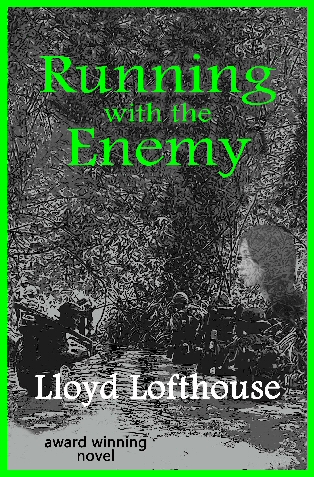
His latest novel is the award winning suspense-thriller Running with the Enemy. Blamed for a crime he did not commit while serving in Vietnam, his country considers him a traitor. Ethan Card is a loyal U.S. Marine desperate to prove his innocence or he will never go home again.

And the woman he loves and wants to save was fighting for the other side.

To follow this Blog via E-mail see upper left-hand column and click on “FOLLOW!”
Coming Home

I flew to Okinawa in late December 2005 and spent the New Year inside a Quonset hut during heavy rain and a typhoon warning. A few weeks later, we boarded a troop transport and my battalion shipped out to Chu Lei, Vietnam.

Fast forward to December 2006, and I was deep underground in a communications bunker. It was 2:00 am and I was alone when I heard the clatter of feet running down the stairs, slowing at the grenade trap and then moving fast again.

At the time, I was sitting in front of the radio set leaning back in a chair. Then another radio operator burst through the door. When I heard “We’re going home,” I fell over backwards and landed with a crash.

With little warning—before noon—three of us were on a flight to Da Nang where we boarded a civilian airliner and flew home to land at LAX fourteen hours later. After being processed, I rented a Mustang using my military driver’s license and headed home to the San Gabriel Valley south of Los Angeles.

It was three in the morning when I pulled into the driveway of my parent’s house. I was twenty-one. I didn’t have a wife, girlfriend or child. I had an older brother and sister who were married and had their own homes.

There was a light on in my father’s half bath. I knew that he was in there shaving and getting ready to go to work.

I rang the doorbell and heard him say, “Who the hell could that be at this hour?”

When the door opened, half of my dad’s face was covered in shaving cream. He was wearing his work pants and a T-shirt. Without saying a word, he stared in stunned shock, then spun around and ran through the house shouting for my mother, who was still in bed sleeping. Then I heard her surprised voice and feet rushing down the hall to the kitchen.

That was my homecoming from war.

Today, returning from war can be a very different experience, but the emotions are the same. Now homecomings are often filmed and posted on You Tube—something impossible in 1966. And when I watch them, which I do, my eyes fill with tears and I remember that early morning in December 1966 when my dad opened the kitchen door.

Discover The Sniper and the Dear-John letter

_______________________

Lloyd Lofthouse is a former U.S. Marine and Vietnam Veteran.

His latest novel is the award winning suspense-thriller Running with the Enemy. Blamed for a crime he did not commit while serving in Vietnam, his country considers him a traitor. Ethan Card is a loyal U.S. Marine desperate to prove his innocence or he will never go home again.

And the woman he loves and wants to save was fighting for the other side.

To follow this Blog via E-mail see upper left-hand column and click on “FOLLOW!”

Is Rape a Hazard of Military Service?

The Associated Press reports, “Sexual assaults in the military are a growing epidemic across the services and thousands of victims are still unwilling to come forward despite a slew of new oversight and assistance programs, according to a new Pentagon report. The report says that of the 1.4 million active duty personnel, 6.1 percent of active duty women — or 12,100 — say they experienced unwanted sexual contact in 2012, a sharp increase over the 8,600 who said that in 2010.”

Do not confuse unwanted sexual contact with sexual assaults. Unwanted Sexual contact is defined as any non-consensual sexual contact, such as touching or fondling of breasts, buttocks, genitals or other sexual/”private” parts. Sexual assault is defined as any sexual activity involving a person who does not or cannot—due to alcohol, drugs, or some sort of incapacitation—consent, and rape may include partner or marital rape.

And unwanted sexual contact and/or sexual assault is not the fault of the victim.

However, there is an explanation for the increase is sexual assaults in the military and it has to do—in part—with the following facts. From 1973 to 2010 the number of active-duty enlisted women in the military increased from about 42,000 to 167,000—a 400% increase.

In addition, the 1991 Gulf War was the first major military deployment where female troops were integrated into almost every military unit, except for combat ground units—this brought more women into daily contact with men suffering from combat induced PTSD.

The increased number of women serving in the US military; integration into almost every military unit and increased numbers of deployments to combat zones leading to more combat induced PTSD explains the increase in sexual assaults in the military.

Why would more combat veterans with PTSD lead to unwanted sexual contact and/or sexual assault?

The Huffington Post reports, “Combat veteran with PTSD were more likely to commit crimes. … A 2009 study of enlisted combat Marines with at least one deployment demonstrated that those with PTSD were six times more likely to be busted on drug charges than Marines without PTSD, and 11 times more likely to be discharged for misconduct.”

The Department of Veterans Affairs says PTSD and alcohol use problems are often found together and alcohol can make PTSD symptoms worse. … If you have a drinking problem, you are more likely than others with your same sort of background to go through a psychological trauma. You may also have problems getting close to others. You may have more conflicts with those people to whom you are close.

In addition, “Alcohol and drugs dis-inhibit people,” says Paul Rinaldi, associate director of the Addiction Institute of New York City.” Source: CBS News

And Helen Benedict writes in her new book “The Lonely Soldier: The Private War of Women Serving in Iraq—one of the symptoms of this disorder (PTSD) is uncontrollable violence (including increased incidents of rape).” Source: Womens enews.org

In conclusion: knowing the cause of this crime is not an excuse for the increase in sexual assaults in the US military, but knowing the cause offers possible solutions. One solution might be to remove military women from combat units and away from veterans—still serving in the military—who abuse alcohol/drugs while suffering from PTSD. Another solution might be through education, intervention and counseling programs for both women and men raising awareness of the problem along with methods to avoid or deal with it.

By The Numbers:

The Air Force has the highest percentage of women: 18% (11,665) are officers and 20% (51,614) are enlisted. In 2012, 790—1.2% of women serving in the Air Force—reported sexual assaults that include women and men.

Army: 15.5% officers (13,560) and 13.2% (59,672) enlisted. In 2012, 1,423—1.9%—reported sexual assaults that include women and men.

Navy: 15.1% (7,769) are officers and 15% (41,294) enlisted. In 2012, 726—1.5%—reported sexual assaults that include women and men.

Marine Corps: 5.8% (1,172) are officers and 6.2% (11,049) enlisted. In 2012, 435—3.6%—reported sexual assaults that include women and men.

Coast Guard: 14.9% (1,212) are officers and 11.6% (3,854) enlisted. One in three women as well as many men in the Coast Guard is going to fall victim of sexual assault and rape. Sources: Daily Kos.com and Slide Share.net

Discover The Dark Side of Humanity

_______________________

Lloyd Lofthouse, a former U.S. Marine and Vietnam Veteran,
is the award winning author of My Splendid Concubine [3rd edition].

His latest novel is Running with the Enemy. Blamed for a crime he did not commit while serving in Vietnam, his country considers him a traitor. Ethan Card is a loyal U.S. Marine desperate to prove his innocence or he will never go home again.

And the woman he loves and wants to save was fighting for the other side.

To follow this Blog via E-mail see upper left-hand column and click on “FOLLOW!”

Returning from Combat with PTSD – the impact on family


I returned from Vietnam late December of 1966, and I did not talk about the war for years. Instead I kept it locked in my head, but I slept with a K-BAR that had a seven-inch blade. The reason I did not sleep with a pistol was because I feared shooting my wife.

I drank too much. I had an explosive temper. When the anger overwhelmed, instead of hitting her, I punched holes in the drywall and drank more.

After falling asleep at night, the flashbacks were vivid, violent and real. There were times that I carried a loaded rifle through the house checking the doors and windows to secure the perimeter. Sometimes I still do. All it takes is an unexpected noise and out comes a loaded weapon and I cannot rest until I know my family is safe.

After the first divorce in 1979, I stopped drinking and fight to contain the anger, and—at the time—most of us still didn’t know what PTSD was. It helped that I started writing about my time in Vietnam in the MFA program I started at Cal Poly, Pomona causing me to open up and talk about what I experienced in the war.

There is no cure for PTSD, but with understanding, the afflicted might be able to manage the trauma better and avoid destroying families and lives. For sure, drugs and alcohol are a bad mix with PTSD.

The impact of PTSD on families is shocking. “Research that has examined the effect of PTSD on intimate relationships reveals severe and pervasive negative effects on marital adjustment, general family functioning, and the mental health of partners.

“These negative effects result in such problems as compromised parenting, family violence, divorce, sexual problems, aggression and caregiver burden.

“About 38% of Vietnam veteran marriages failed within six months of returning from the war. The overall divorce rate among Vietnam veterans is significantly higher than the general population.” Source: ptsd.va.gov


Impact on family

The divorce rate among Afghanistan, Iraq War Vets increased 42% throughout the wars.

A July 2010 report found that child abuse in Army families has been three times higher in homes from which a parent was deployed, for example. From 2001 through 2011, alcohol use associated with physical domestic violence in Army families increased by 54%, and with child abuse by 40%. Source: cost of war.org

In addition, Expedition Balance.org says, “It’s harder for veterans with PTSD to hold jobs.

“The VA reported that more than 130,000 veterans were homeless on any night.

“Studies show that families where a parent has PTSD are characterized by increased anxiety, unhappiness, marital problems and behavioral problems among children.

“People with PTSD are more likely to have problems with drugs and/or alcohol.

“People who suffer from PTSD and depression are significantly more like to take their own lives.

“Female veterans have a higher rate of military sexual trauma. They have a higher rate of divorce and homelessness as well.”

The Huffington Post reported that “Iraq and Afghanistan war veterans who struggle with the anger and emotional outbursts of combat trauma are more than twice as likely as other veterans to be arrested for criminal misbehavior … Veterans ‘who perceive that they have control over their future and who have greater psychological resilience’ are better able to refrain from violence, the study said.”

For me, managing the PTSD—so it does not manage me—is a full time job that is not always successful.

In 2011, there were 21.5 million combat veterans in the United States. Source: American Veterans by the Numbers (that is the cost of America’s endless wars)

Discover A Prisoner of War for Life

_______________________

Lloyd Lofthouse, a former U.S. Marine and Vietnam Veteran,
is the award winning author of My Splendid Concubine [3rd edition].

His latest novel is Running with the Enemy. Blamed for a crime he did not commit while serving in Vietnam, his country considers him a traitor. Ethan Card is a loyal U.S. Marine desperate to prove his innocence or he will never go home again.

And the woman he loves and wants to save was fighting for the other side.

To follow this Blog via E-mail see upper left-hand column and click on “FOLLOW!”

Mirror, Mirror on the wall, who is the fairest superhero of them all?

Smithsonian.com published The Psychology Behind Superhero Origin Stories by Robin Rosenberg.

Rosenberg says, “As a clinical psychologist who has written books about the psychology of superheroes, I think origin stories show us not how to become super but how to be heroes, choosing altruism over the pursuit of wealth and power.”

Rosenberg says, “I’ve found that superheroes undergo three types of life-altering experiences that we can relate to.”

1. trauma

2. a life altering force is destiny

3. sheer chance

“At their best,” Rosenberg says, “superhero origin stories inspire us and provide models of coping with adversity, finding meaning in loss and trauma, discovering our strengths and using them for good purpose.”

Reading Rosenberg’s piece in Smithsonian after watching “To Whom it May Concern, Ka Shen’s Journey” the previous night helped me understand his explanation. Ke Shen’s Journey was a documentary on the life of Nancy Kwan.

You may remember Kwan in “The World of Suzie Wong” (1960), or “Flower Drum Song” (1961). And in 1961, she won a Golden Globe Award for Most Promising Newcomer in film.

In fact, Kwan’s father was a hero. During World War II, he was a spy for the British and when the Japanese discovered what he was doing, he took his two, infant children and fled Hong Kong disguised as a Chinese peasant. Another Chinese spy working for the British in Hong Kong wasn’t so fortunate. He was caught and beheaded by the Japanese.

For Kwon, her life altering experience was the loss of her only child, a son from her first marriage. Bernie died at age 33 in 1996. He contracted AIDS from his girlfriend whom Kwan had cautioned him to avoid.

Bernie had unprotected sex with the girl he loved. He didn’t use a condom. The girlfriend died of AIDS first and Bernie stayed by her side and cared for her to the end. Eventually, when the virus threatened his life, he moved home so his mother and stepfather could care for him, and they watched the son they both loved die slowly over a period of three years as he wasted away.

Today, almost age 75, Nancy Kwan actively supports the study of AIDS and the promotion of AIDS awareness.

I think Rosenberg is right, because I’m convinced that what he explains is one reason why I joined the U.S. Marines and later became a classroom teacher in a barrio high school populated by violent street gangs. I made a choice. We all make choices, but why do we make such choices?

For me it wasn’t trauma—at least I don’t think so—that motivated me to join the U.S. Marines. I think it was the role models I saw in Hollywood films. For example, John Wayne’s movies. By the time I joined the Marines in 1964, John Wayne had been in 158 films. A few that stick in my head are: The Fighting Seabees; Back to Bataan; They were Expendable; Fort Apache; She Wore a Yellow Ribbon; Sands of Iwo Jima; The Horse Soldiers; The Alamo, and The Longest Day, etc.

Of course, no film compares to the reality of combat and coming home from war with PTSD and/or recovering from a severe combat wound. Those factors are also a life altering force.

It seems to me that there are a lot of people in America that are not inspired to be a hero or altruistic.

The Department of Veterans Affairs says that 8.1% of the U.S. population are veterans. In addition, the NY Times reported that less than 1% of the American population is serving in the active military.  What does that tell us about the rest of America—not counting the physically and mentally disabled, police, teachers and firefighters?

Discover John Kerry, Purple Hearts, PTSD and WMD

_______________________

Lloyd Lofthouse, a former U.S. Marine and Vietnam Veteran, is the award winning author of The Concubine Saga.

His latest novel is Running with the Enemy. Blamed for a crime he did not commit while serving in Vietnam, his country considers him a traitor. Ethan Card is a loyal U.S. Marine desperate to prove his innocence or he will never go home again.

And the woman he loves and wants to save was trained to hate and kill Americans.

To follow this Blog via E-mail see upper right-hand column and click on “Sign me up!”

Unwanted Heroes

Many unwanted heroes defend our nation and fight its wars—right or wrong. When America’s leaders declare wars based on lies (for example: Vietnam and Iraq) or the truth (World War I, II, Afghanistan and Korea), unwanted heroes do the fighting and pay the price.

On the side of a bus at the VA medical clinic that I go to, it says, “All gave some; some gave all.” I have a credit card sized VA Department of Veterans Affairs ID card.  It says below my photo: “Service Connected.” That means I have a disability connected to my service in Vietnam in 1966 when I was serving in the US Marines.

What is the price many unwanted heroes pay for trusting their leaders?

This post has the same title of a novel that was recently released, and I had the privilege of editing Unwanted Heroes by Alon Shalev.

In Unwanted Heroes, Shalev brings together a long suffering, battle weary Chinese American Vietnam veteran suffering from the trauma of PTSD and an idealistic and somewhat pretentious young Englishmen, who both share a love for San Francisco, coffee and wine.

Alon Shalev, the author, grew up in London, and has been a political activist since his early teens. He strives through his writing to highlight social and political injustice and to inspire action for change.

Moving to Israel, he helped establish a kibbutz where he lived for 20 years and served in the Israeli army.

Shalev then moved to the San Francisco Bay area and fell hopelessly in love with this unique city. Being new to the US, however, he was shocked to see so many war veterans on the streets. He regularly volunteers at initiatives such as Project Homeless Connect and the San Francisco Food Bank where he meets and talks with war veterans. These experiences lend authenticity to the novel.

In fact, according to NIH (the National Institute of Health) Medline Plus, “PTSD affects about 7.7 million American adults” … and “members of the military exposed to war/combat and other groups at high risk for trauma exposure are at risk for developing PTSD.

“Among veterans returning from the current wars in Iraq and Afghanistan, PTSD and mild to moderate traumatic brain injury (TBI) are often linked and their symptoms may overlap. Blast waves from explosions can cause TBI, rattling the brain inside the skull.

“The U.S. Department of Veterans Affairs estimates that PTSD afflicts almost 31% of Vietnam veterans; as many as 10% of Gulf War (Desert Storm) veterans; 11% of veterans of the war in Afghanistan, and 20% of Iraqi war veterans.”

NIH says, “PTSD is often accompanied by depression, substance abuse, or other anxiety disorders.”

In addition, “between 529,000 and 840,000 veterans are homeless at some time during the year, and on any given night, more than 300,000 veterans are living on the streets or in shelters in the US. … About 33% of homeless males in the US are veterans and veterans are twice as likely as other Americans to become chronically homeless. One of the primary causes of homelessness among veterans is combat-related mental health issues and disability.

The incident of PTSD and suicide rates among veterans is also climbing and 45% of homeless veterans suffer from mental illness including PTSD. Source: Veterans Inc.org

The New York Times reported, “Suicide rates of military personnel and combat veterans have risen sharply since 2005, as the wars in Iraq and Afghanistan intensified. Recently, the Pentagon established a Defense Suicide Prevention Office.”

“The CDC Vietnam Experience Study Mortality Assessment showed that during the first 5 years after discharge, deaths from suicide were 1.7 times more likely among Vietnam veterans than non-Vietnam veterans. …

Why? “The average infantryman in the South Pacific during World War II saw about 40 days of combat in four years. The average infantryman in Vietnam saw about 240 days of combat in one year thanks to the mobility of the helicopter.” Source: History.com – Statistics about the Vietnam War

I did not seek help for my PTSD for thirty-eight years, because I did not know the VA offered counseling.

Discover A Prisoner of War for Life

__________________________

Follow this Blog via Email — sign in near the top-right corner of this screen and click “Follow”

PTSD and Homeless Veterans

In the Marines, we learned to never leave the wounded or dead behind.

I have lived with the symptoms of PTSD for forty-six years. I was fortunate. I was capable of holding down a job. I haven’t forgotten the homeless veteran I met in an alley early one early morning in Pasadena, California. I wrote about it in A Prisoner of War for Life.

The key is to learn how to cope. If you have PTSD, you will never get rid of it as if it were a cold or the flu. PTSD stays with you for life.

USA Today reported, “War might be making young bodies old. … The tragic signs of post-traumatic stress disorder or battlefield concussion are all too evident. Even more alarming for researchers is emerging evidence that these newest American combat veterans — former GIs and Marines in their 20s and 30s — appear to be growing old before their time. Scientists see early signs of heart disease and diabetes, slowed metabolisms and obesity — maladies more common to middle age or later.”

Some veterans are so damaged from combat experience, that they become homeless.

The population of the United States is more than 314 million people. The US Armed Forces that protects America’s civilians numbers 1.458 million—less than one-half-of-one-percent of the total US population. In addition, there are about 860 thousand military reservists.

In fact, the number of military veterans in the United States in 2012 was 21.8 million—6.94% of the total US population.

It doesn’t matter the reason a US citizen joins the military—patriotism or a financial need—and fights in one of America’s foreign wars. The fact that he or she served and put his or her life on the line or risked serious injury in combat,  I think that the ninety-three percent of the population that never served and risked life and limb owes those veterans an obligation.

That also means supporting homeless veterans with jobs and shelter.

The National Alliance to End Homelessness says, “The nation’s homeless population … went from 643,067 in 2009 to 636,017 in 2011. … The only increase was among those unsheltered.”

However, “The national rate of homelessness was 21 homeless people per 10,000 people in the general population. The rate for veterans was 31 homeless veterans per 10,000 veterans in the general population.”


PBS Documentary on Homeless Veterans – WORTH WATCHING if you have the time.

The Veterans Administration is the only federal agency that provides substantial hand-on assistance directly to Veterans who are homeless or at risk of homelessness.

Veteran homelessness is a problem of national importance. According to a count on a January night in 2011, there were 67,495 homeless Veterans. And an estimated 144,842 Veterans spent at least one night in an emergency shelter or transitional housing program in a recent year. Because of this, in 2009, President Obama and U.S. Department of Veterans Affairs Secretary Eric K. Shinseki announced the federal government’s goal to end Veteran homelessness by 2015.

An estimated 144,842 Veterans spent at least one night in an emergency shelter or transitional housing program in one recent year.

Many other Veterans are considered at risk of homelessness because of poverty, lack of support from family and friends, substance use or mental health issues, and precarious living conditions.

The VA has a hot line to support veterans who are homeless or at risk of becoming homeless. That number is: 1-877-4AID-VET (1-877-4243-838) Source: VA.gov/Homeless

In recent months, I have been editing a novel about PTSD and homeless veterans.  It isn’t my work. It was written by Alon Shalev, the author of  The Accidental Activist and A Gardener’s Tale.  His next novel is titled, Unwanted Heroes (to be published soon). It’s a story about healing and/or the failure to heal from PTSD. A love story is part of the mix too.

_______________________
Lloyd Lofthouse is a former U.S. Marine and Vietnam Veteran.

Low-Def Kindle Cover December 11His latest novel is the award winning suspense-thriller Running with the Enemy. Blamed for a crime he did not commit while serving in Vietnam, his country considers him a traitor. Ethan Card is a loyal U.S. Marine desperate to prove his innocence or he will never go home again.

And the woman he loves and wants to save was fighting for the other side.

To follow this Blog via E-mail see upper left-hand column and click on “FOLLOW!”

One Never Forgets

It has been forty-six years since I fought in Vietnam, and watching two movies rebooted my PTSD interrupting my sleep pattern. For years, I usually wake at least once a night and listen. However, since watching the movies, I wake every hour and listen to the night sounds.

In Brothers, one of the two brothers, a captain in the US Marines, goes to Afghanistan on his fourth tour of duty and becomes a tortured and abused POW.  After he is liberated and his captors killed, he returns home suffering from severe PTSD trauma. Tobey Maguire plays Marine Captain Sam Cahill and does a convincing job playing a veteran that is severely damaged by PTSD symptoms.

Watching Maguire act his part reminded me of my first decade back from Vietnam when I drank too much and often woke once or twice and carried a loaded weapon around the house checking the doors and windows.  More than once, when overwhelmed by a burst of anger, I punched holes in walls with fists.

The anger comes fast—one moment you are calm as a rusty doorknob and an instant later an exploding fragmentation grenade.

In the Valley of Elah, Tommy Lee Jones plays a father, who was also a Vietnam combat veteran, searching for answers to explain his son’s death soon after returning from Iraq. In this film, we see how war strips young men of their humanity—that thin veneer that comes with so-called civilization.

From Brothers, I was reminded of the homeless Vietnam veteran I met in an alley in Pasadena, California one early morning. He had been a prisoner of war and similar to the character Tobey Maguire plays, was severely traumatized with PTSD symptoms.

The VA rated the homeless vet I met in that Pasadena alley as 100% disabled by PTSD possibly explaining why he was homeless—not because he could not afford an apartment.  The disability from the VA was more than enough to support him.  However, most of that money went for drugs and booze for him and his homeless buddies.

Then there was another vivid image of a Vietcong POW being tortured by South Korean troops during a field operation I was on.  The South Koreans hung that Vietnamese POW by his heels from a tree limb and pealed the skin off his body while he lived.

In the Valley of Elah reminded me of an ambush where a team of Marines I was a member of went out in a heavy rain at sunset and after an hour or so of slogging through the gloomy downpour, we stopped in a rice paddy with water to our necks and stayed there for more than an hour waiting for complete darkness before moving into position. We shared that rice paddy with a very large king cobra.

In the Marines, one does not question orders—we do or die—so we stayed in that paddy knowing a king cobra was in the water with us.

Both of these films are dramatic examples of what war does to young men and their families.

Some combat veterans avoid seeing films such as these two. However, I do not. I do not want to return to that time where I avoided talking and thinking of my part in the Vietnam War, because at night when we struggle to sleep there is no escape. We cannot hide from the monster that came home with us living inside our skin as if it were an unwanted parasite.

Discover A Prisoner of War for Life

_______________________

Lloyd Lofthouse, a former U.S. Marine and Vietnam Veteran, is the award winning author of The Concubine Saga.

His latest novel is Running with the Enemy. Blamed for a crime he did not commit while serving in Vietnam, his country considers him a traitor. Ethan Card is a loyal U.S. Marine desperate to prove his innocence or he will never go home again.

And the woman he loves and wants to save was trained to hate and kill Americans.

To follow this Blog via E-mail see upper right-hand column and click on “Sign me up!”

The Blood Price – Part 4/4

Granted, World Wars I and II, and the Korean Conflict were unavoidable, and it could be argued that the War in Afghanistan was justified. However, we did not need to send American troops to Vietnam or Iraq and both of these wars were based on lies.

One reason for these needless wars may be linked to corporate profits while keeping unemployment down.

The Great Depression originated in the U.S. and had its start around September 4, 1929 and became worldwide news with the stock market crash of October 29, 1929 (known as Black Tuesday).

The Great Depression devastated countries around the globe. In the United States, industrial production dropped by 46%; foreign trade dropped 70% and unemployment reached 25%—in some countries it was as high as 33%.

The wartime economic boom during World War II caused a dramatic increase in employment, which paralleled the expansion of industrial production. In 1944, unemployment dipped to 1.2 percent of the civilian labor force, a record low in American economic history.

In 1954, after the Korean Conflict unemployment in the United States went up to about 6%. Then the economy turned down in the summer of 1957 and reached a low point in the spring of 1958. Industrial production fell 14%, corporate profits dropped 25% and unemployment reached 7.5%

The US needed another war to stimulate the economy. The US had already unofficially been in Vietnam since 1953 and in 1964 the war became official with the Gulf of Tonkin Resolution.

In 1960, unemployment in the US was 6.1%, but by 1964, unemployment dropped to 4.8% and then 3.4% by 1968. However, a year after the Vietnam War, unemployment was up again to 7.2%—a 212% increase since 1968.

It is now obvious that war is another option to keep Americans employed. Since the end of the Korean Conflict in 1953, the United States has been involved in thirty-two wars/conflicts. Source: List of wars involving the United States

I started to add up all the months and years US troops have been fighting somewhere in the world since 1953 and gave up—just Vietnam, Iraq and Afghanistan (three of the thirty-two conflicts) add up to more than forty years of combat.

In fact, before World War II, the allocation of resources to military purposes was typically no more than 1 percent of GNP, except during actual warfare, which occurred infrequently. Wartime and peacetime were distinct, and during peacetime—that is, almost all the time—the societal opportunity cost of “guns” was nearly nil.

However, following the Korean Conflict, military purchases reached an unprecedented level for “peacetime” and, despite some fluctuations, remained at or above this elevated level permanently. During 1948-86, military purchases cumulated to $6.316 Trillion, averaging about $162 billion per year, or 7.6 percent of GNP. Source: Cato Institute

In conclusion, after the Korean Conflict, the US capitalist consumer economy added war to its financial formula, and the price has been decades of spilled blood all over the world. The last question is, “Who benefits the most?”

Return to The The Blood Price – Part 3 or start with Part 1

_______________________

Lloyd Lofthouse, a former U.S. Marine and Vietnam Veteran, is the award winning author of The Concubine Saga.

His latest novel is Running with the Enemy. Blamed for a crime he did not commit while serving in Vietnam, his country considers him a traitor. Ethan Card is a loyal U.S. Marine desperate to prove his innocence or he will never go home again.

And the woman he loves and wants to save was trained to hate and kill Americans.

To follow this Blog via E-mail see upper right-hand column and click on “Sign me up!”

The Blood Price – Part 3/4

The excuse for the wars in Southeast Asia was to protect Western democracy from the possible spread of Communism. To do this, the United States dropped over 7 million tons of bombs in Vietnam. In Laos, the US dropped 270 million cluster bombs and more than 20,000 Laotians have been killed by these bombs since the war.

In Cambodia, the US dropped 2.75 million tons of bombs.

For a comparison, in World War II a total of just over 2 million tons of bombs were dropped.

The Vietnam War lasted 19 years, 5 months, 4 weeks and 1 day. The number of military dead numbered in the millions. There is no way to count the number of civilian dead.

It is estimated that in Vietnam 411,000 – 2,000,000 civilians were killed; 20,000 – 200,000 in Laos, and 200,000 – 300,000 in Cambodia.


The United States is a peace loving nation!

What about government and religion in Vietnam, Laos and Cambodia?

Vietnam has a Communist government. According to the CIA Factbook, 80.8% of the population belongs to no religion; 9.3% are Buddhists and 6.7% are Catholic (that’s almost seven times the ratio of Christians in Japan and we won that war).

In addition, Laos is still a Communist state. The predominant religion is Theravada Buddhism (67%). Animism is common among the mountain tribes. Buddhism and spirit worship coexist easily. There also are small numbers of Christians and Muslims—only 1.5% of the population is Christian.

Cambodia, however, is a multiparty democracy under a constitutional monarchy. It is no longer a Communist/Socialist state, and 96.4% of its population is Buddhist while 2.1% is Muslim. Despite the French colonization in the 19th century, Christianity made little impact in the country. There are around 20,000 Catholics in Cambodia which represents 0.15% of the total population and less than 2,000 Protestants.

If we use the result of America’s wars in Southeast Asia as an example of what is to come, what will the Middle East look like fifty years after the war in Afghanistan ends?

Continued on August 4, 2012 in The Blood Price – Part 4 or return to Part 2

_______________________

Lloyd Lofthouse, a former U.S. Marine and Vietnam Veteran, is the award winning author of The Concubine Saga.

His latest novel is Running with the Enemy. Blamed for a crime he did not commit while serving in Vietnam, his country considers him a traitor. Ethan Card is a loyal U.S. Marine desperate to prove his innocence or he will never go home again.

And the woman he loves and wants to save was trained to hate and kill Americans.

To follow this Blog via E-mail see upper right-hand column and click on “Sign me up!”